





Summary. A well-designed appraisal system creates structure for evaluations, provides actionable feedback, and aligns employee goals with business objectives. Traditional reviews often fall short, with only 14% of employees reporting they feel inspired by them. In contrast, an effective appraisal system drives growth, accountability, and engagement, as seen in Adobe’s 30% drop in voluntary turnover after adopting continuous feedback. Understanding the difference between performance management and performance appraisal is crucial, since one focuses on ongoing coaching while the other provides formal evaluation checkpoints. Together, a good appraisal system blends both approaches to strengthen employee development, improve retention, and deliver long-term performance success.
Did you know that according to Gartner, only 14% of employees strongly agree that performance reviews inspire them to improve? In contrast, research from Harvard Business Review highlights how companies like Adobe saw voluntary turnover drop by 30% after replacing annual reviews with continuous feedback and check-ins. This shows the power of consistent, actionable feedback in shaping motivated, high-performing teams.

If you’re like many HR professionals or business leaders, you want more than check-box reviews, too; you want a system that’s powerful, motivating, and aligned with what your organization truly needs. That’s where a well-designed appraisal system comes in.
An appraisal system is a structured process for evaluating employee performance against defined goals and responsibilities over a set period. Far beyond a yearly performance ritual, a well-designed one becomes the backbone of feedback, growth, and alignment.
The purpose of performance appraisal is threefold: to provide clear, actionable feedback, surface growth opportunities for every employee, and align individual goals with broader business outcomes.
When done right, you’ll find that a strong appraisal system not only helps managers lead better but also makes employees feel seen, valued, and invested in. It transforms annual reviews from a formal obligation into a meaningful conversation about development and performance.
In this piece, we’ll explore how to design and implement an effective appraisal system that fosters development, enhances performance, and drives organizational success, and how Omni can help you bring it to life.
Importance of Effective Appraisal Systems
On an organizational level, a performance appraisal system isn’t merely about tracking productivity. It also sets the tone for performance expectations and signals the value the organization places on its people. As such, it's a key driver of retention, engagement, and accountability.
Learn more: How Performance Reviews Drive Employee Engagement
When employees understand how their contributions move the needle, they’re far more likely to stay motivated and committed to your company’s success. The result is that highly engaged teams show 23% greater profitability and 51% lower turnover than disengaged ones.
However, it’s important to distinguish between performance management and performance appraisal.
Performance management is the ongoing process of setting goals, providing coaching, and aligning team efforts with business strategy. A performance appraisal, on the other hand, is a formal evaluation conducted at specific intervals to assess how well an employee met expectations during that period.
Think of performance management as the journey and appraisals as the checkpoints along the way.
A good appraisal system brings structure and clarity to this process by:
- Creating a consistent framework for feedback.
- Eliminating ambiguity around performance expectations.
- Building trust by showing employees that evaluations are fair and data-driven.
This structured approach empowers managers to make better decisions regarding promotions and compensation, enhances transparency, and helps employees feel confident that their efforts are recognized and rewarded appropriately.
Designing Effective Performance Appraisal Systems
An effective appraisal system doesn’t happen by chance. It requires a structured approach that links individual performance to business success. That’s why planning intentionally assures the system delivers measurable impact and supports long-term talent development.
These eight steps will help you design a system that delivers on that front:
1. Identify goals and KPIs
The first step in designing a performance appraisal system is to define what you want it to achieve. Is it improving productivity, identifying future leaders, or strengthening employee engagement?
Once the purpose is clear, establish measurable KPIs that reflect both individual and organizational success.
For instance, for a software team aiming to reduce downtime and improve customer satisfaction, a KPI could be the percentage of tickets each developer resolves within 24 hours, which measures individual efficiency, combined with overall system uptime, which reflects the team’s impact on the organization.
This alignment is the foundation of a good appraisal system, keeping it relevant as your business scales.
2. Define skills, behaviours, and benchmarks
Next, break down what success looks like for each role. Identify the skills and behaviors that matter most, then set clear benchmarks to measure them. This minimizes unconscious bias and ensures that evaluations are based on performance rather than perception.
For example, in a sales role, one important skill could be prospecting effectively, with a benchmark of making 50 qualified outreach calls per week.
3. Communicate expectations and performance targets
Employees can only excel when they understand what excellence looks like. Clearly communicate performance expectations from the start, and revisit them regularly to adapt to shifting business priorities.
This could look like a marketing specialist being tasked with generating 50 qualified leads per month through campaigns, with clear guidelines on content quality and deadlines. If the company launches a new product mid-quarter, its priority might shift to generating leads specifically for that product. In that case, expectations would be adjusted during regular 1-on-1 meetings.
4. Set up feedback tools and formal methods
Equip your team with reliable tools for gathering feedback, such as self-assessments, peer reviews, and 360-degree evaluations. Structured data collection makes the process fairer and more accurate, giving managers a complete view of performance.
5. Train managers
Managers play a critical role in delivering constructive feedback and conducting appraisals with empathy and professionalism. Ongoing training empowers them to handle even difficult conversations with confidence.
6. Conduct regular appraisals and feedback
Annual reviews alone are no longer sufficient. Incorporate frequent check-ins and real-time feedback so employees receive guidance and recognition throughout the year, not just at review time.
7. Use appraisal results to reward and improve
Make appraisals actionable by linking results to rewards such as promotions, bonuses, or development programs. Additionally, provide personalized development plans and growth opportunities based on performance insights. This reinforces the value of the process and motivates employees to perform at their best.
Learn more: 12 Employee Recognition Examples For Year-Round Engagement
8. Keep it fair, transparent, and updated
Finally, apply all evaluation criteria consistently to every team member and clearly communicate how decisions are made so employees understand the process. Also, regularly review and update the appraisal system to prevent outdated criteria from skewing evaluations and help maintain credibility, fairness, and long-term effectiveness.
Tips on Implementing the Appraisal System Successfully
Building a good appraisal system is only half the work. Without proper rollout, even the most effective appraisal system can fall flat. These ten tips will help you implement your performance appraisal system smoothly and make it a driver of growth and engagement.
- Announce it strategically with a clear rollout plan so employees understand the purpose of performance appraisal and what to expect.
- Pilot the system first with one department to work out issues before a full company launch.
- Offer hands-on training for managers and employees so everyone feels confident using the tools and processes.
- Create supporting materials like FAQ sheets or video walkthroughs to reinforce learning and reduce confusion.
- Set a communication cadence, such as check-in meetings, to keep the conversation around performance management and appraisal active.
- Track adoption rates using dashboards or HR software to see who’s engaging and where support is needed.
- Address resistance early by gathering feedback and tackling concerns before they spread.
- Reward participation, such as recognizing teams that complete evaluations on time, to encourage compliance.
- Integrate the system with other HR processes like promotions, pay raises, and training programs to show its value.
- Review and refine quarterly to keep the performance appraisal and evaluation process relevant as business needs evolve.
Difference Between Performance Management and Performance Appraisal
While we briefly touched on these terms earlier, it’s worth understanding the difference between performance management and performance appraisal in detail. Many organizations blur the lines between the two, resulting in managers focusing too heavily on annual reviews while neglecting the continuous coaching and feedback that truly drive performance.
Knowing the difference allows you to design a process where day-to-day coaching and long-term development work hand in hand with structured evaluations. Together, they create a balanced approach to performance appraisal and evaluation that supports both employee growth and business performance.
As the table above illustrates, performance management and performance appraisal complement each other. One guides daily performance and skill development, while the other measures results and informs decisions on promotions, pay, or training.
Used together, they create a system where employees clearly understand priorities, see tangible progress, and contribute directly to business outcomes. Neither can function effectively in isolation.
Building Effective Performance Appraisal Systems for Lasting Employee Growth
Impactful leadership and performance management require thoughtful and strategic actions to garner employee engagement and buy-in. Whether that’s through designing and implementing effective performance appraisal systems, consistent and timely communication, or a strong understanding of employee engagement rates and performance through actionable data. Leaders who aim to deepen their impact can benefit from an HRIS system to help them automate and streamline their efforts, helping them free up valuable time to focus on the more strategic components of their role.
Omni offers a comprehensive set of tools to streamline and help you carry out the essential tasks of performance management. By automating the entire end-to-end employee lifecycle, Omni unlocks the ability for managers and leaders to support their employees without sacrificing their limited, valuable time on manual or repetitive tasks.
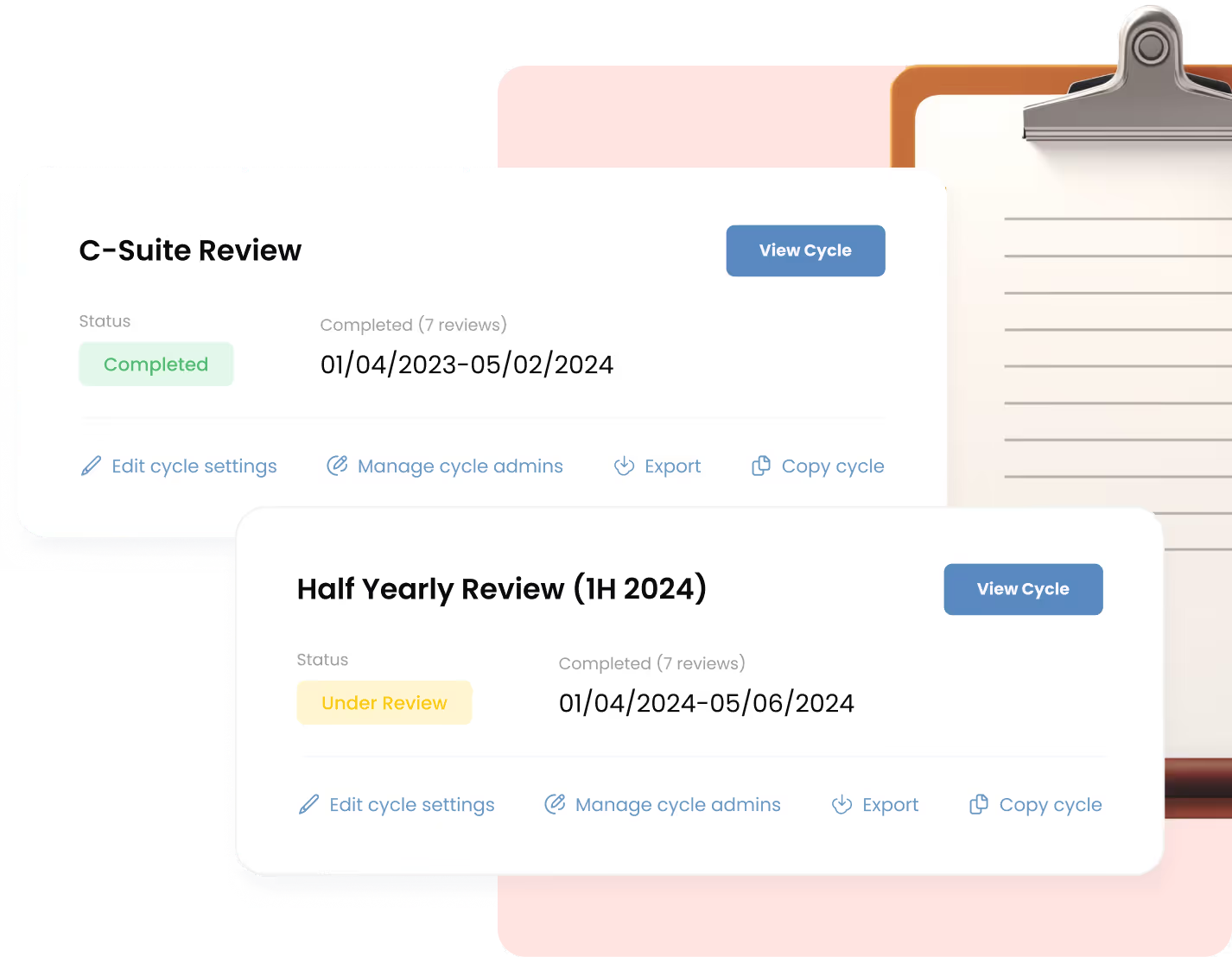
To learn more about how Omni can streamline and strengthen your performance management efforts, book a demo with our team.
Not ready to leverage automation but still want to boost your performance management processes? Download our free comprehensive Performance Review Kit, complete with a variety of templates, guides, and best practices to get the most out of your next performance review cycle.
Full HR & Payroll coverage for Philippines, Singapore, Malaysia, Hong Kong, and Indonesia. Each market has local support teams and built-in compliance features.
Starting at $3/employee/month for core features. Volume-based discounts are available for growing teams. Book a demo for custom pricing.
Enterprise-grade security with ISO 27001, GDPR certifications, and local data residency options.
4 weeks average. Includes free data migration, setup, and team training. No hidden fees.
Built specifically for Asia with local payroll processing, same-day support in Asia time zones, and 40% lower cost than global alternatives.


.avif)

