.png)
Summary. Running payroll in Malaysia manually — or with software that hasn't kept up with regulatory changes — is one of the fastest ways to end up with a compliance problem you didn't see coming. This guide compares the leading cloud payroll platforms available to Malaysian businesses in 2027, covering what to look for, where each option falls short, and which type of business each one actually suits.
Top 3 Cloud Payroll Software in Malaysia: Compared
1. Omni HR
Omni is built for companies that have outgrown basic payroll tools and need an integrated system — one where payroll, compliance, leave, performance, and employee records all live together rather than across disconnected platforms. It's designed specifically for the APAC market, with Malaysian statutory compliance built into the core of how payroll runs.
What it handles well:
- Automated EPF, SOCSO, EIS, HRDF, and PCB calculations with real-time regulatory updates
- EA form, Borang E, and CP39 auto-generation; full LHDN e-Filing support
- Multi-country payroll across 10+ countries — Malaysia, Singapore, Philippines, Hong Kong, Indonesia
- Employee self-service portal and mobile app for payslips, leave, claims, and personal data updates
- Full HRIS suite: leave management, performance reviews, recruitment, attendance, and expense management
- AI-powered workflows and agentic AI built in
- Native integrations with Xero, Slack, Google Calendar, and Microsoft Teams
- Real-time reporting on payroll costs, headcount, and statutory contributions
- Local support team in your timezone
Where to be realistic: Omni is built for teams with more complex needs — mid-sized companies managing multi-country headcount, or growing businesses that need payroll connected to performance and recruiting. If you have five employees and need to run basic Malaysian payroll once a month, it's more system than you need right now.
Best for: Mid-sized and growing Malaysian businesses that need reliable statutory compliance and want to consolidate HR tools, especially those with regional expansion on the roadmap.
Pricing: Starts from $3 per employee per month. Explore plans →
"If you're a growing company, you should consider Omni. Even with jurisdictions in the US and UK, you can utilize this platform because they can be compliant with the technical laws."— Andrei Perevalovi, Head of People Products at Virtual Internships
2. PayrollPanda
PayrollPanda is a Malaysian-born cloud payroll platform built with local SMEs in mind. It does one thing well: payroll. If your primary requirement is accurate, compliant Malaysian payroll without the overhead of a full HR system, this is where most evaluations end up.
What it handles well:
- Automated EPF, SOCSO, EIS, and PCB calculations at current statutory rates
- Payslip generation and government form output including CP39 and EA forms
- LHDN-approved software
- Direct integration with Malaysian bank accounts for salary disbursement
- Leave management and basic attendance tracking
- Employee self-service for payslips and leave balances
- Integration with HR tools including Jibble and Zoho People
- Free tier available for small teams
Where to be realistic:PayrollPanda doesn't support multi-user payroll processing, which creates friction for larger teams or organizations where payroll approval sits across multiple people. Some users have flagged difficulty editing submitted payroll runs — worth testing in a trial before committing. It's also payroll-only: if you need performance management, recruitment, or multi-country payroll in the same system, you'll need to add separate tools.
Best for: SMEs that need straightforward, reliable cloud payroll compliance for a Malaysian workforce, without the complexity of a full HRIS.
Pricing: Free tier for up to a small number of employees; paid plans priced in MYR. Visit the PayrollPanda website for current tier details.
3. Kakitangan
Kakitangan is one of the most widely used HR and payroll platforms among Malaysian SMEs, and for good reason — it covers a genuinely broad set of HR functions at a price point small businesses can work with. Where PayrollPanda goes deep on payroll, Kakitangan goes wide on HR operations.
What it handles well:
- EPF, SOCSO, EIS, and PCB automation
- EA form and statutory form generation
- E Payroll, E Leave, E Claim, E Attendance in a single platform
- Simple user interface — accessible for teams without dedicated HR staff
- Strong Malaysian bank integrations for direct salary disbursement
- HR Sifu advisory module for compliance guidance
- Free tier for very small teams (three employees or fewer get E Payroll, E Leave, and E Claim at no cost)
Where to be realistic: Kakitangan's pricing model takes some working out. It's modular — you pay based on headcount and which modules you activate — and costs can climb quickly as both numbers grow. For 15 employees with E Payroll and E Leave activated, you're looking at roughly RM205/month; for 50 employees with the same modules, the number jumps significantly. It's worth using their pricing calculator before assuming it fits your budget.
The platform is also Malaysia-only — no multi-country payroll support. Teams with regional operations will hit that ceiling fast.
Best for: Malaysian SMEs that want an affordable, locally-focused HR and payroll platform covering leave, claims, and attendance in a single tool.
Pricing: Modular, headcount-based pricing in MYR. Visit the Kakitangan website for current figures — their pricing calculator gives a clearer picture than any static table.
Comparison Guide for Cloud Payroll Malaysia
What is Cloud Payroll Software?
Cloud payroll software is a payroll system that runs entirely online, rather than on a desktop application or local server. Your team accesses it through a browser or mobile app, payroll data is stored securely off-site, and updates to statutory rates or regulatory requirements roll out automatically — without your HR team needing to download a patch or call a vendor.
For Malaysian businesses, that last point matters more than it might seem. EPF contribution rates, SOCSO thresholds, and PCB calculations (the monthly income tax deductions remitted to LHDN on behalf of each employee) are subject to change, and the obligation to calculate them correctly sits entirely with the employer. A desktop payroll system requires manual intervention every time something changes. A good cloud payroll system handles it without you noticing.
The shift toward cloud payroll in Malaysia reflects this. Businesses running payroll in Malaysia are moving away from installed software and spreadsheets toward platforms that stay current, accessible, and integrated with the rest of their HR and finance stack.
What to Look for in Cloud Payroll Software in Malaysia
Not all cloud payroll platforms are built equally — and in the Malaysian market specifically, a few criteria separate the ones that actually work from the ones that create more problems than they solve.
Statutory compliance that updates automatically
The baseline for any Malaysian payroll tool is accurate, automated calculations for EPF, SOCSO, EIS, HRDF, and PCB. What separates good cloud payroll from average is whether those calculations update automatically when statutory rates change — or whether someone on your team needs to manually update rate tables after each LHDN circular. Ask any vendor you're evaluating that question directly.
LHDN reporting and government form generation
A cloud payroll system should generate the documents your business is legally required to produce: the EA form, Borang E, CP39 for monthly PCB submissions, and e-CP39 for direct LHDN e-Filing. If you're assembling these manually at year-end, that's time and risk that belongs to the software, not your HR team.
Leave, overtime, and Employment Act compliance
Malaysia's Employment Act 1955 — updated significantly in 2022 — governs leave entitlements, overtime eligibility, and termination requirements. Your payroll software needs to reflect those rules accurately: correct overtime rates, leave balance calculations that account for the updated paternity and maternity provisions, and overtime eligibility thresholds that reflect the RM4,000 cap introduced by the 2022 amendments.
Multi-bank payment support
Paying employees across different banks is standard for any team of reasonable size. Your payroll system should generate bank files automatically for direct salary disbursement and handle statutory payment submissions without requiring manual uploads to separate portals.
Employee self-service
The best cloud payroll platforms give employees direct access to their own payslips, tax forms, and leave balances — through a portal or mobile app — without routing every request through HR. This reduces the volume of routine queries hitting your team each month and gives employees visibility into their own records.
Integration with your accounting and HR tools
Payroll data that doesn't flow automatically into your accounting software creates reconciliation work. Look for native integrations with Xero, QuickBooks, or whichever accounting platform your finance team uses, as well as connections to time-tracking and attendance tools so overtime and shift data feed directly into payroll calculations.
Security and PDPA compliance
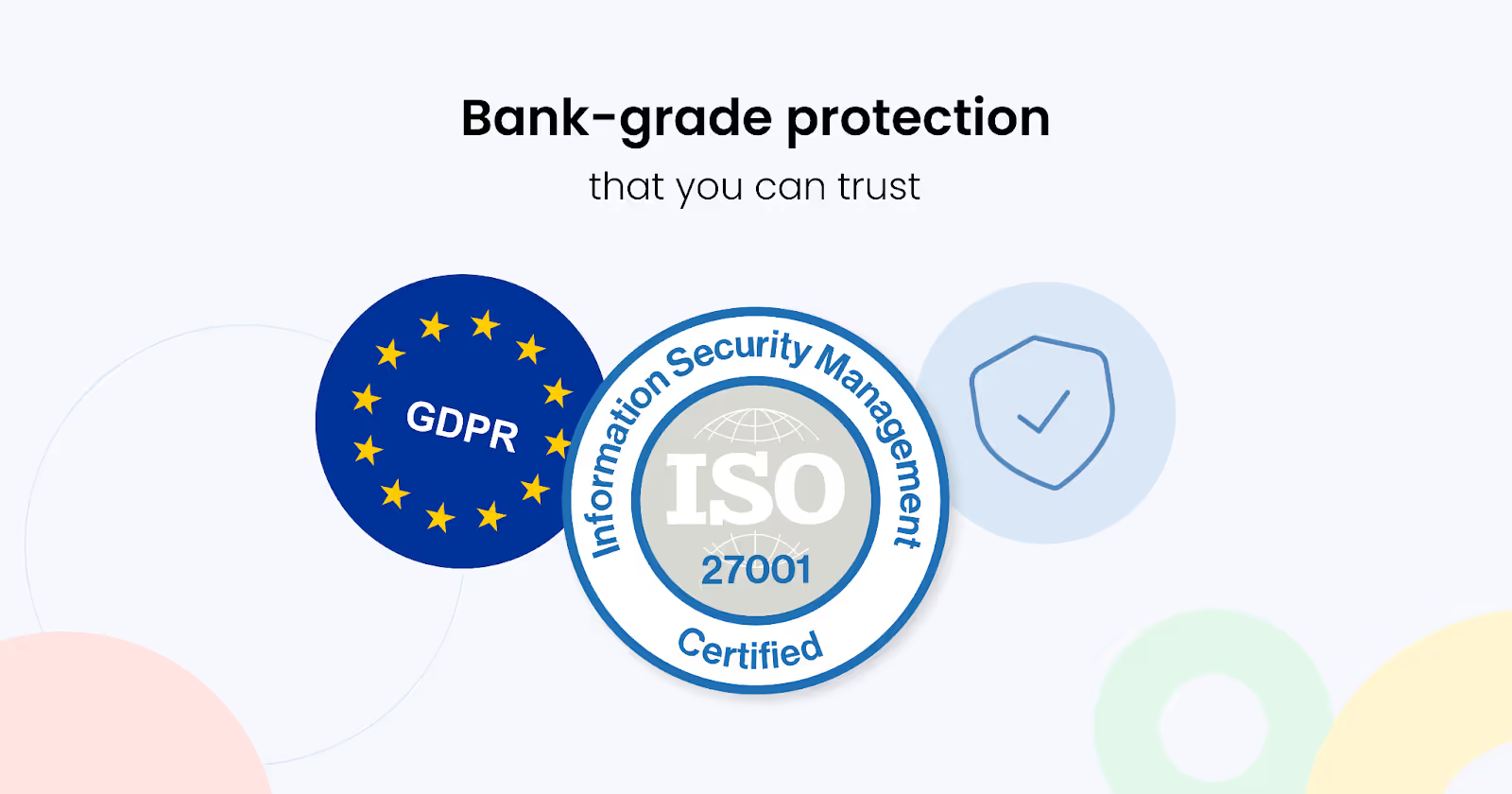
Payroll data is among the most sensitive information a business holds. The platform you use should comply with Malaysia's Personal Data Protection Act (PDPA), hold ISO 27001 certification, and apply end-to-end encryption for data in transit and at rest.
Why Cloud Payroll Makes Sense for Growing Malaysian Businesses
The case for cloud payroll comes down to what breaks as your headcount grows.
At 20 employees, spreadsheets and a basic payroll tool are uncomfortable but manageable. At 60, the errors start. Leave balances go out of sync with payroll deductions. Overtime calculations get missed. Someone submits an EPF file with outdated rates because no one caught the circular in time. These aren't unusual failure modes — they're what happens when manual processes scale past the point they were designed for.
Cloud payroll removes the maintenance overhead that creates those failure points. Regulatory updates happen in the background. Payslips generate automatically. Employees submit leave through a mobile app instead of a paper form that sits on someone's desk. The administrative surface area shrinks, and your HR team gets time back for work that actually requires human judgment.
For businesses operating across multiple countries — or planning to — cloud payroll also makes regional expansion significantly less painful. A platform built for multi-country payroll from the start handles Singapore CPF, Philippines SSS, and Malaysian EPF within a single system, rather than requiring a separate tool for each market.
Inspire Brands Asia, which runs operations across Southeast Asia, reduced payroll processing time by more than 50% after switching to Omni — saving an estimated USD$60,000 annually in operational costs.
"Payroll calculations that used to take three to five working days can now be done in half the time with Omni."
— Tengku Mohaizad, Group Head of HR Asia, Inspire Brands Asia
How to Choose Between Cloud Payroll Software for Malaysia
The honest answer is that the right platform depends almost entirely on two things: how many people you're managing today, and where you're likely to be in two years.
If you're a small team running straightforward Malaysian payroll and your main concern is staying compliant without spending too much, PayrollPanda or Kakitangan both do that job well. PayrollPanda is cleaner if payroll is your only need; Kakitangan makes more sense if you also want leave and claims management in the same place.
If your team is growing, you're managing people across different functions, or you're planning to expand into other markets in the region, a platform that only does Malaysian payroll will become a constraint before long. Migrating payroll systems mid-growth is painful — getting onto a scalable platform earlier avoids that.
A few questions worth working through before you decide:
- Does the platform update automatically when EPF, SOCSO, or PCB rates change — or does someone on your team have to do it?
- Does it reflect the 2022 Employment Act amendments in leave calculations and overtime settings?
- If you expand regionally, does the same system cover payroll in Singapore or the Philippines, or do you start over?
- What does the full cost look like at your expected headcount in 18 months — not just today?
- Is local support available during Malaysian business hours, with people who actually understand LHDN requirements?
Related reading:
Frequently Asked Questions
Cloud payroll software is a payroll system hosted online rather than installed on a local computer or server. It processes salary calculations, statutory deductions, and payslip generation through a web browser or mobile app. For Malaysian employers, the main advantage is that statutory rates — EPF, SOCSO, EIS, PCB — update automatically when regulations change, rather than requiring manual intervention.
You configure the system once with employee details, salary structures, and statutory settings. Each pay cycle, the software calculates salaries, deducts EPF, SOCSO, EIS, HRDF, and PCB at current rates, generates payslips, and produces the government files needed for LHDN e-Filing and statutory submissions. Employees access their payslips and leave balances through a self-service portal. The cloud setup means your data is accessible from anywhere and updated when regulations change.
Desktop payroll software is installed on a single computer and stores data locally. It requires manual updates when statutory rates or regulations change, and access is limited to whoever has the machine. Cloud payroll runs online, updates automatically, allows multiple users to access it from different locations, and backs up data off-site. For most Malaysian businesses in 2026, the maintenance overhead of desktop payroll software outweighs any cost advantage.
Yes. Omni handles EPF, SOCSO, EIS, HRDF, and PCB calculations automatically, generates EA forms, Borang E, and CP39, and supports LHDN e-Filing. It also covers multi-country payroll for teams operating beyond Malaysia — Singapore, Philippines, Hong Kong, and Indonesia within the same platform.
Both are Malaysian-built cloud payroll platforms suited to SMEs. PayrollPanda focuses primarily on payroll — it's simpler, has a free tier, and integrates with accounting tools, but is lighter on broader HR features. Kakitangan covers more HR ground (leave, claims, attendance) in a modular platform, but its pricing gets complex as headcount and module count grow. If payroll compliance is your primary concern, PayrollPanda. If you want HR operations and payroll in one place at an affordable entry point, Kakitangan. If you find that neither fits quite right — PayrollPanda is too limited on HR features and Kakitangan is too complex to price — that's usually a sign you've grown past local SME tools and would be better served by a platform like Omni that connects payroll to the rest of your HR operations."
PayrollPanda offers a free tier for small teams, and Kakitangan provides a free plan for businesses with three employees or fewer. Both cover core statutory compliance at no cost. Omni HR doesn't have a permanent free plan, but does offer a free trial — worth using if you're evaluating whether a full HRMS is the right fit for where your business is headed, rather than committing to a payroll-only tool you'll outgrow. For teams growing past the free tier limits on either local platform, paid plans kick in quickly, so it's worth modelling your expected headcount over the next 12 months before deciding.