.png)
Summary. Managing high-calibre foreign professionals under the PEP Singapore scheme requires precision and compliance readiness. With strict MOM reporting, salary thresholds, and expiry deadlines, manual tracking leaves HR teams exposed to costly errors. Omni provides an all-in-one solution for managing Personalised Employment Pass (PEP) holders through automating expiry reminders, MOM reporting, and document workflows. Gain full visibility into PEP visa Singapore and other work pass data through real-time dashboards, generate compliance reports instantly, and stay audit-ready. Streamline your PEP pass Singapore management with Omni. Book a personalized demo to see how automation can simplify compliance.
In the race for global talent, HR leaders face an escalating challenge: how to seamlessly bring in and manage highly skilled foreign professionals while navigating Singapore's complex and ever-evolving work permit regulations. Keeping up with eligibility criteria, managing mountains of application paperwork, and meeting crucial compliance deadlines for passes like the Employment Pass (EP), ONE Pass, and the unique Personalised Employment Pass (PEP) can be a major source of stress and risk.
This comprehensive guide explains everything about the PEP visa Singapore, from its benefits and eligibility to application steps and key differences from other work passes. For businesses hiring top-tier global talent, Omni HR simplifies PEP pass Singapore management through automated compliance tracking, document management, and seamless integration with your HR workflows, helping you onboard and manage professionals efficiently while staying fully compliant.
Learn more: Singapore Employment Pass: Updates & Requirements in 2025
What is the Personalized Employment Pass (PEP) Singapore?
The PEP Singapore is a premium work pass tailored for high-calibre foreign professionals who seek greater flexibility in their career path in Singapore. Unlike the standard Employment Pass (EP), the PEP is not tied to a specific employer. This means a holder is not required to reapply for a new pass when switching jobs, providing a significant advantage in Singapore's dynamic job market. The pass is issued for a maximum of three years and is non-renewable.
The PEP Singapore is specifically targeted at high-earning professionals, benchmarked to the top 10% of Employment Pass holders. This makes it an attractive and flexible option for top-tier executives and professionals who have already proven their value in the global marketplace.
Benefits of PEP Singapore
The PEP Pass offers unique benefits that align directly with the goals of attracting and retaining top global talent, providing a competitive edge for companies and career freedom for the pass holder.
Talent mobility
The primary benefit of the PEP Singapore is the high degree of talent mobility it grants its holders. Examples include:
- Freedom to change jobs: PEP holders are not tied to a specific employer, giving them the flexibility to switch jobs or sectors without having to reapply for a new work pass, unlike other visas. They only need to notify the Ministry of Manpower (MOM) of the change.
- Job search grace period: If a PEP holder loses their job, they are permitted to stay in Singapore for a continuous period of up to six months to search for new employment, a crucial safety net for high-calibre professionals.
Competitive advantage in attracting global talent
For HR and talent acquisition leads, the PEP visa Singapore is a powerful tool to differentiate your job offer.
- Exemption from restrictions: PEP holders are often exempted from certain recruitment restrictions like the Fair Consideration Framework (FCF) job advertising requirement and the Complementarity Assessment Framework (COMPASS).
- No quota/levy: The pass does not require the employer to adhere to a foreign worker quota or pay a foreign worker levy, reducing administrative burdens and costs for the hiring company.
- Pathway to permanent residency: Holding a PEP provides a strong pathway for applying for Singapore Permanent Residency (PR) after meeting the required criteria.
Read next: PR CPF Contribution Rates in 2025: What Employers and New PRs Should Know
Simplified family relocation policies
The PEP Singapore makes the relocation process significantly easier for the employee and their family, which is a major factor in talent retention and employee satisfaction.
- Dependant passes: PEP holders can apply for Dependant's Passes for their legally married spouse and children under 21 years old.
- Long-term visit passes (LTVP): They can also apply for Long-Term Visit Passes for other eligible family members, including a common-law spouse and parents.
PEP Eligibility and Application Process
For HR professionals and businesses, understanding the stringent eligibility criteria and the precise application steps for the PEP Singapore is critical for a successful submission and long-term compliance.
Eligibility criteria
The Personalised Employment Pass is reserved for high-earning foreign professionals and is benchmarked to the top 10% of Employment Pass holders. Applicants must meet one of the following fixed monthly salary thresholds:
- Existing EP holders: Must earn a fixed monthly salary of at least S$22,500.
- Overseas foreign professionals: Must have earned a fixed monthly salary of at least S$22,500 in the last drawn salary, which must be within the six months before the application.
PEP pass restrictions
It’s important to note the employment restrictions associated with the PEP visa Singapore:
- The holder cannot be a sole proprietor, partner, or director who is also a shareholder in a Singapore-registered company (i.e., they cannot start a business or engage in entrepreneurial activities).
- The pass is non-renewable and is issued only once for a maximum of three years.
- PEP holders are not allowed to be journalists, editors, sub-editors, or producers.
Maintaining the PEP
To retain the pass once issued, the holder must meet these ongoing requirements:
- Must not be unemployed in Singapore for more than six continuous months at any point.
- Must earn a fixed salary of at least S$270,000 per calendar year, regardless of the number of months they are employed.
Applying for the PEP Visa Singapore
Step 1 - Documentation: Required documents include a completed application form, a copy of the passport, a latest resume, educational certificates, and proof of fixed monthly salary (e.g., past 3 months' payslips and latest tax statements).
Step 2 - Submission: Submit your application online via the MOM's EP eService.
Step 3 - Fees: The application fee is S$105 (non-refundable). The pass issuance fee is S$225 (plus S$30 for a Multiple Journey Visa, if applicable).
Step 4 - Timeline: The processing time for most cases is within eight weeks. If approved, MOM issues an In-Principle Approval (IPA) letter, which is valid for six months for the holder to enter Singapore and complete the issuance formalities.
Common compliance risks
Managing the compliance for PEP holders presents unique challenges for HR teams, where manual tracking can easily lead to costly errors.
- Missed updates and incorrect filings: PEP Singapore holders are individually responsible for notifying MOM of any changes in employment status (within 7 days) and declaring their annual fixed salary (by January 31st each year). HR often manages this process, and a lack of systemized tracking can lead to missed deadlines or incorrect filings.
- Expired passes: Although the PEP Singapore is non-renewable, HR must proactively monitor the expiration date to ensure that employees apply for an EP or PR well in advance, thereby maintaining continuous work authorization.
- Unemployment limit breach: The strict six-month unemployment limit can be missed during periods of job transition, potentially leading to the immediate cancellation of the pass and reputational damage for the last employer.
- Annual salary threshold monitoring: PEP visa Singapore holders must meet the S$270,000 annual fixed salary requirement. HR teams must track this to ensure the employee meets the target by the calendar year-end.
PEP Visa Singapore vs Others: Which is Right?
The PEP visa Singapore sits between the standard Employment Pass (EP) and the new, ultra-high-tier Overseas Networks & Expertise Pass (ONE Pass). The choice between these passes is a complex decision for HR teams, depending on the talent's salary, long-term career goals, and entrepreneurial intentions.
1. High salary, entrepreneurial aspirations?
If a candidate meets the S$30,000 threshold and wants the freedom to start a business or work across multiple companies, the ONE Pass is the superior, long-term option.
2. High salary, focus on employment mobility?
For a professional focused purely on employment who hits the S$22,500 threshold but doesn't need the 5-year tenure or entrepreneurial freedom of the ONE Pass, the PEP is ideal.
3. Standard executive hire?
For all other professional hires, the Employment Pass (EP) is the standard path, but this requires continuous monitoring of the COMPASS points system and age-based salary increases, which are tied directly to the employer.
The complexity of these rules—from minimum family pass sponsorship salaries (EP) to the strict non-renewal and annual income declaration requirements of the PEP Singapore—makes manual tracking prone to errors.
HR technology like Omni automates the tracking of expiry dates, compliance deadlines, and annual salary checks across all pass types, mitigating the risk of penalties and ensuring a seamless talent experience.
Challenges HR Teams Face When Managing PEP Pass Singapore
While the PEP Singapore offers exceptional flexibility for the individual, managing a workforce that holds these passes introduces unique administrative and compliance burdens for HR teams, especially at mid-to-large companies. A single compliance misstep can result in serious penalties, debarment from hiring foreign workers, or reputational damage.
Tracking expiry dates across employees
The PEP Singapore is a non-renewable, one-time pass with a strict 3-year validity. This creates a hard deadline that requires proactive planning. For HR teams managing hundreds of passes across various types (EP, S Pass, PEP, ONE Pass), manually tracking this non-renewal deadline for each PEP holder is a significant risk. If the transition to an EP or PR is not executed in time, the employee's legal right to work is jeopardized.
How Omni helps
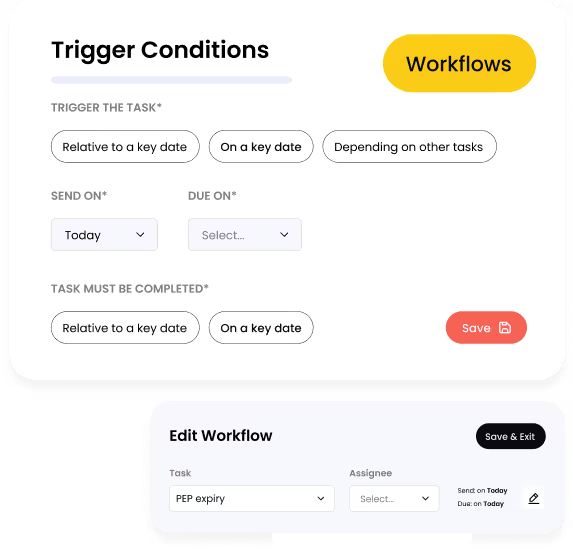
Omni’s document management and automated workflow lets you store and track visa expiry dates and trigger renewal reminders before deadlines hit, reducing compliance risk for teams managing multi-pass employees. With customizable workflows, HR can automate transition processes to EP or PR, ensuring no PEP Singapore expiry slips through the cracks.
Staying updated with the MOM rule changes
Singapore's work pass framework is constantly evolving, with MOM frequently introducing new salary benchmarks and assessment frameworks (like COMPASS). HR teams must monitor two distinct sets of rules:
- PEP-specific compliance: Tracking the strict six-month unemployment limit and the S$270,000 annual fixed salary requirement, which is a compliance duty for both the holder and, in practice, their employer/agent.
- General work pass changes: Ensuring internal HR policies reflect the latest EP and ONE Pass criteria, especially when a PEP holder needs to transition to a renewable pass before the 3-year expiry. Without dedicated systems, remaining agile amidst these changes is a major challenge.
How Omni helps:
Omni simplifies compliance tracking with centralized employee databases and custom fields for salary benchmarks or COMPASS criteria, allowing HR to instantly update and report on eligibility data.
“Having a single source of truth has improved the accuracy of our data and reporting.”
— Shux M., Chief People Officer at Endowus
Manual errors in reporting and documentation
The core compliance actions for a PEP holder are based on reporting:
- Declaring annual salary to MOM by 31 January each year.
- Notifying MOM within seven days of job changes or contact.
Relying on paper forms or spreadsheets introduces a significant risk of missing these deadlines.
How Omni helps:
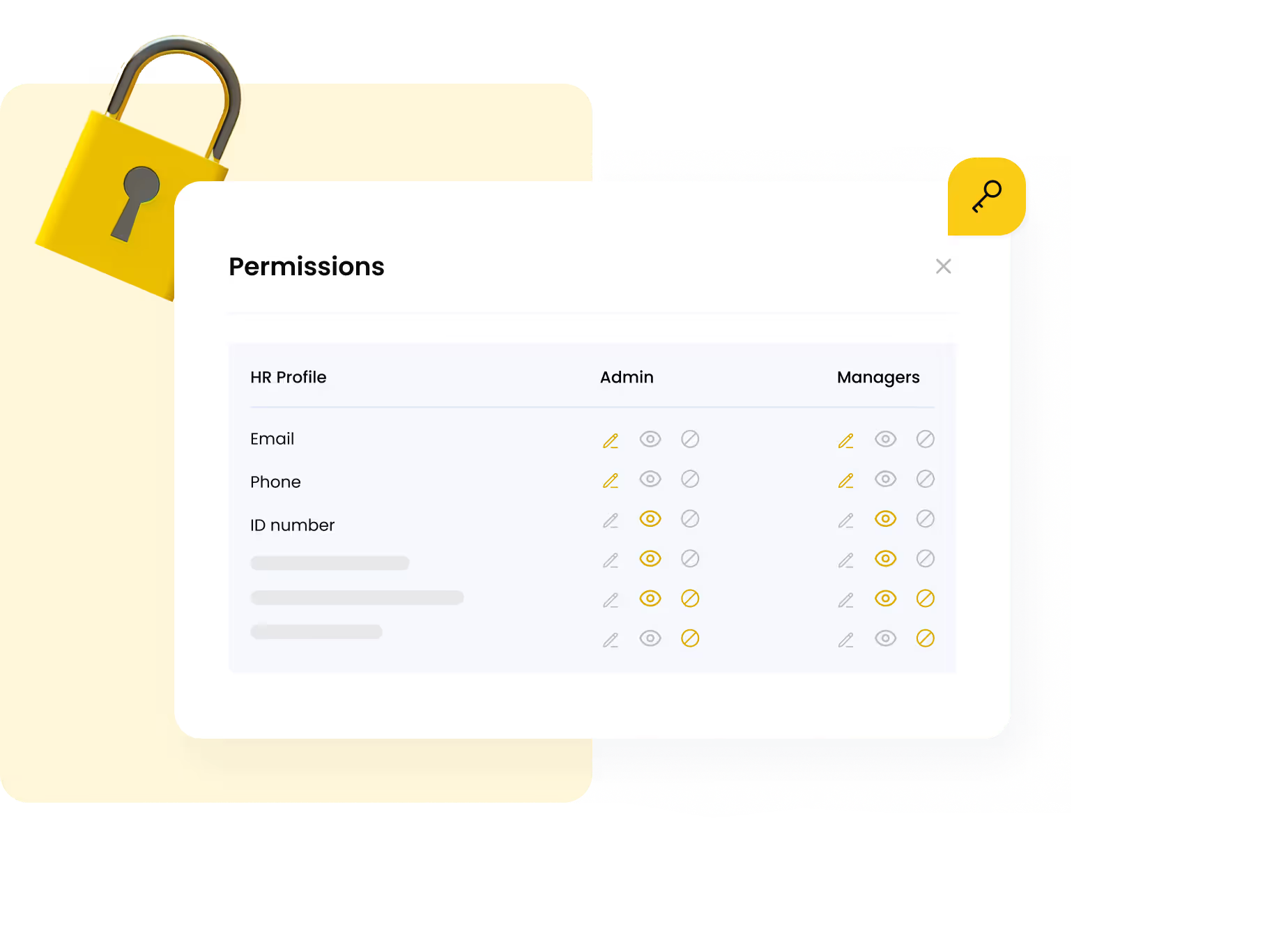
Omni automates documentation with role-based access controls, secure e-signatures, and auto-reminders for compliance actions. Teams can upload and verify declarations directly from our system, ensuring all documentation is accurate, timely, and auditable.
Risk of penalties and reputational damage
Non-compliance with MOM regulations—whether due to an expired pass, failure to meet the minimum annual salary threshold, or making false declarations—can lead to fines, suspension of hiring privileges, or reputational damage.
How Omni helps:
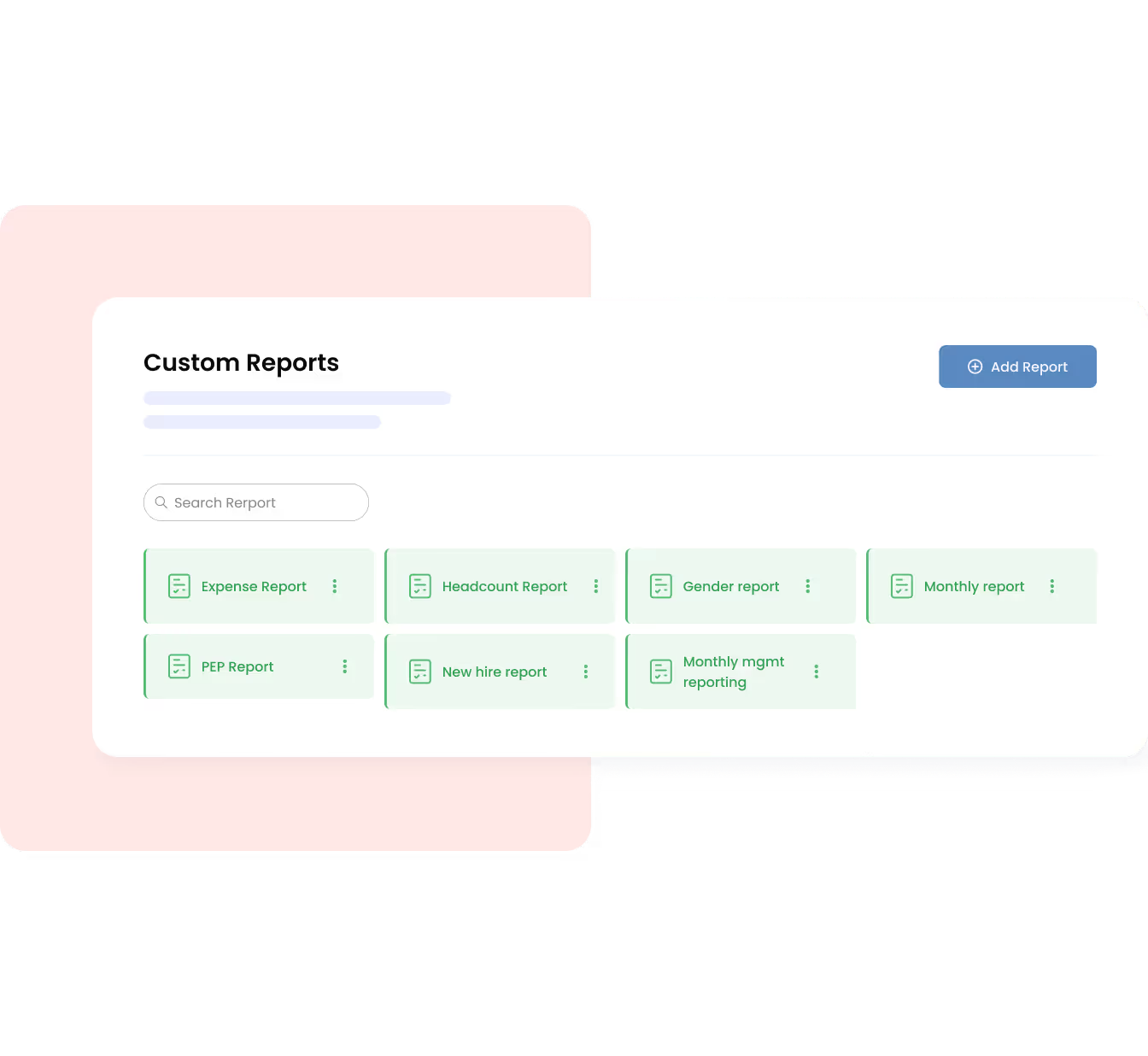
Omni’s reports and analytics give HR teams full visibility into PEP pass compliance, helping you track expiration timelines, salary declarations, and MOM reporting status in real time. With a few clicks, you can generate and download PEP Singapore-specific compliance reports for audits or management reviews.
Frequently Asked Questions
The flexibility and restrictions of the PEP Singapore often lead to specific questions from both candidates and the HR teams managing their compliance. Here are answers to common FAQs about the Personalised Employment Pass.
1. Can I apply for a PEP while outside Singapore?
Yes. You do not need to be currently employed or even residing in Singapore to apply for the PEP Singapore. Overseas professionals whose last drawn fixed monthly salary was at least S$22,500 within the six months before the application are eligible to apply directly. If the application is approved, the Ministry of Manpower (MOM) will issue an In-Principle Approval (IPA) letter, which serves as a pre-approved single-entry visa to enter Singapore and collect the pass.
2. Can PEP holders be self-employed?
No. Despite the PEP offering self-sponsorship and greater job mobility than an EP, the holder is strictly prohibited from being self-employed or engaging in entrepreneurial activities. This includes being a freelancer, a sole proprietor, a partner, or a director who is also a shareholder in a company registered with ACRA. If a PEP Singapore holder wishes to start a business, they must apply for an EntrePass or the ONE Pass.
3. What happens if a PEP holder loses their job?
This is a key feature of the PEP Singapore. The pass holder is allowed a continuous grace period of up to six months to stay in Singapore without a job to search for new employment. This is a major advantage over a standard Employment Pass (EP), which is typically cancelled immediately upon termination. However, if the holder does not secure a new job within these six months, the PEP must be cancelled.
4. Can dependents be included?
Yes. PEP Singapore holders are eligible to apply for passes for their immediate and extended family members.
- Dependant's Pass (DP): Can be applied for a legally married spouse and unmarried children under 21 years old.
- Long-Term Visit Pass (LTVP): Can be applied for other family members, including a common-law spouse, unmarried stepchildren under 21, unmarried handicapped children above 21, and parents.
5. Is the PEP renewable?
No. The PEP Singapore is a non-renewable pass issued only once for a validity of three years. If the holder wishes to continue working in Singapore after the 3-year period expires, they must apply for another eligible pass, typically an Employment Pass (EP) or Singapore Permanent Residency (PR).
How Omni Simplifies PEP Singapore and Work Pass Compliance
Managing PEP Singapore holders can be complex and risky, especially when dealing with a growing team. With Omni, HR teams gain a single platform to automate expiry and reporting reminders, centralize all visa-related documents, and track compliance through real-time dashboards.

Omni transforms compliance management from a manual burden into a streamlined process, helping your team stay audit-ready, reduce administrative burden, and maintain full compliance. Book a personalized demo with our team today and see how Omni can help you automate PEP Singapore and work pass tracking.