.png)
Summary. SSO Thailand is Thailand's mandatory social security system, administered by the Social Security Office (SSO) under Section 33 of the Social Security Act. Both employers and employees contribute 5% of monthly salary, subject to a statutory wage ceiling, which increased from THB 15,000 to THB 17,500 per month in January 2026, raising the maximum monthly contribution per party from THB 750 to THB 875. Coverage extends to local and foreign employees alike, providing access to healthcare, maternity, disability, and retirement benefits tied directly to each employee's contribution history. For HR, payroll, and finance teams, understanding these rules and staying up to date as the ceiling continues to rise through 2032 is essential for accurate payroll, audit readiness, and avoiding contribution penalties.
Expanding or operating a business in Thailand means engaging with the country's statutory social security system early and correctly. Unlike discretionary benefits, SSO Thailand compliance is mandatory and closely monitored by regulators.
For HR managers, payroll specialists, and finance leads, understanding how social security in Thailand works matters. January 2026 brought the most significant overhaul to SSO contribution calculations in nearly two decades, introducing a multi-year phased increase to the wage ceiling that will continue through 2032.
This guide explains how SSO Thailand works, who must contribute, how to calculate contributions correctly under the new 2026 rules, and how to stay compliant for both local and foreign employees.
What is SSO Thailand and the Social Security Office?
SSO Thailand refers to Thailand's compulsory social security system administered by the Social Security Office (SSO). It operates under the Social Security Act and forms the backbone of Thailand's employee welfare framework.
In practical terms, SSO Thailand is a contributory system: employers and employees both pay into a central Social Security Fund (SSF) each month, and employees draw on that fund for healthcare, maternity support, disability coverage, and retirement income. The Social Security Office is the government body responsible for collecting those contributions, maintaining insured member records, and administering the benefits.
The Social Security Office is responsible for:
- Collecting employer and employee contributions monthly
- Managing insured member records and social security numbers
- Administering benefits including healthcare, maternity, disability, and retirement
- Enforcing compliance and issuing penalties for late or incorrect contributions
Any employer with one or more employees is required to register with the SSO. Once registered, eligible employees must be enrolled and contributions deducted and submitted each month. This obligation applies across industries and company sizes whereby local Thai businesses, regional subsidiaries, and international companies operating in Thailand are all covered.
How Social Security in Thailand Works
At its core, social security in Thailand is a contributory system. Both employers and employees make monthly contributions based on the employee's salary, subject to statutory caps.
Who is covered?
Employees are generally covered under Section 33 if they:
- Are aged 15 to 60
- Are formally employed under an employment contract
- Earn a regular salary
Coverage starts from the first day of employment, not after probation.
What benefits does SSO Thailand provide?
SSO Thailand insures employees against several significant life events. From January 2026, benefit amounts also increased in line with the new contribution ceiling:
These benefits are tied directly to an employee's contribution history and social security number, which makes accurate payroll reporting — especially around the new wage ceiling — critical for employees' future claims.
Read next: Understanding Thailand's Employee Welfare Fund
SSO Thailand Contribution Rates and Wage Ceiling (2026 Update)
Under SSO Thailand, social security contributions are shared equally between the employer and the employee. Under Section 33 of Thailand's Social Security Act, both parties contribute a fixed 5% of monthly wages, calculated against a statutory wage ceiling.
Once an employee is eligible, contributions are mandatory. Employers are responsible for calculating, deducting, and submitting contributions correctly every payroll cycle.
Employer vs. employee contribution structure
SSO Thailand follows a flat-rate, shared model:
- Employee contribution: 5% of monthly salary (up to the ceiling)
- Employer contribution: 5% of monthly salary (up to the ceiling)
- Government contribution: Paid separately by the state
Both contributions are calculated from the same salary base and must be submitted together to the Social Security Office by the 15th of the following month.
2026 contribution ceiling and maximum amounts
Thailand's Ministry of Labour published a revised ministerial regulation in the Royal Gazette on 12 December 2025, introducing a phased increase to the SSO wage ceiling effective 1 January 2026. This is the most significant change to SSO contribution calculations in nearly two decades.
Current ceiling (from 1 January 2026):
- Wage ceiling: THB 17,500/month (previously THB 15,000)
- Maximum contribution per party: THB 875/month (previously THB 750)
- Total maximum monthly contribution (employer + employee): THB 1,750/month (previously THB 1,500)
Contributions are only calculated on the first THB 17,500 of an employee's salary. Any earnings above this amount are not subject to SSO contributions.
Example:
Madee is a customer support executive earning THB 18,000/month. Since she earns above the new ceiling, her SSO calculation from January 2026 uses the capped base:
- Contribution base used: THB 17,500
- Employee contribution (5%): THB 875 (deducted from salary)
- Employer contribution (5%): THB 875 (paid separately by employer)
From Madee's perspective, THB 875 is deducted from her monthly salary, an increase of THB 125 from the previous THB 750. In return, Madee's insured wage base rises, directly improving her entitlements for sickness compensation, maternity allowances, and eventual pension calculations.
From the employer's side, the matching THB 875 must be submitted alongside payroll filings to remain compliant.
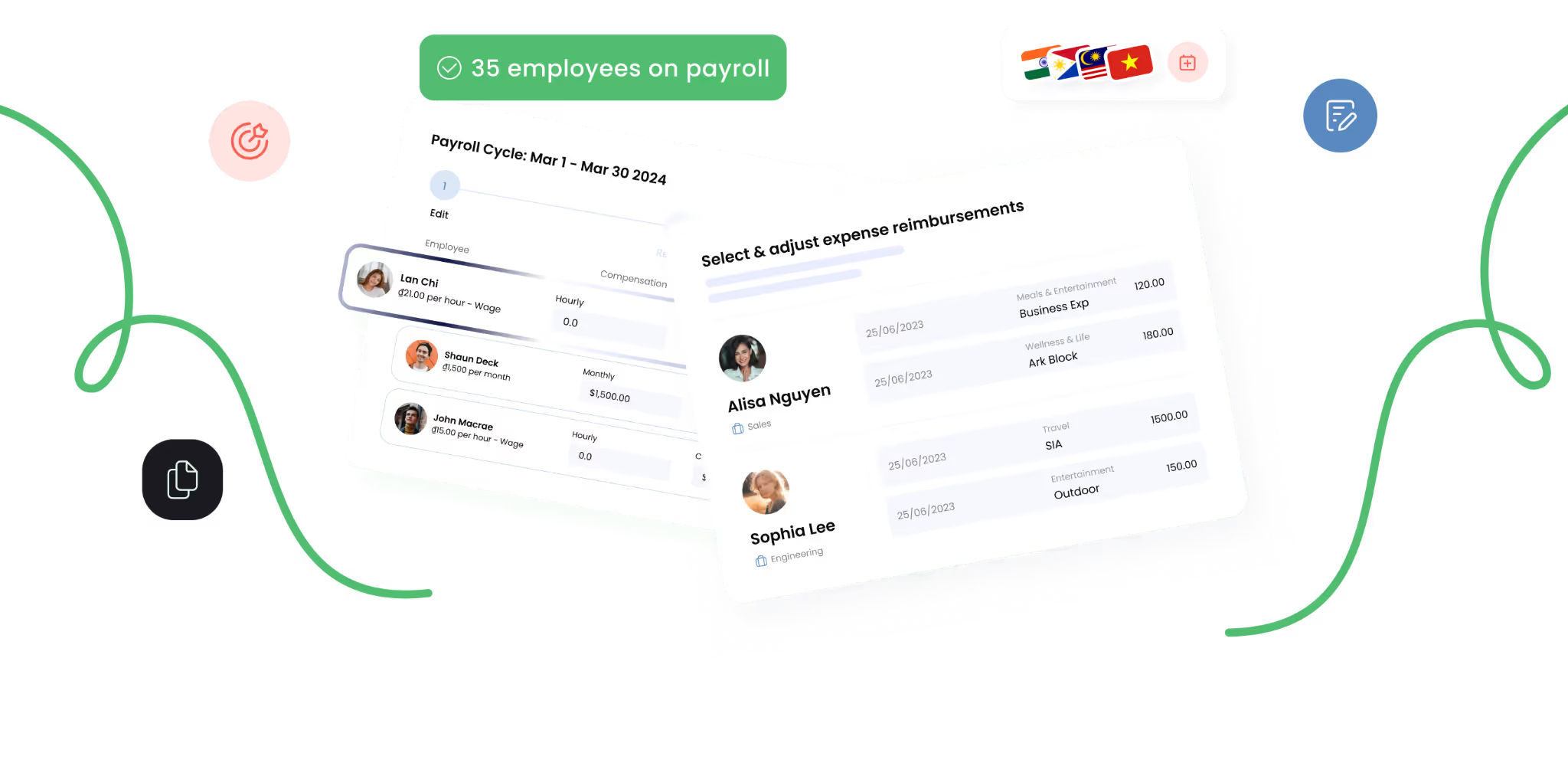
Payroll platforms like Omni automatically apply the updated THB 17,500 ceiling to all eligible employees, calculate the correct contribution for each salary band, and generate SSO-compliant payroll records, reducing the risk of under- or over-deducting contributions during the transition period.
Thailand SSO Contribution Ceiling: The Multi-Year Reform (2026–2032)
The January 2026 change is not a one-off adjustment. The Thai Cabinet endorsed a phased, multi-year roadmap that will continue raising the wage ceiling every three years through 2032.
The minimum contribution base remains unchanged at THB 1,650/month.
Why the increase? The previous THB 15,000 ceiling had been unchanged for nearly two decades. Over that time, average salaries grew substantially, meaning the SSO's benefit calculations — which are tied directly to the contribution base — failed to keep pace with actual living costs. The reform recalibrates the ceiling to reflect current wage realities and strengthens the long-term sustainability of Thailand's social protection fund.
What this means for your payroll planning: Budget for gradual increases in employer contribution costs through 2032. The three-year phase intervals are designed to give employers time to adjust, but building a payroll model that accounts for Phase 2 and Phase 3 changes now will prevent surprises down the line.
Understanding the Social Security Number in Thailand
A social security number in Thailand is a unique identifier issued to every employee registered under SSO Thailand. This number is permanent — it travels with the employee across jobs and remains active as long as they work in Thailand.
The Social Security Office uses it to track each employee's contribution history and calculate benefit entitlements. If the number is missing or incorrectly recorded, employees risk delays in benefit claims or outright denial of coverage.
When you enroll a new hire for the first time, they receive a social security number during the SSO registration process — typically completed as part of onboarding. Employees who have previously worked in Thailand already have a number; employers should confirm and record it accurately in their payroll and HR system from day one.
Maintaining accurate social security records is a key compliance requirement and a common focus area during HR audits.
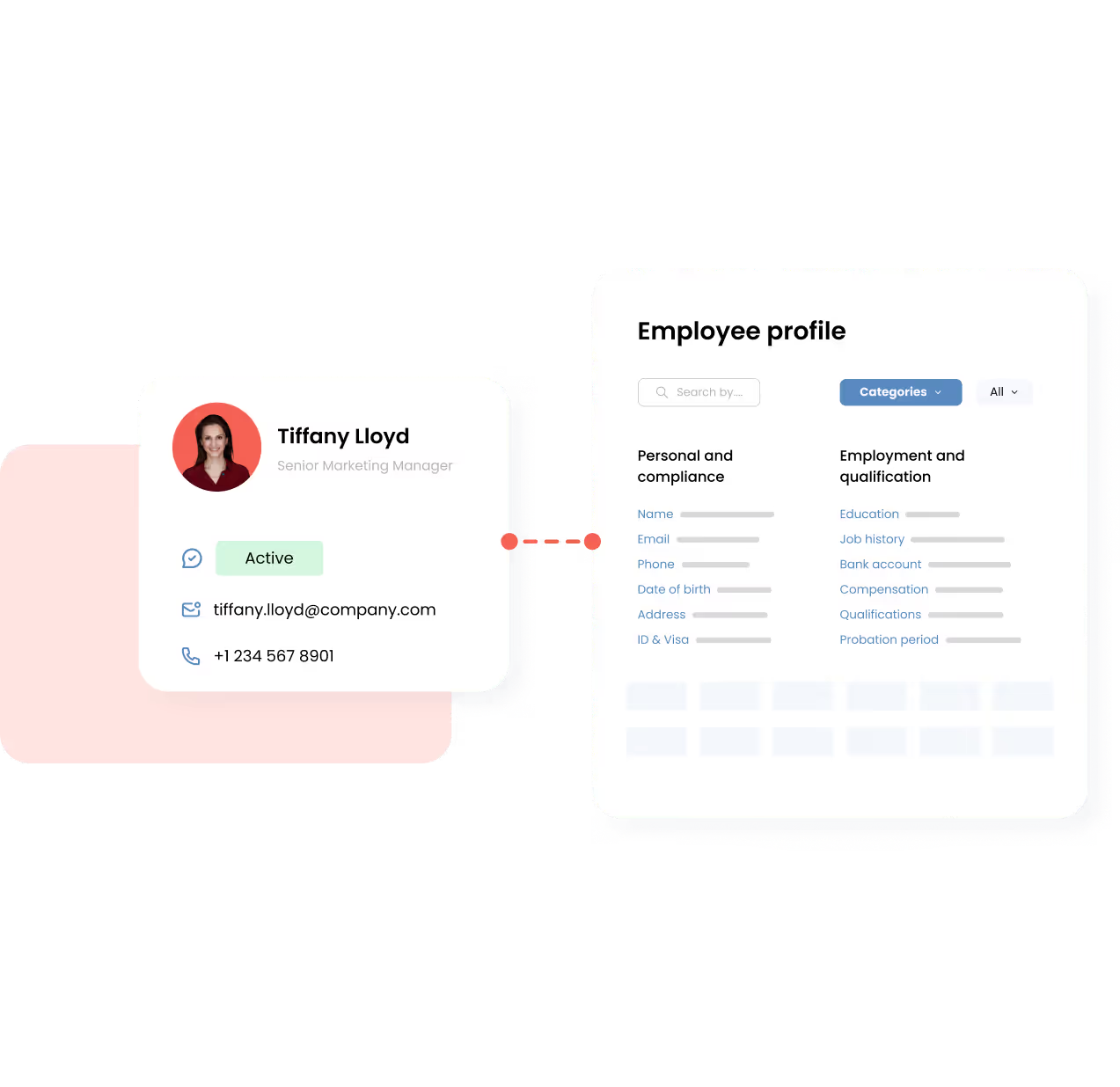
Using a centralized HR and payroll system like Omni HR can simplify this process, ensuring employee records, including Social Security numbers, are accurate, up to date, and easily accessible whenever needed.
"Whenever we need to gather employee data, we can pull the information directly from Omni and get any metric we require. It's as simple as that."
— Rhoanne Therese Jamelo, HR Generalist at ScaleForge
SSO Thailand for Foreigners
Foreign employees working in Thailand under a valid work permit are subject to the same SSO obligations as Thai nationals. There is no exemption based on nationality.
What applies to foreign employees:
- SSO registration is mandatory from the first day of employment under a work permit
- The same 5% contribution rate and THB 17,500 ceiling (from January 2026) apply
- Foreign employees receive access to the same benefits — healthcare, maternity, disability, and death coverage — based on their contribution history
- Pension entitlements accumulate with contributions and can, in some cases, be claimed as a lump sum upon departure from Thailand
Key considerations for HR teams managing foreign hires:
- Work permit changes: If a foreign employee changes employers, their SSO registration must be updated with the new employer. Contribution gaps during the transition can affect benefit eligibility.
- Short-term contracts: Foreign employees on short-term contracts still fall under SSO coverage if they are formally employed. Contractors without an employment relationship may not be covered — confirm the engagement structure with legal counsel.
- Lump-sum withdrawal: Foreign employees who leave Thailand and do not plan to return may apply to withdraw accumulated SSO contributions as a lump sum. HR teams managing departure processes for foreign employees should include this in the offboarding checklist.
How to Register Employees with SSO Thailand
Employers new to Thailand or adding their first employee must complete SSO registration before the first payroll cycle. Here's how the process works:
- Register the company with the Social Security Office using the official SSO registration form (Form SSO 1-01)
- Enroll each employee using Form SSO 1-03, submitting it within 30 days of the employee's start date.
- Receive social security numbers for newly enrolled employees and issue them to employees promptly.
- Submit monthly contributions by the 15th of the following month via e-SSO, the SSO online portal.
- Maintain payroll records that clearly show the contribution base, deduction amounts, and employee SSO numbers — these are required for audits and employee benefit claims.
Late registration or late payment attracts penalties: employers are liable for a surcharge of 2% per month on unpaid contributions. Persistent non-compliance can result in prosecution.
Common SSO Thailand Compliance Mistakes
Even experienced HR teams run into issues with SSO Thailand. The most common errors to watch for:
- Using the old THB 15,000 ceiling in 2026 — any payroll system not updated for the January 2026 reform will under-deduct contributions, creating a compliance gap that must be corrected retroactively
- Missing the 15th-of-the-month deadline — contributions submitted after the 15th attract a 2% monthly surcharge; set calendar reminders for every payroll cycle
- Incorrect social security numbers — a mistyped SSO number breaks the link between contributions and the employee's benefit record; always verify numbers against the employee's official SSO card
- Excluding foreign employees — some employers incorrectly assume foreign nationals on work permits are exempt from SSO; they are not
- Failing to update contribution bases after salary changes — when an employee receives a raise that moves their salary above or below the ceiling, the contribution amount must be recalculated in that same month's payroll
How Omni HR Manages SSO Thailand
SSO Thailand compliance involves a predictable but precise monthly calculation cycle: verify each employee's salary, apply the correct ceiling, calculate the 5% deduction, submit by the 15th. With the 2026 ceiling change — and the Phase 2 and Phase 3 increases still ahead — keeping that calculation logic updated is an ongoing requirement, not a one-time fix.
Omni automates SSO contribution calculations for Thailand-based employees, applies the correct wage ceiling for each payroll period, and maintains a clear audit trail of submissions and employee records. When the ceiling changes again in 2029, the update is handled at the platform level — no manual recalculation required.
For HR teams managing employees across multiple APAC markets, a single platform that applies each country's contribution rules correctly and updates automatically when legislation changes removes a significant source of compliance risk.
%201.avif)
With Omni HR managed payroll services, Thai companies can benefit from:
- Prepare monthly payroll compliant with statutory rules
- Generate bank files for salary payments
- Distribute payslips via email and Omni portal
- Run unlimited off-cycle payrolls at no extra cost
- Submit monthly Social Security reports for employees, new hires, and leavers
- Submit annual Workmen’s Compensation reports
- Submit monthly and annual tax filings (PND1, PND1K)
- Prepare withholding tax certificates for foreigners
By combining automated SSO Thailand compliance with full payroll management, Omni HR ensures accurate contributions, timely filings, and clear visibility for HR teams. Book a demo with our team today to explore more.
Frequently Asked Questions
From 1 January 2026, the SSO wage ceiling increased from THB 15,000 to THB 17,500 per month. This means the maximum monthly contribution per party — employer and employee — is THB 875, up from THB 750. The ceiling will rise again in January 2029 and January 2032 as part of a phased government reform.
Yes. Foreign employees working in Thailand under a valid work permit are subject to the same SSO obligations as Thai nationals. Both the employer and employee must contribute 5% of salary, capped at the statutory wage ceiling. Foreign employees are also entitled to the same SSO benefits, including healthcare, maternity, and disability coverage.
Coverage starts from the first day of formal employment — not after probation. Employers must enroll new employees within 30 days of their start date and begin deducting and submitting contributions from the first full payroll cycle.
Late contributions attract a surcharge of 2% per month on the outstanding amount. Continued non-compliance can lead to prosecution under the Social Security Act. Employers are also personally liable for back-contributions including the surcharge period.
The reform increased the wage ceiling from THB 15,000 to THB 17,500, raising the maximum monthly contribution from THB 750 to THB 875 per party. Employees earning above THB 15,000 per month see a slightly higher deduction; in return, benefit entitlements across sickness, maternity, death, and pension categories also increased. This is a three-phase reform running through 2032.
The Employee Welfare Fund (EWF) is a separate mandatory scheme, originally planned for October 2025 and now expected from October 2026. It provides additional severance protection funded by employer contributions, separate from SSO contributions. Employers should plan for both schemes to be active simultaneously from late 2026 — two distinct payroll obligations on top of the phased SSO ceiling increase.
.png)


.png)