.png)
Summary. Managing retrenchment in Singapore is one of the most challenging responsibilities HR professionals and business leaders face. To navigate retrenchment Singapore processes effectively, employers must understand MOM regulations, severance pay Singapore requirements, and employee eligibility for retrenchment benefits Singapore. Key priorities include ensuring legal compliance under the Employment Act and Tripartite Guidelines, calculating fair severance packages, maintaining clear communication and documentation, and treating affected employees with dignity. A structured, transparent approach to retrenchment not only minimizes compliance risks but also preserves trust, morale, and your company’s long-term reputation.
Managing retrenchment in Singapore is one of the most challenging responsibilities HR professionals and business leaders face. Whether you're navigating your first workforce reduction or refining your retrenchment processes, understanding the severance pay Singapore requirements and retrenchment Singapore regulations is essential.
This guide walks you through the legal requirements, practical steps, and best practices for handling retrenchment and severance while maintaining compliance and treating employees fairly.
Read next: How to Implement Singapore's Workplace Fairness Bill into Your HR Practices
Understanding Retrenchment vs Termination
Retrenchment in Singapore occurs when employment is terminated due to redundancy, reorganization, or business closure, not because of employee performance or misconduct. This distinction carries significant legal implications.
When retrenchment takes place, specific obligations arise around notification, compensation packages, and process. Terminating someone for poor performance or misconduct follows different rules and typically doesn't trigger severance obligations unless specified in employment contracts or collective agreements.
Understanding this difference protects you from compliance issues and helps you apply the correct procedures.
Legal Framework and MOM Requirements
The Employment Act provides baseline protections for employees, though it doesn't mandate severance pay. However, the Tripartite Advisory on Managing Excess Manpower and Responsible Retrenchment establishes industry best practices that employers should follow to demonstrate good faith and avoid potential disputes.
Key MOM requirements include:
- Mandatory retrenchment notification to MOM for companies with 10 or more employees.
- Non-discriminatory selection criteria based on objective business needs.
- Dignified treatment throughout the retrenchment process.
- Good faith negotiations with unions, where applicable.
Access the full guidelines here.
Legal penalties for non-compliance
Employers who fail to notify MOM of retrenchment Singapore face penalties up to $5,000 or imprisonment up to six months for first offenses. Beyond statutory penalties, non-compliance can trigger MOM investigations, reputational damage, and potential employment disputes that result in compensation orders from the Employment Claims Tribunals or courts.
Eligibility and Employee Categories
Let's talk about who qualifies for retrenchment Singapore benefits and what you actually owe them.
Service requirements and severance eligibility
Industry practice in Singapore provides retrenchment benefits to employees with at least two years of continuous service. While not legally mandated, this threshold has become the standard expectation across most sectors. Employees with less than two years may receive ex gratia payments, discretionary compensation that demonstrates goodwill and supports your employer brand during restructuring.
Coverage across employment types
Permanent employees with two or more years of service typically qualify for severance under company policies or collective agreements. Contract workers on fixed-term contracts of six months or longer may qualify for retrenchment Singapore benefits if their contracts are terminated early due to redundancy, depending on contract terms and company policy.
Special considerations for foreign employees and work pass requirements
Foreign employees on Employment Passes, S Passes, or Work Permits are eligible for severance pay on the same basis as local employees when retrenched. However, employers must handle additional requirements:
- Tax clearance from IRAS before the employee leaves Singapore.
- Work pass cancellation within one week of the last day of employment.
- Security bond obligations for certain pass types.
Responsible Retrenchment Practices
Before proceeding with retrenchment Singapore, explore alternative measures:
- Cost-saving measures: Temporary salary adjustments, shortened work weeks, or unpaid leave programs may allow you to retain employees while managing costs.
- Redeployment: Assess openings in other departments or associate companies. Even if retraining is required, redeployment preserves institutional knowledge and maintains morale.
- Natural attrition: Consider holding positions vacant rather than active layoffs where operationally feasible.
- Voluntary programs: Enhanced voluntary retirement or separation packages may attract willing participants, reducing the scale of involuntary retrenchment.
Selection criteria and non-discrimination
Selection for retrenchment Singapore must be based on objective, non-discriminatory criteria tied to legitimate business needs.
Acceptable factors include:
- Skills redundancy due to technology changes or business model shifts.
- Performance records and documented contributions.
- Operational efficiency and role duplication.
- Seniority (LIFO - Last In, First Out) when qualifications are comparable.
Employers must avoid discrimination based on age, race, gender, religion, marital status, or disability status. Maintaining detailed documentation of selection rationale protects against discrimination claims.
Union consultation requirements
For unionized workplaces, genuine consultation with union representatives is required before implementing retrenchment in Singapore. This consultation should cover:
- Business reasons necessitating workforce reduction.
- Selection criteria and affected positions.
- Proposed severance packages and support measures.
- Implementation timeline.
Your collective agreement may specify additional consultation procedures, minimum severance formulas, or dispute resolution mechanisms that must be followed.
Maintaining dignity throughout the Singapore retrenchment process
Employees facing retrenchment experience significant emotional and financial stress. HR teams should ensure:
- Private, respectful notification meetings with adequate time for questions.
- Clear written documentation of reasons, entitlements, and next steps.
- Access to outplacement services and career counseling.
Learn more: Navigating the Digital Divide: Enhancing Remote Team Communication
Retrenchment Notifications & Communication
Timing matters enormously in retrenchment. Here's how to sequence things properly:
Mandatory MOM notification requirements
Employers with 10 or more employees must notify MOM within five working days of notifying affected employees. This notification is submitted through MOM's online portal and includes:
- Number of employees affected by the designation and department.
- Reasons for retrenchment.
- Selection criteria applied.
- Severance and support measures provided.
Companies with fewer than 10 employees are encouraged but not required to submit notifications.
Early alert submission for outplacement support services
Employers can submit an Early Alert to MOM before formal retrenchment Singapore notifications, allowing MOM to activate support services through Workforce Singapore (WSG) and e2i (Employment and Employability Institute). This provides affected employees with immediate access to career coaching, resume workshops, job matching services, and skills training subsidies.
Employee notification timelines and notice period considerations
Honor contractual notice periods, typically one month for non-executives and two to three months for managers and executives. Consider providing additional notice when feasible, as employees who seem employed may secure new positions more quickly.
Severance Pay & Compensation
Calculation methods and industry standards
Although Singapore law doesn't mandate specific severance formulas, industry practice typically calculates severance pay in Singapore based on:
Common formula: 2 weeks to 1 month of salary per year of service
For example, an employee with 5 years of service earning S$5,000 monthly might receive:
Conservative approach: 2 weeks × 5 years = 10 weeks = S$11,538
Generous approach: 1 month × 5 years = 5 months = S$25,000
Factors affecting severance calculations
Several factors influence the final severance amount:
- Company financial position: Struggling businesses may offer lower multiples, while profitable companies may provide enhanced packages to maintain goodwill.
- Length of service: Longer-tenured employees typically receive proportionally higher benefits.
- Employee level: Senior positions may command enhanced packages reflecting greater difficulty in finding comparable roles.
- Collective agreement terms: Union contracts often specify minimum severance formulas that become contractually binding.
Salary basis determination
Severance calculations typically use basic monthly salary excluding variable components like bonuses, allowances, or commissions. However, when employers have implemented recent pay cuts, the pre-reduction salary may be used as the calculation basis to ensure fairness, particularly when pay cuts were implemented as temporary payroll cost-saving measures.
Read next: How to Calculate Daily Salary in Singapore: A Step-By-Step Guide
Payment Components and Timeline
Final payment requirements
Your affected employee's last payment needs to include every single thing they're owed:
- Severance pay or retrenchment benefits.
- Pro-rated 13th-month bonus or annual wage supplement.
- Unused annual leave encashment.
- Notice pay (if notice period is not served).
- Outstanding salary for work performed.
- Pro-rated variable bonuses where contractually due.
All of this must be paid on their last day of employment. Not a week later, not when your next payroll runs.
Negotiation processes
Severance packages are generally negotiable between employers and employees. For unionized workplaces, union representatives participate in negotiations. Key negotiation points include:
- Severance payment multiplier
- Extended medical benefits coverage
- Outplacement service quality and duration
- Reference letter terms
Ex gratia payments
These are discretionary goodwill gestures that employers may offer beyond contractual obligations. These payments recognize contributions of short-tenure employees, demonstrate corporate responsibility, and maintain employer brand reputation during restructuring.
Tax and CPF Implications
Tax treatment
Severance payments compensating for job loss are tax-exempt up to specific thresholds under IRAS guidelines:
- $10,000 per year of service for retrenchment or ill health (subject to caps)
- Different exemptions for voluntary retirement
Amounts exceeding exemption thresholds become taxable income at progressive tax rates.
Learn more: Employer’s Manual for Taxation in Singapore
CPF contributions
Severance pay is not subject to CPF contributions. However, other final payment components remain CPF-able:
- Outstanding salary for work performed
- Unused annual leave encashment
- Pro-rated annual wage supplements
Using integrated systems like Omni's CPF calculator ensures accurate contribution calculations across different payment components, reducing compliance risks.

Tax deductibility
Severance payments are generally tax-deductible business expenses when the employer continues operating. When a business closes entirely, tax deductibility may be restricted. Document your business rationale to support tax deduction claims during potential audits.
Foreign employee tax clearance
Foreign employees require tax clearance from IRAS before permanent departure:
- Submit notification to IRAS at least one month before departure.
- Ensure all tax obligations are settled or secured.
- Obtain clearance confirmation before work pass cancellation.
Support Programs and Retrenchment Benefits Singapore
Government support services
Singapore offers substantial retrenchment benefits and support for affected workers, but many don't know about these retrenchment benefits in Singapore unless you tell them. Make sure your affected employees know about:
- Workforce Singapore (WSG) coordinates national support, including career matching, skills upgrading subsidies through SkillsFuture, career conversion programs, and professional development workshops.
- e2i (Employment and Employability Institute) provides one-on-one career coaching, resume and interview preparation, industry-specific job fairs, and training programs.
- NTUC's U PME Centre offers targeted support for professionals, managers, and executives, including personalized career advisory, executive job matching, and networking opportunities.
Alternative employment in associate companies
Provide internal redeployment to other business units or associate companies before external retrenchment in Singapore. This approach retains institutional knowledge, reduces severance costs, and demonstrates commitment to workforce welfare.
Documentation and Contract Considerations
Comprehensive documentation protects employers during disputes and regulatory investigations. Maintain records of:
- Business justification: Written explanation for workforce reduction with specific business conditions or strategic changes driving the decision.
- Selection criteria: Documentation of objective rationale for affected positions and individuals.
- Notification letters: Individual letters detailing reasons, entitlements, timelines, and available support.
- MOM notification: Proof of submission within required timeframes.
- Payment calculations: Detailed severance calculations and disbursement records.
- Union correspondence: Documentation of all consultation meetings and agreements.
Retain these retrenchment Singapore records for at least six years to ensure availability during potential claims or audits.
Contract provisions
Review employment contracts for severance provisions specifying:
- Eligibility criteria for retrenchment benefits
- Calculation methodology
- Salary components included in calculations
- Payment timeline and conditions
For unionized workplaces, collective agreement terms establish binding minimum severance terms that supersede individual contracts.
Technology and Automation Solutions
Managing retrenchment Singapore manually is error-prone and time-consuming. And errors in severance calculations or final payments lead directly to disputes.
How modern HRMS helps
Modern Human Resource Management Systems (HRMS) like Omni help streamline retrenchment Singapore administration through automated severance calculations based on configurable formulas, integrated approval workflows for payment authorization, centralized document management for compliance records, and audit trails tracking all actions and approvals.
Payroll software benefits
Specialized payroll software handles severance payment complexity, including incomplete month salary calculations, pro-rated annual leave and bonus computations, accurate tax and CPF treatment across payment categories, and itemized payment statements for transparency.
PSG grant support
The Productivity Solutions Grant (PSG) supports SMEs in adopting pre-approved HR and payroll solutions, covering up to 50% of qualifying costs. This funding makes enterprise-grade HRMS accessible to organizations that might otherwise rely on manual processes.
Read next: Top SME Grants in Singapore for 2025: PSG, BGP, and More Explained
Dispute Resolution and Legal Recourse
Negotiation strategies
When employees dispute severance offers, effective approaches include:
- Benchmarking against industry standards and company precedent.
- Documenting employee contributions and tenure.
- Proposing structured payment plans for cash-constrained situations.
- Including non-monetary benefits like extended medical coverage or enhanced outplacement services.
TADM mediation
The Tripartite Alliance for Dispute Management (TADM) provides free mediation services for employment disputes, including severance disagreements. The process involves:
- Filing a claim through TADM's online portal.
- Attending mediation sessions with trained mediators.
- Reaching voluntary settlement agreements.
- Proceeding to Employment Claims Tribunals if mediation fails.
Approximately 70% of cases reaching mediation achieve settlement, making TADM an efficient first step before formal legal action.
Legal consultation
When disputes escalate, employment lawyers can assess claim strength, review documentation, advise on appropriate forums, and provide representation during proceedings.
MOM claims
Employees who believe they've been unfairly treated can file claims with MOM, which has the authority to issue compliance orders, impose penalties for violations, and restrict foreign workers.
Streamline Severance & Retrenchment with Omni
When managing retrenchment and severance pay Singapore, precision, empathy, and strict compliance is necessary. But with multiple moving parts from MOM notifications and severance pay calculations to tax, CPF, and documentation, manual processes can easily lead to costly errors and penalties.
That’s where Omni comes in. Built specifically for modern teams in Singapore and beyond, Omni helps HR professionals manage retrenchment in Singapore and the full employee lifecycle on an all-in-one, intuitive platform.
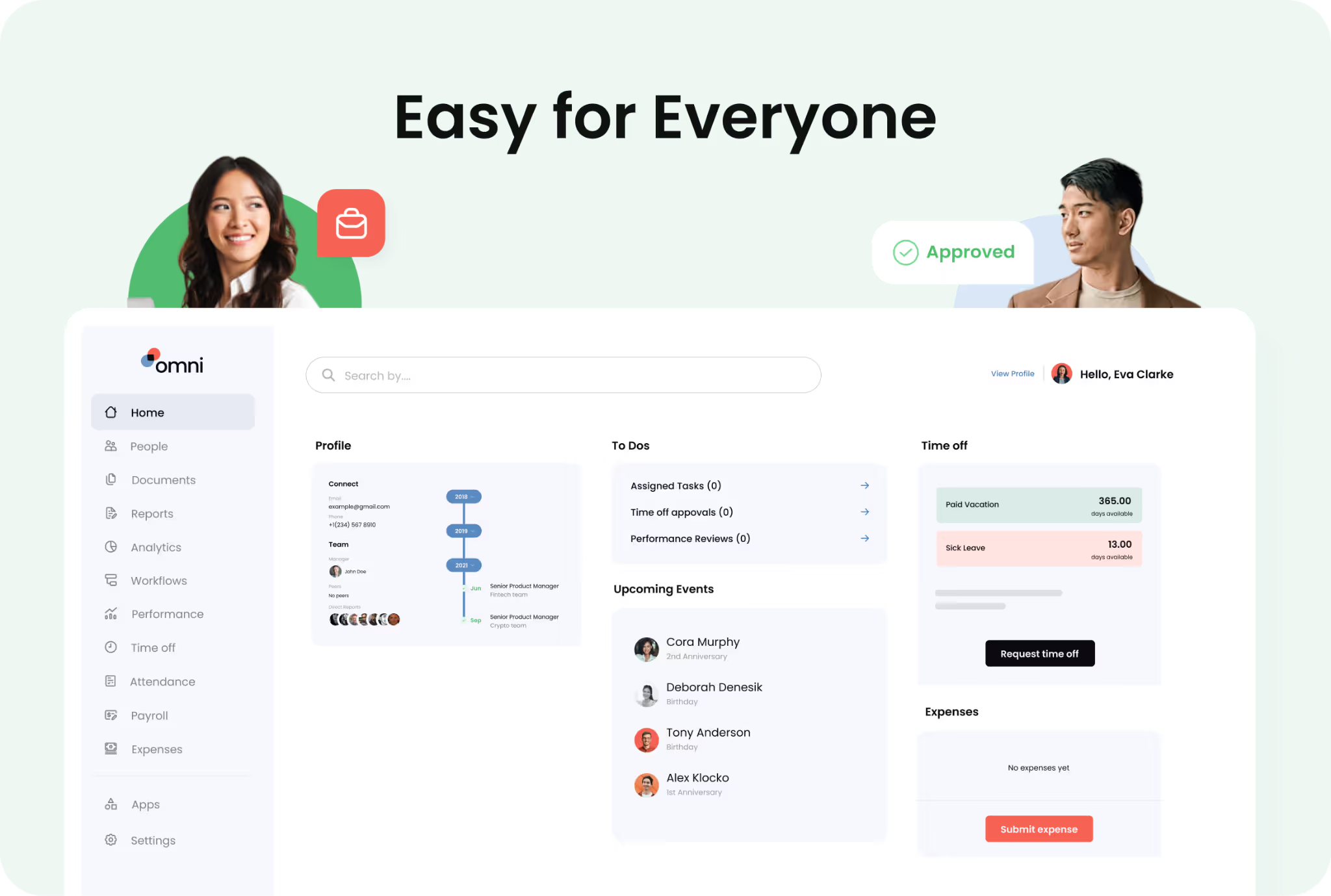
With modules like smart automation workflow and local Singapore payroll, HR teams can be freed from administrative bottlenecks and reduce miscalculations. Omni also offers:
- Centralized employee records for secure storage of employee contracts, retrenchment policies, and payment documentation.
- Automated payroll and compliance across multiple currencies, ensuring every severance pay Singapore aligns with local statutory requirements.
- Employee self-service tools for transparent access to payslips, tax information, and relevant offboarding documents.
- Integrated document management and approvals, streamlining every step from retrenchment notification to final payment.
- Local support within APAC time zones, backed by an award-winning, easy-to-use interface trusted by hundreds of teams across the globe.
With Omni, you can transition from reactive compliance management to proactive workforce care, all while maintaining empathy, dignity, and transparency throughout the retrenchment Singapore process. Book a demo with our team today and learn how modern tools can help you handle severance efficiently and compliantly.
.png)


.png)