.png)
Summary. The Workfare Income Supplement (WIS) is a Singapore government initiative under the Workfare Income Supplement scheme designed to support lower-wage workers by providing both cash and CPF contributions. Eligible employees, self-employed, and platform workers can receive their workfare payouts based on age and income, with more workers benefiting under the enhanced 2025 scheme, including those earning up to S$3,000. Companies can streamline management of WIS using tools like the workfare calculator or WIS calculator to track entitlements, plan around the workfare $3,000 payout date, and ensure compliance with workfare regulations, improving accuracy and employee financial well-being.
What Is the Workfare Income Supplement?
The Workfare Income Supplement (WIS) is a financial assistance scheme that supports lower-wage workers who remain employed in Singapore. It's fully funded by the Singapore government through the Ministry of Manpower and administered by the CPF Board (CPFB). Through WIS, eligible workers receive payment in cash and Central Provident Fund (CPF) contributions, so working continues to build both immediate income and long-term savings.
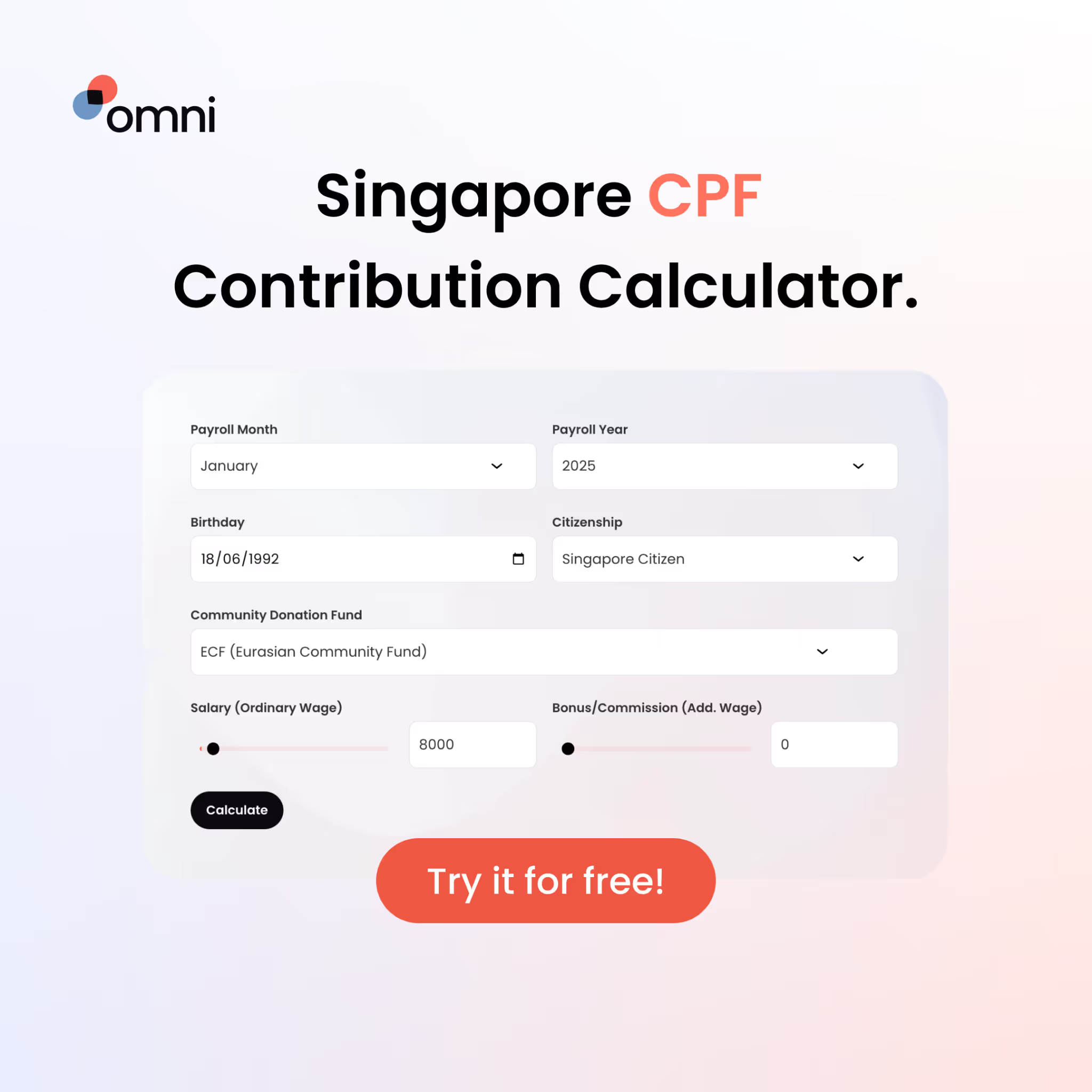
We automatically calculate CPF contributions and generate MOM-compliant payslips for Singapore-based teams, so eligibility signals like gross monthly income are always accurate and easy for your HR team to track. More on that below.
Why Was It Introduced?
Singapore introduced WIS in 2007 as part of its broader Workfare strategy, an approach that supports work rather than dependency. Three reasons shaped the move:
1. To encourage work and self-reliance. Rather than offering welfare benefits that could discourage employment, WIS was designed to reward effort and motivate employees to stay in the workforce, even in lower-paying jobs.
2. To support older and lower-income workers. As Singapore's economy grew, older and less-skilled workers risked being left behind. WIS helps them manage living costs while building CPF savings for retirement.
3. To narrow the income gap. By supplementing wages directly, the government raises the take-home pay of lower-wage workers without adding cost pressure on employers.
How Does the Workfare Payout Work?
Every WIS payout is split into two parts: cash and CPF contributions.
Cash portion: goes straight to the recipient's bank account, giving them flexible support for day-to-day costs like groceries, transport, and bills, with no borrowing or waiting required.
Learn more: Employee Financial Wellness Programs & Benefits
CPF portion: builds long-term security. It's credited across three CPF accounts:
- Ordinary Account for housing
- Special Account for retirement
- MediSave Account for healthcare
This means today's support also strengthens tomorrow's retirement, housing, and healthcare savings.
How the split works:
- Employees receive 40% of their WIS in cash and 60% credited to CPF accounts.
- Self-employed persons (SEPs) receive 10% in cash and 90% credited to MediSave, since they contribute independently without employer CPF support.
- Platform workers follow the same 10% cash / 90% MediSave split as SEPs through Work Year 2028, moving toward the employee split from 2029 as their CPF contribution rates align.
Who Is Eligible for the Workfare Income Supplement?
Not every worker in Singapore qualifies. You'll need to meet the conditions for your worker type below.
Employees
You'll qualify for WIS if you meet all of these:
- You're a Singapore citizen.
- You're 30 or older as of 31 December of the work year, or a person with disabilities of any age (there's no minimum age for persons with disabilities).
- Your gross monthly income is at least S$500 and does not exceed S$3,000 for the month worked. Persons with disabilities, workers who qualify for ComCare Short-to-Medium-Term Assistance, and eligible caregivers can qualify for concessionary WIS even below the S$500 floor.
- Your average gross monthly income over the past 12 months also does not exceed S$3,000.
- You've received CPF contributions as an employee for the work done.
- You live in a property with an annual value of S$21,000 or less, and you own no more than one property.
- If you're married, you and your spouse together own no more than one property, and your spouse's assessable income doesn't exceed S$70,000 for the preceding Year of Assessment.
Self-Employed Persons (SEPs)
You'll qualify if you meet the following:
- You're a Singapore citizen aged 30 or older (or any age if you have a disability).
- Your average monthly Net Trade Income (NTI) is at least S$500 and does not exceed S$3,000.
- You've declared your NTI and made your MediSave contributions in full.
- You meet the same property and spousal income conditions as employees.
Platform Workers
This group includes people working through ride-hailing, delivery, or freelance digital platforms.
You'll qualify if you:
- Are a Singapore citizen aged 30 or older (or any age if you have a disability).
- Earn a monthly income, including net platform earnings, of at least S$500 and not more than S$3,000.
- Make MediSave contributions.
- Meet the same property ownership, residence, and spousal income conditions as employees.
How Much Are the Workfare Payouts?
Your payout depends on your age and employment type. The table below shows the current maximum annual WIS amounts, effective for Work Year 2025 and, based on CPF Board's latest published rates, still the applicable figures for payouts through 2026. We'll update this table as soon as CPF Board publishes new Work Year 2026 figures, expected after upcoming Budget announcements.
Employees (40% cash / 60% CPF)
Self-Employed Persons & Platform Workers (10% cash / 90% MediSave)
Eligibility at a Glance
Examples
For employees: If you qualify for S$2,000 in WIS, you'd receive about S$800 in cash to your bank account and S$1,200 credited to CPF, giving you immediate flexibility alongside long-term savings growth.
For self-employed persons: If you earn within the qualifying range and qualify for S$1,800 in WIS, the full amount would be credited to your MediSave and Retirement Accounts.
When Are the Workfare Payouts Made?
Employees receive WIS monthly. If you worked in a given month, your payout typically lands by the end of the second month after (for example, work done in January is paid by end March via PayNow or bank crediting, or the first week of April via GovCash).
Self-employed persons receive WIS annually, once income is declared and MediSave contributions are made in full. The earliest you can receive it is by end April of the following work year.
Platform workers receive WIS monthly, starting from March 2025 onward, following the same schedule as employees.
Payments are automatically credited to:
- Your bank account (for the cash portion), or
- Your CPF account (for the CPF or MediSave portion)
No application is needed if you're an employee, since your eligibility is assessed from your CPF records. Self-employed persons need to declare their annual income and make MediSave contributions to receive their payout.
Changes to Platform Workers
Starting Work Year 2025, platform workers receive WIS payouts monthly, aligning them with employees. This was part of MOM's 2023-2024 announcements to provide more consistent financial support and CPF contributions throughout the year, instead of waiting for a single annual payout.
What Does the "S$3,000 Payout" Actually Mean?
You might see this phrase used loosely online, but it refers to the WIS income eligibility ceiling, not a fixed payout amount. To qualify, your gross monthly income (or average monthly income for SEPs and platform workers) needs to stay at or below S$3,000, alongside the S$500 income floor and other eligibility criteria above. Your actual payout is calculated based on your age bracket and income, using the tables above, not a flat S$3,000 figure.
Modes of Payment
You can receive your WIS payout through several channels:
- PayNow (linked to your NRIC): the fastest and most convenient option.
- Direct bank transfer: used if you don't have PayNow linked.
- GovCash: for those without a bank account, letting you collect your payout at OCBC ATMs using your NRIC and Singpass Face Verification.
WIS Calculator: How to Estimate Your Workfare Payout
You can check your estimated payout, the cash versus CPF split, and your expected payment date using the official Workfare Income Supplement calculator on the CPF Board or MOM website.
Here's how it works:
- Enter your birth year, since this determines your age group and WIS rate.
- Enter your gross monthly income, or average monthly income if it varies.
- If you're self-employed, enter your net trade income as well.
- Review your estimated payout, broken down into cash amount, CPF or MediSave amount, and expected payment schedule.
Changes to Workfare Income Supplement in 2025 and Beyond
Higher income ceiling: from Work Year 2025, the qualifying monthly income limit raised from S$2,500 to S$3,000 for employees, SEPs, and platform workers alike.
Increased payouts for older workers: the maximum annual amounts rose across every age bracket starting Work Year 2025, as shown in the table above.
Platform worker inclusion: from 2025, eligible platform workers receive monthly WIS payouts instead of annually, and continue to receive the same maximum amount as SEPs through 2028. From 2029, platform workers who've opted into higher CPF contribution rates will receive WIS at the same level as employees.
Frequently Asked Questions
1. Do I need to apply for the Workfare Income Supplement (WIS)?
No. If you're an employee, you're automatically assessed through your CPF records. Self-employed persons need to declare their Net Trade Income (NTI) and make the required MediSave contributions. Platform workers don't need to apply either, as long as their platform operator submits the required data.
2. How often will I receive my Workfare payout?
Employees and platform workers receive WIS monthly. Self-employed persons receive it annually, once the work year ends and MediSave contributions are made.
3. How do I check my Workfare payout status?
You can check your WIS, CPF, and other government benefits through the CPF or Workfare e-services portals using Singpass. CPF Board provides tools showing both your estimated payout and your actual disbursement.
4. What's the maximum Workfare payout I can receive?
For work done from 2025 onward, the annual maximums are S$2,450 (age 30 to 34), S$3,500 (age 35 to 44), S$4,200 (age 45 to 59), and S$4,900 (age 60 and above, or persons with disabilities).
5. Why is my payout smaller than expected?
This usually comes down to higher income, fewer working months, exceeding the property or spousal income limits, or insufficient MediSave contributions for SEPs.
6. Can I receive WIS alongside other government support schemes?
es, in most cases. There's no blanket rule preventing you from receiving WIS while on other schemes, as long as you separately meet WIS's own eligibility criteria. Some specific programs may have their own restrictions, so it's worth checking your other scheme's terms if you're unsure.
Smart Workfare Income Supplement Management with HR Tools
Managing WIS across your workforce means correctly calculating entitlements for employees and SEPs, tracking payouts, and staying on top of CPF contributions and management, all while your team grows. A modern HR platform makes this easier.
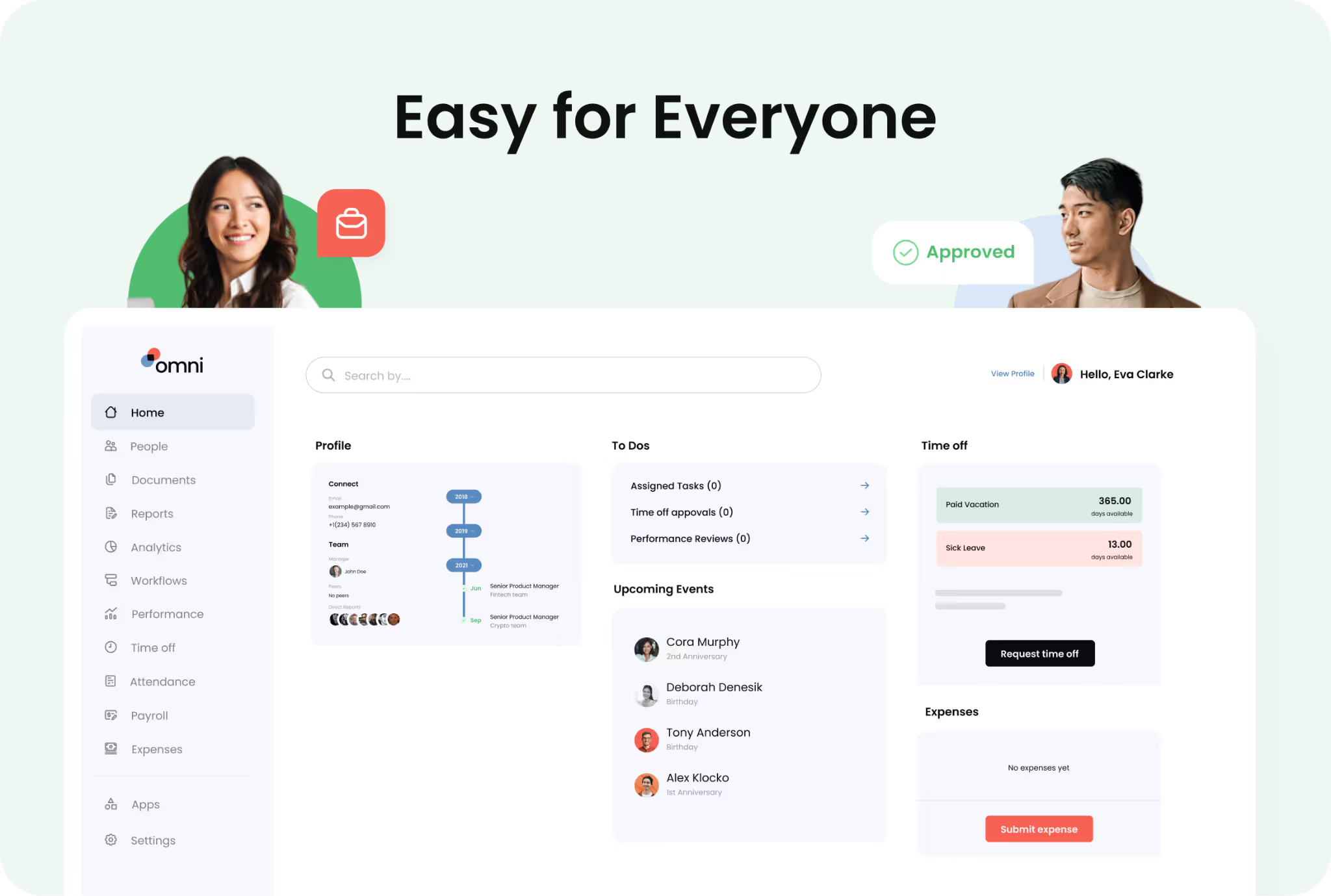
We simplify this with integrated payroll, compliance, and employee records built specifically for Singapore's regulatory environment. Your HR team can quickly estimate WIS entitlements, monitor key deadlines, and keep every WIS-related payment accurate and on time. By centralizing these tasks, we help Singapore businesses stay compliant while strengthening employee financial wellness and freeing up your team's time for higher-value work.
Book a demo with our team today to learn more.