.png)
Summary. Cloud HR software has become the operational backbone for modern teams managing people across Asia. Unlike on-premise systems that fragment data and slow down HR, a cloud-based HRIS gives your team real-time visibility, automated payroll, and built-in compliance for statutory contributions like CPF, EPF, and SSS — from a single platform. This guide covers what cloud HR software is, the key benefits for distributed teams, what to look for when evaluating platforms, and how Omni helps APAC teams manage complex, multi-country structures without the overhead of legacy tools.
Cloud HR software — also known as a cloud-based HRIS or HRMS (Human Resource Management System) — is a people management platform hosted on remote servers and accessed via the internet, rather than installed directly on your company's own hardware. Think of it as HR delivered as a service: accessible to your whole team, from anywhere, on any device.
For teams managing employees across multiple countries or offices in Asia, that shift in infrastructure isn't just a technical upgrade — it's what makes compliant, efficient, and scalable people operations actually possible.
Whether you're an HR team of five managing 300 employees across Singapore and Malaysia, or a regional enterprise coordinating thousands of headcount across APAC, the case for cloud HR software comes down to the same fundamentals: better data, faster processes, and compliance you don't have to chase manually.
Read next:Enterprise HRIS Solutions | Global HRIS System Guide
What is cloud HR software, and how is it different from on-premise systems?
The difference between cloud HR software and a traditional on-premise HRIS is where your data lives and how your team accesses it.
With on-premise systems, the software is installed on servers your company owns and maintains. Updates require manual intervention, IT overhead is ongoing, and your data is only accessible from approved devices or networks. For distributed teams — especially those operating across multiple countries or time zones — this creates real friction.
Cloud HR software flips that model. Your data is hosted securely by the software provider on remote servers, and your team accesses the platform through a browser or app. Updates roll out automatically. New features deploy without downtime. And your HR team, managers, and employees can access what they need from wherever they're working.
Here's a quick comparison:
For growing APAC teams, the compliance column alone is worth the switch. Statutory requirements across Singapore (CPF), Malaysia (EPF, SOCSO, EIS), and the Philippines (SSS, PhilHealth, Pag-IBIG) change regularly. With a cloud-based platform, those updates happen in the background — your team doesn't need to audit and reconfigure the system every time a regulatory threshold shifts.
Key benefits of cloud HR software for APAC teams
Real-time visibility across your workforce
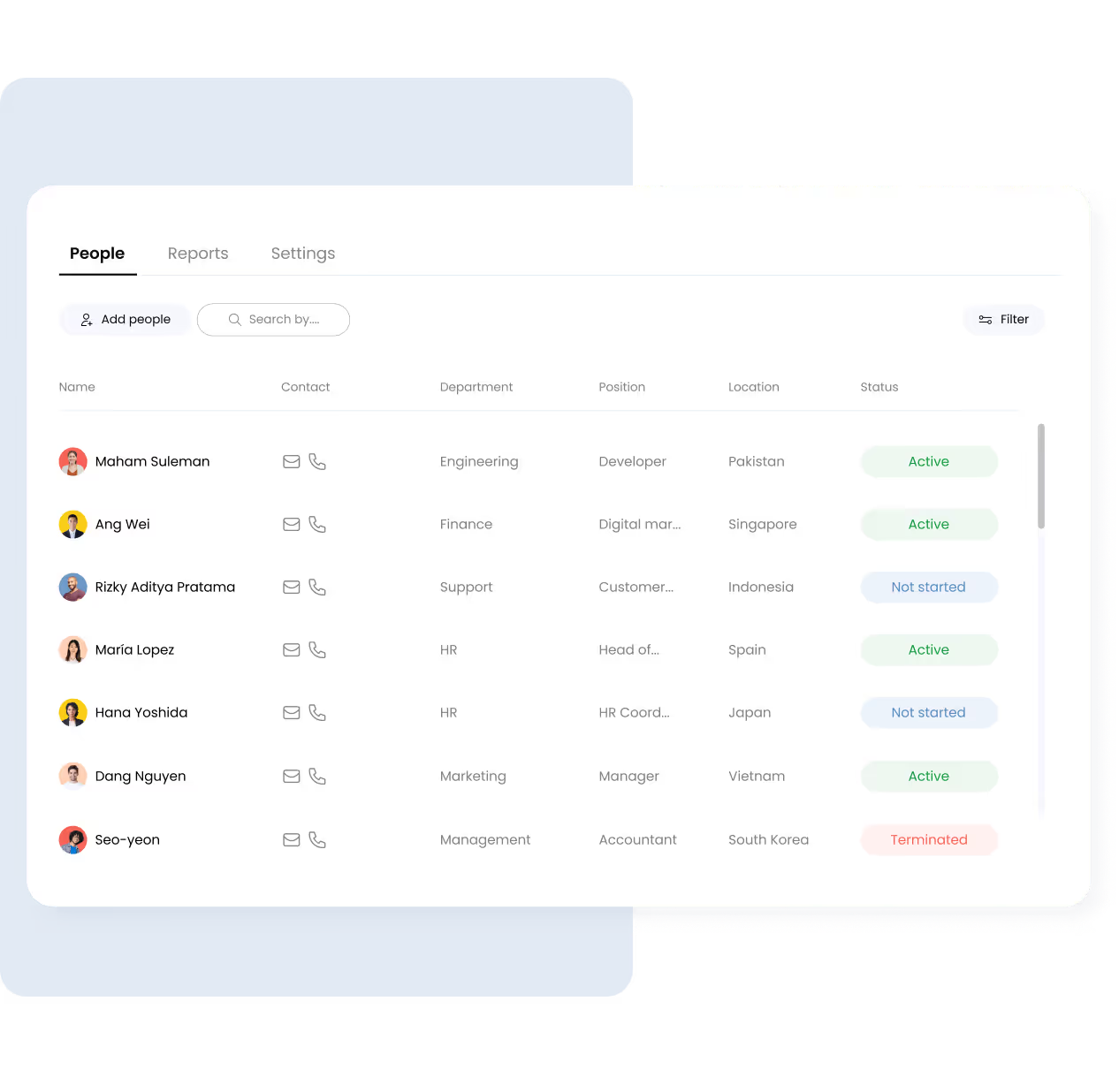
On-premise and legacy systems often produce static reports that are outdated by the time they're generated. Cloud HR software gives HR leaders, finance teams, and executives access to live workforce data — headcount trends, payroll summaries, leave balances, and performance metrics — without waiting for someone to pull a report.
For teams managing employees across multiple locations, this unified view is what makes consistent people strategy possible. You're not reconciling data across spreadsheets from three different country HRs; you're looking at one source of truth.
Scalability without IT overhead
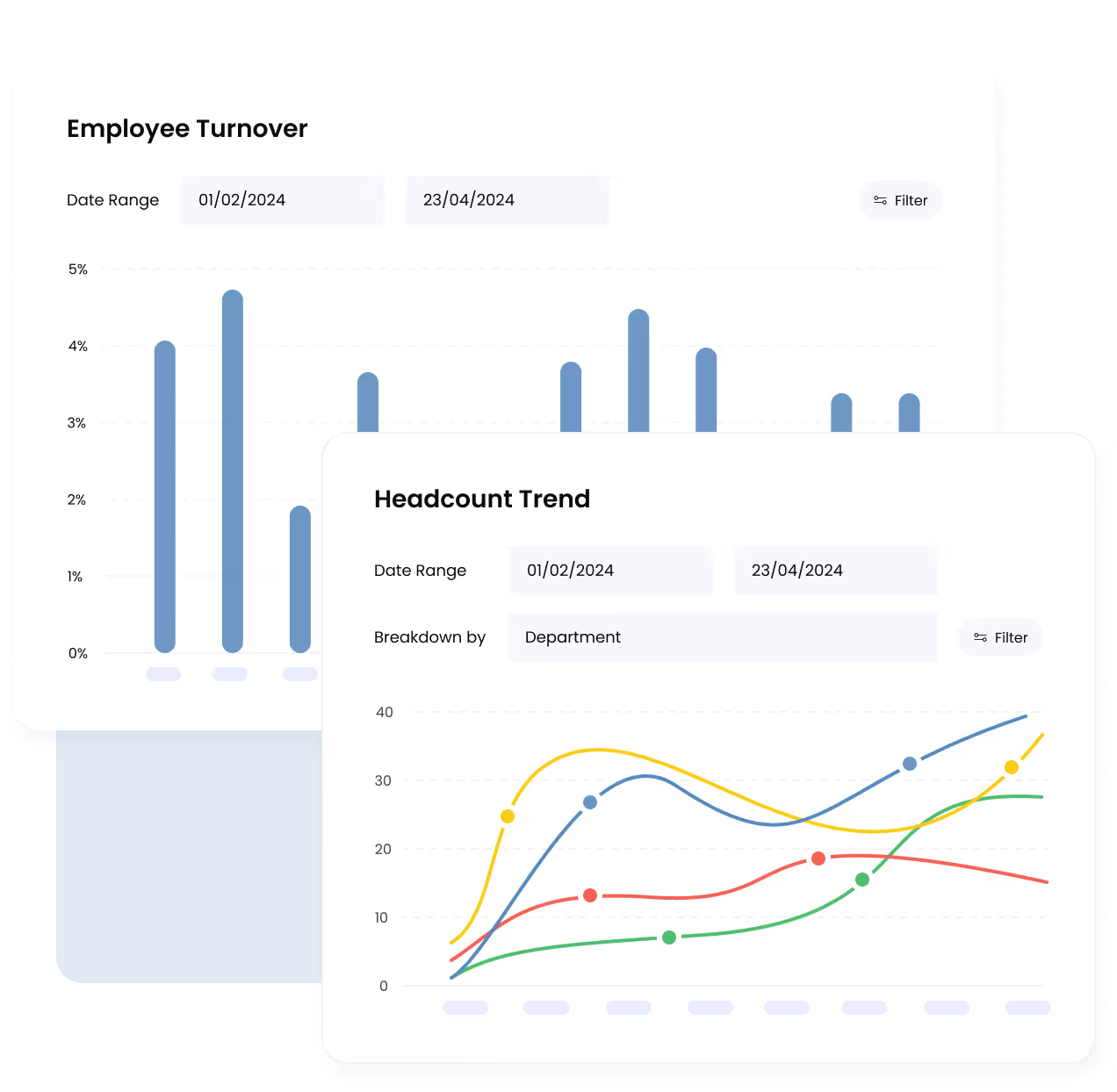
Cloud platforms are built to grow with you. Whether your headcount doubles or you open offices in two new markets, a cloud-based HRIS scales without requiring new servers, additional licenses, or a heavyweight IT project. This makes it the right foundation for companies growing from 100 to 1,000+ employees — and for teams that need to onboard new entities fast when expanding into a new APAC market.
Automated compliance for APAC statutory contributions
For HR teams in Asia, compliance isn't a one-country problem. Platforms like Omni automatically calculate and process statutory contributions across Singapore (CPF), Malaysia (EPF, SOCSO, EIS), and the Philippines (SSS, PhilHealth, Pag-IBIG) — and update those calculations as regulations change, without requiring manual reconfiguration.
This reduces compliance risk significantly, particularly for companies managing payroll across multiple jurisdictions where getting contribution thresholds wrong can trigger regulatory penalties.
Payroll automation from a single platform
Running multi-country payroll from disconnected systems — one tool for SG, another for MY, another for PH — creates reconciliation headaches and error risk. A cloud HR and payroll platform consolidates pay runs across regions, handles currency differences, manages tax withholding, and keeps audit trails clean, all from one place.
Better employee experience through self-service
Cloud HR software empowers employees to handle routine tasks themselves: submitting leave requests, downloading payslips, updating personal information, accessing benefits details. This reduces the administrative load on your HR team and gives employees the transparency and autonomy they expect from a modern employer.
For distributed teams, self-service access from any device or location isn't a nice-to-have — it's essential.
Predictable costs, lower total overhead
Traditional on-premise systems require significant upfront investment in hardware, licenses, and IT resources, plus ongoing maintenance. Cloud HR software operates on a subscription model, converting large capital expenditures into predictable monthly operational costs. For growing teams evaluating HR infrastructure trade-offs, this shift frees up budget for higher-value HR investments.
What to look for in a cloud HR software platform
Not all cloud HR software is built equally — especially for teams operating in APAC, where local compliance requirements add real complexity to vendor evaluation. Here's what to assess before committing to a platform:
1. Built-in APAC compliance
The platform should natively handle statutory contribution calculations for every market you operate in, and update those calculations automatically when regulations change. For Singapore-based teams, this means CPF automation and compliance with MOM guidelines. For Malaysia, EPF, SOCSO, and EIS. For the Philippines, SSS, PhilHealth, and Pag-IBIG.
If a platform requires your team to manually configure or recalculate these on a per-country basis, it creates unnecessary risk.
2. Multi-country payroll in a single system
Look for a platform that handles end-to-end payroll across multiple countries from one interface — salary calculations, deductions, tax withholding, direct deposit, and payslip generation — without requiring you to use separate tools for each market.
3. Role-based permissions and audit logs
Enterprise-grade security matters, especially when sensitive payroll and HR data is involved. The platform should offer granular, role-based permissions so you control exactly who can view, edit, or approve HR data. Comprehensive audit logs are equally essential for compliance reviews and internal governance.
4. Integration with your existing tools
A cloud HR platform shouldn't sit in isolation. Evaluate whether it integrates with the tools your team already relies on — ATS platforms, accounting software, productivity tools like Slack and Google Calendar, and ERP systems. Strong integrations reduce duplicate data entry and keep information flowing accurately between departments.
5. Flexible org structure and approval workflows
For teams with complex structures — multiple entities, regional business units, tiered management hierarchies — the platform needs to support intricate org charts and multi-level approvals for leave, expenses, performance reviews, and more. It should simplify your complexity, not force you to flatten it.
6. AI-powered recruitment and talent management
Modern cloud HR software increasingly incorporates AI across the talent lifecycle. Look for an AI-powered Applicant Tracking System (ATS) that automates candidate sourcing, screening, and interview scheduling, alongside performance management tools that help identify and develop your best people before they leave.
7. Localized onboarding and implementation support
Regional expertise matters. A vendor with strong knowledge of APAC HR practices and regulatory environments will accelerate your implementation and reduce the risk of getting something wrong during go-live. Dedicated onboarding support — not just documentation — is worth factoring into your evaluation.
Cloud HR software for APAC teams: a comparison
When evaluating cloud HR software for teams in Singapore and across Asia, the market broadly divides into global platforms that are adapted for APAC and APAC-first platforms built natively for the region. Here's how the major options compare:
Why APAC teams choose Omni for cloud HR
Omni is an all-in-one HRIS and multi-country payroll platform built for modern teams operating in and across Asia. Unlike legacy software that forces your team to work around its limitations, Omni is designed to adapt to how you actually work — across borders, compliance environments, and org structures.
Here's what that looks like in practice:
Unified HR and payroll across APAC. Omni centralizes employee records, payroll, compliance, and reporting across Singapore, Malaysia, the Philippines, and 190+ countries, giving your team a single source of truth instead of fragmented tools per market.
Automated statutory contributions. Omni handles CPF, EPF, SOCSO, EIS, SSS, PhilHealth, Pag-IBIG, and other regional contribution calculations automatically, updating as regulatory changes roll out so your team is always compliant.
AI-powered recruitment. Omni's AI-powered Applicant Tracking System (ATS) streamlines hiring from job posting through offer, with automated candidate screening and interview scheduling built in.
Scalable employee lifecycle management. From automated onboarding workflows and digital document collection through performance management and offboarding, Omni covers the full employee lifecycle — and scales as your headcount grows.
Enterprise-grade security. Omni is built with AES-256 encryption and ISO 27001 certified data infrastructure. Compliance updates and security patches deploy automatically, so your system is always current without IT intervention.
Employee self-service. Omni's self-service portal lets employees submit leave requests, download payslips, update personal data, and access expense records from anywhere — reducing HR admin load while improving transparency.
"If you're a growing company, you should consider Omni. Even with jurisdictions in the US and UK, you can utilize this platform because they can be compliant with the technical laws."— Andrei Perevalovi, Head of People Products at Virtual Internships
Omni starts at $3/employee/month with a 7-day free trial — no sales call required to get started.
Book a demo to see how we support cloud HR for your specific markets, or explore our pricing to find the right plan for your team size.
Frequently Asked Questions
A cloud-based HRMS centralizes all HR and payroll processes into one secure platform accessible from anywhere. For companies operating in multiple SEA markets, this ensures: * Real-time access to employee data and payroll information. * Automated updates for local compliance and statutory regulations. * Seamless integration across HR modules, payroll, accounting, and productivity tools. * Scalable operations as your team grows across countries. Omni’s cloud-based HRMS allows HR teams to manage the entire employee lifecycle, including recruitment, onboarding, attendance, payroll, and performance, without juggling multiple systems and spreadsheets.
Cloud HR software is an HR management platform hosted on remote servers and accessed via the internet, rather than installed on a company's own hardware. Also referred to as cloud HRIS or cloud HRMS, it gives HR teams and employees access to HR data and tools from any device, anywhere — with updates, security patches, and compliance changes managed automatically by the vendor.
For APAC teams, the main advantages are automated statutory compliance (CPF, EPF, SOCSO, SSS, and others), multi-country payroll from a single platform, real-time workforce reporting, and scalability as headcount grows across markets. Cloud HR software also reduces the IT overhead associated with maintaining on-premise systems.
The best cloud HR platforms for Asia natively calculate and process statutory contributions — Singapore's CPF, Malaysia's EPF, SOCSO, and EIS, the Philippines' SSS, PhilHealth, and Pag-IBIG — and update automatically when regulatory thresholds or rates change. This reduces manual configuration risk and keeps your payroll compliant across jurisdictions.
Cloud HR software is hosted remotely by the vendor and accessed via browser or app — it updates automatically and scales with your team without hardware investment. On-premise HRIS is installed on your company's own servers, requires manual updates, and typically involves significant upfront and ongoing IT costs. For multi-country teams, cloud is the standard choice due to compliance automation and accessibility.
Prioritize platforms that handle end-to-end payroll across all your operating markets from a single interface, with native support for each country's statutory contribution rules. Also evaluate integration capabilities with your existing tools, role-based permissions for data security, audit logs for governance, and the vendor's level of localized APAC support.
Pricing varies significantly by platform and feature set. Some platforms charge per employee per month (Omni starts at $3/employee/month), while others use custom or tiered pricing that requires a sales conversation. When comparing costs, factor in the total cost of compliance risk, IT overhead, and time saved on payroll processing — not just the headline subscription fee.
.png)


.png)