.png)
Summary. Enterprise HR software — also known as enterprise HRIS or enterprise HRMS — is a people management platform built for the scale and complexity of large, distributed organisations. Unlike standard HR tools, enterprise HR systems are designed to handle hundreds or thousands of employees across multiple functions, locations, and countries, with the security controls, compliance automation, and workflow customisation that large teams require. This guide covers what enterprise HR software is, how it differs from standard HRIS, what features to look for, and how platforms like Omni help large teams in APAC manage people operations end-to-end.
Enterprise HR software is a category of people management platform purpose-built for large, complex organisations — those managing significant headcount across multiple departments, locations, or countries, where a standard HR tool simply can't keep up.
Also referred to as enterprise HRIS (Human Resources Information System) or enterprise HRMS (Human Resources Management System), these platforms go beyond basic employee record-keeping. They centralise HR, payroll, compliance, analytics, and talent management in one system, with the security architecture, role-based controls, and integration depth that enterprise operations demand.
For HR leaders at large organisations — particularly those expanding across APAC — the shift from legacy or fragmented systems to a dedicated enterprise HR platform isn't optional. It's what makes compliant, efficient, and scalable people operations possible.
According to Cognitive Market Research, Asia Pacific holds approximately 23% of global HRIS market revenue and is projected to grow at a CAGR of 6.7% from 2024 to 2031 — driven by economic expansion and the acceleration of digital HR transformation across the region.
Read next: Cloud HR Software for APAC Teams | Global HRIS System Guide
What is enterprise HR software?
Enterprise HR software is a centralised platform built to manage the full employee lifecycle at scale — from recruitment and onboarding through performance management, payroll, compliance, and offboarding — across large, often distributed workforces.
Where standard HRIS tools are designed for smaller or mid-sized teams with relatively straightforward HR needs, enterprise HR systems are built for complexity: multi-entity org structures, multi-country payroll and compliance, granular role-based permissions, deep integration with existing enterprise tools, and the audit controls that large organisations and regulated industries require.
How enterprise HR software differs from standard HRIS
Key features to look for in enterprise HR software
1. Centralised employee database with configurable fields
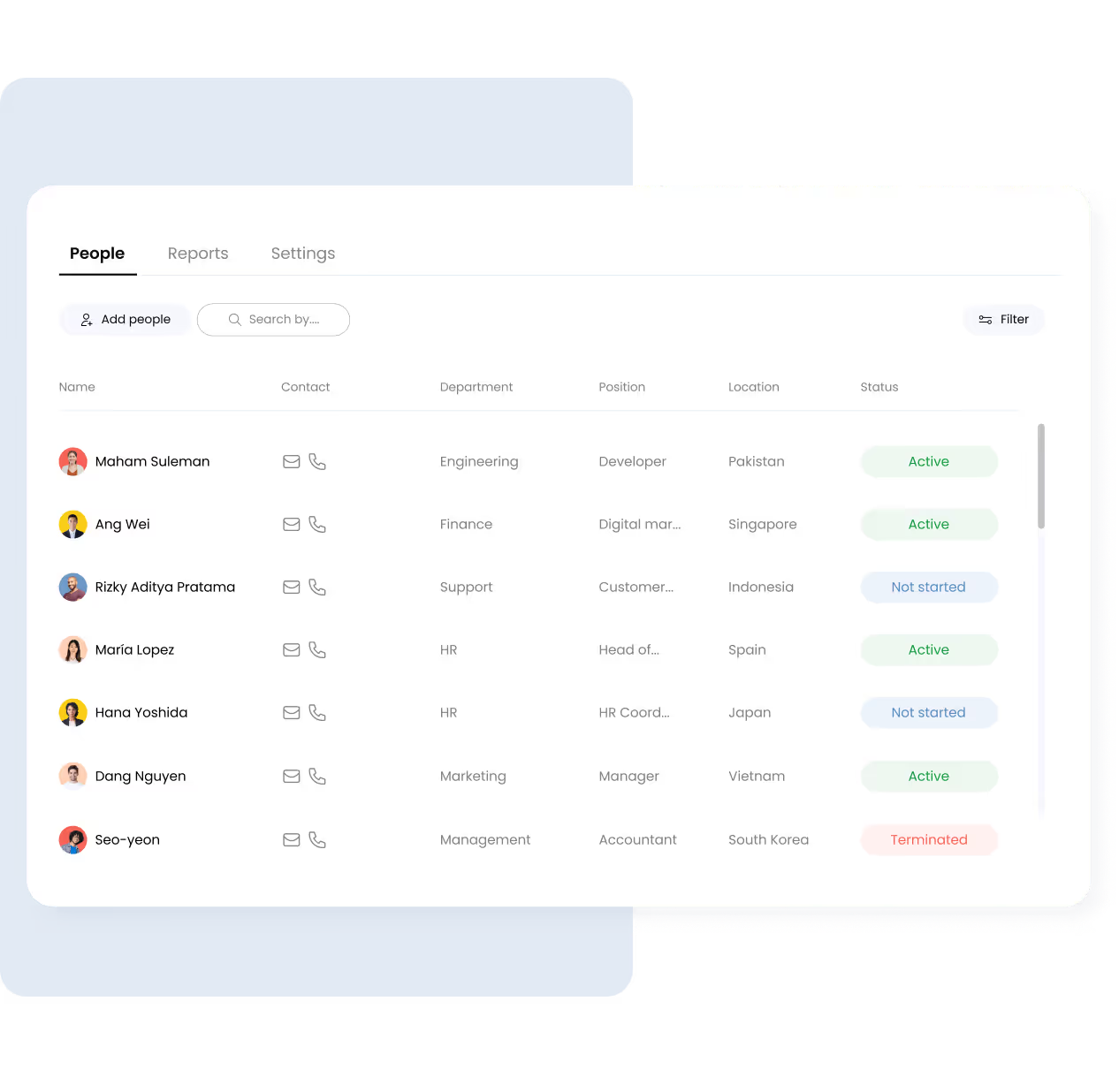
The foundation of any enterprise HR platform is a single source of truth for employee data — accessible in real-time across departments, locations, and HR functions. For large teams, this means a customisable database that accommodates complex org structures, multiple employment types, and regional data requirements, without forcing your team to maintain separate systems per country or business unit.
"Having a single source of truth has definitely improved the accuracy of our data and reporting."— Shux M., Chief People Officer at Endowus
2. Multi-country payroll and statutory compliance

For multinational businesses, payroll and personnel modules can't operate as separate systems, since a discrepancy between the two is exactly where compliance errors originate. For enterprises operating across APAC, payroll isn't a single process — it's a different compliance exercise in every market. Your enterprise HR software needs to handle region-specific statutory contributions automatically: Singapore's CPF, Malaysia's EPF, SOCSO, and EIS, the Philippines' SSS, PhilHealth, and Pag-IBIG, and tax withholding requirements across jurisdictions.
A platform that requires manual reconfiguration every time a regulatory rate changes isn't enterprise-grade — it's a liability.
3. Role-based permissions and enterprise-grade security
Sensitive payroll and HR data can't be accessible to everyone. Enterprise HR software must support granular, role-based access controls so every employee, manager, and HR administrator sees exactly what they need — and nothing more.
Look for: AES-256 data encryption, single sign-on (SSO), two-factor authentication, GDPR compliance measures, ISO-27001 certified infrastructure, and comprehensive audit logs that support internal governance and external compliance reviews.
4. Workflow automation across the employee lifecycle
Manual HR processes — onboarding paperwork, leave approvals, performance review cycles, expense claims — don't scale. Enterprise HR software should automate these workflows end-to-end, with configurable approval chains that mirror your actual org structure rather than forcing your team to work around the software's limitations.
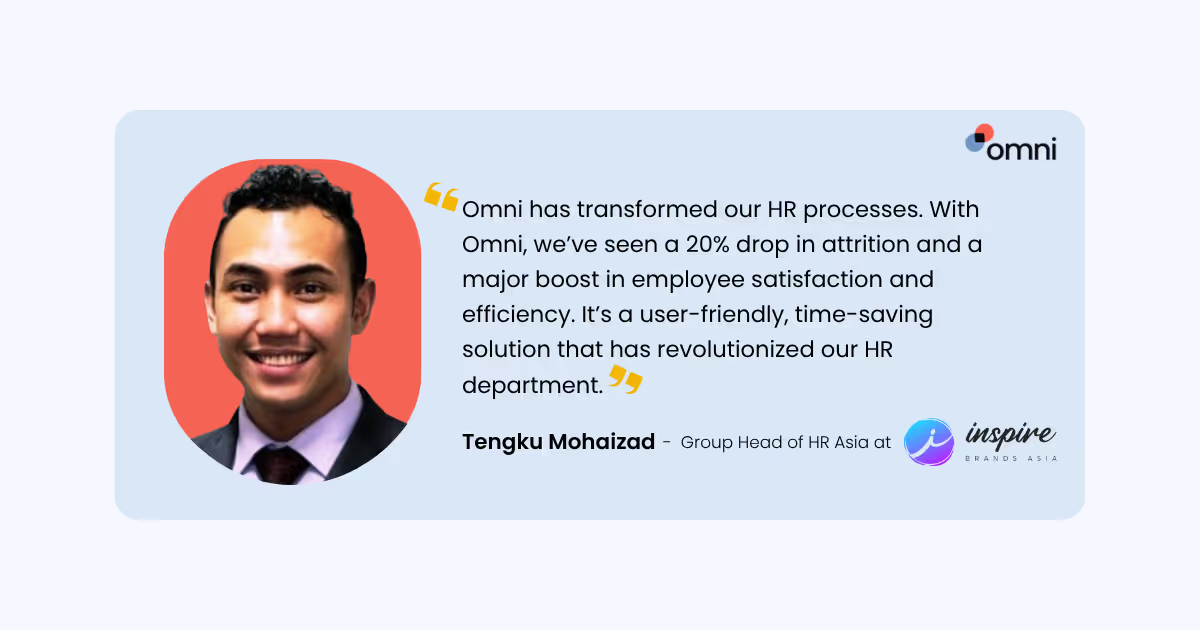
Inspire Brands Asia, a leading health and fitness group managing hundreds of employees across Southeast Asia, used Omni's automated workflows to unify time tracking, payroll processing, and performance reviews across countries — cutting manual work significantly and improving retention by 20%. Read the full story.
5. Real-time HR analytics and reporting
Large organisations can't make workforce decisions from static monthly reports. Enterprise HR analytics software gives HR leaders and executives live access to headcount trends, payroll cost summaries, leave analytics, performance data, and attrition risk — from a single dashboard, without waiting for someone to compile a spreadsheet.
This visibility is especially critical for multi-country teams, where aggregated reporting across entities is otherwise a manual, error-prone process.
6. AI-powered recruitment and talent management
Enterprise hiring at scale demands more than a basic ATS. Modern enterprise HR software integrates an AI-powered Applicant Tracking System (ATS) that automates candidate sourcing, screening, and interview scheduling — reducing time-to-hire and ensuring hiring managers across locations are working from the same candidate pipeline.
Beyond recruitment, performance management tools built into the platform help identify high-potential employees, structure review cycles, and link individual goals to business outcomes.
7. Deep integration with existing enterprise tools
Enterprise HR software doesn't replace your whole tech stack — it connects it. Look for native integrations with the tools your teams already rely on: communication platforms like Slack and Microsoft Teams, accounting and finance tools like Xero, ERP systems, and identity providers for SSO. Strong integrations eliminate duplicate data entry, reduce reconciliation errors, and keep information flowing accurately across departments.
8. Employee self-service (ESS)
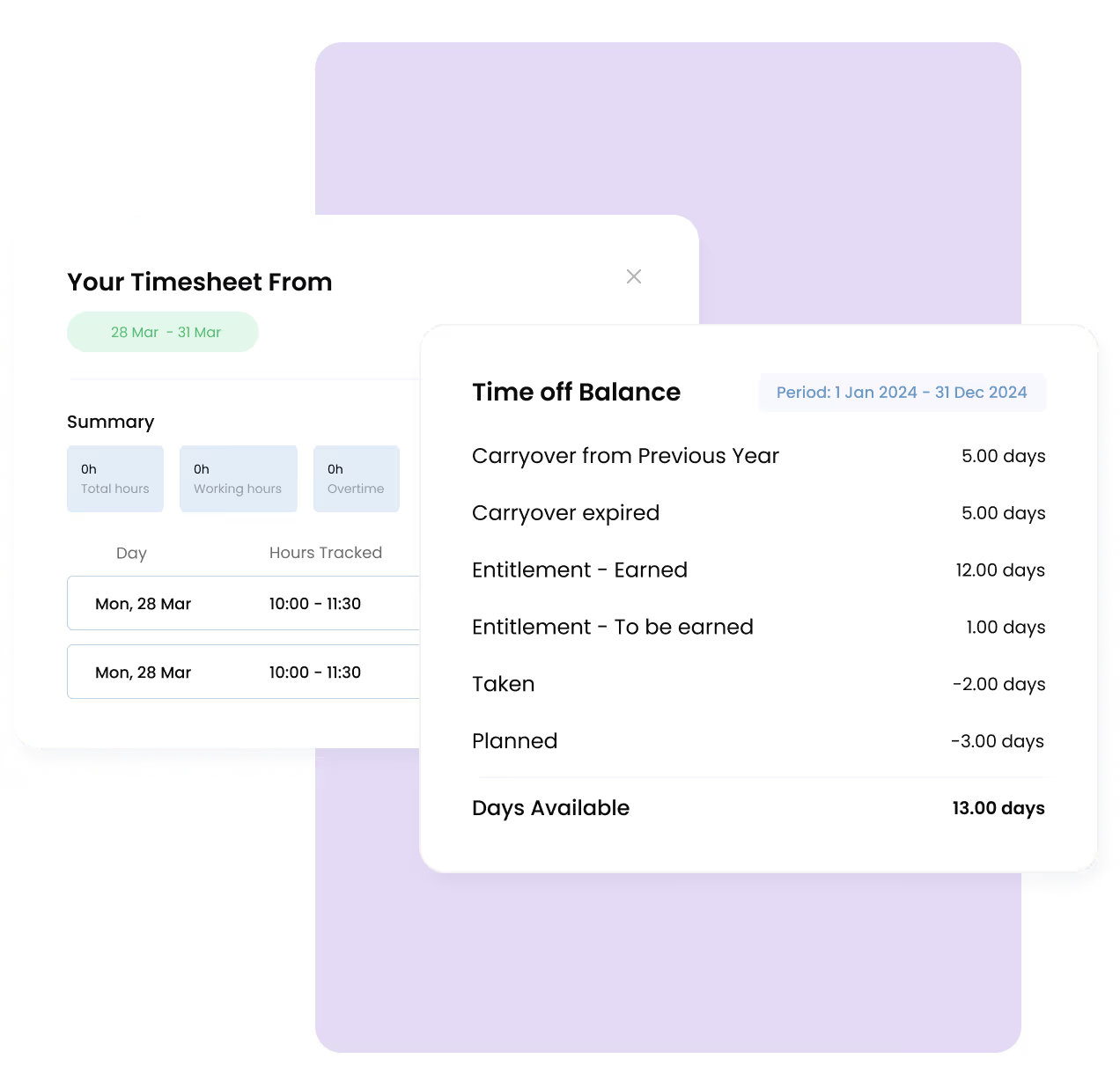
At enterprise scale, HR can't be the bottleneck for every employee request. A self-service portal lets employees manage their own HR tasks — submitting leave requests, downloading payslips, updating personal data, accessing expense records, completing performance reviews — from any device, anywhere. This reduces administrative load on HR and creates a consistent, responsive employee experience regardless of location.
9. Scalable support for complex org charts and approvals
Multi-entity organisations have multi-layered approval structures. Your enterprise HR system should support tiered approval workflows for leave, expenses, performance reviews, and more — and accommodate complex org charts with regional business units, matrix reporting lines, and multiple employment entities without requiring workarounds.
Multi-Country Payroll Software: The Core of Enterprise HR at Scale
Of everything an enterprise HR platform needs to handle, multi-country payroll carries the most operational risk. Running payroll across Singapore, Malaysia, the Philippines, and beyond means reconciling different statutory contribution schemes, different pay cycles, and different currencies, often in the same pay run. A platform that treats each country as a separate configuration rather than a unified process is the reason payroll teams end up doing reconciliation work by hand.
Multi-currency payroll adds another layer. Enterprises paying employees in SGD, MYR, PHP, and other regional currencies need consolidated reporting in a single currency for finance and leadership, without manual conversion at month-end. For a closer look at how multi-currency payroll actually works and what to look for in a platform, see our guide to multi-currency payroll.
What breaks without enterprise HR software
Understanding what goes wrong when large organizations run on legacy or fragmented HR systems helps clarify why the upgrade matters.
Disjointed data. When employee data lives across spreadsheets, local HR tools, and country-specific payroll systems, every report becomes a reconciliation exercise. Manual data entry across systems creates errors, and producing consolidated workforce insights requires pulling from multiple sources — a process that's slow, expensive, and unreliable.
Regional compliance risk. Enterprises operating across multiple markets face different tax regulations, statutory contribution requirements, and labour law obligations in every jurisdiction. A single payroll process for all won't do. Without a system that handles these requirements automatically — and updates as regulations change — the compliance burden falls on your HR team, and the risk of penalties falls on your organisation.
Inefficient manual processes. Payroll processing, time tracking, onboarding workflows, and performance review cycles all carry a significant manual overhead when HR tools aren't integrated or automated. At enterprise scale, this overhead isn't just slow — it actively limits what HR can accomplish strategically.
Learn more about Inspire Brands Asia’s success
Poor employee experience. When HR is overwhelmed with administrative work, employees feel it: slow approvals, delayed responses, limited visibility into their own HR information. This frustration compounds at scale and contributes to disengagement. Enterprise HR software shifts this by giving employees self-service access and giving HR the capacity to focus on the work that actually moves the business.
How to evaluate enterprise HR software for APAC teams
Not all enterprise HR platforms are built equally — and for teams operating in Asia, the gap between global-first and APAC-native platforms is significant.
Here's what matters most for APAC enterprise buyers:
APAC compliance depth. Does the platform natively handle statutory contributions for every market you operate in — CPF, EPF, SOCSO, SSS, and others — and update automatically when regulatory thresholds change? Or does it require your team to configure and maintain this manually?
Regional support and implementation expertise. Does the vendor have teams and resources in your time zone, with genuine knowledge of APAC HR and compliance environments? Implementation is where enterprise HR projects succeed or fail.
Scalability across new markets. As you expand into new APAC markets, can the platform add new countries without significant re-implementation? Look for platforms that support 100+ countries out of the box.
Total cost of ownership. Enterprise HR software pricing varies widely. Some platforms price per employee per month (Omni starts at $3/employee/month with public pricing — no sales call required). Others quote custom enterprise pricing that obscures the true cost. Factor in implementation, integration, and support costs alongside headline subscription pricing.
HRIS Platforms for Multi-Country Operations: A Comparison
Enterprise HRIS implementation: what to expect
Implementing enterprise HR software is a significant undertaking, and a poorly managed rollout defeats the purpose of the investment. Understanding the process helps you set realistic expectations and prepare your team.
Implementation timeline
Most enterprise implementations complete within weeks, not months — depending on:
- Size of your workforce and number of entities
- Volume and complexity of historical data to migrate
- Compliance and security configuration requirements
- The level of customisation needed for your workflows
The role of implementation managers
A successful implementation depends on dedicated support — not documentation and a ticketing system. Look for a vendor that assigns a named implementation manager who works directly with your HR team throughout the process, anticipates issues before they arise, and understands the local compliance nuances specific to your operating markets.
Omni provides dedicated implementation management and regional support throughout onboarding, with expertise across APAC compliance environments.
Data migration and go-live
Data migration is where enterprise implementations most commonly run into problems. Ensuring your data is clean, correctly structured, and completely accounted for before migration begins is critical. Your vendor should guide you through a structured preparation process — not just hand you a data template.
Before go-live, a thorough testing phase ensures all workflows, approvals, integrations, and payroll calculations are running as expected. Omni's team supports you through testing and remains available at go-live so your team is never left to troubleshoot alone.
Ongoing account management
Implementation is the beginning, not the end. Your enterprise HR software vendor should provide ongoing account management — regular check-ins, proactive communication about system updates and compliance changes, and support as your HR needs evolve and your team grows into new markets.
Why enterprises choose Omni for HR and payroll
Omni is an all-in-one HRIS and multi-country payroll platform built specifically for modern teams operating in and across Asia. For large and growing enterprises, Omni combines the enterprise-grade features your organisation needs with the APAC compliance depth and implementation support that global-first platforms often lack.
What that looks like in practice:
- Unified HR and payroll across APAC — centralised employee records, multi-country payroll, and compliance across Singapore, Malaysia, the Philippines, and 190+ countries from a single platform
- Automated statutory contributions — CPF, EPF, SOCSO, EIS, SSS, PhilHealth, Pag-IBIG, and others, updated automatically as regulations change
- Enterprise-grade security — AES-256 encryption, ISO-27001 certified infrastructure, SSO, 2FA, GDPR compliance, granular role-based permissions, and full audit logs
- AI-powered ATS — automated candidate sourcing, screening, and interview scheduling built into the platform
- Full employee lifecycle automation — onboarding workflows, performance management, leave and expense tracking, and offboarding, all configurable to your org structure
- Deep integrations — Slack, Microsoft Teams, Xero, Google Calendar, and more
- Dedicated implementation and account management — regional expertise and named support from day one
- Transparent pricing — starting at $3/employee/month with a public pricing page and a 7-day free trial
Explore Omni for enterprise teams | Book a demo | Start your free trial
Frequently Asked Questions
Enterprise HR software — also called enterprise HRIS or enterprise HRMS — is a people management platform built for large, complex organisations. Unlike standard HR tools, enterprise HR systems are designed to handle significant headcount across multiple locations, entities, or countries, with advanced security controls, multi-country payroll, compliance automation, and deep integration capabilities.
Standard HRIS tools are typically designed for smaller or mid-sized teams with straightforward HR needs in a single country. Enterprise HR software adds multi-entity org structure support, multi-country payroll and statutory compliance, granular role-based permissions, ERP and enterprise tool integrations, configurable approval workflows, and dedicated implementation and account management — all of which are necessary at scale.
At minimum: a centralised employee database, multi-country payroll and statutory compliance automation, role-based permissions and audit logs, enterprise-grade security (ISO certification, SSO, AES encryption), workflow automation across the employee lifecycle, real-time analytics and reporting, an AI-powered ATS, deep tool integrations, and employee self-service.
Most enterprise implementations complete within weeks, depending on workforce size, data complexity, and the level of customisation required. Vendors with dedicated implementation managers and structured data migration processes typically move faster and with fewer issues than self-serve implementations.
For teams operating in and across Asia, the most important criteria are APAC-native compliance (automatic handling of CPF, EPF, SOCSO, SSS, and similar statutory contributions), multi-country payroll from a single platform, and regional implementation support. Omni is built specifically for APAC markets, starting at $3/employee/month, and supports teams across 190+ countries.
Enterprise HR platforms built for multi-country operations automatically calculate and process statutory contributions for each jurisdiction — and update those calculations when regulations change, without requiring manual reconfiguration. This includes Singapore's CPF, Malaysia's EPF and SOCSO, the Philippines' SSS and PhilHealth, and tax rules across additional markets.
- Banks: You can use your bank to convert currencies, but they may charge high fees and offer less favorable exchange rates.
- Foreign exchange brokers: Specialized foreign exchange brokers can offer better exchange rates and lower fees than banks.
- International payment providers: Providers like Wise or PayPal offer competitive exchange rates and fast international transfers.
- Global payroll providers: Many global payroll providers have built-in currency conversion features and can handle this aspect of payroll processing for you.
.png)


.png)