.png)
Summary. The Workplace Fairness Act 2025 (WFA) is Singapore's first legally binding anti-discrimination framework for the workplace, replacing what was previously a guidelines-based approach under the Tripartite Guidelines on Fair Employment Practices (TGFEP). It prohibits employers from making adverse employment decisions based on 11 protected characteristics across the entire employment lifecycle — from hiring to dismissal. Employers with 25 or more employees are required to establish formal written grievance-handling processes. Once a complaint is made, a mandatory three-tiered resolution path applies: internal grievance handling, mediation, then adjudication at the Employment Claims Tribunals (ECT) or High Court. The full Act is expected to come into force by end-2027, giving employers a preparation window they should be using now — not waiting.
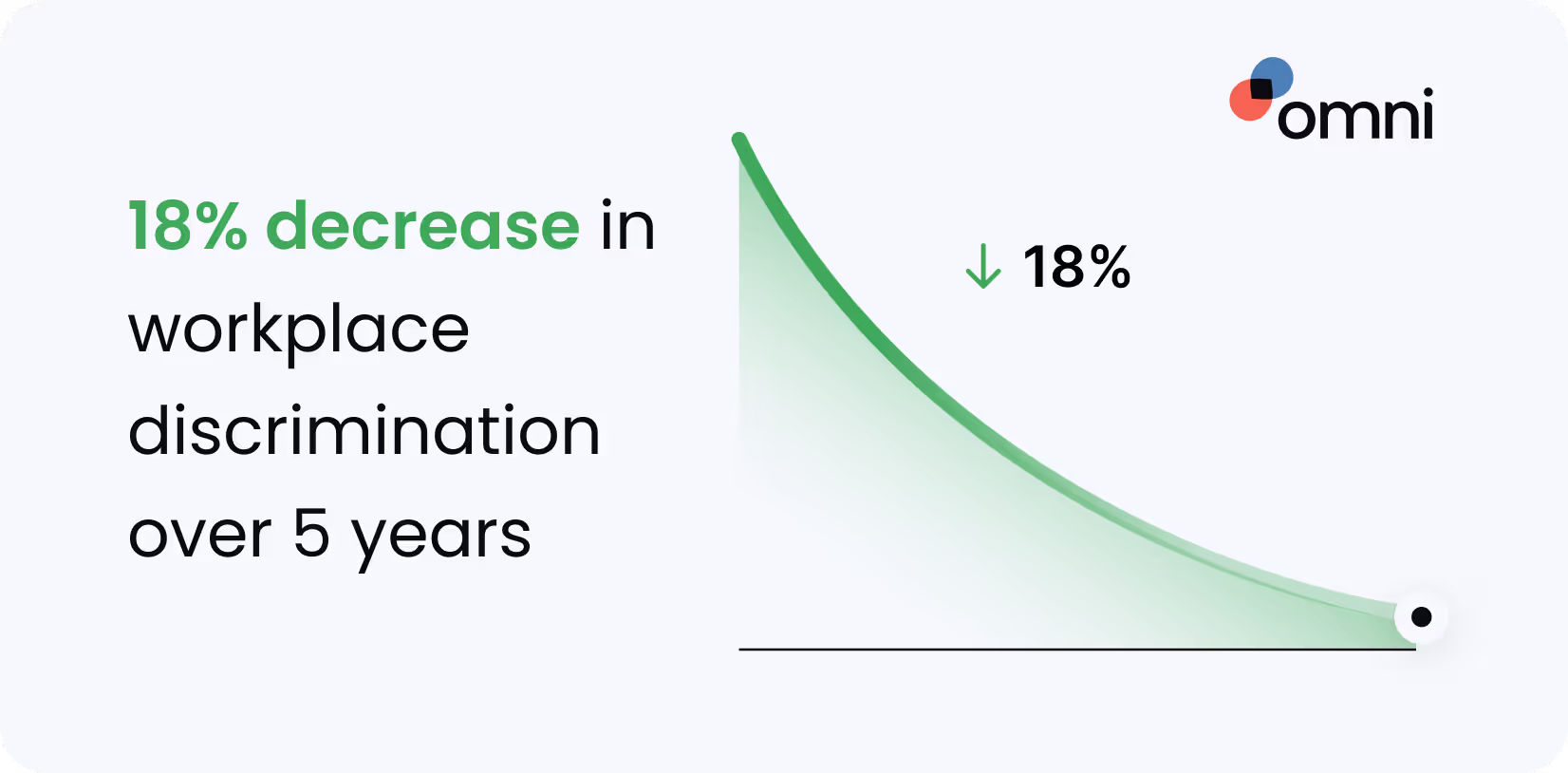
In Singapore, fairness at work is becoming a priority driven by real progress. The latest Fair Employment Practices Report shows that only 6% of employees experienced discrimination in 2023, down sharply from 24.1% in 2018. This shift reflects how much workplace fairness legislation has shaped employer behaviour over the past decade.
Building on that progress, Singapore has now enacted the complete Workplace Fairness Act framework. For the past two decades, the Tripartite Guidelines on Fair Employment Practices (TGFEP) set the standard — but they were guidelines, not legislation. Breaches led to consequences like work pass restrictions, but not direct civil liability.
That changed with the WFA. When the Act comes into force — confirmed by the Ministry of Manpower for end-2027 — employees will have the legal right to bring discrimination claims to a tribunal, and employers will face enforceable obligations around how they hire, manage, and dismiss people.
This guide explains what the WFA requires, what it means for your day-to-day HR operations, and the concrete steps you should take to prepare before enforcement begins.
Read next: Top Regulatory Compliance Monitoring Software for Asia 2025
What is the Workplace Fairness Act 2025?
The Workplace Fairness Act 2025 (WFA) is Singapore's first comprehensive, legally binding anti-discrimination legislation for the workplace. It was enacted through two bills:
- Workplace Fairness Act 2025 (No. 8 of 2025) — passed 8 January 2025. Covers the substantive rights and obligations: which characteristics are protected, what constitutes discrimination, employer obligations on fair consideration and grievance handling, and enforcement mechanisms.
- Workplace Fairness (Dispute Resolution) Bill — passed 4 November 2025. Sets out how individuals can seek redress: the mandatory mediation step, the Employment Claims Tribunals jurisdiction, private claim procedures, and safeguards against vexatious claims.
Together, these two pieces form the complete WFA framework. The Act is expected to come into force by end-2027, as confirmed by Manpower Minister Tan See Leng during the second reading of the Dispute Resolution Bill — slightly later than the initial 2026-2027 estimate, giving employers additional time to prepare.
In the meantime, the TGFEP remains in force and continues to be enforced through MOM and work pass restrictions. For a practical guide on embedding the WFA into your existing HR processes, see our companion post: How to Implement Singapore's Workplace Fairness Bill into Your HR Practices.
The WFA complements rather than replaces the TGFEP — broader fair employment expectations continue to apply for characteristics not specifically named in the WFA.
Why It Matters for Employers and HR Leaders
With the WFA now fully enacted, the question is no longer whether to prepare — it's how quickly you can get your HR systems and internal HR policies ready.
The WFA requires companies with 25 or more employees to have formal, documented grievance-handling processes, putting a spotlight on complaint-handling channels, investigation workflows, and audit-ready documentation.
Beyond legal compliance, this is also an opportunity to build genuine trust and embed fairness into your company culture. When employees know there's a clear, safe, and fair process to raise concerns, they're more likely to speak up early — which means you resolve issues before they escalate into formal claims.
The preparation window is real but not infinite. End-2027 sounds distant, but the changes required are structural: reviewing hiring practices, rebuilding grievance workflows, retraining managers, and updating documentation systems all take time. Starting now puts you ahead; waiting until 2027 puts you at risk.
The 11 Protected Characteristics under the WFA
The WFA prohibits adverse employment decisions based on any of the following protected characteristics across every stage of the employment lifecycle:
- Age
- Nationality
- Sex (including pregnancy-related considerations)
- Marital status
- Pregnancy (past, current, or intended)
- Caregiving responsibilities
- Race
- Religion
- Language ability
- Disability
- Mental health condition
These 11 characteristics were selected because they account for the vast majority of discrimination complaints historically received by TAFEP and MOM. Characteristics not listed — such as sexual orientation — are not protected under the WFA, though broader TGFEP expectations continue to apply. Treat the WFA list as the legal floor, not the ceiling of fair practice.
What counts as an adverse employment decision?
The WFA covers discrimination at every stage of Singapore employment, including:
- Pre-employment: Job advertisements with discriminatory criteria, screening based on protected characteristics, biased interview questions
- During employment: Performance reviews, employee promotions, salary decisions, training opportunities, job assignments
- End of employment: Dismissal, retrenchment selection, refusal of re-employment
Discrimination can be direct (treating someone less favourably because of a protected characteristic) or indirect (applying a policy that disadvantages a protected group without objective justification). For more on how gender discrimination plays out in practice, including what to audit and fix in your hiring workflows, see our detailed guide.
Employer Obligations Under the WFA
1. Fair consideration in hiring (Section 26)
Employers must make hiring and employment decisions based on merit — assessing candidates on skills, experience, performance, and qualifications relevant to the role. This aligns with Singapore's existing Fair Consideration Framework, which already requires fair consideration of local candidates. The WFA formalises and extends this into a broader statutory obligation.
Practically, this means:
- Job advertisements must not specify criteria tied to protected characteristics, unless it is a genuine job requirement
- Interview questions must relate to the genuine requirements of the role
- Selection criteria must be defined in advance and applied consistently across all candidates
- Employers should retain selection documentation — scoring frameworks, interview notes, assessment criteria — to demonstrate merit-based decisions if a dispute arises
For practical guidance on HR regulatory compliance including fair hiring checklists, anti-discrimination policy templates, and documentation frameworks for Singapore, our compliance toolkit covers each of these areas in detail.
2. Grievance handling (Section 27) — mandatory for employers with 25+ employees
This is the requirement most likely to drive operational change for HR teams. Under Section 27 of the WFA, employers with 25 or more employees must establish and maintain a formal, written grievance-handling process meeting specific standards.
The mandatory process must include:
- Written procedures — employees must be informed in writing about the grievance process and how to access it
- Inquiry — each grievance must be properly investigated in a fair and impartial manner
- Review — a mechanism for reviewing investigation outcomes
- Outcome notification — employees must be informed in writing of the outcome of their grievance
- Confidentiality — grievance-related information, including the identity of the person raising the complaint, must not be disclosed except where reasonably necessary
- Record retention — grievance records must be maintained for a specified period
Many organisations currently have informal complaint channels. These do not satisfy the WFA — the process must be documented, consistently applied, and structured to meet each of the above requirements.
Platforms like Omni help Singapore HR teams build the documentation infrastructure the WFA demands — centralising grievance records with secure document storage, maintaining audit-ready logs of employment decisions, and creating structured automated workflows for investigation and outcome notification that meet the Act's confidentiality and record-keeping requirements. Employee self-service portals also give employees a structured, accessible channel to raise concerns — meeting the accessibility requirement without adding manual overhead to HR teams.
3. Prohibition against retaliation (Section 28)
Employers are prohibited from taking retaliatory action against employees who raise a grievance, participate in a grievance process, or are suspected of intending to do so. Retaliatory acts include dismissal, salary deductions, contract changes, harassment, or any action that adversely affects an employee's terms of employment.
This prohibition extends beyond the individual who raised the complaint — it also covers witnesses or anyone suspected of involvement. Retaliation is a separate enforceable obligation under the Act, independent of the underlying discrimination claim.
How the Dispute Resolution Framework Works
The Workplace Fairness (Dispute Resolution) Bill structures resolution through three sequential tiers. Employees must exhaust each tier before proceeding to the next.
Tier 1: Internal resolution
The employee raises the concern through the employer's internal grievance process. HR and managers work together to resolve the issue fairly and transparently. This tier is mandatory — employees must attempt internal resolution before accessing external channels.
A well-designed internal process resolves the majority of complaints before they escalate. Employers who invest in this now are directly reducing their exposure when the WFA comes into force.
Example — age-based discrimination:A senior employee notices junior colleagues consistently receiving higher-profile assignments and raises the concern through HR's grievance process. After review, the parties are unable to agree on a resolution, and the case moves to the next tier.
Tier 2: Mediation (mandatory)
Before any formal claim can be filed, mediation with a neutral third party is mandatory. Both sides attend structured mediation to discuss the issue and explore remedies. Mediation proceedings are confidential and designed to achieve an amicable resolution without formal legal proceedings.
Continuing the example:The employee and employer attend mandated mediation. After structured discussion, they are unable to reach a mutually acceptable settlement. The case proceeds to formal adjudication.
Tier 3: Employment Claims Tribunal or High Court
If mediation fails, the employee may bring a formal claim:
- Employment Claims Tribunals (ECT): Hears workplace fairness claims up to SGD 250,000 — a significant expansion from the ECT's current wrongful dismissal limit of SGD 20,000. Proceedings are judge-led, held without legal representation, and all hearings are conducted in private.
- High Court (General Division): Claims above SGD 250,000, or cases where complexity warrants it, proceed to the High Court with standard civil procedures.
Filing deadlines under the Dispute Resolution Bill:
- Pre-employment or end-of-employment claims: within 1 month
- In-employment claims: within 6 months
MOM may accept late submissions where there are reasonable grounds (such as illness, maternity leave, or incapacity). For further information on how both workers and employers can access the resolution process, the NTUC's explainer on the Dispute Resolution Bill covers practical worker-side guidance.
Completing the example:The employee files a claim with the ECT. After examining project assignment records and performance documentation, the ECT rules in the employee's favour and awards SGD 180,000 — within the ECT's SGD 250,000 jurisdictional cap. All proceedings are held in private.
Who Is Covered — and Who Is Exempt?
The WFA applies to employees and job applicants working under a contract of service in Singapore, as governed by the Singapore Employment Act.
Employers with 25 or more employees face the full set of obligations, including the mandatory written grievance-handling process.
Employers with fewer than 25 employees are initially exempt from the mandatory grievance process, but remain subject to the substantive anti-discrimination provisions. The exemption threshold is subject to review within five years of the Act coming into force — smaller employers should treat this as a deferral, not a permanent exclusion.
Exceptions to the anti-discrimination provisions:
- Genuine job requirement: Decisions based on a protected characteristic are permitted if the characteristic is a genuine and proportionate requirement of the specific role (e.g., a religious organisation may require certain employees to share that faith)
- Fair consideration for citizens and PRs: Under the existing Fair Consideration Framework, employers may continue to give fair consideration preference to Singaporeans and PRs
- Religious organisations: Specific exceptions apply for religious bodies in certain roles
- Age: Specific exceptions exist in relation to retirement age policies
What's Changing in the Supporting Ecosystem
TAFEP transitions to SNEF (April 2026)
From 1 April 2026, TAFEP's Employer Advisory Service — previously the primary support channel for employers navigating fair employment questions — transitioned to the Singapore National Employers Federation (SNEF). SNEF now provides fair employment advisory services for both members and non-members, though non-member appointments through ARCC@SNEF are fee-based. If your HR team has historically relied on TAFEP's guidance materials and workshops, update your contacts and bookmark SNEF's resources.
TAFEP continues to receive and investigate fair employment complaints in the period before the WFA comes into force.
Upcoming Tripartite Guidelines (2026)
Two additional pieces of guidance remain pending as of this update, which will directly affect HR compliance in Singapore:
- Tripartite Guidelines on Restraint of Trade Clauses in Employment Contracts (expected in the second half of 2026, not yet released). Will address the reasonable use of restrictive covenants, particularly in retrenchment scenarios.
- Tripartite Advisory on Reasonable Accommodations for Persons with Disabilities (not yet released). Will complement the WFA's disability protections and define what constitutes reasonable accommodation in practice.
Monitor MOM's newsroom for release dates.
Shared Parental Leave extension (April 2026)
From 1 April 2026, statutory Shared Parental Leave increased from six to 10 weeks for eligible working parents of Singapore citizen children. This is directly relevant to WFA compliance: both pregnancy and caregiving responsibilities are protected characteristics, and parental leave decisions are explicitly covered employment decisions under the Act. Ensure leave policies are updated and decisions around parental leave are clearly documented and non-discriminatory.
Retirement and re-employment age increase (July 2026)
From 1 July 2026, Singapore's minimum retirement age rose from 63 to 64, and the re-employment age rose from 68 to 69. Since age is one of the 11 protected characteristics under the WFA, this shift is directly relevant to compliance. Review retirement and re-employment decisions against the same fair, objective, merit-based standard the Act requires for every other protected characteristic, and update any policy documents that still reference the old age thresholds.
How to Prepare: An Employer Checklist
The WFA comes into force by end-2027 — but the preparation is structural, not a policy update. HR processes, documentation systems, manager training, and complaint channels all need to be reviewed and, in many cases, rebuilt. For a comprehensive compliance calendar covering Singapore and 9 other APAC markets, download our APAC HR Compliance Planner 2026.
Immediately:
- Audit all current job advertisements and remove any criteria tied to the 11 protected characteristics (unless a genuine job requirement exception applies)
- Confirm whether you currently have a written grievance process — and whether it meets Section 27's requirements for inquiry, review, outcome notification, confidentiality, and record retention
- Review your anti-discrimination policies and align them with the WFA's 11 protected characteristics
Within the next 6 months:
- Draft or update a written grievance procedure meeting all Section 27 requirements — use MOM's framework and SNEF advisory resources
- Review interview question banks and hiring scoring frameworks for discriminatory criteria
- Audit promotion, performance review, and salary decision processes for documented, objective criteria
- Update your company culture guides and employee handbook to reflect WFA-aligned policies
Before end-2027:
- Train HR teams and line managers on WFA obligations, protected characteristics, and how to handle complaints correctly
- Implement a documentation system for employment decisions (hiring, promotion, termination) that captures the objective criteria applied — this is your primary defence in any ECT claim
- Establish a confidential record-keeping system for grievance records
- Review retrenchment selection processes — retrenchment decisions touching protected characteristics carry the most significant liability under the WFA
- Monitor MOM for the Disability Accommodations Advisory and Restraint of Trade Guidelines
- Build your company culture around fairness as a genuine operational value, not just a compliance box
How HR Technology Supports Compliance with Workplace Fairness Legislation
The WFA's most demanding operational requirement is not a policy document — it is a documentation and process discipline that needs to run through every employment decision your organisation makes.
Every hire, promotion, performance review, and termination needs to be capable of being explained and evidenced under a fair, objective, merit-based standard. Grievance records need to be captured, stored confidentially, and retained. Outcomes need to be communicated in writing. This is not a one-time compliance exercise — it is a permanent change to how HR workflows operate.
Omni helps Singapore-based HR teams in Singapore build that operational foundation through:
- Employee Self-Service (ESS) portals for submitting feedback, forms, or complaints through structured internal workflows — meeting the WFA's accessibility requirement without adding manual overhead
- Secure document storage for maintaining investigation notes, policy acknowledgements, meeting records, mediation documentation, and employment decision logs
- Role-based access controls so that confidential grievance information is restricted to authorised HR staff, as required under Section 27
- Configurable automated workflows that route grievance cases through each required step — inquiry, review, outcome notification — with a clear audit trail at every stage
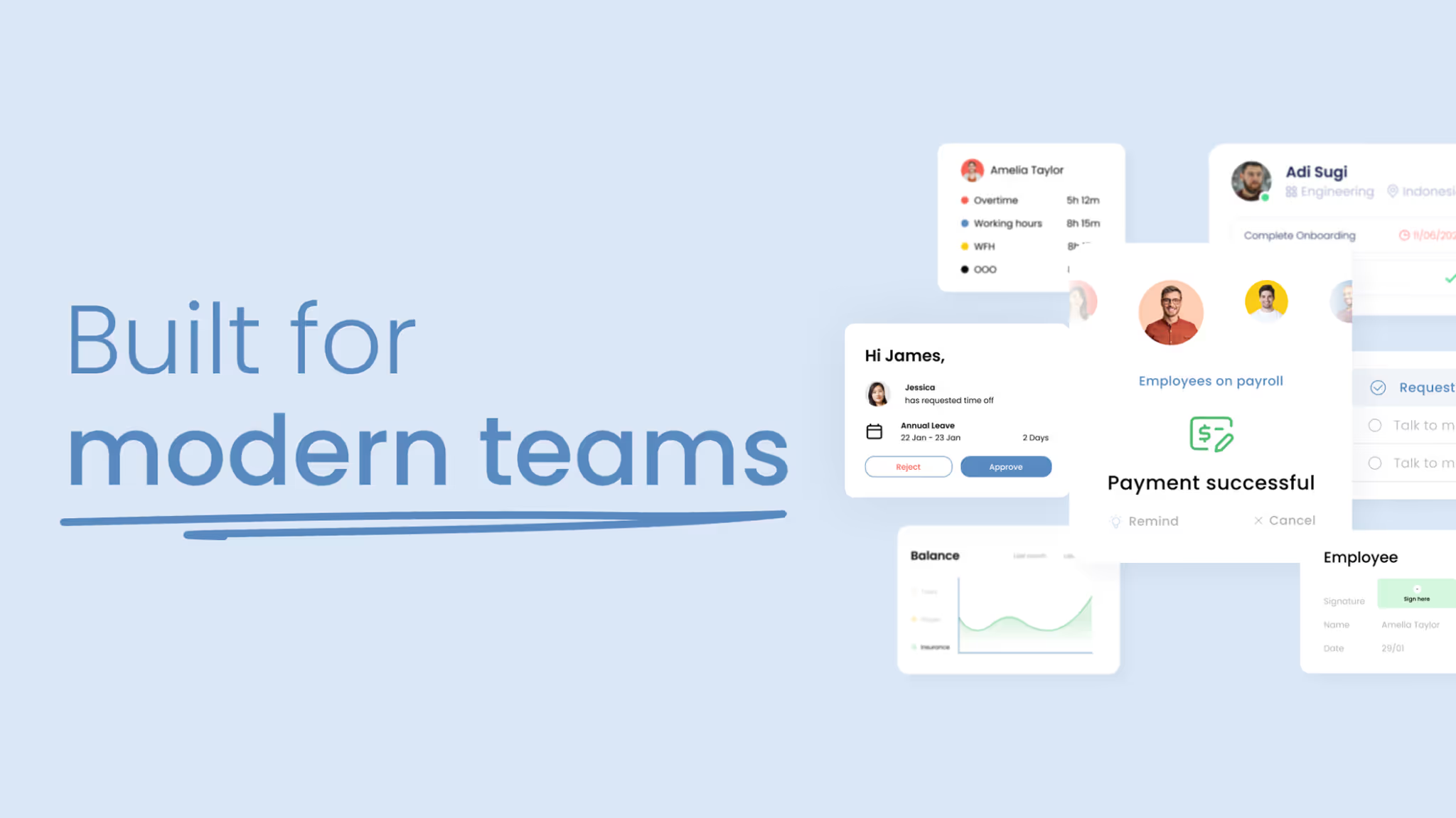
By bringing policies, records, approvals, and employee communications into a single system, HR teams can better manage internal dispute processes, from initial reporting and documentation to mediation tracking and final resolution review, in a way that supports transparency and accountability without increasing administrative burden. Book a demo with our team today to learn more.
Frequently Asked Questions
The Workplace Fairness Act 2025 is Singapore's first legally binding anti-discrimination law for the workplace. Passed through two bills in January and November 2025, it prohibits adverse employment decisions based on 11 protected characteristics — including age, race, nationality, pregnancy, disability, and mental health condition — and mandates formal grievance-handling processes for employers with 25 or more employees. The Act is expected to come into force by end-2027.
The WFA is confirmed to come into force by end-2027, as stated by Manpower Minister Tan See Leng in November 2025. This is slightly later than the initial 2026-2027 estimate, reflecting employer feedback that additional preparation time is needed. The TGFEP continues to apply in the meantime.
The mandatory grievance-handling requirement under Section 27 applies to employers with 25 or more employees. The substantive anti-discrimination provisions apply to all employers. Employers with fewer than 25 employees are encouraged to prepare now, as the exemption threshold is subject to review within five years of the Act coming into force.
The WFA covers 11 protected characteristics: age, nationality, sex, marital status, pregnancy, caregiving responsibilities, race, religion, language ability, disability, and mental health condition. These cannot form the basis of adverse employment decisions at any stage of the employment lifecycle.
Resolution follows three mandatory tiers: internal grievance handling, mediation, and — if both fail — formal adjudication. Claims up to SGD 250,000 go to the Employment Claims Tribunals (ECT), which holds all proceedings in private. Claims above SGD 250,000 proceed to the High Court. Filing deadlines are 1 month for pre- or end-of-employment claims and 6 months for in-employment claims.
No — they are distinct frameworks that complement each other. The TGFEP are non-binding guidelines enforced through work pass restrictions and MOM investigations. The WFA creates legally enforceable obligations and gives employees the right to bring direct civil claims. The TGFEP remains in force until the WFA takes effect and continues to cover broader fair employment expectations beyond the WFA's 11 protected characteristics.
TAFEP's Employer Advisory Service transitioned to the Singapore National Employers Federation (SNEF) on 1 April 2026. SNEF now handles employer advisory services on fair employment practices for both members and non-members. TAFEP continues to receive and investigate complaints until the WFA comes into force.
.png)