















.png)
Summary. For CTOs and IT leaders evaluating HR software across Asia-Pacific, HR data security is no longer a secondary consideration, but a core infrastructure decision. Effective HRIS data management requires a platform that goes beyond basic compliance checkboxes, combining certified security standards, layered access controls, and enterprise-grade infrastructure to protect employee data at every stage of its lifecycle. Omni HR addresses this with ISO 27001 certification, AES-256 encryption, and a multi-jurisdictional compliance framework that spans Singapore, Malaysia, Thailand, Indonesia, Hong Kong, and more. With role-based access control, multi-factor authentication, continuous threat monitoring, and a documented incident response capability, the platform functions as a comprehensive HRIS safeguard that scales with your organisation across borders, without placing the operational burden of security management on your internal team.
When evaluating HR software, HR data security is more than a line item on the checklist, especially for CTOs and IT teams responsible for protecting sensitive employee information across multiple countries.
Payroll data, bank account details, identification numbers, and employment records are among the most valuable and regulated data an organisation holds. A breach does not just cost money; it erodes employee trust and can trigger regulatory action across every jurisdiction you operate in.
Sound HRIS data management means more than storing records in a cloud database. It means having the certifications, infrastructure, access controls, and incident-response capabilities to protect that data throughout the employee lifecycle. Getting HR data security right from the start is far less costly than responding to a breach after the fact.
This guide answers the security questions that technical decision-makers ask most often when evaluating an HRIS for Asia-Pacific operations.
What security certifications does Omni HR hold?
For any team serious about HR data security, certifications matter because they replace vendor self-assessment with independent verification.
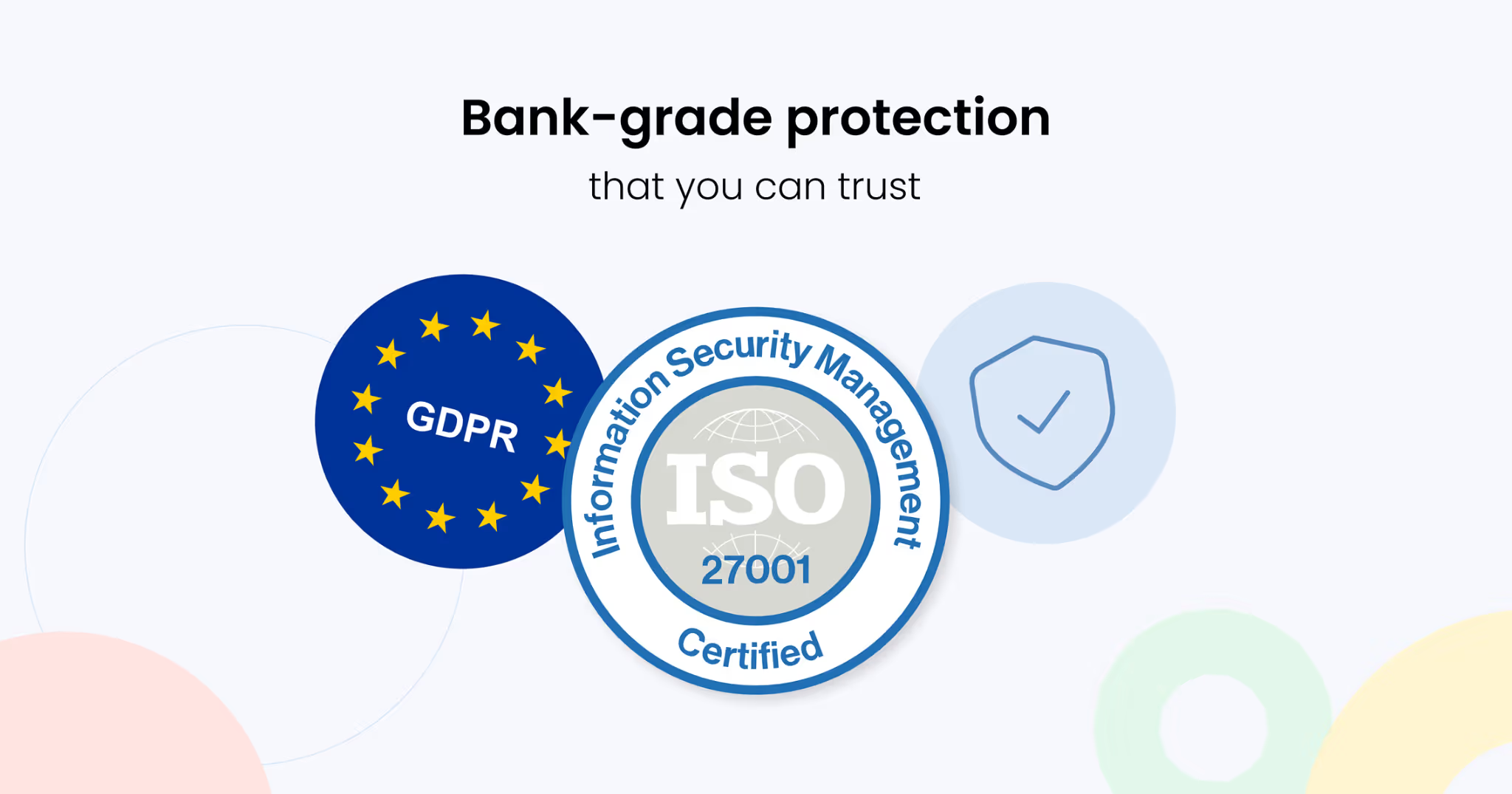
Omni HR holds two of the most widely recognised security certifications in enterprise software.
ISO 27001 is the international standard for information security management systems. It requires organisations to implement and maintain documented security controls across access management, risk assessment, incident response, and more — and to have those controls independently verified annually.
SOC 2 Type II goes a step further than many vendors offer. While a SOC 2 Type I report assesses whether controls are well-designed at a point in time, Type II evaluates whether those controls have been operating effectively over an extended period.
In addition, penetration testing is conducted twice yearly by external firms, with the most recent test completed in Q4 2025.
How is employee data encrypted?
Omni HR applies encryption at every stage of the data lifecycle, a foundational component of how our platform acts as an HRIS safeguard for sensitive employee records.
At rest, all employee data is encrypted using AES-256, implemented through AWS RDS and AWS Key Management Service (KMS). This means data stored in databases is unreadable without the corresponding encryption keys, even if the underlying storage were somehow accessed.
In transit, all application traffic is protected using TLS 1.2 or higher. This applies to data moving between users and Omni HR's servers, as well as traffic between internal services.
Key management is handled through AWS KMS, with automated key rotation, restricted access controls, and a full audit log of all key management activity. Encryption keys are stored separately from the data they protect, which limits the blast radius of any hypothetical compromise.
Where is employee data physically stored?
Omni HR is hosted on AWS, where physical security at these facilities includes 24/7 surveillance, biometric access controls, redundant power and cooling systems, and on-site security personnel, all managed and independently certified by AWS under ISO 27001, SOC 2, and FedRAMP.
For organisations with data residency requirements beyond Singapore, whether due to regulatory obligations or internal policy, on-premise and alternate region deployments are available on a case-by-case basis.
What cloud infrastructure and security tooling does Omni HR use?
Our platform's security posture is built on a combination of AWS-native and enterprise-grade third-party security services covering:
- Threat detection: Behaviour-based monitoring that continuously analyses activity for malicious patterns, compromised credentials, and anomalous API usage, including malware scanning on uploaded files.
- Audit logging: Immutable logs of all infrastructure and application actions, retained and accessible for security investigations and compliance audits.
- Real-time monitoring and alerting: Continuous health and security metrics with automated alerting to on-call engineers.
- Encryption key management: Automated key rotation with restricted access and full logging of all key operations.
- Network isolation: Separate environments for development, staging, and production, each with independent access controls.
Vulnerability scanning runs continuously across application, operating system, and network layers. Our platform is deployed across multiple availability zones with automated failover, meaning there is no single point of failure at the database layer.
How does Omni HR control who can access employee data?
Effective HRIS data management depends on more than encrypting data — it requires controlling precisely who can see and act on it. Access control in Omni HR is enforced through several layers that IT teams can configure to match their organisation's structure and risk profile.
Role-Based Access Control (RBAC) applies the principle of least privilege across the entire platform. Organisations can define custom roles — for example, giving regional HR managers access only to employees in their geography, or granting compliance officers read-only access to specific modules. As reporting lines change, access permissions update to reflect the current organisational structure.
Multi-Factor Authentication (MFA) is supported via mobile and email OTP, with mandatory enforcement configurable at the organisation level. Administrators can require MFA across all users or target it to specific roles.
Single Sign-On (SSO) integrations are available for Okta, Microsoft Entra ID, and Google Workspace, allowing organisations to manage authentication centrally through their existing identity provider and apply their existing security policies without friction.
Additional controls include IP allowlisting (restricting access to approved networks or VPN ranges) and configurable session timeouts.
What audit logging and monitoring are in place?
Every interaction with employee data is logged — capturing user identity, action taken, and timestamp. These logs are a critical part of HR data security, giving organisations the visibility needed to detect misuse and demonstrate compliance. Logs are retained for a defined period in line with regulatory requirements, access is restricted to authorized personnel, and exports are available on request.
Activity monitoring runs continuously to detect anomalies such as unusual access times, bulk data exports, or access patterns consistent with insider threats. Administrators receive alerts for suspicious activity, and the audit trail is available to support internal investigations or regulatory inquiries.
Which data protection regulations does Omni HR comply with?
For organisations operating across Asia-Pacific, the compliance picture is complex. GDPR and HR systems were historically treated as a European concern, but as Southeast Asian regulators have modernised their data protection frameworks, many of them modelled on GDPR principles. Organisations now face overlapping obligations across multiple jurisdictions simultaneously. Strong HRIS data management practices are what make it possible to stay compliant as you scale across borders.
Omni HR is built to support compliance across all of these:
For companies with European operations or employees, GDPR and HR systems compliance is supported through data minimisation controls, data subject rights tooling, lawful basis management, and Standard Contractual Clauses for cross-border transfers. Custom Data Processing Agreements (DPAs) are available on request for organisations that require them as part of their vendor onboarding process.
How is data secured during migration from a legacy system?
Data migration is one of the most overlooked HR data security risks in any HRIS implementation, as data that is normally tightly controlled must temporarily move between systems. A robust HRIS safeguard strategy must account for this transition period, not just steady-state operations.
Omni HR addresses this through several controls:
- All data transfers use encrypted channels (TLS).
- Password-protected files are used where necessary during file-based transfers.
- Migration access is restricted to authorised implementation personnel and fully logged throughout the process.
- Once migration is complete, all temporary access is immediately and permanently revoked.
- For payroll customers, year-to-date and last-12-month payroll re-runs are conducted during migration to verify data accuracy before go-live.
Learn more: How Omni HRIS Securely Migrates Your Employee Data
What happens if there is a security incident?
Omni HR maintains a documented incident response plan with a Computer Emergency Response Team (CERT) in place — a key component of any credible HRIS safeguard framework. Automated monitoring detects potential incidents in real time, triggering immediate escalation to on-call engineers.
When an incident occurs, the process covers: containment of affected systems, investigation of scope and root cause, remediation and patching, and customer notification through a formal process with defined roles and responsibilities. Post-incident reviews are conducted for all significant security events, with findings used to improve controls.
On the recovery side, customer data can be retrieved and restored following data loss incidents. Failover is automated, maintaining the same security posture in disaster recovery mode.
What are our responsibilities as an organisation using Omni HR?
Security is a shared model. Omni HR secures the platform infrastructure, application, and data — but sound HRIS data management also requires organisations to maintain controls on their side:
- User access management: who is granted access, what roles and permissions they are assigned, and when access is revoked (for example, when an employee leaves).
- Authentication configuration: enabling and enforcing MFA, managing SSO integration settings.
- Employee security hygiene: ensuring users follow strong password practices, recognise phishing attempts, and report compromised credentials promptly.
- Data governance decisions: what employee data is collected, how long it is retained, and when it should be deleted.
How can we verify Omni HR's security claims before signing?
At Omni, we understand that enterprise procurement requires more than just taking our word for it. Security verification is handled on a case-by-case basis, depending on the nature of your organization’s requirements and the stage of evaluation.
For organizations conducting formal due diligence, our team works directly with your technical or compliance team to provide the appropriate level of documentation and transparency.
For CTOs and IT teams evaluating HRIS platforms, the HR data security fundamentals to look for are consistent: strong encryption, certified infrastructure, granular access controls, multi-jurisdictional compliance including GDPR, HR systems readiness, independent audits, and a credible incident response capability. Omni HR acts as a comprehensive HRIS safeguard across all of these dimensions, with the documentation to back it up.
To discuss your organization’s specific security requirements or request compliance documentation, book a demo with our team today.



.avif)
.avif)