.png)
Summary. The best employer of record for enterprise depends on where you're hiring. For multinational teams expanding across Asia-Pacific, Omni HR leads on country-level compliance depth across 10 APAC markets. For global-first teams, Deel and Remote offer the broadest coverage. This guide compares six enterprise EOR solutions across five criteria, including coverage, APAC compliance, HRIS integration, support model, and data security, with verified 2026 pricing, an EOR vs. entity decision framework, and a full FAQ.
An employer of record (EOR) for enterprise is a third-party organisation that legally employs workers on behalf of a large company in countries where that company doesn't have a registered entity — handling employment contracts, payroll, statutory contributions, and compliance while you retain full control over the actual work. See our guide for a full breakdown of how an EOR works and its pros and cons.
For large companies and multinational teams, choosing the right employer of record is more complex than it appears. Volume, compliance rigour, HRIS integration, and market-specific depth vary significantly between providers, and the wrong choice creates compliance exposure that compounds at scale.
The best enterprise EOR provider depends on where you're hiring. For companies expanding across Asia-Pacific, the depth of country-level compliance knowledge matters more than global headcount. For global-first teams, breadth of coverage and platform integrations take priority. This guide breaks down the leading enterprise EOR solutions for 2026 and beyond so you can make an informed decision.
Note: Omni HR is included in the list — we built this comparison, and we hold ourselves to the same criteria as every other provider on the list.
How We Evaluate the Best Enterprise EOR Provider
We assessed each provider across five criteria that matter specifically to large companies and multinational teams:
Comparison Table: Enterprise EOR Solutions
*Pricing reflects published rates as of June 2026. EOR pricing can vary by country and headcount - confirm directly with each provider before budgeting.
The Best Enterprise EOR Providers in 2026
1. Omni HR — Best EOR for Enterprise Teams in Asia-Pacific
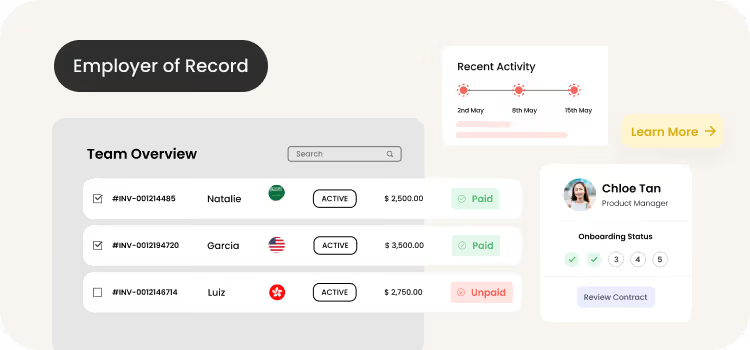
Omni HR is an APAC-native HR and EOR platform built specifically for large companies and multinational teams hiring across Asia. Where global generalists treat Asia as one of many regions, Omni is localised at the country level, with dedicated compliance logic, statutory calculation engines, and payroll rules built in for each market.
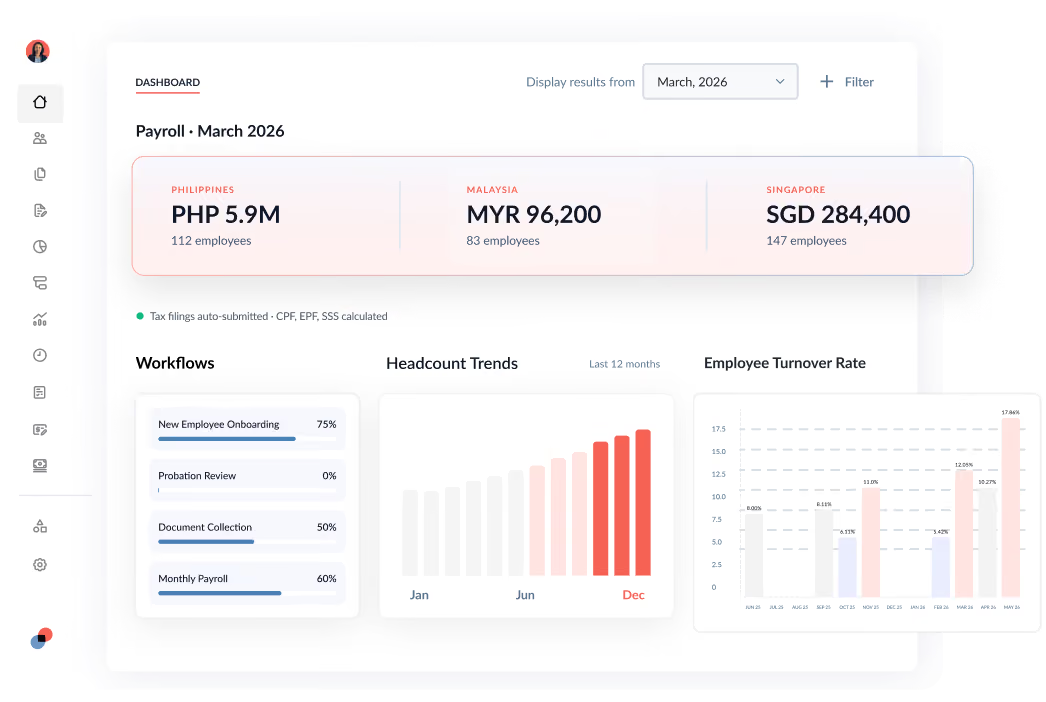
This makes Omni one of the best enterprise EOR solutions for companies where the Asia-Pacific region is a primary or growing hiring market. See how we compare across 12 providers in our best EOR services for APAC teams guide.
Coverage: Singapore, Malaysia, Philippines, Indonesia, Hong Kong, Thailand, Vietnam, China, Taiwan, and Australia
Enterprise strengths:
- Automated payroll with statutory contributions calculated correctly per market: CPF (Singapore), EPF and SOCSO (Malaysia), SSS, PhilHealth, and Pag-IBIG (Philippines)
- Mino, Omni's AI agent, is schema-aware: it queries your workforce data structure directly rather than transmitting raw employee records to a third-party model, a meaningful distinction for enterprise teams operating under PDPA and other regional data privacy laws
- Full HRIS is included in the platform, so enterprise teams can manage EOR, payroll, leave, and people data in one place without separate integrations
- ISO 27001-certified and SOC 2 Type II compliant; infrastructure hosted on AWS in Singapore for APAC data residency assurance
- Proven enterprise outcomes: SleekFlow achieved a 40% reduction in payroll processing time; Lucence cut payroll processing time by 50%
Where to watch: As Omni’s focus is on APAC, enterprise teams with significant headcount in Europe or the Americas may find limitations.
Best fit: Enterprise and multinational teams where Asia-Pacific is a core hiring market and compliance accuracy at the country level is non-negotiable.
2. Deel — Best Enterprise EOR for Global-First Teams
Deel is one of the largest EOR platforms by country coverage, operating across 150+ countries through a mix of owned entities and local partners.
Enterprise strengths:
- Strong API and native integrations with enterprise HRIS platforms
- Dedicated enterprise account team and in-house legal review support
- Handles equity, expenses, and off-cycle payroll well at scale
Where to watch: In APAC specifically, Deel operates through local partners in several markets, which can create compliance variability.
Best fit: Large companies with distributed global headcount where the majority of hiring sits outside Asia-Pacific.
3. Remote — Best Enterprise EOR for Compliance-Rigorous Teams
Remote has invested in building owned legal entities in every country they operate in. For enterprise compliance teams, this distinction matters: Remote is directly liable for employer obligations, not passing that liability downstream to a third party.
Enterprise strengths:
- Owned entities model across all 90+ supported markets
- IP protection clause is included as standard in all employment agreements
- GDPR-compliant with strong data privacy architecture; clear data residency documentation
Where to watch: The platform is designed for simplicity — enterprise teams needing deep customisation or advanced reporting may find it limiting. APAC coverage is solid but less comprehensive than that of APAC-specialist providers.
Best fit: Enterprise teams in privacy-sensitive industries (fintech, healthtech, legal) that need documented, contractual clarity on who is legally responsible for employment in every country.
4. Pebl — Best Enterprise EOR for High-Touch Accounts
Velocity Global rebranded as Pebl in September 2025, repositioning as an AI-first global hiring platform across 185+ countries. Their reputation for personalised service and strong compliance rigour across complex markets remains intact. Their model is more service-heavy than self-serve, which suits enterprise HR teams that want a hands-on partner rather than a software-first tool.
Enterprise strengths:
- High-touch account management with named contacts and in-country language support
- Strong compliance track record across difficult jurisdictions in 185+ countries
- Flexible immigration, visa, and relocation support alongside EOR services
- Well-suited to senior or specialised hires requiring bespoke employment arrangements
Where to watch: Pricing is not fully published — the standard rate is approximately $399/month per employee, with add-ons for visa support, HR consultations, and expense management that can add significantly to the total cost. Fewer native HRIS integrations than platform-first providers.
Best fit: Enterprise teams making high-value hires in complex markets where white-glove service and immigration support justify the pricing model.
5. Rippling — Best Enterprise EOR for US-Headquartered Teams
Rippling is a workforce management platform that includes EOR as part of a broader suite covering HRIS, payroll, IT, and benefits. For large companies already using Rippling for domestic HR, adding international EOR through the same platform removes significant operational friction.
Enterprise strengths:
- Single platform for domestic HR and international EOR — strong value for US-headquartered enterprise teams
- Strong automation for onboarding, offboarding, and device management
- 650+ native app integrations — deepest library of any provider in this comparison
- Good depth in the US, UK, Canada, and Western Europe markets
Where to watch: APAC compliance depth in Southeast Asia is less proven than in North America and Europe. Less suitable as a standalone EOR if Rippling isn't already your HRIS.
Best fit: US-headquartered enterprise companies expanding into 3–5 international markets where Rippling already manages domestic HR operations.
6. Papaya Global — Best Enterprise EOR for Payroll Consolidation
Papaya Global positions itself as a global workforce platform with particular strength in consolidated payroll reporting. Enterprise HR and finance teams managing headcount across 20+ countries often struggle with fragmented payroll data — Papaya's analytics-first approach is designed to centralise visibility across all markets.
Enterprise strengths:
- Global payroll consolidation across 160+ countries with real-time analytics dashboards
- Strong financial reporting for enterprise finance teams managing multi-currency payroll spend
- Payments infrastructure supporting multi-currency payroll in a single run
- Useful for large companies that need payroll as a managed service alongside EOR
Where to watch: Platform UI has historically lagged behind competitors. Compliance depth in Southeast Asia has been flagged as an area of ongoing development.
Best fit: Large enterprises where consolidated payroll analytics and multi-currency financial reporting are the primary requirements alongside EOR services.
How Enterprise EOR Needs Differ From Standard EOR
Standard EOR platforms are built for companies hiring one or two people in a new country. EOR for large companies requires significantly more:
- Volume and automation: Hiring 20+ people across 5+ countries simultaneously demands workflow automation, not manual processing per hire. Enterprise EOR solutions need to handle this without breaking.
- Compliance at scale: Statutory filings, benefits parity, and termination protocols must work correctly across every jurisdiction, including those that receive less attention from global-first providers.
- HRIS integration: Enterprise HR teams need EOR data to flow into their existing systems (Workday, SAP, SuccessFactors, or a dedicated HRIS such as Omni HR) without manual re-entry or reconciliation. Read more on managing multi-country HR operations across APAC.
- Dedicated support: When a payroll issue surfaces at 5 pm in Singapore, and your team is in Amsterdam, email ticketing is not enough. Enterprise EOR solutions need named account contacts and documented SLAs.
- Audit trails: Enterprise legal and finance teams require compliant documentation, entity-level reporting, and data residency clarity, particularly in markets with strict data protection laws like Singapore's PDPA and the EU's GDPR.
EOR vs. Setting Up a Foreign Entity
A common question for enterprise teams: at what point does it make more sense to establish a local entity rather than continue with an EOR? Here's a practical framework. For a step-by-step walkthrough of the decision, see our guide to expanding globally with an EOR.
The right enterprise EOR provider for large companies is one that also supports eventual entity setup, whether that’s through advisory services or a clear transition path when the time comes.
What Enterprise Teams Should Ask Before Signing
Most EOR demos focus on the easy questions. These are the ones that reveal whether a provider can actually handle enterprise-scale complexity:
1. Do you operate through owned entities or local partners in [specific country]?
This determines who is legally liable if something goes wrong. A local partner network introduces an accountability layer that enterprise compliance teams should understand contractually before signing.
2. What is your SLA for payroll corrections in [country]?
Off-cycle corrections are inevitable for large companies running EOR at scale. Knowing how quickly a provider can correct an error and who owns that process matters more than knowing how many countries they cover.
3. How does your platform integrate with our HRIS or ERP?
Ask to see integration documentation, not just confirmation that it exists. Native integrations behave differently from webhook-based workarounds, and the difference matters when you're running payroll across 10+ countries.
4. Where is employee data stored, and what data residency options exist?
For enterprise teams subject to GDPR, Singapore's PDPA, or other data residency requirements, this should be documented and contractually guaranteed instead of a verbal assurance during the sales process.
5. What does your offboarding process look like in [country]?
Termination compliance is where EOR providers most often fall short. Ask for a sample process walk-through in a specific market, especially one with complex notice or severance requirements like Indonesia or the Philippines.
For APAC-focused enterprise teams, Omni HR provides documented compliance workflows for all 10 supported markets built into the platform.
APAC Enterprise EOR: Why It Requires Specialist Knowledge
Employer of record services for multinational teams operating in Asia-Pacific face a layer of complexity that global-first providers frequently underestimate. Asia-Pacific is not a single market — it's distinct compliance environments, each with its own employment law, statutory contribution schemes, and regulatory bodies.
Here's what makes APAC different for enterprise EOR:
Statutory contributions vary significantly by market
- Singapore: employers contribute to the Central Provident Fund (CPF)
- Malaysia: EPF (Employees Provident Fund) and SOCSO (Social Security Organisation)
- Philippines: SSS (Social Security System), PhilHealth, and Pag-IBIG
Each scheme has different rates, caps, and filing timelines that must be calculated correctly for every payroll run. An enterprise EOR solution that handles these accurately across all markets removes a significant source of compliance risk.
Employment law differs at the country level
- Singapore's Employment Act was significantly amended in 2019
- Malaysia's Employment Act 1955 underwent major updates in 2022
- The Philippines Labor Code mandates 13th-month pay, night differential, and rest day entitlements regardless of company size
Regional generalisations don't hold up at the compliance level — and for large companies, an error in any one market creates downstream risk across the whole operation.
Filing deadlines are non-negotiable
- Missing a statutory filing deadline triggers penalties and interest in every APAC market
- In some jurisdictions, non-compliance creates personal liability for company directors
- Regulatory requirements update frequently — providers need active compliance monitoring, not static rule sets
Multinational teams need an employer of record that treats APAC compliance as a primary capability, not a regional extension of a global platform. For a deeper look at what global payroll compliance involves across multiple jurisdictions, see our full guide.
Best EOR for Enterprise: Our Verdict
For enterprise teams hiring primarily in Europe or the Americas, Deel, Remote, and Pebl (formerly Velocity Global) each offer strong coverage for different priorities. For US-headquartered companies that want EOR inside their existing HR platform, Rippling is worth evaluating. For large companies where consolidated payroll analytics is the priority, Papaya Global has the deepest reporting capability.
For enterprise and multinational teams where Asia-Pacific is a core or growing market, the calculus is different. The best enterprise EOR provider for APAC is one with country-level compliance depth, owned entities, and a platform built for the region — not a global tool with Asia as an afterthought.
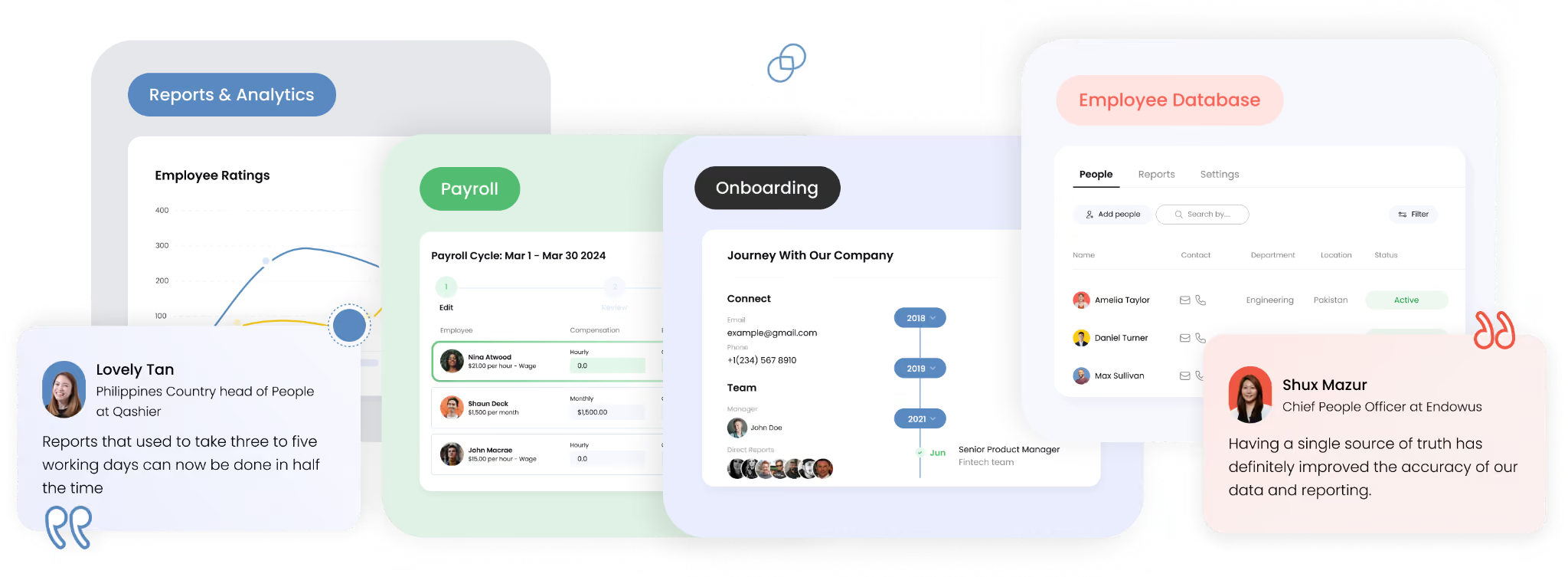
Omni HR was built specifically for this complexity:
- Statutory contributions across all 10 APAC markets are calculated automatically, with zero manual intervention required
- Mino, Omni's AI agent, gives enterprise teams schema-aware workforce analytics without transmitting raw employee records to a third-party model, a meaningful distinction for teams operating under PDPA and other regional data privacy regulations
- Every enterprise account gets a dedicated Customer Success Manager with in-timezone APAC support, not a shared ticket queue
- Employee data is hosted on AWS Singapore, with ISO 27001 certification and SOC 2 Type II compliance providing enterprise-grade security and data residency assurance across the region
- A single dashboard gives enterprise teams full visibility across their entire APAC headcount, whether they have 10 employees in one market or 200 across six markets
If you're scaling enterprise headcount across Singapore, Malaysia, the Philippines, Indonesia, or any other APAC market, book a demo with our team to see how we handle it in practice.
Frequently Asked Questions
An employer of record (EOR) for enterprise is a third-party organisation that legally employs workers on behalf of a large company in countries where it doesn't have a registered entity. The EOR handles employment contracts, payroll, statutory contributions, tax filings, and local compliance while the enterprise retains full control over day-to-day work.
It depends on where you're hiring. For multinational teams in Europe and the Americas, Deel and Remote offer the broadest coverage. For enterprise teams where Asia-Pacific is a core market, Omni HR offers owned entities and country-level compliance across 10 APAC markets, outperforming global generalists on accuracy and support. See our top EOR providers in Asia guide for the full comparison.
Most enterprise EOR providers charge around $599 per employee per month at list price. Papaya Global sits higher at $650–$770/month. At volume, Deel can reach $350–$400/month at 50+ employees on a multi-year contract, and Remote's floor is approximately $500/month. These are platform fees only. Statutory employer contributions add 15–40% on top of gross salary, depending on the market. Always request a fully loaded cost breakdown.
A PEO co-employs workers but requires a registered legal entity in that country. An EOR acts as the sole legal employer, so large companies can hire in markets where they have no entity. For international expansion, EOR is the right structure. See our EOR vs PEO comparison for a full breakdown.
For fewer than 20–30 employees in a new market, EOR is typically faster and more cost-effective. Entity setup costs run $20,000–$100,000+ per market. Beyond that threshold, a local entity may offer more control and lower per-employee costs in the long term. The right EOR provider will support that transition when the time comes.
Five dimensions matter most:
- Country coverage depth (owned entities vs. partner networks)
- Compliance accuracy in target markets
- HRIS and ERP integration quality
- Dedicated enterprise support with documented SLAs
- Data security standards (ISO 27001, SOC 2 Type II)
For APAC-focused teams, country-level compliance specificity is the most important differentiator between providers.