Best Payroll Services Providers in Malaysia

10
min Read
10
min Read
Save this article for future use
Download PDF

Summary. Payroll services in Malaysia play a critical role in helping businesses manage payroll accurately while staying compliant with the Employment Act 1955 and statutory requirements from LHDN, EPF, SOCSO, EIS, and HRD Corp. As headcount grows and payroll structures become more complex, many companies turn to payroll outsourcing services to reduce compliance risk, eliminate manual errors, and free up internal HR resources. Payroll outsourcing Malaysia providers handle salary calculations, statutory submissions, year-end EA forms, reporting, and audit support, offering both managed payroll services and software-led solutions. Leading providers such as Omni HR combine integrated HR automation with flexible options to manage payroll in-house or outsource payroll services Malaysia, enabling scalable, compliant payroll operations that support business growth.

For any business operating in Malaysia, payroll can be a high-stakes compliance exercise. Between the intricacies of the Employment Act 1955 and the rigorous requirements of statutory bodies like the Inland Revenue Board (LHDN) and the Employees Provident Fund (EPF), the margin for error is razor-thin.

As companies scale, the complexity of managing payroll internally often outpaces the capacity of a generalist HR team. This is why many organizations are turning to payroll outsourcing services. By partnering with a specialist, businesses can ensure total compliance while freeing up internal resources for strategic growth.

In this guide, we evaluate the best payroll services providers in Malaysia to help you make an informed decision for your organization.

What do payroll services in Malaysia typically cover?

At its core, payroll services (or payroll outsourcing) involve delegating the entire administrative and compliance-related function of paying employees to a third-party expert.

In Malaysia, this is a managed service. Unlike a simple software subscription where you still press the buttons, a payroll outsourcing Malaysia partner takes full responsibility for the calculations, statutory filings, and disbursements. They act as your extended payroll department, ensuring that every cent is accounted for and every deadline is met.

When you outsource payroll services in Malaysia, the scope of work is comprehensive. A high-quality provider should manage the following end-to-end:

  • Salary & allowance calculations: Processing basic pay, overtime (calculated according to Employment Act standards), bonuses, and various allowances (fixed vs. variable).
  • Statutory deductions & submissions: Automating and filing monthly contributions for EPF, SOCSO, EIS, and PCB. This includes generating the necessary text files for bank uploads.
  • HRDF management: Monitoring headcount and ensuring the 1% levy is accurately calculated and paid for eligible employers.
  • Secure payslip generation: Providing employees with secure, digital access to their monthly payslips (often via a mobile app or self-service portal).
  • Monthly reporting: Detailed payroll registers, variance reports, and departmental cost breakdowns for the finance team.
  • Year-end support: The heavy lifting of payroll, generating EA forms for employees, and assisting with the company’s E-Form (CP8D) submission to LHDN.

Payroll software vs. managed payroll services

It is important to distinguish between the two. Payroll software is a tool you use yourself. Managed payroll services include the tool plus the human expertise to run it for you. Outsourcing provides a level of accountability and peace of mind that software alone cannot offer.

Who should consider payroll outsourcing in Malaysia?

Choosing to outsource payroll services in Malaysia is often a turning point for a business. This decision validation section helps you identify if your organization is at the stage where managed services provide the highest ROI.

Payroll outsourcing is best suited for:

  • SMEs without in-house payroll specialists: Small to medium enterprises often rely on generalist HR staff or office managers to handle payroll. Without a dedicated specialist who understands the nuances of the Employment Act and LHDN tax brackets, the risk of accidental non-compliance is high.
  • Growing companies managing increasing headcount: As you scale from 20 to 100+ employees, the administrative burden of payroll grows exponentially. Outsourcing allows your team to focus on talent acquisition and culture rather than on monthly data entry and filing.
  • Businesses struggling with payroll errors or compliance risks: If your current process results in late statutory submissions, incorrect PCB calculations, or constant "firefighting" during audit season, moving to a professional payroll outsourcing Malaysia partner eliminates these operational headaches.
  • Organisations with multiple entities or complex pay structures: Managing different pay cycles, varying commission structures, and multiple employer codes across different subsidiaries requires a high degree of technical oversight that managed services are built to provide.
  • Companies planning regional or cross-border expansion: If you are expanding your footprint beyond Malaysia or entering the local market from abroad, a partner with local statutory expertise is essential to ensure your new entity meets all Malaysian legal requirements from day one.

Top Payroll Services Providers in Malaysia

Based on technology, local expertise, and scalability, here are the top contenders for your payroll needs:

Omni HR

Automated statutory compliance for Malaysia

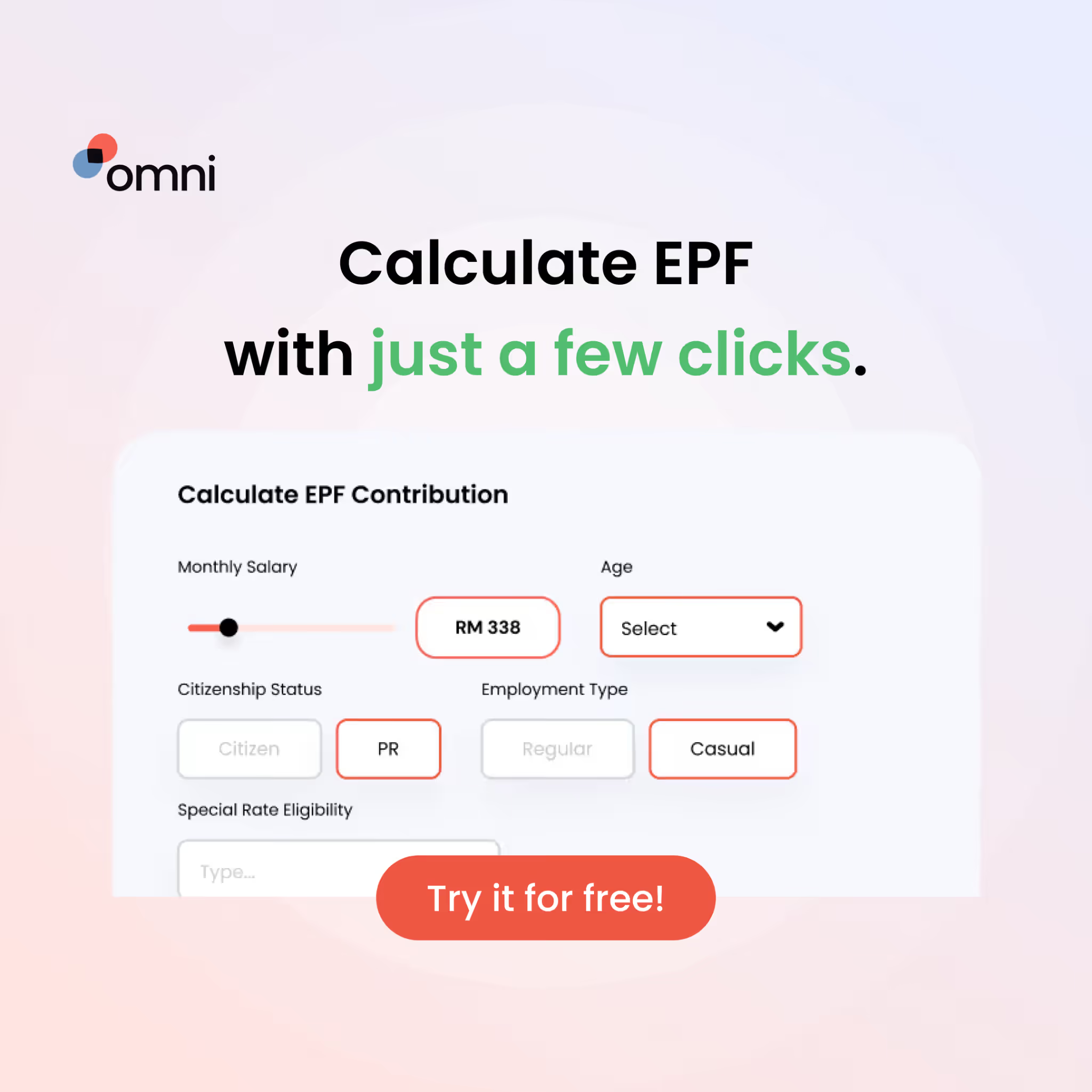
Omni HR delivers end-to-end payroll services for Malaysian businesses navigating complex statutory requirements. From EPF, SOCSO, EIS, and PCB submissions, Omni HR automates calculations and ensures every payroll run aligns with the latest regulatory updates from LHDN, HRD Corp, and other statutory bodies.

For companies looking to manage payroll internally with confidence, Omni HR reduces compliance risk while maintaining full transparency and control. 
payroll service

Integrated payroll & HR data to reduce errors

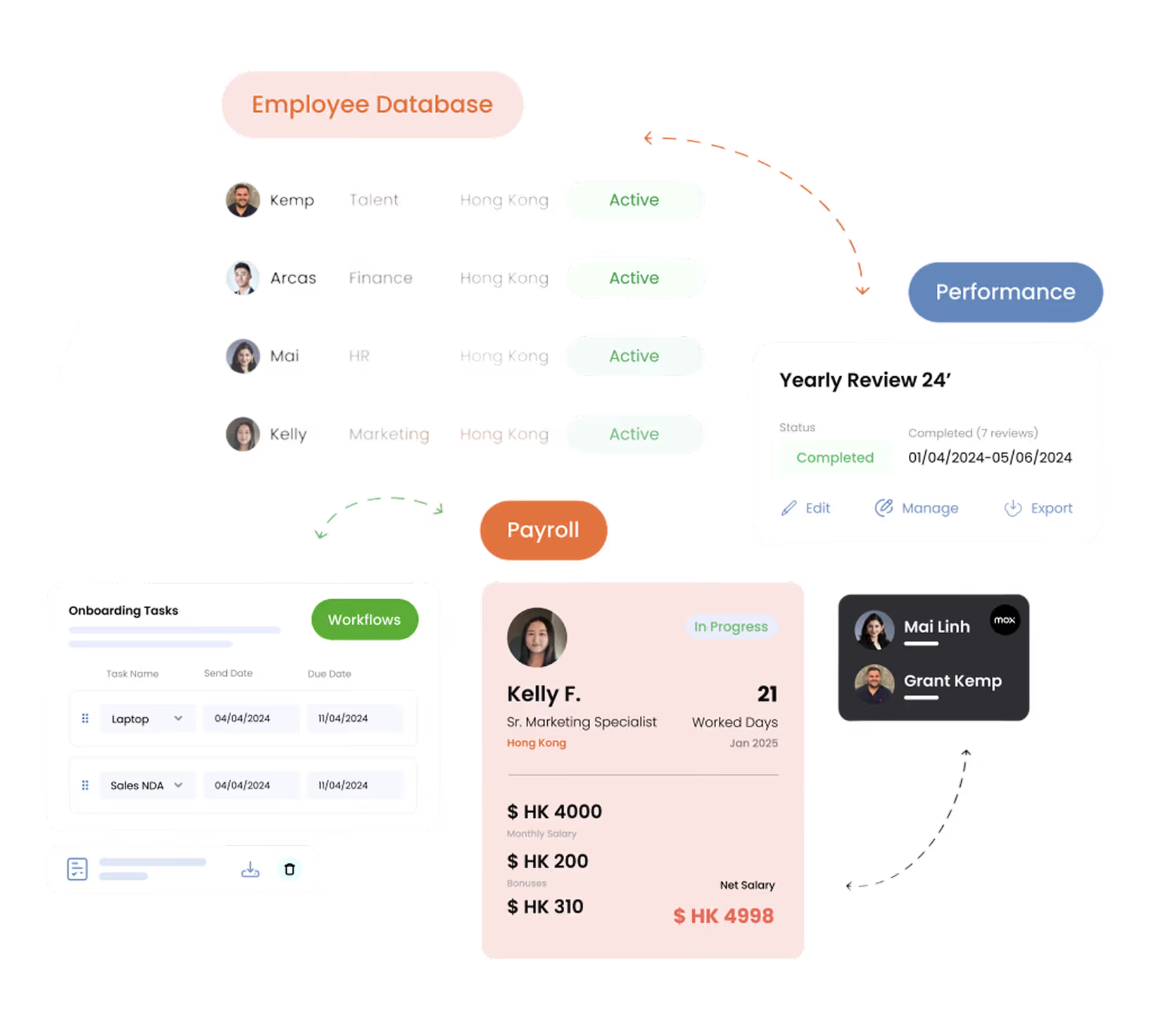
Unlike standalone legacy tools, Omni connects payroll directly with other modules like attendance, leave, claims, and employee records within a unified platform. This removes duplicate data entry and significantly reduces payroll discrepancies caused by manual adjustments. 
manage payroll

For Malaysian HR teams considering payroll outsourcing services, Omni offers the reliability of managed workflows while retaining internal visibility over every calculation and submission. 

Manage in-house or outsource payroll services Malaysia

Omni supports both self-managed payroll and fully managed payroll outsourcing Malaysia models. 

Businesses that prefer to retain control can run payroll independently using built-in compliance safeguards. Meanwhile, companies that choose to outsource payroll services Malaysia can rely on our team of payroll specialists to handle calculations, statutory filings, and reporting, significantly reducing administrative burden while ensuring compliance. 

This flexibility makes Omni a strong option for both growing, modern teams and global organizations. 

Best for: 

  • Businesses without a dedicated payroll team
  • Growing companies scaling beyond 50-100 employees
  • Organizations seeking payroll outsourcing services with Malaysian statutory expertise
  • Multi-entity businesses managing complex payroll structures
  • Companies expanding regionally but requiring strong local compliance

Key strength: 

  • Omni HR combines compliant Malaysian payroll services, integrated HR automation, and optional payroll outsourcing Malaysia support within a single platform. 
  • Rather than choosing between software and outsourcing, businesses gain the flexibility to manage payroll internally or outsource payroll services Malaysia as complexity grows. 

CentralHR

CentralHR focuses heavily on the managed aspect of payroll for businesses that value support and hands-on service delivery.

Best for: 

  • Traditional enterprises requiring robust, localized support. 
  • Businesses that prefer a high-touch, fully managed payroll model
  • Organizations seeking a provider with a long-standing reputation in the Malaysian market

Key strength: Deep familiarity with Malaysian labor laws and local HR practices, supported by a model designed for enterprises that prioritize relationship-based payroll management. 

Quick HR

Quick HR offers a streamlined approach to payroll. While they operate regionally, their Malaysian module is configured to meet local statutory requirements. 

Best for: 

  • Smaller businesses or startups with simple payroll needs. 
  • Companies looking for a straightforward, simplified payroll solution 
  • Organizations prioritizing ease of use and fast implementation

Key strength: User-friendly interface and quick setup, making it accessible for teams without dedicated payroll specialists. 

Mercans

Mercans provides global payroll solutions capable of managing payroll across multiple jurisdictions while centralizing reporting. 

Best for: 

  • Multinational corporations (MNCs) with regional footprints
  • Companies operating across Malaysia, Singapore, and Thailand
  • Organizations requiring consolidated cross-border payroll reporting

Key strength: Global reach and multi-currency support, making it suitable for enterprises with complex international payroll structures.

Provider Managed Payroll Service Availability Malaysian Statutory Compliance Coverage Technology & Reporting Capabilities Scalability (Multi-entity / Regional) Best-Fit Use Case
Omni HR Full managed service & self-service platform Complete (EPF, SOCSO, EIS, PCB, EA Forms) Cloud-native platform, automation-driven reporting, employee mobile app High: Handles multiple entities & cross-border teams Growth-oriented SMEs and tech-forward enterprises
CentralHR Full managed service Complete (Malaysia-focused statutory compliance) Traditional payroll system with structured reporting Moderate: Primarily domestic Malaysian entities Established local firms prioritizing personal service
Quick HR Primarily software-led (managed services limited or partner-based) Complete (Automated Malaysian statutory calculations) Core payroll & HR modules, standard reporting Moderate: Regional SME focus Small teams with simple payroll requirements
Mercans Full managed global payroll service Localized Malaysian compliance within the global framework Enterprise-grade global payroll dashboard and consolidated reporting High: Native support for multi-country footprints Large MNCs with complex regional payroll needs

How to Choose the Best Payroll Outsourcing Malaysia Partner

Statutory compliance expertise: Does the provider have a track record of handling LHDN and EPF audits? Ask them how they stay updated on budget changes (like the recent changes to SOCSO ceilings or tax bracket adjustments).

Technology support and reporting: These days, employees expect to view their payslips on their phones. Ensure the provider offers a secure employee self-service portal or app. This reduces the administrative burden of employees asking HR for past payslips during bank loan applications.

Scalability: Can the provider handle your growth? If you expand from a single office in KL to branches in Penang and Johor, or even overseas, your payroll partner should be able to scale with you without a total system overhaul.

Service model: Who is your point of contact? If there is a calculation error, how quickly is it rectified? A good partner takes ownership of mistakes and provides a clear Service Level Agreement (SLA).

Pricing and transparency: Watch out for "hidden" fees. Some providers charge extra for EA forms, implementation, or "off-cycle" payroll runs (e.g., for bonuses). Look for a clear, predictable pricing structure.

Common Payroll Outsourcing Mistakes to Avoid

Even with the best intentions, many businesses stumble when transitioning to outsource payroll services Malaysia. To ensure a smooth transition, avoid these critical mistakes:

Choosing providers without strong Malaysian statutory expertise

Some global firms treat Malaysia as a secondary market, using standardized templates that don't account for unique local requirements like the MTD (PCB) variations or the correct wage ceiling for SOCSO and EIS. Choosing a partner without local on-the-ground expertise is the fastest way to trigger an LHDN audit or receive penalties for late EPF submissions.

Confusing payroll software with managed payroll services

This is the most frequent misconception. Many vendors sell a SaaS platform that automates calculations, but you are still responsible for pressing "submit" and verifying the data. If you don't have a payroll expert on staff to oversee the software, you haven't truly mitigated your risk. A managed service provider is the expert who runs the tool for you.

Unclear service scope and accountability

Vague contracts lead to finger-pointing when errors occur. For example, if a bank file is rejected due to a wrong account number, is it the provider's job to fix it, or yours? Ensure your Service Level Agreement (SLA) explicitly defines who is responsible for data validation, correcting payment rejections, and answering employee tax queries.

Hidden fees for compliance or year-end support

Many providers lure businesses in with a low per-head monthly fee, only to charge significant surcharges for mandatory year-end tasks. This includes generating EA forms for every employee or assisting with the company's E-Form (CP8D) submission. Always ask for an all-inclusive price that covers monthly processing and statutory year-end requirements.

​Limited reporting and audit support

Payroll is a major line item on your balance sheet. If your provider cannot provide instant, customizable reports for your finance team (or if they take days to pull data for a simple internal audit), their technology is insufficient. You need a partner that offers real-time visibility into payroll variances, departmental costs, and contribution histories. 

End-to-End Payroll Support That Scales With You

Payroll in Malaysia is more than just paying salaries; it’s about ensuring compliance, protecting your reputation, and creating operational confidence as your team scales. From navigating the Employment Act to meeting submission requirements from LHDN and other statutory regulatory bodies, the stakes are too high for legacy systems or manual workarounds.

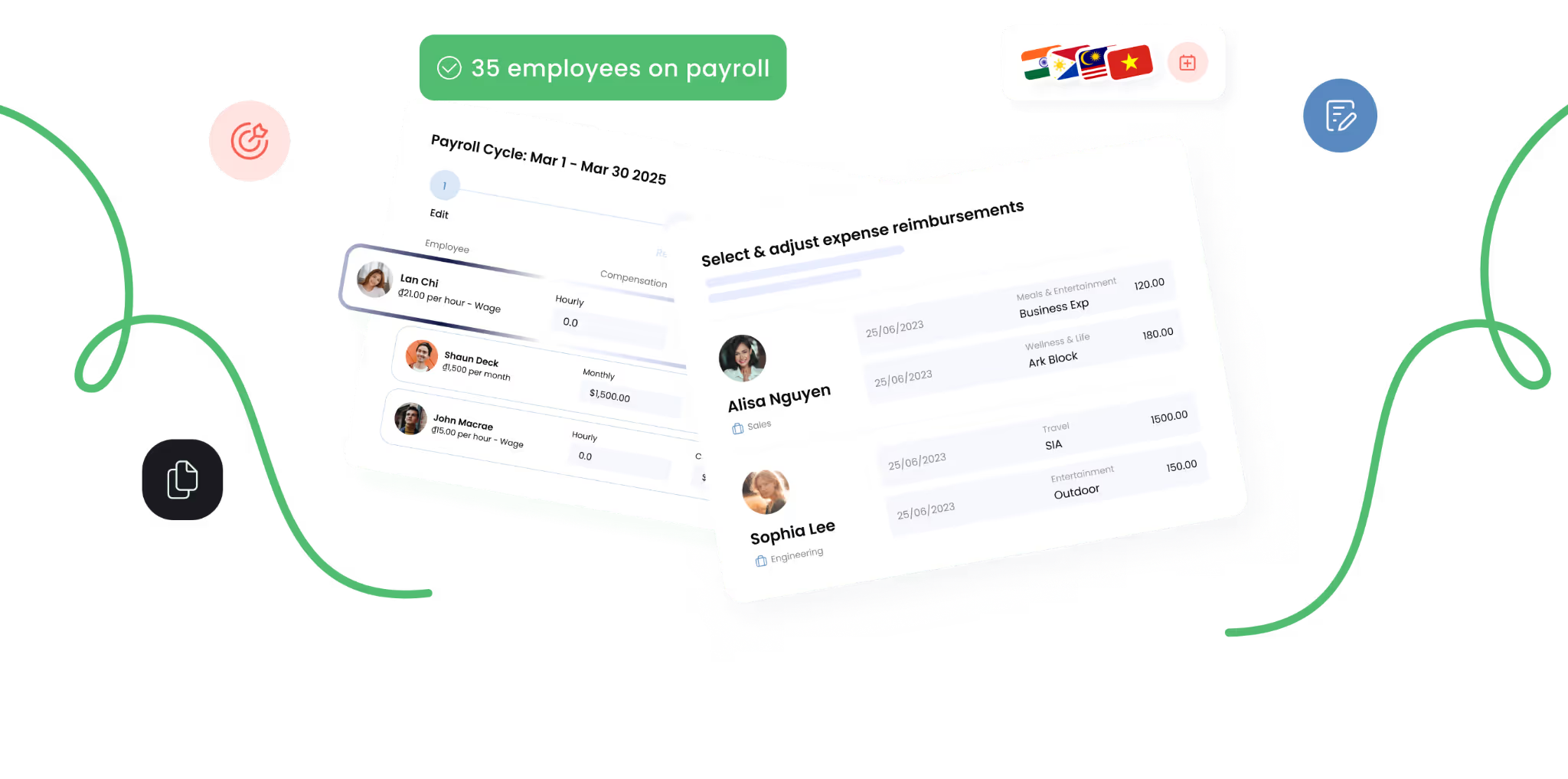
Omni HR brings together compliant Malaysian payroll services, integrated HR automation, and optional payroll outsourcing Malaysia support within one unified platform. Whether you need to manage payroll internally or fully outsource payroll services Malaysia to a dedicated payroll specialist team, Omni adapts to your growth without needing to switch systems. 
payroll outsourcing malaysia

As your head count grows, entities multiply, or regional ambitions form, your payroll partner should scale with you. Omni HR provides the flexibility of software, the accountability of managed payroll services, and the visibility your finance team needs all in one place. 

If you’re in the process on evaluating payroll services, schedule your product tour today and see how you can streamline payroll, eliminate compliance risk, and build a foundation for sustainable growth. 

Frequently Asked Questions

1. What are payroll services and why do businesses need them?

Payroll services help companies manage payroll accurately and compliantly by handling salary calculations, statutory contributions, tax filings, payslip generation, and reporting. As businesses expand across Malaysia and the region, managing payroll manually becomes complex due to changing labour laws and contribution requirements. Engaging professional payroll outsourcing services reduces compliance risks and administrative burden.

2. What is the difference between managing payroll in-house and payroll outsourcing services?

When businesses manage payroll in-house, they rely on internal HR or finance teams to calculate salaries, deductions, and statutory contributions. Payroll outsourcing services, on the other hand, shift these responsibilities to an external provider with specialised expertise and technology. Outsourcing is often more cost-effective for SMEs and growing companies that lack dedicated payroll specialists.

3. Is payroll outsourcing Malaysia a good option for SMEs?

Yes. Payroll outsourcing Malaysia is particularly beneficial for SMEs that want to ensure compliance with EPF, SOCSO, EIS, and PCB requirements without hiring a full payroll team. It reduces errors, minimises penalties, and allows business owners to focus on growth instead of administrative tasks.

4. How do outsource payroll services Malaysia providers ensure compliance?

Reputable providers stay updated with Malaysian labour laws, statutory contribution rate changes, and tax regulations. They use automated systems to calculate contributions accurately and submit reports on time. When choosing a provider, businesses should assess their compliance track record, data security standards, and reporting capabilities.

5. Can payroll services support multi-country payroll management?

Many modern payroll services providers offer regional or global coverage. This is especially useful for companies expanding across Southeast Asia, where employment laws and statutory schemes differ significantly between countries. A unified system helps businesses manage payroll across markets while maintaining local compliance.

6. How does Omni HR help businesses manage payroll more efficiently?

Omni HR centralises employee data, leave management, claims, and payroll processing in a single platform. By integrating HRIS and payroll workflows, businesses can reduce manual data entry, minimise calculation errors, and generate accurate payroll reports. This streamlined approach makes it easier to manage payroll at scale.

7. Does Omni HR support payroll outsourcing services?

Yes. Omni HR can complement payroll outsourcing services by providing clean, centralised employee data and automated workflows that improve accuracy. Businesses that outsource payroll services Malaysia can use Omni to ensure payroll inputs such as attendance, leave, and claims are synchronised and audit-ready.

8. What should businesses look for when selecting payroll services in Malaysia?

Key factors include compliance expertise, automation capabilities, data security standards, integration with HR systems, scalability, and transparent pricing. Businesses should also evaluate whether the provider offers advisory support, especially if they plan to expand or outsource payroll services Malaysia across multiple entities.

For any business operating in Malaysia, payroll can be a high-stakes compliance exercise. Between the intricacies of the Employment Act 1955 and the rigorous requirements of statutory bodies like the Inland Revenue Board (LHDN) and the Employees Provident Fund (EPF), the margin for error is razor-thin.

As companies scale, the complexity of managing payroll internally often outpaces the capacity of a generalist HR team. This is why many organizations are turning to payroll outsourcing services. By partnering with a specialist, businesses can ensure total compliance while freeing up internal resources for strategic growth.

In this guide, we evaluate the best payroll services providers in Malaysia to help you make an informed decision for your organization.

What do payroll services in Malaysia typically cover?

At its core, payroll services (or payroll outsourcing) involve delegating the entire administrative and compliance-related function of paying employees to a third-party expert.

In Malaysia, this is a managed service. Unlike a simple software subscription where you still press the buttons, a payroll outsourcing Malaysia partner takes full responsibility for the calculations, statutory filings, and disbursements. They act as your extended payroll department, ensuring that every cent is accounted for and every deadline is met.

When you outsource payroll services in Malaysia, the scope of work is comprehensive. A high-quality provider should manage the following end-to-end:

  • Salary & allowance calculations: Processing basic pay, overtime (calculated according to Employment Act standards), bonuses, and various allowances (fixed vs. variable).
  • Statutory deductions & submissions: Automating and filing monthly contributions for EPF, SOCSO, EIS, and PCB. This includes generating the necessary text files for bank uploads.
  • HRDF management: Monitoring headcount and ensuring the 1% levy is accurately calculated and paid for eligible employers.
  • Secure payslip generation: Providing employees with secure, digital access to their monthly payslips (often via a mobile app or self-service portal).
  • Monthly reporting: Detailed payroll registers, variance reports, and departmental cost breakdowns for the finance team.
  • Year-end support: The heavy lifting of payroll, generating EA forms for employees, and assisting with the company’s E-Form (CP8D) submission to LHDN.

Payroll software vs. managed payroll services

It is important to distinguish between the two. Payroll software is a tool you use yourself. Managed payroll services include the tool plus the human expertise to run it for you. Outsourcing provides a level of accountability and peace of mind that software alone cannot offer.

Who should consider payroll outsourcing in Malaysia?

Choosing to outsource payroll services in Malaysia is often a turning point for a business. This decision validation section helps you identify if your organization is at the stage where managed services provide the highest ROI.

Payroll outsourcing is best suited for:

  • SMEs without in-house payroll specialists: Small to medium enterprises often rely on generalist HR staff or office managers to handle payroll. Without a dedicated specialist who understands the nuances of the Employment Act and LHDN tax brackets, the risk of accidental non-compliance is high.
  • Growing companies managing increasing headcount: As you scale from 20 to 100+ employees, the administrative burden of payroll grows exponentially. Outsourcing allows your team to focus on talent acquisition and culture rather than on monthly data entry and filing.
  • Businesses struggling with payroll errors or compliance risks: If your current process results in late statutory submissions, incorrect PCB calculations, or constant "firefighting" during audit season, moving to a professional payroll outsourcing Malaysia partner eliminates these operational headaches.
  • Organisations with multiple entities or complex pay structures: Managing different pay cycles, varying commission structures, and multiple employer codes across different subsidiaries requires a high degree of technical oversight that managed services are built to provide.
  • Companies planning regional or cross-border expansion: If you are expanding your footprint beyond Malaysia or entering the local market from abroad, a partner with local statutory expertise is essential to ensure your new entity meets all Malaysian legal requirements from day one.

Top Payroll Services Providers in Malaysia

Based on technology, local expertise, and scalability, here are the top contenders for your payroll needs:

Omni HR

Automated statutory compliance for Malaysia

Omni HR delivers end-to-end payroll services for Malaysian businesses navigating complex statutory requirements. From EPF, SOCSO, EIS, and PCB submissions, Omni HR automates calculations and ensures every payroll run aligns with the latest regulatory updates from LHDN, HRD Corp, and other statutory bodies.

For companies looking to manage payroll internally with confidence, Omni HR reduces compliance risk while maintaining full transparency and control. 

payroll service

Integrated payroll & HR data to reduce errors

Unlike standalone legacy tools, Omni connects payroll directly with other modules like attendance, leave, claims, and employee records within a unified platform. This removes duplicate data entry and significantly reduces payroll discrepancies caused by manual adjustments. 

manage payroll

For Malaysian HR teams considering payroll outsourcing services, Omni offers the reliability of managed workflows while retaining internal visibility over every calculation and submission. 

Manage in-house or outsource payroll services Malaysia

Omni supports both self-managed payroll and fully managed payroll outsourcing Malaysia models. 

Businesses that prefer to retain control can run payroll independently using built-in compliance safeguards. Meanwhile, companies that choose to outsource payroll services Malaysia can rely on our team of payroll specialists to handle calculations, statutory filings, and reporting, significantly reducing administrative burden while ensuring compliance. 

This flexibility makes Omni a strong option for both growing, modern teams and global organizations. 

Best for: 

  • Businesses without a dedicated payroll team
  • Growing companies scaling beyond 50-100 employees
  • Organizations seeking payroll outsourcing services with Malaysian statutory expertise
  • Multi-entity businesses managing complex payroll structures
  • Companies expanding regionally but requiring strong local compliance

Key strength: 

  • Omni HR combines compliant Malaysian payroll services, integrated HR automation, and optional payroll outsourcing Malaysia support within a single platform. 
  • Rather than choosing between software and outsourcing, businesses gain the flexibility to manage payroll internally or outsource payroll services Malaysia as complexity grows. 

CentralHR

CentralHR focuses heavily on the managed aspect of payroll for businesses that value support and hands-on service delivery.

Best for: 

  • Traditional enterprises requiring robust, localized support. 
  • Businesses that prefer a high-touch, fully managed payroll model
  • Organizations seeking a provider with a long-standing reputation in the Malaysian market

Key strength: Deep familiarity with Malaysian labor laws and local HR practices, supported by a model designed for enterprises that prioritize relationship-based payroll management. 

Quick HR

Quick HR offers a streamlined approach to payroll. While they operate regionally, their Malaysian module is configured to meet local statutory requirements. 

Best for: 

  • Smaller businesses or startups with simple payroll needs. 
  • Companies looking for a straightforward, simplified payroll solution 
  • Organizations prioritizing ease of use and fast implementation

Key strength: User-friendly interface and quick setup, making it accessible for teams without dedicated payroll specialists. 

Mercans

Mercans provides global payroll solutions capable of managing payroll across multiple jurisdictions while centralizing reporting. 

Best for: 

  • Multinational corporations (MNCs) with regional footprints
  • Companies operating across Malaysia, Singapore, and Thailand
  • Organizations requiring consolidated cross-border payroll reporting

Key strength: Global reach and multi-currency support, making it suitable for enterprises with complex international payroll structures.

Provider Managed Payroll Service Availability Malaysian Statutory Compliance Coverage Technology & Reporting Capabilities Scalability (Multi-entity / Regional) Best-Fit Use Case
Omni HR Full managed service & self-service platform Complete (EPF, SOCSO, EIS, PCB, EA Forms) Cloud-native platform, automation-driven reporting, employee mobile app High: Handles multiple entities & cross-border teams Growth-oriented SMEs and tech-forward enterprises
CentralHR Full managed service Complete (Malaysia-focused statutory compliance) Traditional payroll system with structured reporting Moderate: Primarily domestic Malaysian entities Established local firms prioritizing personal service
Quick HR Primarily software-led (managed services limited or partner-based) Complete (Automated Malaysian statutory calculations) Core payroll & HR modules, standard reporting Moderate: Regional SME focus Small teams with simple payroll requirements
Mercans Full managed global payroll service Localized Malaysian compliance within the global framework Enterprise-grade global payroll dashboard and consolidated reporting High: Native support for multi-country footprints Large MNCs with complex regional payroll needs

How to Choose the Best Payroll Outsourcing Malaysia Partner

Statutory compliance expertise: Does the provider have a track record of handling LHDN and EPF audits? Ask them how they stay updated on budget changes (like the recent changes to SOCSO ceilings or tax bracket adjustments).

Technology support and reporting: These days, employees expect to view their payslips on their phones. Ensure the provider offers a secure employee self-service portal or app. This reduces the administrative burden of employees asking HR for past payslips during bank loan applications.

Scalability: Can the provider handle your growth? If you expand from a single office in KL to branches in Penang and Johor, or even overseas, your payroll partner should be able to scale with you without a total system overhaul.

Service model: Who is your point of contact? If there is a calculation error, how quickly is it rectified? A good partner takes ownership of mistakes and provides a clear Service Level Agreement (SLA).

Pricing and transparency: Watch out for "hidden" fees. Some providers charge extra for EA forms, implementation, or "off-cycle" payroll runs (e.g., for bonuses). Look for a clear, predictable pricing structure.

Common Payroll Outsourcing Mistakes to Avoid

Even with the best intentions, many businesses stumble when transitioning to outsource payroll services Malaysia. To ensure a smooth transition, avoid these critical mistakes:

Choosing providers without strong Malaysian statutory expertise

Some global firms treat Malaysia as a secondary market, using standardized templates that don't account for unique local requirements like the MTD (PCB) variations or the correct wage ceiling for SOCSO and EIS. Choosing a partner without local on-the-ground expertise is the fastest way to trigger an LHDN audit or receive penalties for late EPF submissions.

Confusing payroll software with managed payroll services

This is the most frequent misconception. Many vendors sell a SaaS platform that automates calculations, but you are still responsible for pressing "submit" and verifying the data. If you don't have a payroll expert on staff to oversee the software, you haven't truly mitigated your risk. A managed service provider is the expert who runs the tool for you.

Unclear service scope and accountability

Vague contracts lead to finger-pointing when errors occur. For example, if a bank file is rejected due to a wrong account number, is it the provider's job to fix it, or yours? Ensure your Service Level Agreement (SLA) explicitly defines who is responsible for data validation, correcting payment rejections, and answering employee tax queries.

Hidden fees for compliance or year-end support

Many providers lure businesses in with a low per-head monthly fee, only to charge significant surcharges for mandatory year-end tasks. This includes generating EA forms for every employee or assisting with the company's E-Form (CP8D) submission. Always ask for an all-inclusive price that covers monthly processing and statutory year-end requirements.

​Limited reporting and audit support

Payroll is a major line item on your balance sheet. If your provider cannot provide instant, customizable reports for your finance team (or if they take days to pull data for a simple internal audit), their technology is insufficient. You need a partner that offers real-time visibility into payroll variances, departmental costs, and contribution histories. 

End-to-End Payroll Support That Scales With You

Payroll in Malaysia is more than just paying salaries; it’s about ensuring compliance, protecting your reputation, and creating operational confidence as your team scales. From navigating the Employment Act to meeting submission requirements from LHDN and other statutory regulatory bodies, the stakes are too high for legacy systems or manual workarounds.

Omni HR brings together compliant Malaysian payroll services, integrated HR automation, and optional payroll outsourcing Malaysia support within one unified platform. Whether you need to manage payroll internally or fully outsource payroll services Malaysia to a dedicated payroll specialist team, Omni adapts to your growth without needing to switch systems. 

payroll outsourcing malaysia

As your head count grows, entities multiply, or regional ambitions form, your payroll partner should scale with you. Omni HR provides the flexibility of software, the accountability of managed payroll services, and the visibility your finance team needs all in one place. 

If you’re in the process on evaluating payroll services, schedule your product tour today and see how you can streamline payroll, eliminate compliance risk, and build a foundation for sustainable growth. 

Frequently Asked Questions

1. What are payroll services and why do businesses need them?

Payroll services help companies manage payroll accurately and compliantly by handling salary calculations, statutory contributions, tax filings, payslip generation, and reporting. As businesses expand across Malaysia and the region, managing payroll manually becomes complex due to changing labour laws and contribution requirements. Engaging professional payroll outsourcing services reduces compliance risks and administrative burden.

2. What is the difference between managing payroll in-house and payroll outsourcing services?

When businesses manage payroll in-house, they rely on internal HR or finance teams to calculate salaries, deductions, and statutory contributions. Payroll outsourcing services, on the other hand, shift these responsibilities to an external provider with specialised expertise and technology. Outsourcing is often more cost-effective for SMEs and growing companies that lack dedicated payroll specialists.

3. Is payroll outsourcing Malaysia a good option for SMEs?

Yes. Payroll outsourcing Malaysia is particularly beneficial for SMEs that want to ensure compliance with EPF, SOCSO, EIS, and PCB requirements without hiring a full payroll team. It reduces errors, minimises penalties, and allows business owners to focus on growth instead of administrative tasks.

4. How do outsource payroll services Malaysia providers ensure compliance?

Reputable providers stay updated with Malaysian labour laws, statutory contribution rate changes, and tax regulations. They use automated systems to calculate contributions accurately and submit reports on time. When choosing a provider, businesses should assess their compliance track record, data security standards, and reporting capabilities.

5. Can payroll services support multi-country payroll management?

Many modern payroll services providers offer regional or global coverage. This is especially useful for companies expanding across Southeast Asia, where employment laws and statutory schemes differ significantly between countries. A unified system helps businesses manage payroll across markets while maintaining local compliance.

6. How does Omni HR help businesses manage payroll more efficiently?

Omni HR centralises employee data, leave management, claims, and payroll processing in a single platform. By integrating HRIS and payroll workflows, businesses can reduce manual data entry, minimise calculation errors, and generate accurate payroll reports. This streamlined approach makes it easier to manage payroll at scale.

7. Does Omni HR support payroll outsourcing services?

Yes. Omni HR can complement payroll outsourcing services by providing clean, centralised employee data and automated workflows that improve accuracy. Businesses that outsource payroll services Malaysia can use Omni to ensure payroll inputs such as attendance, leave, and claims are synchronised and audit-ready.

8. What should businesses look for when selecting payroll services in Malaysia?

Key factors include compliance expertise, automation capabilities, data security standards, integration with HR systems, scalability, and transparent pricing. Businesses should also evaluate whether the provider offers advisory support, especially if they plan to expand or outsource payroll services Malaysia across multiple entities.

No items found.
No items found.
Which countries do you support?

Full HR & Payroll coverage for Philippines, Singapore, Malaysia, Hong Kong, and Indonesia. Each market has local support teams and built-in compliance features.

How does pricing work as we scale?

Starting at $3/employee/month for core features. Volume-based discounts are available for growing teams. Book a demo for custom pricing.

How do you handle security?

Enterprise-grade security with ISO 27001, GDPR certifications, and local data residency options.

How long is implementation?

4 weeks average. Includes free data migration, setup, and team training. No hidden fees.

What makes Omni different from global HR platforms?

Built specifically for Asia with local payroll processing, same-day support in Asia time zones, and 40% lower cost than global alternatives.