




















.png)
Summary. The Annual Wage Supplement Singapore is a common year-end payment that rewards employees with an additional month’s salary, but despite its popularity, it’s not legally required. Understanding the AWS salary meaning is essential for HR teams, as it affects CPF contributions and payroll compliance. While AWS is typically equal to one month’s basic pay, factors like employee start date and CPF annual wage ceilings complicate the process. Knowing how to calculate CPF contribution for AWS and when to use monthly vs. daily proration is key to avoiding errors and penalties. With Omni’s automated tools, including a built-in AWS salary calculator, businesses can eliminate manual payroll tasks, stay compliant, and ensure every AWS payout is accurate, transparent, and aligned with Singapore’s evolving regulations.
In Singapore, the Annual Wage Supplement (AWS), often called the 13th-month payment, is an extra payment given at year-end as a reward for employees.
Many people assume AWS is a compulsory bonus, but that’s actually a misconception. In reality, the Annual Wage Supplement Singapore is not required by law; it’s a voluntary benefit for employees.
Even though it’s optional, the Annual Wage Supplement Singapore is very common because companies use it to recognize employees’ contributions over the year.
Since AWS increases an employee’s yearly earnings, it’s important for employers and HR teams to understand how to calculate it correctly and comply with CPF (Central Provident Fund) contribution rules. Missteps in AWS calculations or CPF deductions can lead to compliance issues, unhappy employees, or even penalties.
In this article, we’re diving into the ins and outs of the Annual Wage Supplement Singapore, from AWS salary meaning and pro-rated calculations to CPF obligations. Learn how to calculate CPF contribution for AWS accurately and avoid compliance risks. With Omni’s all-in-one tools, you can simplify payroll and stay compliant with confidence.
Understanding the Annual Wage Supplement in Singapore
The Annual Wage Supplement in Singapore is typically equal to an employee’s one-month basic salary, given as a lump sum at the end of the year.
What is the difference between AWS and bonus?
Although AWS often gets paid together with bonuses, there’s a clear distinction between the two. While both are year-end payouts, AWS is usually a fixed, across-the-board payment, so if you’re eligible, you get it. It’s not linked to performance or company profits but a token of appreciation built into your pay structure.
A bonus, on the other hand, is performance-based. It varies by role, department, or business results, and some people may get more or none at all. In that sense, AWS is more predictable, while a bonus is more discretionary.
Is the Annual Wage Supplement Singapore mandatory?
As mentioned earlier, AWS isn’t actually a legal requirement, as it’s not mandatory under the Singapore Employment Act. Employers are only obligated to pay AWS if it’s explicitly written into the employment contract.
That said, many companies still offer it because it’s become a widely accepted practice, something employees have come to expect as part of a complete compensation package.
When is the Annual Wage Supplement Singapore usually paid?
The Annual Wage Supplement Singapore is usually paid out in December. That aligns with how most companies close their financial year and gives employees a boost heading into the holiday season. Some businesses, especially those with different fiscal calendars, might pay it at another time.
Others might even split the payment half mid-year, half at the end. There’s no fixed rule around when it must be paid; it really comes down to company policy and internal payroll timelines.
Read next: How to Cut Singapore Payroll Costs
What are the exceptions for the Annual Wage Supplement Singapore?
The Annual Wage Supplement Singapore might not be distributed to everyone; here are some cases of such exceptions:
- Resignation before payout: Employees who leave before AWS is disbursed typically forfeit it, unless their contract says otherwise. Many companies require staff to still be employed and not on notice during payout day.
- Probation or recent hires: Some companies only pay AWS to confirmed employees. Those still on probation or who joined late in the year might receive a pro-rated amount or none at all depending on the policy or offer letter.
- Poor business performance: If a company has had a difficult financial year, it may reduce or skip AWS altogether since it’s not a legal obligation. However, it should be clearly communicated to avoid impacting employee morale.
- Specific contract terms: Employers may exclude certain roles or circumstances, such as staff under investigation or those on high-commission schemes. When in doubt, check the employment agreement.
To avoid confusion, most companies clearly outline their Annual Wage Supplement Singapore policies in employment contracts or handbooks.
According to MoM guidelines, if your company did not provide AWS before August 1988, you’re capped at one month’s salary, a rule that still applies today.
At year-end, your HR team shouldn’t be scrambling to manage manual AWS salary calculations, proration, and wondering how to calculate CPF contribution for AWS. Instead, streamline the process with a reliable AWS salary calculator or automate CPF calculations with Omni’s payroll software, ensuring accuracy and compliance every step of the way.
“Payroll calculations that used to take three to five working days can now be done in half the time with Omni.”
— Tengku Mohaizad, Group Head of HR Asia, Inspire Brands Asia
Read Inspire Brands Asia’s full story
How to calculate the Annual Wage Supplement Singapore?
Calculating AWS in Singapore is rather straightforward since it typically equates to a month’s worth of basic salary. However, AWS salary calculation can be rather tricky if the employee joins midyear.
For employees who have yet to complete the full year, the Annual Wage Supplement Singapore is often pro-rated. There are two AWS salary calculation methods for pro-rated employees.
For example, an employee earns S$4,000 per month and joined the company on 1 July. Your company pays the Annual Wage Supplement Singapore in December.
Method 1: Monthly proration (simple and common)
Based on the example above, the employee worked for 6 out of 12 months in the year. The Annual Wage Supplement calculation is as follows:
Annual Wage Supplement = Employee’s monthly salary x (total months worked / 12)
AWS = S$4,000 x (6/12) = S$2,000
Method 2: Daily proration (more precise)
Assuming the employee joined on 1 July and your company uses a 365-day year for calculations, the employee worked 184 days (from 1 July to 31 December) in total.
Annual Wage Supplement = Employee’s monthly salary x (total days worked / 365)
AWS = S$4,000 x (184/365) = S$2,016.44
The choice between choosing a monthly or daily proration method depends on your internal HR policy. What matters most is applying consistent calculation and clarity in your employment contracts to ensure workplace fairness.
How AWS Affects CPF Contributions
Why does AWS matter when it comes to CPF?
When managing Singapore payroll, understanding how the Annual Wage Supplement Singapore affects CPF contributions is crucial, especially when it impacts the payroll process. While knowing how to calculate CPF contribution for AWS may feel like a technical detail, it’s a key compliance checkpoint for HR and payroll teams.
How is AWS classified under CPF?
According to the CPF board, the Annual Wage Supplement Singapore is classified as Additional Wages, which differ from Ordinary Wages like monthly salaries, fixed allowances, and commissions.
In summary:
- Ordinary Wages refer to monthly, recurring pay
- Additional Wages refer to one-off or irregular payments (e.g., AWS, bonuses, leave encashment)
How do CPF contributions apply to AWS?
In Singapore, CPF contributions apply to AWS but only up to a fixed limit each year, known as the CPF Annual Salary Ceiling.
For 2025, the ceiling is S$102,000 total wages (Ordinary + Additional Wages). So if your employee’s total wages exceed this ceiling, CPF is no longer payable on the excess.
How to calculate CPF contribution for AWS?
Step 1: Calculate total Ordinary Wages for the year
If your employee earns S$6,000 per month, their Ordinary Wages for the year are S$72,000.
Step 2: Find the remaining CPF limit for AWS
Taking the 2025 ceiling limit, the Additional Wage ceiling limit is:
S$102,000 (CPF limit) - S$72,000 (total Ordinary Wages) = S$30,000 (Additional Wage ceiling)
This means CPF contributions can apply up to S$30,000 of bonus or Annual Wage Supplement Singapore.
Step 3: Check how much AWS is CPF contributable
Let’s compare two different AWS scenarios to show how CPF applies:
So:
- In the first case, the AWS is entirely within the CPF ceiling, so full CPF applies.
- In the second case, the AWS exceeds the ceiling by S$10,000, so CPF only applies to the first S$30,000.
Step 4: Apply CPF contribution rates
Once you know how much AWS is CPF-contributable, apply the standard CPF rates:
- Employer contribution: 17%
- Employee contribution: 20% (deducted from AWS)
Example:
If AWS is S$4,000:
- Employer CPF = 17% of S$4,000 = S$680
- Employee CPF = 20% of S$4,000 = S$800
So the employee takes home S$3,200, and both CPF portions are submitted accordingly.
These rates differ for older employees or permanent residents in their first or second year of PR status, so it’s important your payroll system reflects the correct rates by employee profile. We recommend using payroll software that is tailored for APAC countries for better local compliance.
Streamline with Omni's CPF calculator
Additional reminders for AWS CPF contributions
- CPF does not apply to foreign employees (e.g., EP or work permit holders).
- CPF contributions for AWS must be reported and submitted in the month AWS is paid (usually in December).
- Most common mistake: Forgetting to calculate the Additional Wages ceiling and over- or under-contributing to CPF. This can be avoided by learning how to calculate CPF contributions for AWS accurately or adopting a payroll system that automates CPF calculations and reduces manual AWS-related errors.
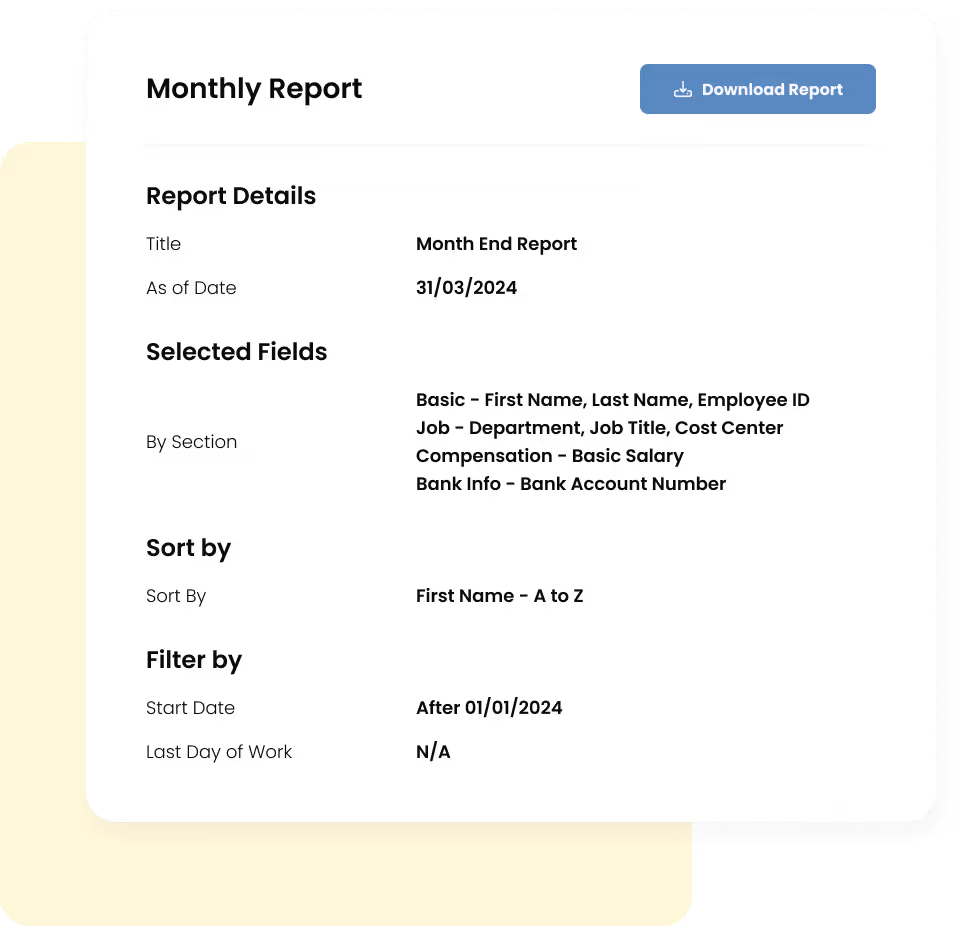
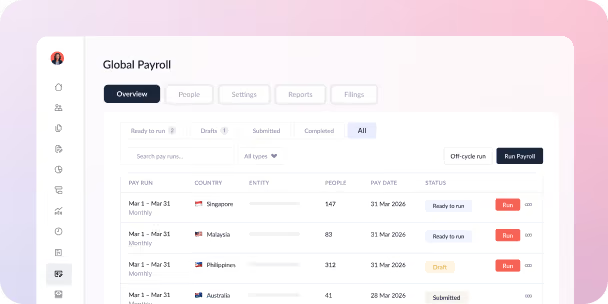
Omni helps automate CPF contributions according to Singapore's requirements, freeing HR professionals from compliance headaches and avoiding manual errors. Our comprehensive payroll reporting provides detailed breakdowns on salary, tax, and statutory contributions. Reports are also fully exportable in multiple formats, ideal for audits, financial reviews, and regulatory submissions.
What are some common challenges faced when calculating AWS?
On the surface, calculating the Annual Wage Supplement Singapore might look easy since it’s just an extra month’s worth of pay. However, the actual calculation process can get tricky without the right payroll systems in place.
Here are some of the most common issues your HR and payroll teams can run into:
- Manual errors in pro-rating and CPF deductions: It’s easy to miscalculate AWS when doing without an AWS salary calculator. Things like using the wrong start date, missing CPF rates, or overlooking the Additional Wage ceiling can lead to errors. Small mistakes like these can lead to overpaying or under-deducting CPF, which means extra work fixing it later.
- Exceeding the CPF annual ceiling: If you’re not tracking wages across the year, you might apply CPF to AWS that exceeds the S$102,000 cap. This leads to over-contribution and the hassle of processing refunds, thereby creating more admin load.
- Inconsistent application across departments: Without a centralized policy or system, different teams might calculate the Annual Wage Supplement Singapore differently. One might prorate by months, another by days. Some may include probationers; others may not. This creates confusion and can lead to staff feeling unfairly treated.
- Lack of automation in AWS tracking: If your company has a large or distributed team, manually keeping track of join dates, eligibility, and CPF limits is inefficient and error-prone. Without automation, it’s hard to ensure accuracy and fairness at scale.
How to Avoid These AWS Pitfalls with Omni
As we’ve seen, calculating the Annual Wage Supplement isn’t always as straightforward as it looks, especially when manual processes, inconsistent policies, and complex CPF rules and ceilings come into play. That said, don’t let these deter you from using AWS to reward and motivate your team. With the right HR tools by your side, these challenges can be completely avoidable.
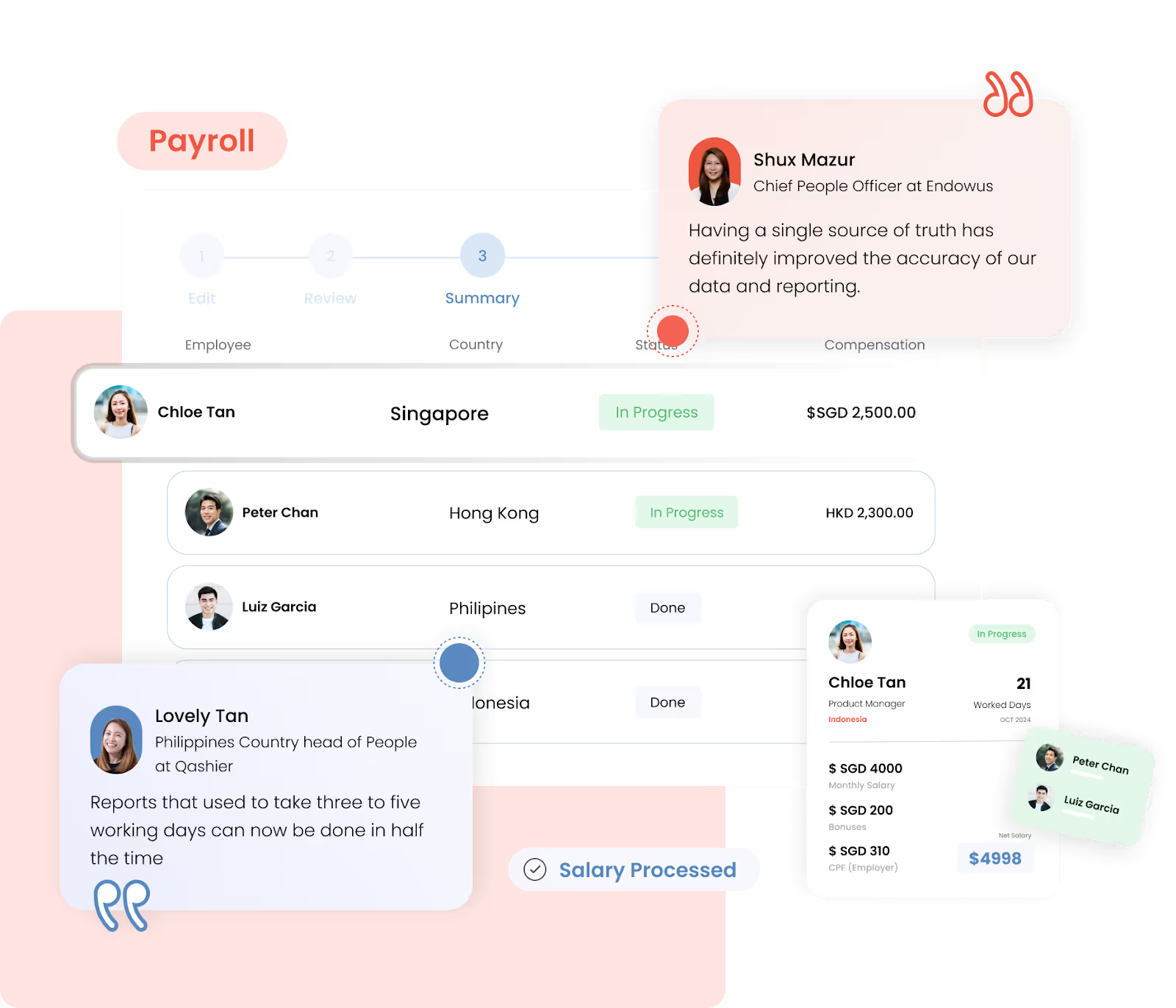
Omni’s automated payroll module is built specifically for Singapore’s regulatory landscape, ensuring every CPF calculation and payroll report is accurate, audit-ready, and in line with MoM guidelines.
From automated CPF calculations to integrated payslips that reflect deductions, Omni ensures timely and transparent payout every time. With our customizable payroll reports, you can stay compliant and in control of your Singapore payroll without adding burden upon your HR and finance teams.
Why Singapore enterprises choose Omni
Book a product tour today to see how Omni simplifies the management of Annual Wage Supplement in Singapore and CPF compliance for growing, modern businesses.



.avif)
.avif)