.png)
Summary. As Q4 2025 approaches, HR leaders across Asia must navigate critical compliance deadlines and legislative changes impacting Singapore, Malaysia, the Philippines, Thailand, Indonesia, and Hong Kong. Key updates include work pass renewals, unlimited work permit duration, S Pass levy increases, mandatory EPF for foreign workers, visa promotion rules, minimum wage adjustments, 13th-month pay obligations, and new employee welfare fund and foreign staff regulations. Staying compliant requires updating payroll systems, managing workforce eligibility, and tracking statutory contributions accurately. Leveraging Omni’s integrated HR and payroll solutions simplifies these processes with automated workflows, real-time dashboards, and audit-ready reporting, helping HR teams stay on top of labor updates, reduce manual workload, and ensure full compliance before year-end.
Q4 2025 HR Compliance Updates Across Asia
The final quarter of the year is one of the most important periods for HR compliance. Organizations must review, reconcile, and prepare to meet regulatory obligations that align with the calendar year. Not only that, changes in labour laws from earlier quarters often take effect or impact this final stretch.
As Q4 2025 rolls around, significant legislative changes across Asia are directly impacting operations and HR compliance. This guide highlights all the essential updates in Singapore, Malaysia, the Philippines, Thailand, Indonesia, and Hong Kong, along with actionable steps that HR teams can take to prepare payroll systems, workforce management, and ensure HR legal compliance.
Q4 Compliance Update Snapshot
Singapore
Key updates and reminders:
- Work pass renewals
- Unlimited work permit duration and higher age cap — effective 1 July 2025
- S pass levy increase — effective 1 September 2025
Work pass renewals
If you hire foreign employees, now is the time to assess work pass validity, prepare, and plan for the coming new year.
Employment Pass (EP) and S Pass renewals can be filed up to 6 months before expiry. Work permits, on the other hand, should be renewed 7 to 12 weeks before expiry. This gives enough time to extend medical insurance, update security bonds, and complete mandatory medical checks. Late renewals can potentially trigger levy liabilities and even overstaying penalties.
How Omni streamlines this: Instead of manually tracking due dates on your calendar, Omni lets you set up automated workflows that trigger renewal tasks at the right time.

Our system can notify HR, finance, and managers via Slack integration, ensuring everyone stays on the same page and nothing slips through the cracks.
Unlimited work permit duration and higher age cap
Starting 1 July 2025, work permits can be renewed indefinitely, and the maximum age rises to 63, with new applicants capped at 61.
Previously, foreign workers were forced to leave Singapore due to fixed work permit duration limits and age caps, even if they were critical to operations. With this new change, companies can retain skilled and experienced workers longer, reducing turnover and recruitment costs.
How does this change impact operations and planning:
- Employers can now plan long-term retention strategies for key foreign employees.
- Succession planning becomes easier as experienced foreign workers can stay beyond previous age limits.
- Payroll forecasting and budgeting become more predictable, as HR no longer needs to account for forced departures due to work permit issues.
- Boost employee morale and loyalty, as high-performing foreign workers can now see an opportunity for longer-term employment in Singapore.
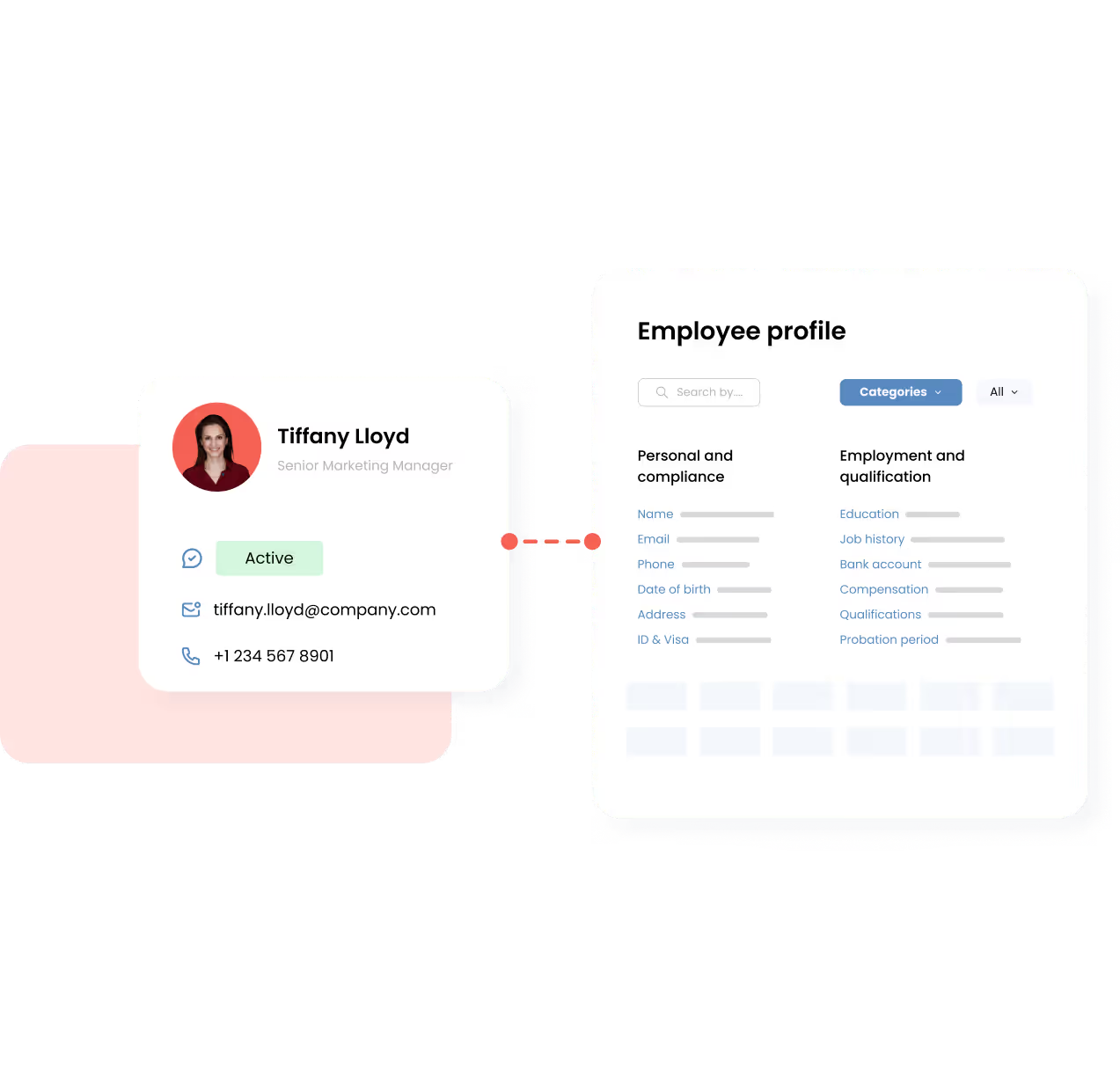
With Omni, you can update employee profiles seamlessly with new eligibility criteria and generate custom reports highlighting employees who are affected by the previous age and duration limits. Integrated payroll can also adjust projections accordingly, all without manual tracking or countless spreadsheets, helping ensure hr compliance.
S Pass levy increase
Starting 1 September 2025, the S Pass levy increases to S$650. This translates to a higher cost of employing foreign workers, especially for Singaporean businesses with large S pass workforces.
Update your payroll in time to ensure accurate deduction, budgeting, and forecasting for the rest of the year.
Best practices:
- Set automated reminders in your HR system, like Omni, to alert you a few days before the 17th of each month.
- Reconcile payroll and levy bills in advance to catch any miscalculations.
- Schedule levy payments via GIRO or PayNow ahead of time to avoid last-minute hassle.
- Set up dashboards to track which employees’ levies are due and their payment status.
- Integrate with Slack or Microsoft Teams to notify HR and finance teams instantly once payments have been made and processed.
Malaysia
Key updates and reminders:
- Mandatory EPF for foreign workers — effective October 2025, first contribution due 15 November 2025
Mandatory EPF for foreign workers
In June 2025, the Malaysian government officially announced the introduction of mandatory EPF enrollment for foreign workers, effective October 2025 payroll, with first contributions due by 15 November 2025.
The goal of this change is to align foreign worker benefits with local employment standards and ensure all Malaysian employees have access to retirement savings security.
Previously, foreign workers in Malaysia were excluded from EPF contributions, leaving them without retirement savings or access to the formalized benefit system. With these new rules, foreign employees are now able to accumulate retirement savings and take advantage of the statutory benefits—creating greater parity across the workforce.
Actionable steps:
1. Update payroll systems
Employers and foreign employees are now both required to contribute 2% each of their monthly wages to EPF. Test contribution calculations in October payroll to ensure proper setup before the actual remittance in November.
2. Register foreign employees
You should start register your foreign employees starting 1 October 2025. However, the official process is still being streamlined. Kindly refer to the KWSP official channels for announcements.
3. Communicate with employees
Explain the new contribution rates, employer matching, and withdrawal rights to impacted employees. Provide clear, concise FAQs or translated guides for clarity across different nationalities.
Refer to KWSP’s official guide for more information.
4. Ensure timely remittance
As highlighted, the first contribution is due 15 November 2025. Set automated reminders or recurring payment instructions to avoid HR compliance penalties.
5. Leverage HR software
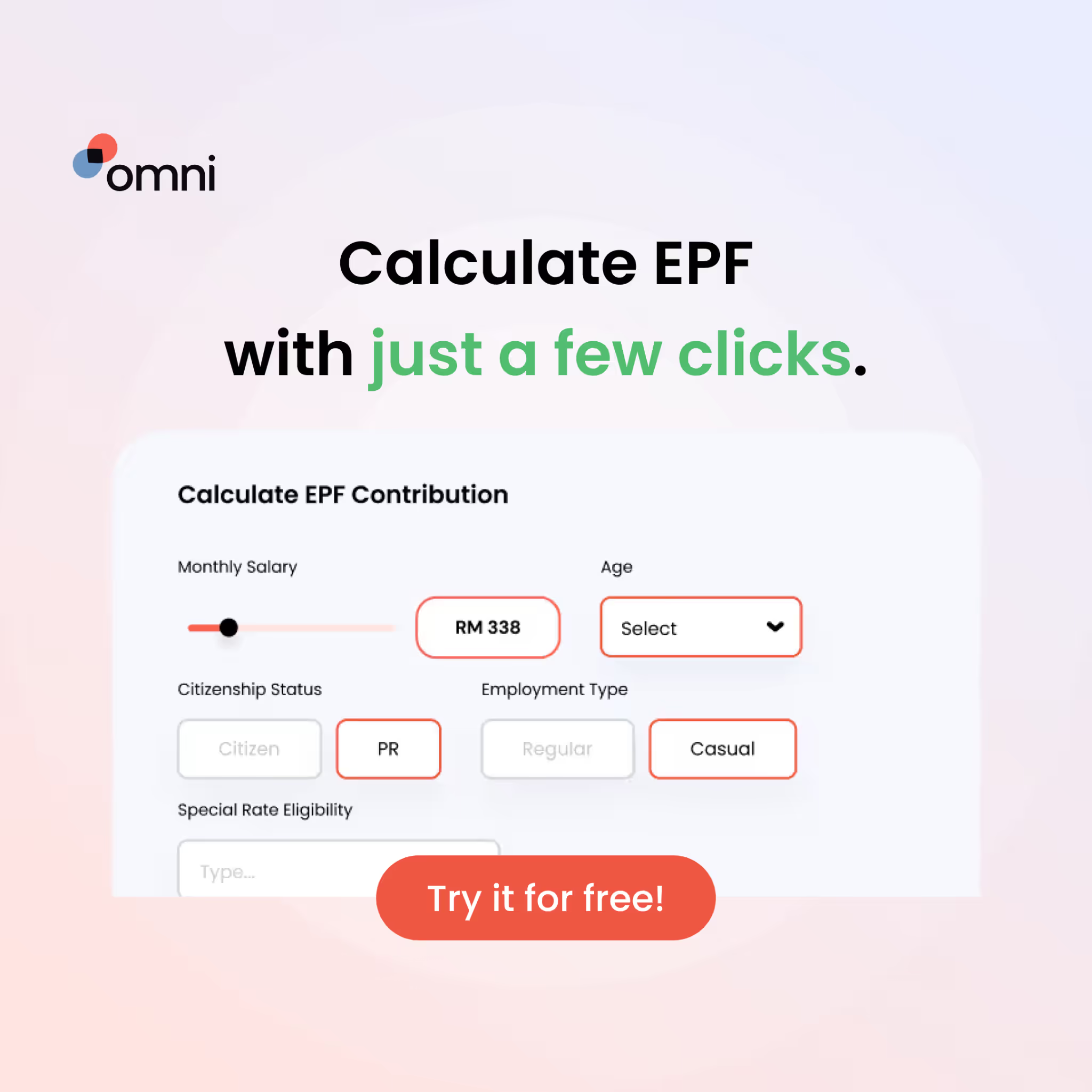
With Omni HR, you can automate EPF calculations and remittance workflows with a few clicks. Generate compliance reports based on specific employee groups or payroll periods, and store contribution records for audit in one secure place, maintaining compliance in HR.
Philippines
Key updates:
- 9(G) visa promotion rules — since September 2024
- Minimum wage (NCR-26) — effective 18 July 2025
- 13th-month pay — due by 24 December 2025
9(G) visas
Since September 2024, the Bureau of Immigration clarified the rules for promoted 9(G) Pre-arranged Employment Visa holders.
When a foreign employee is promoted, whether that be a job title or position change within the same company, employers no longer need to downgrade to a Temporary Visitor 9(A) visa.
Instead, companies must:
- Submit a notice of promotion to the bureau with the appointment/election document.
- File a 9(G) visa extension within 30 days of the bureau’s receipt of that notice.
- Cancel the old ACR I-Card and apply for a new one, aligned with the extended 9(G).
Non-compliance can trigger denial or cancellations, and an Order to Leave, so staying proactive is key for HR compliance.
Read more: Global Hiring Guide: Philippines
Actionable steps:
- Incorporate Bureau of Immigration approvals within your promotion workflow.
- Sync Alien Employment Permit validity with visa timelines. The 9(G) extension becomes coextensive with the AEP for the new role.
- Keep certified copies of the promotion and the updated job scope on file in case of audits.
Minimum wage changes
On 18 July 2025, the Regional Tripartite Wages and Productivity Board (RTWPB)-NCR issued the Wage Order NCR-26, highlighting the change in national minimum wage.
- Non-agriculture: PHP 695/day
- Others: PHP 658/day
Note: RTWPBs in other regions may still issue or finalize wage orders in the coming months. Monitor DOLE announcements.
13th-month pay
The 13th-month pay is mandatory under Presidential Decree (PD) 851 and must be paid out on or before 24 December 2025 to ensure HR legal compliance.
Employees are entitled to at minimum 1/12 of the basic salary actually earned within the year. Pro-rated rates apply for employees who resigned or were terminated any time after serving at least a month.
Note: 13th-month pay and “other benefits” are tax-exempt up to PHP90,000 in aggregate; the excess is taxable—making tax compliance a critical part of compliance in HR.
Best practices:
- Regularly audit pay scales against NCR and other regional wage orders. Update wage tables and pay items before the November payroll cut-off to ensure computations are accurate.
- Recalculate pay components such as overtime, night shift differential, and public holiday pay based on the updated minimum wage.
- Stay ahead of regional wage board bulletins.
Thailand
Key updates and reminders:
- Employee Welfare Fund (EWF) — postponed to 1 October 2026, pending royal ordinance confirmation
- BOI foreign staff rules — new applications effective 1 October 2025; existing certificates effective 1 January 2026
Employee Welfare Fund (EWF)
The Ministry of Labour announced the implementation of the Employee Welfare Fund in January 2025, confirming the contribution rates, registration process, and compliance requirements. In Mid-2025, the government postponed implementation by one year—from October 2025 to October 2026—giving employers more time to prepare. However, authorities are still waiting for royal ordinance confirmation, and no official documentation is available on the Government portal yet. Keep an eye out for official announcements and updates.
Why this matters:
- The EWF applies to employers with 10+ employees.
- Both employer and employee contribute 0.25% of wages, rising to 0.50% in 2030.
- Employers with existing provident funds with coverage of 2%-15% from day one may be exempted.
- Despite the postponement, early preparation is essential as non-compliance risks a 5% surcharge per month and fines up to THB 10,000 or imprisonment. Maintaining EWF compliance is a key part of hr compliance.
Best practices:
- Monitor government portals for official royal ordinance confirmation before implementation.
- Audit existing provident fund coverage and confirm if exemptions apply.
- Prepare registration documents in advance for the October 2026 filing.
- Test 0.25% contribution calculations on payroll systems.
- Budget ahead and include EWF contributions in 2026 projections.
Automate EWF contributions with Omni, and set reminders in advance for the new 15 November 2026 remittance deadline. Check out our interactive demo for more info.
BOI foreign staff rules
On 5 June 2025, the Board of Investment issued Notification No. Por. 8/2568, introducing revised rules for approving and renewing foreign employee positions under Sections 25 and 26 of the Investment Promotion Act B.E. 2520 (1977).
These new criteria replace the previous 2024 guidelines (BOI Notification No. Por. 3/2567) and are confirmed for phased implementation starting 1 October 2025.
Why this matters:
- Sets minimum salary thresholds:
- Executives: 27+ years, THB 150,000+/month
- Management: 27+ years, THB 75,000+/month (or THB 50,000 with a degree)
- Operations: 22+ years, THB 50,000+/month
- IBPO/TISO staff: THB 35,000+/month
- Special roles (Researchers, Engineers, IT Specialists, Teachers, Pilots) have tailored requirements
- TISO, BPO, and IBPO companies now receive 1-year work permits only (reduced from previous terms).
- Manufacturing and production license firms with more than 100 employees must ensure Thai employees make up equal or more than 70% of the total workforce for re-hires within 1 year.
- New PND1 Kor and PND1 (3-month) documentation required for standardization.
- New salary requirements apply only to new employees not included in existing PND1 records.
- Non-compliance risks the loss of BOI benefits, blocked visa renewals, and reputational damage.
Best practices:
- Review salaries and adjust current packages to meet new age and salary thresholds.
- Prepare for shorter 1-year permit cycles if operating TISO, BPO, or IBPO businesses.
- Check the current workforce ratio and plan a headcount strategy to hit an equal or more than 70% Thai worker share applicable for manufacturing/production businesses with more than 100 employees.
- Update employment contracts for HR legal compliance.
- Track enforcement dates:
- New certificates: 1 October 2025
- Existing certificates: 1 January 2026
How Omni streamlines this:
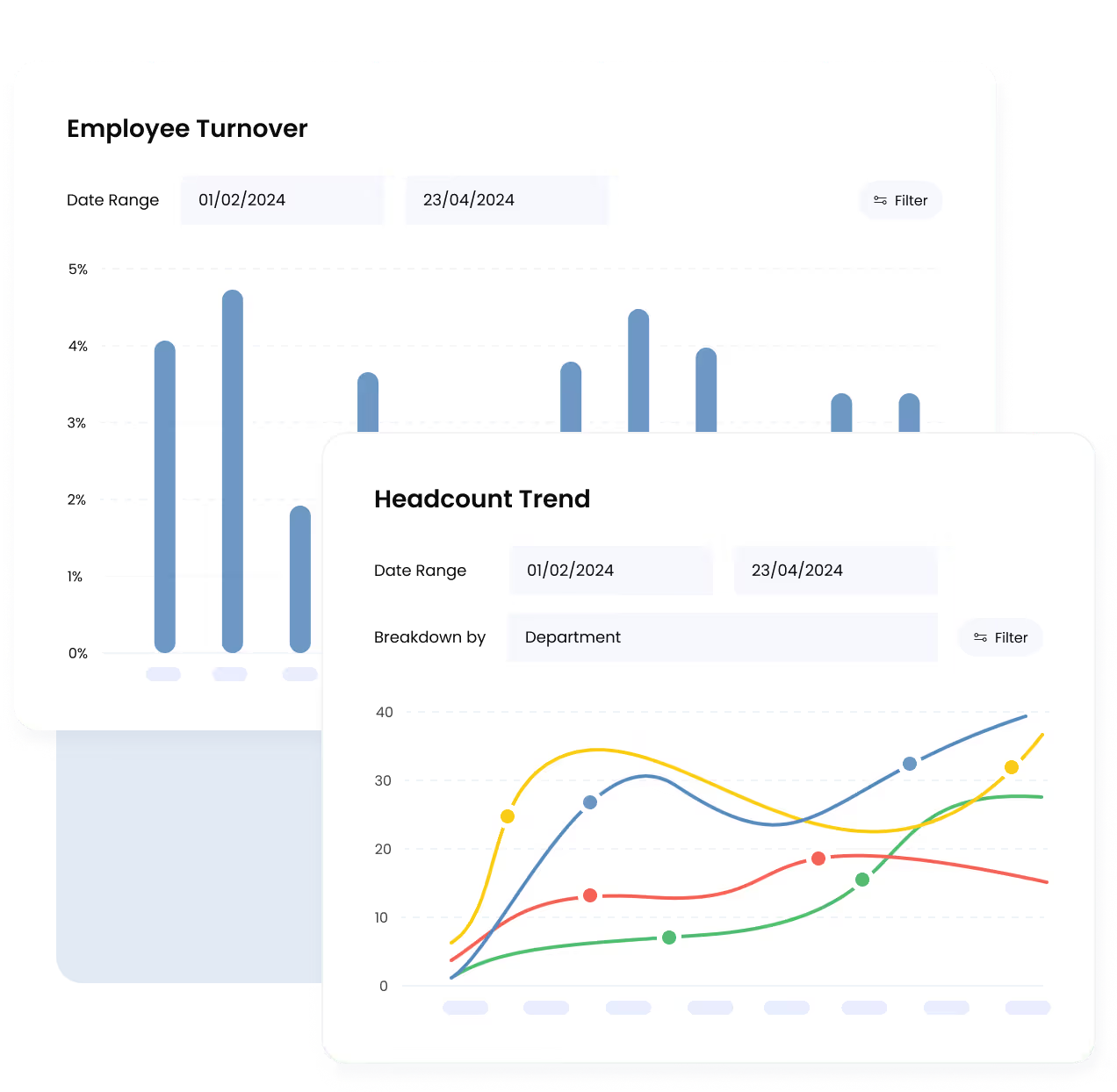
Our integrated payroll module automatically handles PND1 documentation, 6-monthly Social Security updates, and EWF contribution calculations when they come into effect. Generate custom reports with real-time data to monitor workforce ratios, salary thresholds, and other compliance metrics, while ensuring accurate statutory submissions and compliance tracking—saving you valuable time each month.
Indonesia
Key updates and reminders:
- Minimum wage compliance — effective 1 January 2025
- Updated employment termination procedures
- Year-end audits and foreign worker permits
Minimum wage compliance
In late 2024, the Indonesian government announced a 6.5% minimum wage increase effective 1 January 2025.
For Q4 2025, HR teams should ensure:
- Payroll systems reflect the new rates for any back-pay adjustments or performance bonuses.
- Wage-related calculations, such as overtime, holiday pay, and allowances, should align with the updated minimum wage.
- Any retroactive adjustments for employees hired late in 2024 or early in 2025 are processed.
Employment termination procedures
The Constitutional Court ruling on Article 151(4) now requires a legally binding court decision for terminations.
For Q4, HR teams must:
- Review termination workflows to comply with HR legal compliance requirements.
- Ensure managers understand that employees must continue receiving wages until a court decision is made and issued.
- Audit any pending termination cases in accordance with the new ruling to avoid non-compliance risks.
Other Q4 compliance essentials
- Conduct year-end labor audits of HR policies, payroll, and workforce records.
- Confirm that foreign worker permits such as RPTKA, IMTA for legacy cases, e-ITAS, and visas are current and renewed if expiring.
- Monitor digital permit systems for updates and prepare early for any documentation requirements.
Hong Kong
Key updates and reminders:
- Employment (Amendment) Ordinance 2025 — effective 18 January 2026
Employment (Amendment) Ordinance 2025
The Employment (Amendment) Ordinance 2025 introduces significant changes to the definition of “continuous contract” under the Employment Ordinance (Cap. 57).
These amendments aim to broaden the scope of employees eligible for statutory benefits, especially benefiting part-time and non-standard employees.
- The weekly working hours required to qualify as a “continuous contract” have been reduced from 18 hours to 17 hours.
- Employees can still qualify for a continuous contract if their total working hours over any 4 consecutive weeks reach 68 hours, regardless of weekly fluctuations.
- There are no changes to existing statutory entitlements; employees qualifying under the new criteria will continue to be entitled to the same benefits as before.
Actionable steps:
- Assess existing part-time employees to determine if they meet the new “continuous contract” criteria.
- Revise internal HR policies and employee handbooks to reflect the new definition.
- Ensure payroll systems are updated to accommodate the new criteria, including tracking weekly (17 hours) and aggregate working hours (63 hours).
- Clearly communicate to employees about the upcoming changes and how they may be impacted. Consider creating FAQ decks or hosting information sessions.
- Provide training to HR and management teams to ensure they know how to apply the new criteria appropriately and effectively.
Stay Compliant and Confident with Omni HR
To keep your HR operations ahead of the rest, subscribe to regulatory updates, consult local labor resources, and embed adaptive workflows into your operations. Taking these proactive steps protects your organization against changing trends and gives your HR team confidence and clarity heading into the new year.
With Omni, HR leaders can further streamline HR legal compliance across multiple jurisdictions.
- Automated workflows help you track work pass renewals, levy payments, and statutory contributions effortlessly.
- Integrated payroll means accurate 13th-month pay calculations, statutory contributions like CPF, EPF, MPF, and more, and minimum wage updates.
- Monitor workforce trends, employee eligibility, and payroll changes at a glance with comprehensive reporting and analytics dashboards.
- Generate audit-ready reports instantly to comply with regulatory requirements and internal reviews.
Schedule your product tour today and see how Omni can take the stress out of your HR compliance process.
.png)


.png)