




















.png)
Summary. Global payroll compliance involves adhering to diverse international labor laws for employee compensation and taxation across multiple regions. Companies face challenges including varying regulations, data privacy requirements, currency fluctuations, and complex tax systems. Non-compliance can result in financial penalties, legal issues, and reputational damage. Best practices include understanding local regulations, implementing strong security measures, using centralized systems, and partnering with reliable payroll providers to ensure accurate, timely payments while maintaining compliance across jurisdictions.
Global payroll compliance is the process by which an organization adheres to the labor laws, tax regulations, and reporting requirements governing employee compensation in every country where it operates. It covers tax withholding, statutory benefit contributions, worker classification, pay schedules, data privacy obligations, and filing deadlines — all of which vary by jurisdiction and change with some regularity.
Getting it wrong is expensive. An EY report on payroll error costs found that companies make an average of 15 payroll errors per pay period, costing between $291 and $5,000 monthly. Scale that across multiple countries, and the exposure compounds quickly — the IRS alone reported over four million civil penalty cases for employment taxes in 2023, resulting in more than $8.5 billion in penalties.
For companies expanding internationally, global payroll compliance is one of the fastest ways to run into legal trouble you didn't see coming. A missed filing deadline in one country, an incorrect statutory contribution rate in another, or a misclassified contractor in a third can each carry serious financial and reputational consequences — regardless of whether the error was deliberate.
This guide covers the main compliance challenges multi-country teams face, the best practices that keep payroll on the right side of regulation, and how modern payroll software handles the compliance overhead so your team doesn't have to.
Read next: Comprehensive Guide to Global HR Compliance
What are the main challenges of managing global payroll compliance?
Below, we explore the challenges companies face when managing global payroll compliance.
In this guide:
- Varying regulations and requirements
- Data security and privacy
- Currency fluctuations and exchange rates
- Local labor laws and practices
- Tax compliance
- Data management and integration
- Vendor management
- Communication and collaboration
- Technology and automation
1. Varying regulations and requirements
Operating in multiple countries requires dealing with different payroll regulations. Each country has its own specific laws regarding taxation, benefits, minimum wage, and deduction rates. For example, employers and employees in the Philippines are required to contribute 2% each of their gross salary to the Pag-IBIG contribution.
Keeping up with these laws, though necessary, is challenging. It demands a lot from HR teams, who must understand the regulations and stay current with updates. Otherwise, they risk implementing outdated policies.
2. Data security and privacy
Collecting and managing accurate and up-to-date employee data, such as joining dates, salary details, and work hours, across borders can be complex. It requires consistency and compliance with data privacy laws like the Personal Data Protection Act (PDPA) in Singapore, the General Data Protection Regulation (GDPR) in Europe, and others that apply to each country.
Employers must adopt strict data protection standards to protect employees’ information and avoid data breaches. Adherence to these individual privacy laws further complicates the global payroll compliance process.
3. Currency fluctuations and exchange rates
Multi-currency payroll introduces errors that domestic payroll processes simply don't face. Volatile exchange rates can shift the real value of an employee's salary between the time payroll is calculated and when payment is disbursed. Transfer limits, foreign currency restrictions, and different banking timelines across markets add further complexity — a payment that's on-time by your system's standards may arrive late in the employee's local bank. For growing APAC teams specifically, this is compounded by the number of currencies in play: a company with employees in Singapore, Malaysia, the Philippines, and Indonesia is managing four separate currency exposures in a single pay cycle.
4. Local labor laws and practices
According to the HR Research Institute, over 35% of organizations find complying with wage, hour, and taxation policies challenging. The reason is clear—what is considered standard in one country may not be the same in another. To worsen the situation, these laws are constantly evolving. HR teams must understand them and continuously adjust to shifting regulatory standards to avoid costly fines, employee disputes, or other compliance issues.
5. Tax compliance
Employers are responsible for withholding taxes on behalf of employees. However, adhering to every country’s rates, withholding requirements, and filing deadlines can be difficult. Understanding these laws is vital to avoid noncompliance issues like tax evasion, double taxation, or inaccurate deductions. As IRS 2023 figures highlight, companies have accumulated over four million cases of civil penalties for employment taxes, resulting in over $8.5 billion.
6. Data management and integration
Global payroll compliance involves managing sensitive employee data, which is challenging due to the complexities of handling information and manual data entry across multiple regions. Companies often use HR tools to manage data, but this integration further complicates multi-country compliance. For one, businesses must ensure seamless data exchange between payroll, HR, and finance systems in accordance with each region's employment regulations. Failure to do so can result in missed deadlines or wrong calculations.
7. Vendor management
Companies often rely on multiple third-party providers across different countries. Each vendor has its own processes, compliance standards, and charges, which can increase organizational expenses.
Lack of integration between vendors and internal payroll systems also poses challenges, as inconsistencies, delays, and security issues may arise when employee data spreads across different vendors. To meet global payroll compliance standards, companies need centralized vendor management with clear communication and regular audits.
8. Communication and Collaboration
Managing global payroll compliance requires clear communication and collaboration among teams. HR, finance, and legal teams must work together to ensure payroll processes align with local employment laws and company policies. Slow team communication can delay sharing important updates regarding payroll compliance.
Furthermore, your company must also relate with external stakeholders, such as government agencies and third-party payroll providers. This facilitates easy reporting and data sharing to ensure timely and compliant payroll processes.
9. Technology and automation
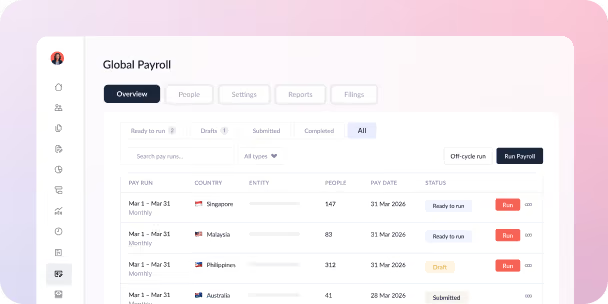
HR technology helps you automate repetitive payroll tasks like tax filings and salary deductions. Platforms like Omni simplify payroll workflows and reduce operational overhead, allowing HR teams to focus on more strategic tasks. Many of these tools even offer free trials or freemium models so you can test their effectiveness before committing to them.
However, they incur ongoing subscription fees, which can increase over time and significantly impact your company's budget. Furthermore, some tools require regular updates to adjust for new laws and remain compliant. This places more pressure on HR teams to regularly monitor regulations and manually update their tools.
How Modern Payroll Software Addresses Global Compliance
The nine challenges above have a common thread: they all get harder to manage manually as headcount and markets grow. At 20 employees in two countries, a spreadsheet-led process is uncomfortable but workable. At 80 employees across five markets, it becomes a liability.
Modern global payroll software addresses these challenges by embedding compliance logic directly into the payroll process — so statutory rates, filing requirements, and regulatory updates are handled by the platform rather than your team.
What that looks like in practice:
Statutory rate automation. Rather than manually updating contribution rates when the CPF Board in Singapore, DOLE in the Philippines, or LHDN in Malaysia releases new guidelines, a compliant platform applies those changes automatically. Your team processes payroll at current rates without tracking every regulatory circular.
Worker classification and contract management. The line between employee and contractor carries different tax and benefit implications in every market. Platforms with built-in worker classification support — and Employer of Record (EOR) capabilities for markets where you don't have a legal entity — remove the guesswork from this decision. Read more in our Employer of Record guide.
Centralized data with local compliance logic. The data management challenge — scattered records, inconsistent fields, manual re-entry across systems — is largely a systems architecture problem. A platform that centralizes employee records, attendance, leave, and payroll in one place means every statutory calculation draws from the same source of truth. No reconciliation across vendors, no data entry errors from manual transfers.
Audit-ready reporting. Tax authorities in every market expect documentation on demand. A strong global payroll platform generates contribution statements, payslip records, and statutory filing reports automatically — so your team isn't assembling documentation under pressure when an audit is triggered.
Omni HR combines all of these capabilities in a single platform built specifically for the APAC market. Local compliance for Singapore, Malaysia, the Philippines, Hong Kong, and Indonesia is built into the core — not added as a configuration layer. For teams navigating multi-country payroll management across the region, that means statutory contributions, tax filings, and regulatory updates are handled by the system, not your HR team.
"Payroll calculations that used to take three to five working days can now be done in half the time with Omni."— Tengku Mohaizad, Group Head of HR Asia, Inspire Brands Asia
See how Omni handles global payroll compliance →
Global Payroll Compliance Checklist
Use this checklist when setting up or auditing payroll in a new market, or reviewing your existing multi-country payroll process.
Statutory compliance
- Confirm applicable statutory contributions for each market (social security, retirement funds, health insurance, training levies)
- Verify contribution rates are current — check against official government sources, not vendor documentation alone
- Confirm correct worker classification for every employee and contractor in each jurisdiction
- Set up payslip formats that meet each country's MOM/labor authority requirements
Tax compliance
- Register for employer tax obligations in each country before the first payroll run
- Confirm withholding tax rates and filing deadlines per market
- Set up annual tax form generation (IR8A in Singapore, BIR 2316 in the Philippines, EA Form in Malaysia, etc.)
- Schedule year-end filings calendar with deadlines per country
Data and privacy
- Map which employee data is collected, stored, and processed in each market
- Confirm compliance with local data privacy laws (PDPA in Singapore, DPA in the Philippines, PDPA in Malaysia, GDPR if applicable)
- Implement role-based access controls so only authorized personnel can access sensitive payroll data
- Conduct a data audit across all payroll systems to identify inconsistencies or gaps
Process and systems
- Confirm payroll system updates automatically when statutory rates change — do not rely on manual rate updates
- Run a parallel payroll cycle before going live in a new market to catch configuration errors
- Document approval workflows for payroll changes, corrections, and off-cycle runs
- Set up audit trails for all payroll transactions
Vendor and partner management
- If using local payroll vendors, confirm each vendor's compliance certifications and review SLAs
- Establish escalation paths for urgent compliance queries in each market
- Schedule quarterly compliance reviews with all payroll vendors
What are some of the implications of non-compliance?
Failure to meet multi-country compliance standards can lead to severe consequences such as:
Financial penalties
Governments may conduct audits and impose heavy fines for infractions, such as missed deadlines, tax avoidance, or incorrect wages. These sanctions can incur financial losses and affect operational efficiency. Additionally, delayed or inaccurate tax filings can increase tax costs, disrupt financial planning, and cause cash flow problems.
Legal repercussions
Non-compliance can attract lawsuits from employees or government agencies, incurring costly legal fees. In extreme cases, the court may demand compensation for the aggrieved employee. The government can even place a temporary or permanent ban, preventing your business from operating in the country.
Reputational harm
Failing to comply with multi-country compliance can harm relationships with employees, customers, and investors, breaching trust. If this becomes public, it could lead to negative press coverage that damages your company's reputation and market positioning. Ultimately, such negative employer branding makes it harder to attract and keep top talent, hindering growth.
Employee morale and productivity
Incorrect or delayed compensation can lead to decreased employee morale and productivity. Since they don’t trust your company to pay their exact wages early, they may feel reluctant to execute their tasks. Some may even quit their jobs, increasing turnover rates.
Cash flow disruptions
Not managing global payroll compliance can disrupt cash flow due to unexpected financial penalties, legal expenses, or interest charges. Besides imposing fines, government agencies can freeze bank accounts until outstanding payments are settled. These sudden financial interruptions can strain company resources, making it harder to cover payroll expenses, vendor payments, and other vital business expenses.
Business interruptions
Noncompliance can divert resources from core business activities toward rectifying mistakes, causing more delays in payroll processing. As Sage’s Changing Face of HR report highlights, HR teams already handle heavy workloads. Adding unexpected tasks like recalculating deductions and updating records can lead to burnout.
Furthermore, regulatory bodies may suspend business operations, preventing your company from expanding into new markets or receiving client payments. Past noncompliance can also make it harder to secure deals with clients who prioritize compliance, slowing business growth.
Get my global payroll management manual
Best Practices for Global Payroll Compliance
1. Understand local regulations
Study the employment laws of the various regions in which you have employees. Also, regularly monitor changes in these laws and adapt to them to avoid outdated practices causing errors detrimental to employee satisfaction and compliance.
2. Adhere to data privacy regulations with strong security measures
Abide by the cross-border data transfer laws governing each region when managing global payroll compliance. Also, leverage payroll platforms with strong data protection systems to safeguard employee payroll information.
Such measures include:
- End-to-end encryption—to maintain confidentiality when sharing data between devices.
- Access controls, such as passwords, two-factor authentication, and biometric passwords.
- Using secure cloud storage solutions like Google Drive.
3. Implement strategies to manage currency fluctuations
Use payroll software that supports payments in multiple currencies. Ensure the tool has fair exchange rates and fast processing times.
4. Ensure accurate calculations
Double-check all calculations and deductions to confirm accuracy. Instead of calculating payments and deductions manually, invest in a payroll tool. Automation reduces manual errors and ensures payroll calculations align with regulatory requirements. Access my free EPF calculator, CPF calculator and SSS calculator now.
5. Be mindful of local customs and practices
Respecting local customs and cultures is crucial for multi-country compliance. It ensures smooth operations and helps your company maintain a positive reputation in various jurisdictions.
Ensure HR teams adapt to the payroll methods applicable to each region. For example, payroll frequency and benefits differ by country. While some regions prefer hourly pay cycles, others prefer monthly payments. Also, some countries have mandatory social contributions, such as the Central Provident Fund (CPF) in Singapore and the Employees Provident Fund (EPF) in Malaysia. Take note of them so you don’t deny employees their rights.
6. Ensure timely and accurate filing of tax returns
Use compliance tracking tools or automated payroll software to set reminders and receive real-time notifications regarding deadlines. Tools like Google Calendar send automated alerts ahead of deadlines, while project management tools like Trello help assign tasks and send deadline reminders.
7. Implement a centralized system to manage data
Invest in an all-in-one tool to manage data without incurring separate subscription fees, which can quickly add up and increase costs. Centralized automation integrates HR, payroll, and compliance into a single platform, reducing costs, simplifying workflows, and increasing efficiency.
8. Choose reputable and experienced payroll providers
Research your chosen payroll provider to confirm they have a solid reputation. Check for reviews from actual users on third-party sites like G2 or Trustpilot to be sure the tool can handle all global payroll compliance needs accurately.
9. Establish clear communication channels
Adopt communication and team management tools like Calendly, Slack, email, and Zoom to keep employees informed about changes in payroll, tax, or benefits administration. Create standard operating procedures (SOPs) for reporting payroll issues and compliance updates.
Schedule monthly or quarterly check-ins with global payroll compliance teams to address these changes and challenges.
10. Invest and integrate robust HR tools
Invest in an all-in-one HR tool that centralizes HR tasks, including payroll, compliance, and data management, into one intuitive platform. This unified approach reduces costs, saves time, and ensures accurate calculation without violating labor laws. Also, configure the tool to automatically calculate contributions based on employee data and a specified rate per region while tracking salary changes and regulatory updates.
Building a Robust Global Payroll Compliance Framework

Omni makes it easy to support employees across multiple countries, time zones, and currencies.
Affordable, functional, and suitable for modern, growing businesses—Omni is the payroll provider that your business can rely on. With a comprehensive payroll solution tailored to various countries specific requirements with features like support for HKD, SGD, and MYR, automated tax calculations, and managed contributions, HR teams can simplify their payroll processes while ensuring global payroll compliance.
Our time and attendance features empower teams to automate data and produce detailed reports in minutes, making payroll calculations instantaneous and accurate. With payroll solutions that support local currencies and payment schedules, Omni offers an entire suite of solutions to make your global payroll processing seamless.
With plans starting at just USD $3 per month per employee, discover how Omni's all-in-one HR software streamlines the entire employee lifecycle, saving People leaders from administrative tasks. Book your product tour with our team today to learn more!
RELATED READING
Frequently Asked Questions
Global payroll compliance is the process by which a business adheres to the labor laws, tax regulations, and statutory reporting requirements that govern employee compensation in every country it operates. It covers tax withholding, social security and retirement contributions, worker classification, leave entitlements, data privacy obligations, and filing deadlines — all of which vary by jurisdiction and change regularly. Non-compliance can result in financial penalties, legal action from employees or regulators, and reputational damage.
The risks are direct and concrete. Financial penalties vary by country but can be substantial — the IRS alone issued over $8.5 billion in employment tax civil penalties in 2023. Beyond fines, non-compliant payroll can trigger audits, create personal liability for company directors in some jurisdictions, generate employee disputes over unpaid or incorrectly calculated statutory contributions, and damage the employer brand in markets where you're trying to attract talent.
Most multinational companies use one of three approaches: in-house payroll teams with local expertise in each market, a network of local payroll vendors coordinated centrally, or a unified cloud payroll platform with built-in local compliance logic. The third approach is increasingly common for growing APAC businesses because it eliminates the data consistency issues that come from managing multiple vendors, and ensures compliance updates are applied automatically rather than requiring manual intervention.
The terms are used interchangeably in most contexts. "Global payroll" typically refers to the overall system or strategy for managing payroll across multiple countries, while "international payroll" often refers to the mechanics of processing payroll for employees in countries other than the company's home jurisdiction. In practice, both describe the same operational challenge: paying employees accurately and compliantly across multiple regulatory environments.
Compliant payroll software embeds statutory contribution rates, filing requirements, and labor law rules directly into the payroll process — so calculations are made at current rates automatically, filings are generated in the correct format for each jurisdiction, and regulatory updates are applied without manual intervention. For APAC specifically, this means platforms like Omni HR handle CPF in Singapore, EPF and SOCSO in Malaysia, SSS/PhilHealth/Pag-IBIG in the Philippines, and MPF in Hong Kong from a single system — with local compliance logic built into the core rather than configured as an afterthought.
A global payroll compliance checklist is a structured set of verification steps used to confirm that payroll processes in each market meet statutory and regulatory requirements. It typically covers statutory contribution verification, tax registration and filing deadlines, worker classification, data privacy compliance, and vendor management. See the checklist section above for a complete version.



.avif)
.avif)