
















.png)
Summary. Enterprise buyers evaluating AI HR software face a scale problem most comparisons ignore: AI features that work cleanly on a 200-person dataset often break down at 10,000 employees across a dozen legal entities, where data fragmentation, regional compliance, and legacy system integration are the norm, not the exception. We assess 10 platforms across AI feature depth, global payroll and compliance capability, security and governance, integration depth, and pricing transparency.
Most AI HRIS comparisons are written for US or European buyers. APAC compliance is often an afterthought rather than a genuine evaluation of whether the platform can handle CPF contributions in Singapore, EPF in Malaysia, SSS in the Philippines, and Super in Australia within the same system.
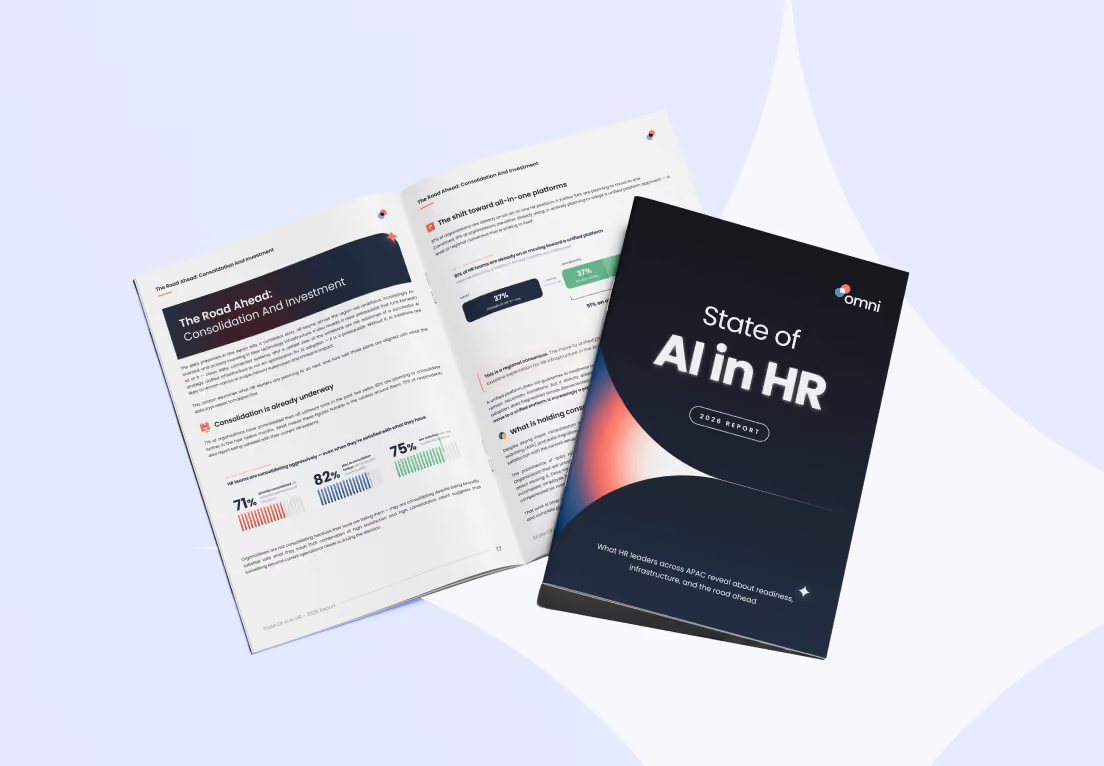
The harder problem for enterprise teams specifically: AI is only as reliable as the data architecture underneath it. Our State of AI in HR 2026 Report found that 82% of HR leaders plan to adopt AI, but only 21% trust it enough to act on its output without manual verification. At enterprise scale, where HR data typically spans multiple systems, entities, and (for multinational organizations) statutory frameworks, this gap only gets wider.
In this guide, we compare 10 platforms on the AI capabilities that matter for large organizations and the enterprise-grade infrastructure (security, integration, multi-entity handling) that determines whether those AI features hold up outside a sales demo.
Note: Omni HR is included in this list. We built this comparison, and we hold ourselves to the same five criteria as every other provider on it.
Quick Comparison: Best AI HR Software for Enterprise Teams
*G2 ratings are current as of July 2026. Ratings can change over time as new reviews are submitted, verify current ratings and capabilities directly with each vendor or G2 before shortlisting.
How We Evaluated the Best AI HR Software for Enterprise
Enterprise HR software has different failure modes than SMB or mid-market tools. We assessed each platform on five criteria that matter specifically at scale:
Evaluating HR software for a large organization? Check out these guides before you shortlist:
- The Best HRIS Software with AI Features (And What to Actually Look For)
- Best AI-Powered HRIS for APAC Teams
- Free resource: Payroll RFP Template for APAC
The 10 Best AI HR Software Platforms for Enterprise Teams
1. Omni HR
G2 rating: 4.6/5 (High Performer, Easiest to Use, Best Support)
AI type: Native, Mino conversational AI agent built into the platform, plus a native MCP integration for external AI assistants
Enterprise coverage: Australia, China, Hong Kong, India, Indonesia, Malaysia, Philippines, Singapore, Taiwan, Thailand, Vietnam, and more.
Best for: APAC-headquartered enterprises, or global enterprises with a significant APAC operating footprint, that need compliance-grade multi-country HR and conversational AI without a multi-year SAP or Workday-scale implementation.
Omni HR tops this list for enterprises operating in or through APAC because of what most global platforms get wrong in this region: they treat CPF, EPF, SSS, and similar statutory frameworks as configuration on top of a global data model, added after the fact rather than built in.
Omni HR treats multi-country APAC compliance as core architecture. Mino, our conversational AI agent, reads an enterprise's data schema (not raw employee records), constructs a query based on the question asked, and runs it through existing access controls before passing results to the language model for synthesis.
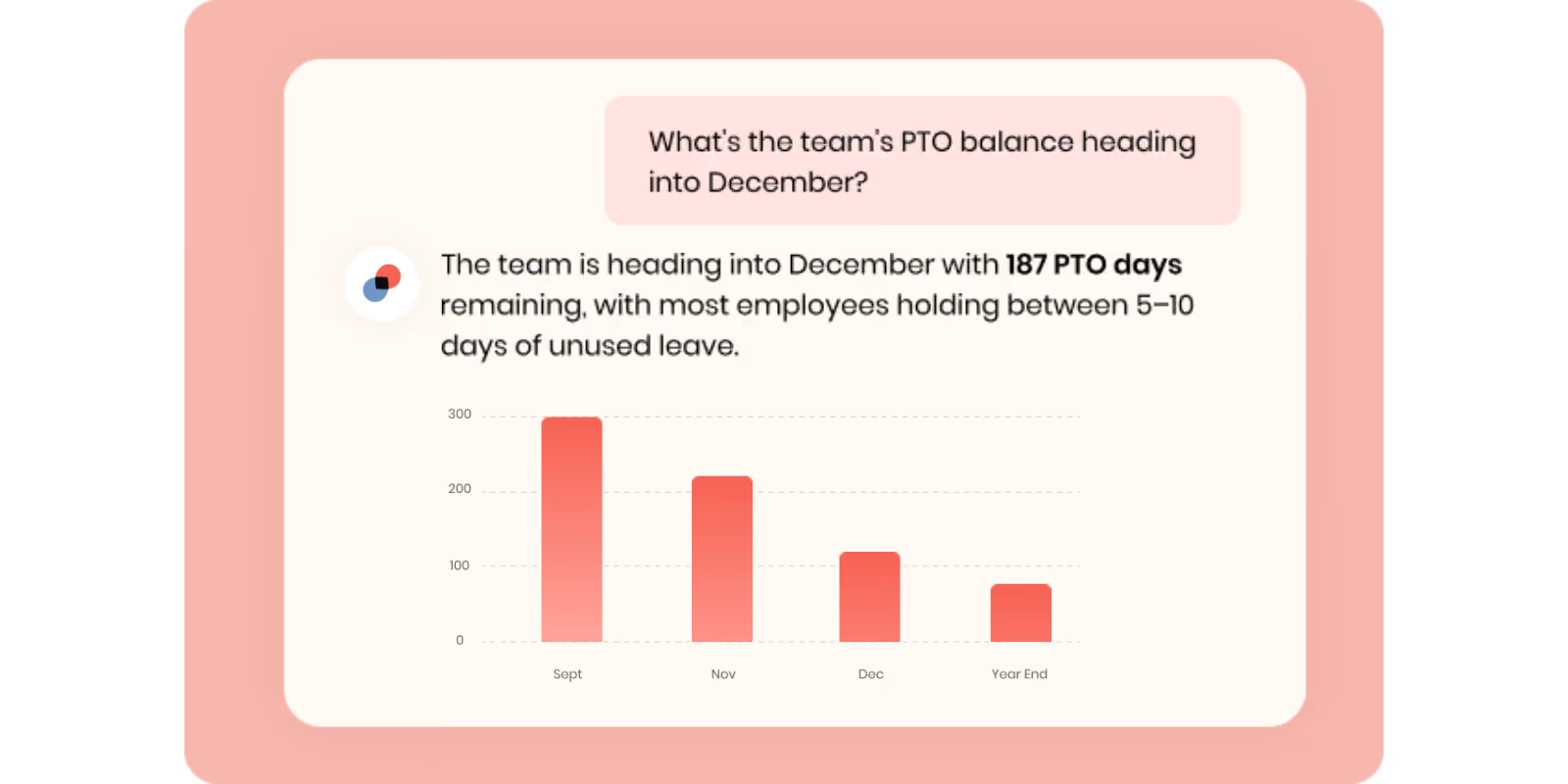
No other platform in this comparison combines that AI architecture with native APAC statutory depth in one system, which is the specific gap enterprise teams with regional operations keep running into. See how Mino works from a technical perspective.
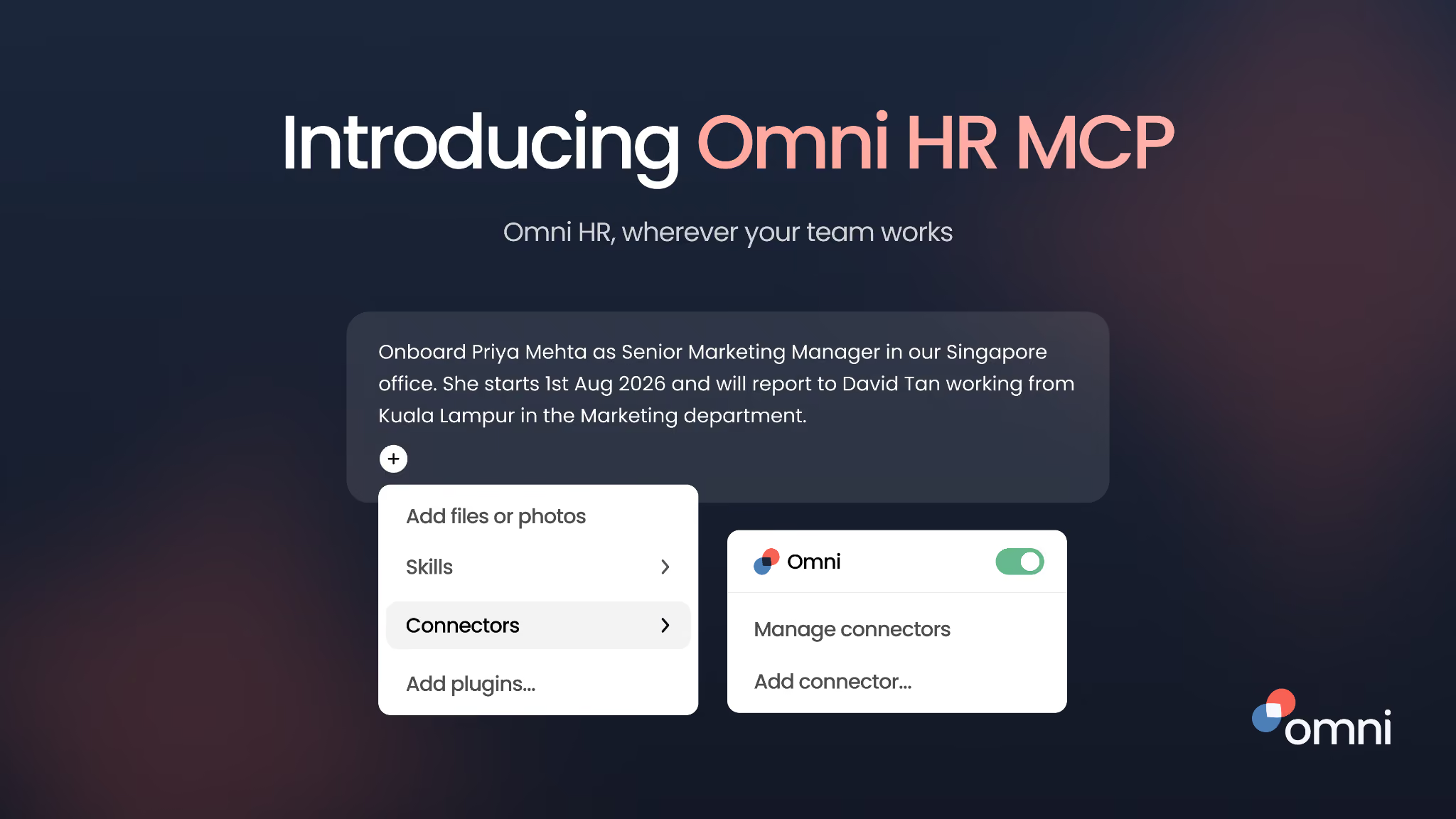
Omni HR has also launched a native MCP (Model Context Protocol) integration, extending that same architecture outward to the AI assistants enterprise teams already use, including Claude, ChatGPT, and Cursor. Rather than exporting HR data into a separate tool, teams can ask their assistant to pull a headcount snapshot, check who's on leave, or update an employee record directly, with every action scoped to the requesting user's existing Omni permissions and logged to the audit trail. Nothing is stored at the connector level and no new access is granted beyond what the user could already see or do inside Omni.
"Mino brought AI into Omni. The MCP integration brings Omni into the AI tools your teams are already using every day. What makes both of them different is that your access controls travel with the data. The AI doesn't get a bigger view of your business than the person operating it, and we think that's the standard the whole industry should be held to."
— Brian Ip, CEO, Omni HR
What it handles:
- Conversational workforce analytics (headcount, attrition, department breakdowns) via Mino
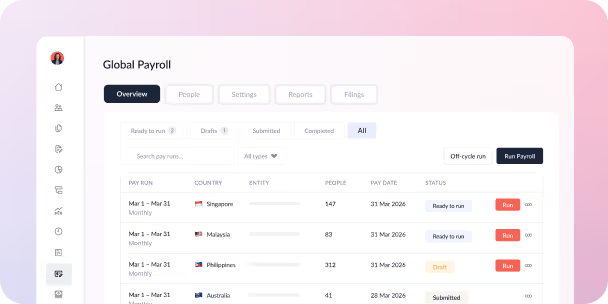
- Multi-country payroll with native CPF, EPF, SSS, MPF handling
- AI-powered workflow automation for onboarding, leave, and approvals
- Reports and analytics across all entities in one view
- Performance management, recruitment (ATS), surveys, and expense management
- Native MCP integration for reading and acting on live HR data from Claude, ChatGPT, Cursor, and other MCP-compatible tools, permission-scoped to each user
Omni HR customers report measurable results at scale: SleekFlow reduced payroll processing time by 40% after consolidating HR across four countries; Lucence cut payroll processing time by 50% while scaling headcount; DNB reduced data errors by 67%.
Honest limitation: Omni HR's depth is regional, not global. If an enterprise's headquarters and majority headcount sit outside APAC, or if the organization needs a single global system spanning Latin America, EMEA, and APAC in one contract, a global platform may be a better architectural fit. Mino also currently covers core employee, job, and expense data; payroll analytics and performance data are on the roadmap but not yet fully in scope for AI queries.
2. Workday
G2 rating: 4.2/5
AI type: Native, Workday Illuminate across HR, finance, and workforce planning
Enterprise coverage: Global, with deep functionality for large, multi-region organizations
Best for: Global enterprises with complex, multi-region operations where workforce planning complexity justifies the investment.
Workday is the platform most large enterprises benchmark against. Illuminate spans hundreds of AI-powered actions across HR, payroll, and planning workflows, and the platform's data model was built for organizational complexity from the start rather than retrofitted for it.
What it handles:
- Illuminate AI actions embedded across HR, payroll, and financial planning workflows
- Workday Peakon Employee Voice for engagement trend and flight-risk analysis
- Adaptive Planning with AI for workforce scenario modeling and headcount planning
- Skills inference that tags employees based on job history and learning data
Honest limitation: Workday requires a significant implementation budget and a dedicated HR operations team to configure and maintain. Value compounds most at scale (typically 1,000+ employees), and smaller enterprises rarely see ROI without a multi-year implementation runway.
3. SAP SuccessFactors
G2 rating: 4.1/5
AI type: Native, Joule AI copilot across all HXM modules
Enterprise coverage: Broad global coverage, strongest where already integrated with SAP finance and operations
Best for: Large global enterprises already in the SAP ecosystem that want AI capability across HR, finance, and operations in one vendor relationship.
SAP SuccessFactors is one of the most comprehensive enterprise HCM suites available, and Joule represents genuine investment in conversational AI across HR transactions, talent management, and workforce planning rather than a single bolted-on feature.
What it handles:
- Joule conversational AI copilot embedded across all SuccessFactors modules
- AI-powered skills ontology for talent mobility and succession planning
- Predictive analytics for workforce planning and attrition modeling
- AI-assisted job description writing and candidate scoring in Recruiting
Honest limitation: SuccessFactors is complex to implement and expensive to run. Joule performs best once the platform is fully configured and the underlying data is clean, a process that typically takes 12-24 months for large deployments. For enterprises outside the SAP ecosystem, this isn't a platform to adopt for AI features alone.
4. Oracle Fusion Cloud HCM
G2 rating: 3.8/5
AI type: Native, Oracle AI Agents embedded across HR processes
Enterprise coverage: Global, strongest for organizations already standardized on Oracle
Best for: Enterprises standardizing on Oracle across HR, finance, and supply chain that want a single-vendor AI strategy.
Oracle Fusion Cloud HCM extends Oracle's broader AI investment into HR, with agents designed to handle multi-step HR processes (not just surface insights) across recruiting, workforce management, and payroll.
What it handles:
- AI agents for recruiting, onboarding, and workforce management workflows
- Predictive analytics for attrition and workforce planning
- Embedded AI across payroll processing and compliance checks
- Deep integration with Oracle ERP, finance, and supply chain modules
Honest limitation: Oracle HCM's biggest advantage (deep native integration with Oracle ERP) is close to irrelevant if an enterprise isn't already running Oracle for finance or operations. Implementation complexity and cost mirror other top-tier enterprise suites, and the platform is generally not competitive on price for organizations evaluating it as a standalone HR system.
5. UKG Pro
G2 rating: 4.3/5
AI type: Native, Bryte AI for workforce insights and anomaly detection
Enterprise coverage: Strongest in the US, particularly for complex scheduling and labor compliance
Best for: Large US-headquartered enterprises with complex scheduling, shift work, or multi-state labor compliance needs.
UKG Pro has built a reputation on workforce management depth, particularly for enterprises with complex scheduling, shift work, or labor law exposure across US states. Bryte AI is applied most heavily to anomaly detection and workforce insight generation.
What it handles:
- Bryte AI for payroll anomaly detection and workforce pattern insights
- AI-assisted scheduling recommendations for complex shift environments
- Predictive analytics for turnover and workforce planning
- Embedded compliance guardrails for US labor law complexity
Honest limitation: UKG Pro's AI and compliance depth is strongest for US-headquartered enterprises. International and multi-country capability exists but is less mature than the platform's US labor law and scheduling functionality, so enterprises with significant non-US headcount should scrutinize this specifically before shortlisting.
6. ADP Workforce Now
G2 rating: 4.2/5
AI type: Native, ADP Assist AI across payroll and HR workflows
Enterprise coverage: Global payroll infrastructure with decades of compliance track record
Best for: Enterprises prioritizing payroll accuracy and a long compliance track record over AI feature novelty.
ADP's core advantage isn't newness, it's payroll infrastructure that's been battle-tested at enterprise scale for decades. ADP Assist layers AI on top of that infrastructure rather than replacing it, which is a meaningfully different risk profile than a newer AI-first platform.
What it handles:
- ADP Assist AI for payroll processing insights and anomaly flags
- Compliance monitoring across US and global payroll requirements (via GlobalView for multinational enterprises)
- AI-assisted HR service delivery and case management
- Workforce analytics and benchmarking against ADP's large customer dataset
Honest limitation: ADP's AI layer is genuinely newer than its payroll infrastructure, and enterprises evaluating it primarily for AI capability (rather than payroll reliability) may find the AI features less differentiated than newer entrants. The platform's strength is compliance track record, not cutting-edge AI functionality.
7. Dayforce
G2 rating: 4.2/5
AI type: Native, Dayforce Co-Pilot for HR and payroll queries
Enterprise coverage: Global, with a real-time pay engine built for multi-country complexity
Best for: Enterprises wanting a single continuous pay calculation engine across multiple countries rather than stitched-together regional payroll runs.
Dayforce's architectural bet is a single continuous pay calculation engine rather than periodic batch payroll runs, and Co-Pilot is built to query that same real-time data model conversationally.
What it handles:
- Dayforce Co-Pilot for natural-language queries against HR and payroll data
- Real-time payroll calculation across multiple countries and entities
- AI-assisted scheduling and workforce management
- Predictive analytics for turnover and labor cost forecasting
Honest limitation: Dayforce's real-time pay engine is powerful but represents a genuine architectural shift from how most enterprises currently run payroll, which means implementation and change management are non-trivial. Enterprises should budget for a longer transition period than a like-for-like platform swap.
8. Rippling
G2 rating: 4.8/5
AI type: Native, AI built on a unified HR, IT, and finance data model
Enterprise coverage: Growing quickly in upper-mid-market and early enterprise; SEA statutory compliance limited
Best for: Tech-forward enterprises with a US or global headquarters wanting deep HR, IT, and finance integration, where APAC statutory complexity isn't the primary constraint.
Rippling's core differentiation is a unified data model spanning HR, IT provisioning, payroll, and finance, which gives its AI layer more signal than platforms where HR data sits in a silo.
What it handles:
- Cross-functional workflow automation triggered from a single HR event (hire, change, terminate)
- Analytics connecting headcount, compensation, and software spend in one view
- AI-assisted headcount planning and scenario modeling
- Device provisioning and IT management alongside HR
Honest limitation: Rippling's compliance coverage for Southeast Asia is limited; for enterprises running payroll in Singapore, Malaysia, or the Philippines, statutory compliance tooling is less mature than APAC-native options like Omni HR. Pricing requires a custom quote layered on top of existing subscription costs, and AI features are most valuable once the full Rippling stack is deployed.
9. Darwinbox
G2 rating: 4.4/5
AI type: Native, Darwinbox Sense (people analytics) and HiringX (AI recruitment)
Enterprise coverage: Strongest enterprise depth in India, Indonesia, Malaysia, and Vietnam
Best for: Enterprise organizations with headcount concentrated in India and Southeast Asia that need deep regional HRIS functionality with a mature AI talent suite.
Darwinbox is one of the most widely adopted enterprise HRIS platforms in South and Southeast Asia, with genuine regional depth that global competitors typically lack in this geography.
What it handles:
- HiringX for AI-powered resume screening, candidate scoring, and interview scheduling automation
- Darwinbox Sense for people analytics with engagement signal monitoring and attrition prediction
- Automated workflow builder across onboarding, performance cycles, and exit processes
- Payroll and compliance management across India and select SEA markets
Honest limitation: Darwinbox's strength concentrates in India and large enterprise deployments in Indonesia and Malaysia. For enterprises with significant headcount in Singapore, Hong Kong, or the Philippines, compliance depth outside its core markets may vary, and pricing is custom-quote only, which makes it harder to benchmark against other vendors like Omni HR upfront.
10. Paylocity
G2 rating: 4.4/5
AI type: AI-assisted insights layered across payroll, talent, and engagement modules
Enterprise coverage: Established mid-to-large enterprise presence, primarily US-focused
Best for: US-headquartered enterprises wanting an all-in-one payroll-first HCM without the SAP or Workday-scale implementation.
Paylocity has scaled from a mid-market payroll provider into a genuine large-enterprise contender, with AI features focused on surfacing insights across payroll accuracy and talent data rather than a conversational AI agent.
What it handles:
- AI-assisted payroll anomaly and error detection
- AI-surfaced insights from engagement and survey data
- Automated compliance alerts for US federal and state requirements
- Talent analytics across recruiting, performance, and retention
Honest limitation: Paylocity's international and multi-country capability is materially behind its US functionality. Enterprises with significant non-US headcount will likely need a separate platform or integration layer for those employees.
Enterprise HR Software Features to Look For
Beyond AI, here’s five other capabilities that separate genuinely enterprise-ready HR software from mid-market tools stretched past their limits:
- Multi-entity and multi-country support. The platform should handle separate legal entities, currencies, and statutory requirements natively, not through workarounds or spreadsheets bolted on the side.
- Role-based access control at scale. Enterprise organizations need granular permissions across regions, departments, and management layers, not a flat admin/employee structure.
- Audit trails and compliance reporting. Every AI-generated recommendation or automated action should be traceable for compliance and audit purposes.
- Integration with existing ERP and finance systems. Enterprise HR software rarely operates in isolation; it needs to sync cleanly with the finance and IT systems already in place.
- Implementation and change management support. At enterprise scale, the vendor's implementation team matters nearly as much as the product itself.
How to Choose the Best AI HR Software for Your Enterprise
The right platform depends on where your workforce actually sits, how many entities you're managing, and whether "enterprise" means global mega-scale or a large, regionally concentrated organization.
What is AI HR Software for Enterprise?
AI HR software for enterprise is a human resources information system (HRIS or HCM) that applies artificial intelligence to workforce data at organizational scale, meaning across multiple entities, regions, and often statutory frameworks, rather than within a single office or country.
At enterprise scale, AI features generally fall into four categories:
- Automation removes repetitive manual work across large HR operations teams: routing approvals, flagging payroll anomalies, triggering onboarding sequences across entities.
- Analytics and reporting turns fragmented workforce data into a coherent view: headcount trends, attrition signals, and engagement patterns across the whole organization, not just one region.
- Conversational interfaces give HR teams natural-language access to workforce data without waiting on a report to run or an analyst to build a query.
- Decision support surfaces signals that let HR act proactively at scale: flight-risk prediction, pay equity alerts, and workforce scenario modeling across entities.
Most platforms have automation and basic analytics covered. The harder differentiation, especially for enterprise buyers, is whether conversational and decision-support AI actually understands the organization's real data complexity, or whether it just answers questions faster on data that was already fragmented to begin with.
Start With AI HR Software Built for Your Actual Footprint
The biggest mistake enterprise buyers make in this category is evaluating AI features in isolation from the data architecture underneath them. An AI copilot that can't see clean, unified data across your entities will surface the same problems your HR team already has, just faster.
If your enterprise operates primarily in Singapore, Malaysia, the Philippines, or Hong Kong, or has a significant APAC footprint alongside global operations, Omni HR's Mino is built specifically for that environment, working with the same data that powers your payroll runs and compliance records across every APAC entity.
Book a demo to see how Mino and Omni HR's multi-country HRIS work together for enterprise teams with APAC operations.
Frequently Asked Questions
The strongest Workday alternatives depend on what's driving the search. SAP SuccessFactors and Oracle Fusion Cloud HCM are the closest matches for organizations that need the same level of global, multi-region depth but want a different vendor relationship. Rippling is a common alternative for tech-forward enterprises that want HR, IT, and finance unified in one system. For enterprises with significant APAC operations specifically, Omni HR is worth evaluating alongside Workday, since native multi-country APAC compliance is often the gap Workday implementations run into in this region.
It depends on where the company's workforce actually sits. Workday and SAP SuccessFactors lead for large, globally distributed workforces (1,000+ employees across many regions) where implementation budget supports multi-year rollouts. Darwinbox leads for large companies concentrated in India and Southeast Asia. Omni HR leads for large companies headquartered in or operating significantly across APAC that need multi-country compliance and conversational AI without a Workday-scale implementation. There's no single best HRIS for every large company; the right one matches your actual geographic footprint.
No, but the composition of HR work is shifting. AI is automating repetitive tasks and accelerating analytics, but our State of AI in HR 2026 Report found only 21% of HR leaders trust AI output enough to act on it without manual verification. At enterprise scale specifically, AI works best as a tool that surfaces problems and drafts first-pass answers faster, with people still making the final call on compliance-sensitive or judgment-heavy decisions.
Most enterprise HR software, including every platform in this comparison, uses custom pricing based on headcount, modules, and implementation scope rather than public per-seat pricing. Expect implementation timelines ranging from a few months (Omni HR, Rippling, Paylocity) to 12-24 months for the largest global suites (Workday, SAP SuccessFactors, Oracle), and get a total cost of ownership estimate that includes implementation, not just the ongoing subscription.
It depends on the platform's architecture, not just its marketing claims. Some AI HR tools send raw employee records (names, salaries, performance data) to a third-party language model, or store data at the connector level when integrating with outside AI assistants. Others, like Omni HR's Mino and its MCP integration, query a data schema and enforce the requesting user's existing permissions before returning results, without storing HR data at the connector layer. That distinction matters for enterprises operating under data privacy regulations like PDPA or the Philippines Data Privacy Act. Ask any vendor directly what data the AI actually touches, and where it's stored, before shortlisting.



.avif)
.avif)