

















.png)
Summary. The best AI HRIS for BPO handles high-volume onboarding, 24/7 shift scheduling, and multi-site statutory compliance, without sending agent data outside the platform to process it. This guide compares 10 AI-powered HRIS platforms on AI feature depth, high-volume workforce handling, native APAC compliance, multi-client capability, and pricing transparency. Agent attrition is one of BPO's best-documented challenges, so real-time AI isn't optional. Omni HR's Mino agent queries data schemas instead of transmitting raw records, and its native MCP integration extends that same schema-safe access to other AI tools, natively handling SSS, PhilHealth, Pag-IBIG, and BIR alongside EPF, SOCSO, and CPF across APAC.
Most "best HRIS" comparisons are written for a single-entity company hiring a few dozen people a year. That isn't the BPO reality. A mid-size outsourcing firm might onboard hundreds of agents in a single month for a new client ramp, run payroll across multiple statutory jurisdictions at once, and need HR data segmented by client account for billing and reporting, all while managing attrition rates that would alarm almost any other industry.
The harder problem: AI in HR is only as reliable as the data it runs on, and BPO data is some of the most fragmented in any sector, split across client-specific workflows, multiple delivery sites, and constant headcount churn.
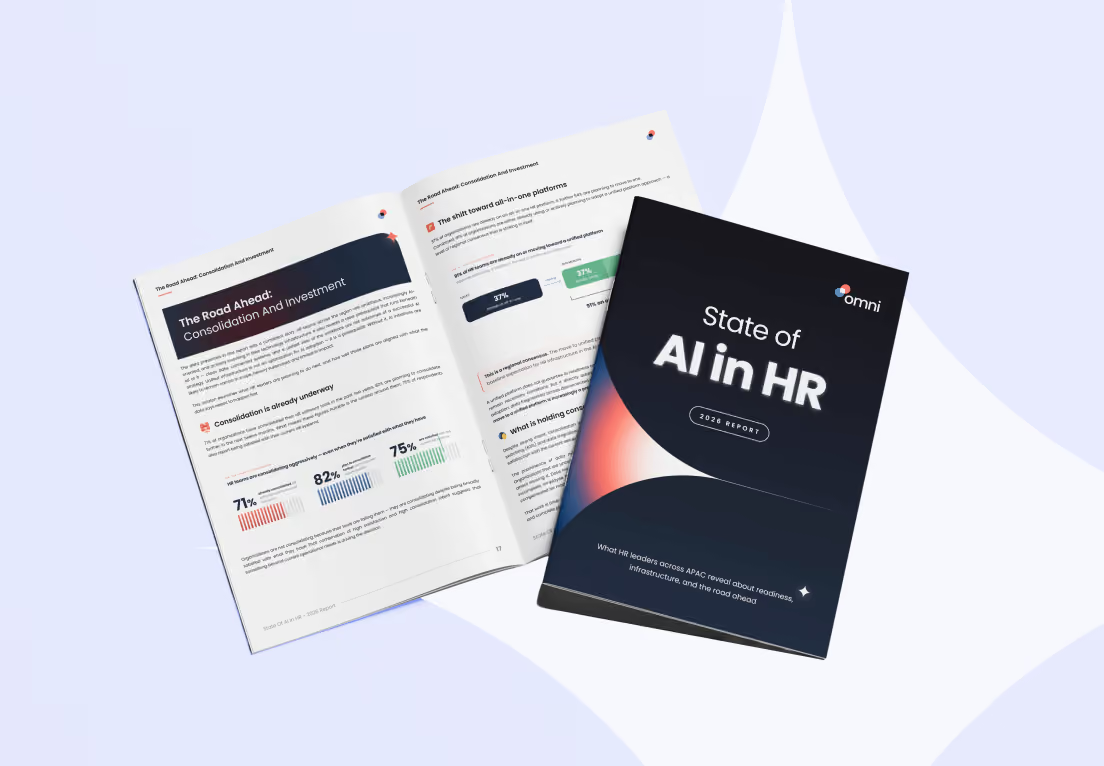
Download our State of AI in HR 2026 Report
In this guide, we compare 10 platforms on the AI features that matter for outsourcing operations and the compliance and scale depth that determines whether those AI features hold up once you're running payroll for 2,000 agents across three countries.
Note: Omni HR is included in this list — we built this comparison, and we hold ourselves to the same five criteria as every other provider on the list.
How We Evaluated the Best AI HR Software for BPO
Not all AI features are equal, and not all HRIS platforms are built to survive BPO-scale churn. We assessed each platform on five criteria that specifically matter for outsourcing and BPO operations:
Quick Comparison: Best AI HR Software for BPO
*G2 ratings as of July 2026. Verify directly with each vendor before shortlisting.
The 10 Best AI HR Software for BPO
1. Omni HR
G2 rating: 4.7/5 (High Performer, Easiest to Use, Best Support)
AI type: Native — Mino conversational AI agent, built into the platform
BPO/APAC coverage: Philippines, Malaysia, Singapore, Indonesia, Hong Kong, Australia, China, Taiwan, Thailand, and Vietnam
Best for: APAC-first or APAC-primary BPOs that want AI analytics built into compliance-grade multi-country HR without stitching together separate tools for each delivery market.
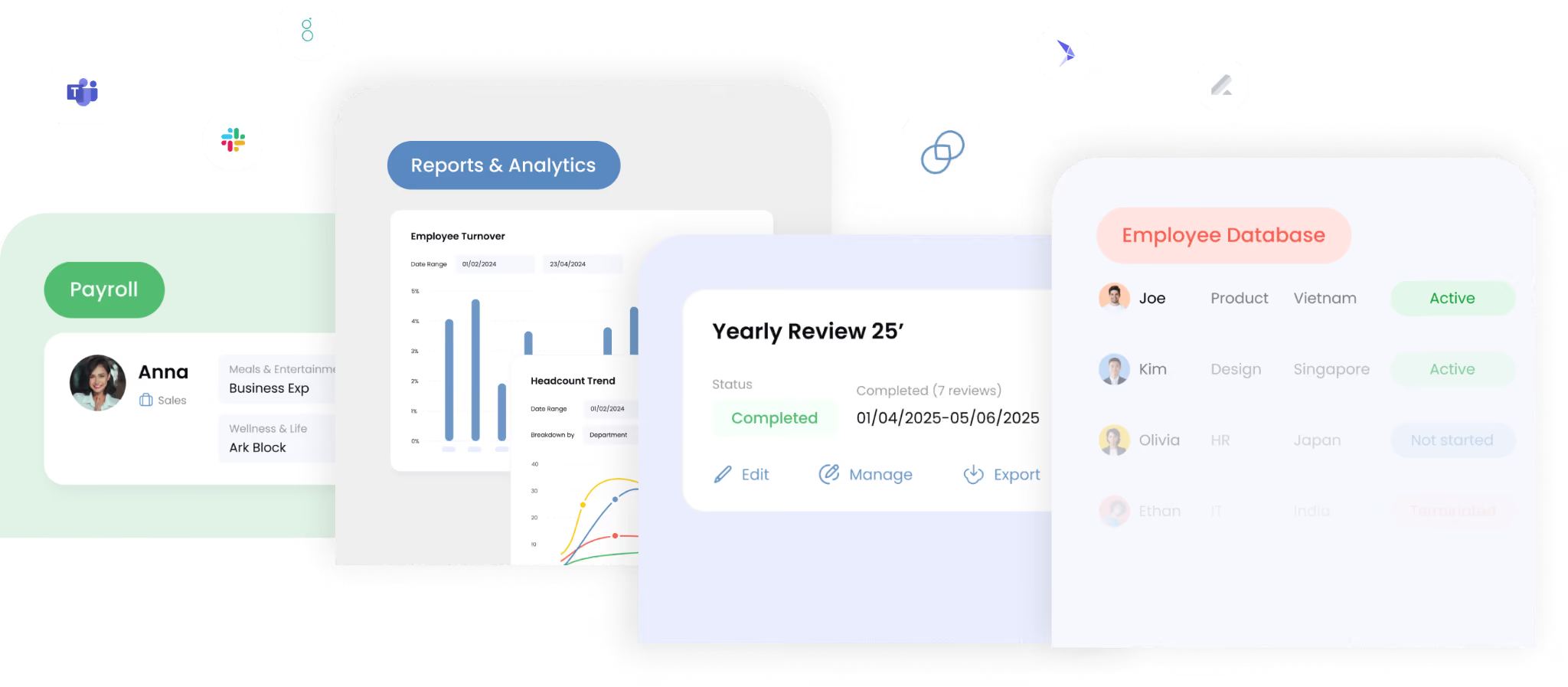
Omni HR is an AI-powered HRIS built specifically for Asia-Pacific, and that regional focus matters most in an industry where a single client contract can require you to staff delivery teams across three or four countries at once. Our AI differentiator is Mino, a conversational AI agent that lets HR and workforce teams query agent data the way they'd ask a colleague, without exports, pivot tables, or waiting on a report to run during a live client ramp.
Most "AI in HR" features follow a GPT wrapper pattern: the platform takes your employee data, sends it to a hosted large language model, and asks it to read through everything and return an answer. In a BPO context, that means agent PII, much of it tied to specific client accounts under NDA, gets transmitted to a third-party model outside your infrastructure.
Mino is designed differently. Our AI agent reads your data schema (not your agent records), constructs a database query based on your question, runs that through Omni's existing access controls, and only then passes the result to the language model for synthesis. No raw PII is transmitted. For BPO teams managing client-segmented data under PDPA (Singapore, Malaysia) or the Philippines Data Privacy Act, this architecture is not a nice-to-have. See how Mino works from a technical perspective.
That same schema-safe architecture extends to Omni HR's native MCP (Model Context Protocol) integration, which lets external AI tools and agents, including the ones your finance, workforce planning, or client reporting teams already use, query Omni data through the same access-controlled layer instead of pulling raw exports into a separate system. For a BPO segmenting HR data by client account, that means a client-specific reporting tool can be connected to Omni without duplicating agent PII outside the platform in the first place.
What it handles:
- Conversational workforce analytics (headcount, attrition, client-account breakdowns) via Mino
- Native MCP integration connecting external AI tools and agents to Omni data through the same schema-safe, access-controlled layer
- Multi-country payroll with native SSS, PhilHealth, Pag-IBIG, BIR, EPF, and SOCSO handling
- AI-powered workflow automation for bulk onboarding, leave, and approvals
- Reports & Analytics segmented across entities, sites, or client accounts
- Performance management, recruitment (ATS), surveys, and expense management
- Employee self-service portal built for distributed, shift-based teams
Omni HR customers report measurable results: SleekFlow reduced payroll processing time by 40% after consolidating HR across four countries, and Lucence cut payroll processing time by 50% while scaling headcount. See all customer stories.
Honest limitation:
Mino currently covers core employee data, job records, and expense data. Payroll analytics and performance data are on the roadmap but not yet fully in scope for AI queries. Omni's footprint is also APAC-specific; BPOs running delivery centers in Latin America or EMEA alongside APAC will need a separate tool for those regions.
2. Sprout Solutions
G2 rating: 4.7/5
AI type: Native — Sunnies, AI-assisted payroll processing and HR insights
BPO/APAC coverage: Philippines-native; limited coverage outside the Philippines
Best for: Philippines-first BPOs and outsourcing SMEs that need deep native statutory compliance and don't require multi-country coverage in the same contract.
Sprout Solutions is one of the most widely adopted HR and payroll platforms in the Philippines, and for BPOs whose delivery footprint is entirely or mostly Philippine-based, that native depth is hard to match. It was built around Philippine statutory requirements from day one rather than adapting a global platform to fit them.
What it handles:
- AI-assisted payroll processing with anomaly flagging
- Native BIR, SSS, PhilHealth, and Pag-IBIG compliance and reporting
- Time and attendance built for shift-based, multi-site operations
- Employee self-service and document management
- Recruitment and applicant tracking
Honest limitation:
Sprout Solutions' strength is concentrated in the Philippines. BPOs with delivery centers in Malaysia, India, or elsewhere in APAC will need a separate system (or systems) for those markets, which reintroduces the data fragmentation problem AI is supposed to solve. Its AI features are also newer and less conversational than platforms built AI-first.
3. Darwinbox
G2 rating: 4.4/5
AI type: Native — Darwinbox Sense (people analytics), HiringX (AI recruitment)
BPO/APAC coverage: India, Indonesia, Malaysia, Vietnam; enterprise deployments across Southeast Asia
Best for: Enterprise BPO and ITES organizations with headcount concentrated in India and Southeast Asia that need deep regional HRIS functionality with a mature AI talent layer.
Darwinbox has genuine traction inside large BPO and ITES operations across India and Southeast Asia, where its enterprise-grade workflow builder and analytics layer are built to handle the scale and churn these organizations run at.
What it handles:
- HiringX: AI-powered resume screening, candidate scoring, and interview scheduling automation for high-volume hiring
- Darwinbox Sense: people analytics with engagement signal monitoring and attrition prediction
- Employee self-service chatbot for common HR queries
- Automated workflow builder across onboarding, performance cycles, and exit processes
- Payroll and compliance management across India and select SEA markets
Honest limitation:
Darwinbox's strength is India and large enterprise deployments in Indonesia and Malaysia. For BPOs primarily delivering out of the Philippines, compliance depth and support responsiveness may vary. Its pricing model is enterprise-first, custom quotes only, which isn't ideal for smaller outsourcing shops benchmarking vendors on a budget.
4. UKG
G2 rating: 4.4/5
AI type: Native — UKG Bryte AI for workforce forecasting, scheduling, and anomaly detection
BPO/APAC coverage: Global platform; APAC statutory compliance typically requires local configuration or a partner implementation
Best for: BPOs where 24/7 shift coverage, shrinkage, and labor forecasting are the top operational priority, and where a separate solution already handles APAC statutory payroll.
UKG built its reputation on workforce management, and for BPOs running 24/7 shift operations across multiple time zones, that's precisely the problem most general-purpose HRIS platforms handle poorly. Bryte AI forecasts staffing needs and flags scheduling anomalies before they turn into coverage gaps.
What it handles:
- AI-driven demand forecasting for shift scheduling and labor coverage
- Shrinkage and absence pattern detection
- Time and attendance built for complex, rotating shift patterns
- Workforce analytics across sites and business units
- Core HR and talent management modules
Honest limitation:
UKG's AI depth is strongest in scheduling and workforce management, not in APAC statutory payroll compliance. BPOs running Philippine or Southeast Asian payroll will likely need local configuration, a regional partner, or a separate payroll engine, which adds integration overhead that can undercut the platform's own AI accuracy.
5. ADP
G2 rating: 4.2/5
AI type: Native — ADP Assist for payroll anomaly detection and HR insights
BPO/APAC coverage: Global payroll infrastructure via ADP GlobalView and Celergo; APAC depth varies by local ADP entity
Best for: Large multinational BPOs that want to standardize payroll processing across many countries under one enterprise vendor relationship.
ADP is a familiar name across the outsourcing and staffing industry, largely because of its payroll processing scale and its long history serving multinational employers that need consistent payroll infrastructure across many countries at once.
What it handles:
- ADP Assist: AI-powered anomaly detection across payroll runs
- Global payroll processing across a wide footprint of countries
- Compliance monitoring and regulatory update alerts
- Workforce analytics and reporting
- Talent acquisition and onboarding tools
Honest limitation:
ADP's AI layer is narrower than purpose-built AI HRIS platforms, most of the intelligence is concentrated in payroll anomaly detection rather than conversational analytics or workforce planning. Its enterprise pricing and implementation timelines are also better suited to large multinational BPOs than to mid-size outsourcing shops evaluating multiple vendors on a shorter runway.
6. PeopleStrong
G2 rating: 4.5/5
AI type: Native — Alt, PeopleStrong's AI layer for people analytics and diagnostics
BPO/APAC coverage: India-native; limited coverage outside India
Best for: India-first BPO and ITES organizations that want AI-enabled attrition prediction alongside deep India statutory compliance.
PeopleStrong has strong adoption inside India's BPO and ITES sector, where it competes directly with Darwinbox for large-scale, high-churn workforce management. Its Alt AI layer focuses on surfacing attrition and engagement signals early.
What it handles:
- Alt: AI-powered attrition prediction and workforce diagnostics
- High-volume recruitment and onboarding automation
- Native India statutory compliance (PF, ESI, professional tax)
- Performance management and continuous feedback tools
- Workforce analytics dashboards
Honest limitation:
PeopleStrong's coverage outside India is limited, so BPOs with delivery sites in the Philippines, Malaysia, or elsewhere in Southeast Asia will need a separate platform for those markets. Its AI features are also more developed in attrition and hiring analytics than in broader conversational data access.
7. greytHR
G2 rating: 4.4/5
AI type: Native — GreyLo, an AI assistant for HR queries and compliance alerts
BPO/APAC coverage: India-native (PF, ESI, TDS, professional tax); minimal coverage outside India
Best for: Mid-size BPO and ITES teams concentrated in India that prioritize compliance reliability over broader AI capability.
greytHR is a long-standing, trusted name for statutory compliance in India, and its newer GreyLo AI assistant extends that trust into faster query resolution and proactive compliance alerts, useful for BPOs juggling constant regulatory updates across delivery sites.
What it handles:
- GreyLo: AI assistant for compliance queries and HR policy questions
- Native India payroll and statutory compliance (PF, ESI, TDS, professional tax)
- Leave and attendance management for shift-based teams
- Employee self-service portal
- Exit management and full-and-final settlement automation
Honest limitation:
greytHR's AI ceiling is lower than platforms built AI-first, GreyLo is helpful for compliance queries but doesn't extend into conversational workforce analytics or predictive attrition modeling. Its geographic coverage is also concentrated in India, so it isn't a fit for BPOs with a multi-country APAC footprint.
8. Kissflow HR
G2 rating: 4.3/5
AI type: Native — Kissflow AI copilot for workflow automation and process design
BPO/APAC coverage: Global workflow platform; statutory payroll compliance typically handled through integrations
Best for: BPOs with heavy manual approval chains and client-specific onboarding processes that need workflow automation layered on top of an existing payroll system.
BPOs run on approval chains, client onboarding checklists, and repetitive process work at volume. Kissflow HR's core strength is workflow automation, and its AI copilot helps teams design and troubleshoot those workflows without needing dedicated process engineers.
What it handles:
- AI copilot for building and optimizing HR approval workflows
- Bulk onboarding and offboarding workflow automation
- Client- or project-based workflow segmentation
- Integration layer connecting to third-party payroll and compliance tools
- Reporting on process bottlenecks and cycle times
Honest limitation:
Kissflow HR is a workflow automation platform first and a core HRIS second. Statutory payroll compliance is typically handled through integrations rather than natively, which means BPOs still need a dedicated payroll engine for APAC markets underneath it.
9. Workday
G2 rating: 4.1/5
AI type: Native — Workday Illuminate, AI across HR, finance, and workforce planning
BPO/APAC coverage: Global; APAC-specific statutory compliance requires local configuration
Best for: Large-scale BPOs (5,000+ seats) with multi-region operations where workforce planning complexity justifies the investment.
Workday Illuminate is among the most mature AI layers in the enterprise segment, and for BPO groups operating at genuinely large scale, thousands of seats across multiple regions, that maturity can justify the investment.
What it handles:
- Workday Illuminate: AI-powered actions embedded across HR, payroll, and planning workflows
- Workday Peakon Employee Voice: machine learning for engagement trends and flight risk prediction
- Adaptive Planning with AI: workforce scenario modeling and headcount planning across client accounts
- Skills inference: automatically tags agents with skills based on job history and training data
Honest limitation:
Workday is built for enterprises with significant implementation budgets and dedicated HR operations teams. For APAC-specific statutory compliance, additional configuration or local implementation support is typically required, and the AI layer does not natively understand APAC compliance nuance out of the box. The value compounds most at scale, which means smaller outsourcing shops rarely see ROI without a multi-year implementation.
10. Zoho People
G2 rating: 4.4/5
AI type: Native within Zoho ecosystem — Zia AI assistant
BPO/APAC coverage: India strong; limited SEA statutory payroll handling
Best for: Small to mid-size outsourcing shops that want affordable AI HR tools and have relatively straightforward, single-country compliance requirements.
Zoho People sits within the broader Zoho ecosystem and benefits from Zoho's investment in Zia, its AI assistant. For smaller outsourcing shops that need a capable HRIS with AI features at an accessible price point, it's one of the more practical entry options.
What it handles:
- Zia AI assistant: natural language queries for HR data and leave balances
- AI-powered sentiment analysis from employee check-ins and surveys
- Automated workflow suggestions based on historical HR patterns
- Integration with Zoho Recruit for AI-assisted high-volume hiring
Honest limitation:
Zoho People's AI features trail the depth of dedicated HRIS platforms. Its statutory compliance depth for Southeast Asia, particularly SSS, PhilHealth, EPF, and SOCSO handling, is limited and often requires manual configuration or third-party integrations. BPOs with multi-country APAC payroll will likely outgrow its built-in compliance tooling.
How to Choose the Best AI HR Software for Your BPO
Not every AI-powered HRIS is built to survive BPO-scale churn. The right choice depends on where your delivery centers are, how many client accounts you need to segment data across, and whether shift scheduling or statutory compliance is your bigger operational risk.
Start With AI HR Software Built for Outsourcing Operations
Most AI in HR was built for a single-entity company with steady headcount and one statutory framework to worry about. That is not the world BPO and outsourcing teams operate in.
If you're managing delivery centers across the Philippines, Malaysia, or other APAC markets, the value of AI isn't just speed, its accuracy across jurisdictions and client accounts at a scale most HRIS platforms were never built to handle. Omni HR's Mino is built specifically for this environment, working with the same data that powers your payroll runs and compliance records across every delivery site, with access controls that reflect your actual client structure. And because Mino runs on Omni's native MCP integration, that same access-controlled data is available to the other AI tools your team already relies on, not just the ones built into Omni.
Book a demo to see how Mino and Omni's multi-country HRIS and MCP work together for BPO and outsourcing teams.
Frequently Asked Questions
The best AI-powered HRIS for BPO depends on where your delivery centers are and what you need AI to do. For outsourcing teams managing delivery across the APAC markets, Omni HR is the strongest option, it's the only platform where AI analytics (Mino), multi-country compliance, and core HRIS sit in one system. For Philippines-only operations, Sprout Solutions offers the deepest native statutory compliance. For enterprise BPOs in India or Southeast Asia, Darwinbox and PeopleStrong lead on regional depth. For 24/7 shift-heavy operations, UKG's workforce forecasting AI is purpose-built for scheduling and shrinkage.
Prioritize conversational analytics that can segment by client account and delivery site, predictive attrition modeling given how costly unplanned agent churn is mid-contract, and AI-assisted bulk onboarding for client ramps. If you want to cite a specific attrition benchmark here, pull one from a current industry report (e.g. IBPAP or a recent BPO workforce survey) rather than an unsourced range. Shift scheduling and forecasting AI matters most if you run 24/7 operations. Statutory compliance automation across every delivery market you operate in should be treated as a baseline requirement, not a differentiator, since AI insights built on non-compliant or fragmented payroll data will surface problems faster than they solve them.
A traditional HRIS stores and manages HR data — employee records, leave requests, payroll runs. An AI-powered HRIS adds a layer that can automate tasks, surface insights from that data, enable natural language queries, and support HR decisions with predictive signals. The distinction in 2026 is often about depth: many HRIS platforms claim AI features, but few go beyond automated reports into genuine conversational analytics or proactive decision support.
It depends on the platform's architecture. Some AI HRIS tools transmit raw employee records, including agent PII tied to specific client contracts, to third-party language models for processing. Others, including Omni HR's Mino, query the data schema rather than the underlying records, so no raw PII leaves your access-controlled environment. For BPOs handling data under client NDAs and regional privacy laws like the Philippines Data Privacy Act or PDPA, ask any vendor directly how their AI processes data before raw records ever reach a model.
Start with whether the AI is native to the platform or bolted on through a third-party integration, native AI generally has deeper access to your actual data. Then test it against BPO-specific scenarios: can it forecast shift coverage, flag attrition risk by client account, and process bulk onboarding during a client ramp without manual reconfiguration. Finally, verify statutory compliance depth for every country you actually deliver from, not just the vendor's largest market.



.avif)
.avif)