.png)
Most HRIS platforms now claim AI capabilities, but few back it up with clean data or APAC-relevant compliance context — a gap confirmed by Omni HR's State of AI in HR 2026 report. This guide evaluates seven platforms (including Omni HR, Workday, Rippling, HiBob, HONO, BambooHR, and ADP) on their AI features, breaks down what AI in HR actually means in practice, and offers a five-point framework for separating real capability from roadmap marketing. For teams managing HR across Singapore, Malaysia, and the Philippines, it closes with the case for Omni HR's AI agent, Mino.
Every HR software vendor probably has an AI story in 2026. The pitch might look something like this: smarter workflows, automated admin, predictive analytics. But not all HR software with AI features delivers on that promise.
Before implementing AI in HR, it’s important to understand that ambition and readiness isn’t the same thing. Our State of AI in HR 2026 report found that 82% of HR leaders plan to adopt AI, yet only 21% trust AI enough to act on its recommendations without checking first. Meanwhile, 1 in 2 say fragmented data is already limiting their ability to adopt AI at all.
That last finding matters more than what most vendors will tell you. AI in HR is only as good as the data it runs on. And for teams that are managing HR across multiple APAC markets, each with its own payroll calendar, statutory requirements, and compliance framework, the data fragmentation problem is consequential.
The harder question isn’t whether a platform has AI; it’s whether that AI can do what your team actually needs, and whether it’s built on data you can actually trust.
This guide covers both. First, a framework for evaluating AI in an HRIS without getting distracted by the buzzwords. Then, a breakdown of platforms with notable AI capabilities, including how we think about the space at Omni HR.
Want the full picture on where APAC HR teams stand on AI readiness? Download our State of AI in HR 2026 Report now!
The Best HRIS with AI: Platforms Worth Evaluating in 2026
Omni HR: Best for APAC Teams That Need AI Built Into Compliance-Grade HR
If you’re looking for an HRIS with AI that understands APAC compliance from day one, this is where Omni stands apart.
Our platform consolidates payroll, compliance, workforce data, and HR operations for teams in Singapore, Malaysia, Philippines, Indonesia, and Hong Kong — and we're building AI into our platform in a way that's grounded in the compliance complexity those markets actually require.
What makes Omni's AI different:
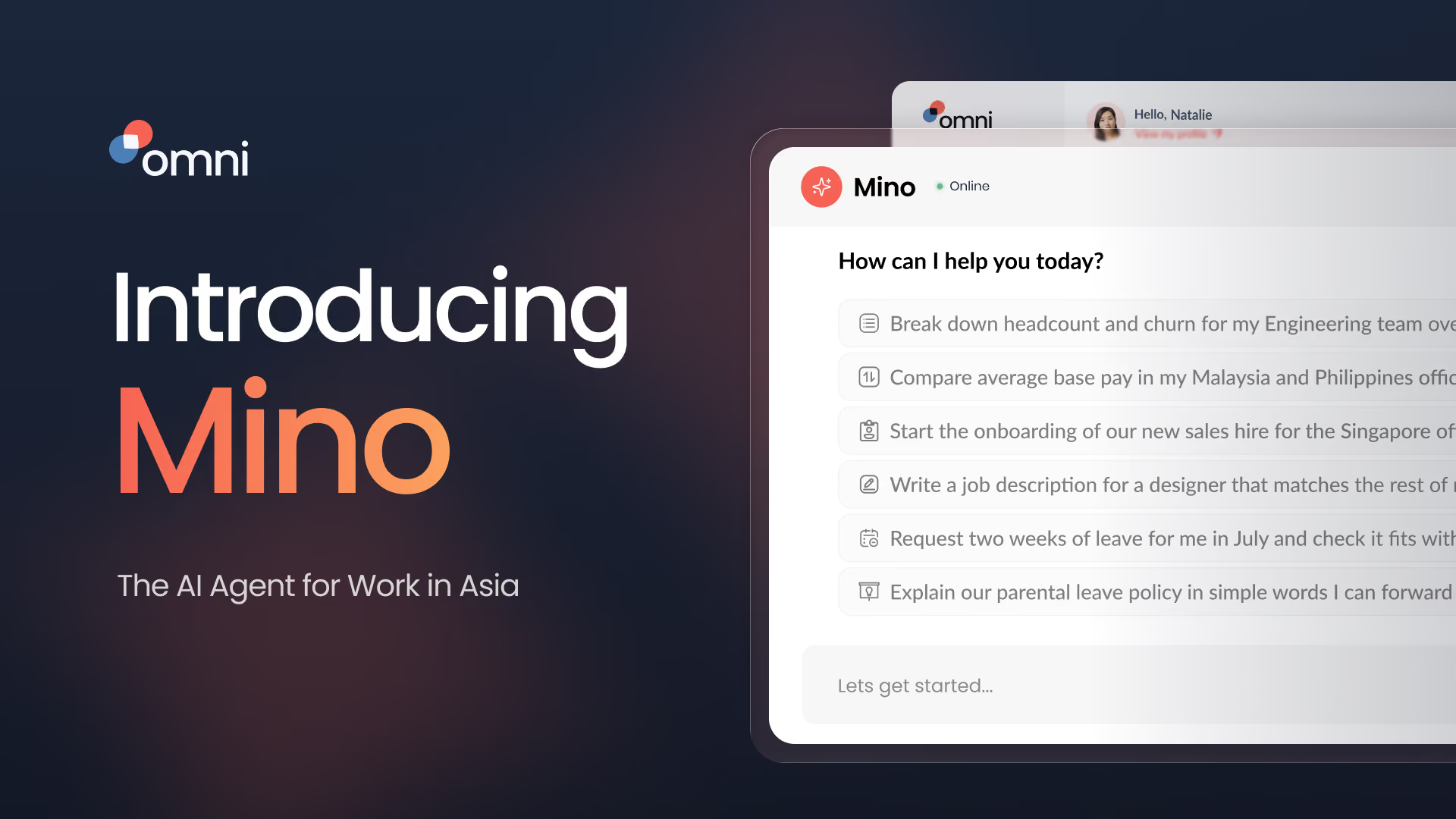
Most HRIS platforms add AI onto systems that weren’t designed for it. At Omni, our AI agent Mino is built into the platform from the ground up, which means it works with your actual HR data, across your actual entities, in the markets where compliance actually varies.
Mino lets your team interact with workforce data the way they'd talk to a colleague: ask a question, get an answer. No exports, no pivot tables, no waiting on a report to run.

What makes this meaningful for APAC teams is context. Mino understands the compliance environment your people operate in, not just global defaults applied to a regional dataset. As Mino grows across the Omni platform, that context travels with it, whether you're asking about headcount, payroll, or anything else tied to your workforce.
Best for: Mid-sized companies running HR across multiple APAC markets who want AI that understands local statutory requirements, not just global payroll logic.
Workday — Best for Large Enterprises with Complex Workforce Planning Needs
Workday has been investing in AI across its platform for several years, and in 2026, its AI layer is among the most mature in the enterprise segment. Workday Illuminate spans hundreds of AI-powered actions across HR, finance, and workforce planning.
Notable AI capabilities:
- Workday Peakon Employee Voice uses machine learning to surface engagement trends and predict flight risk
- Adaptive Planning supports AI-driven workforce scenario modelling across departments and geographies
- Skills inference automatically tags employees with skills based on job history and learning data
Limitations to note: Workday is built for enterprises with significant implementation budgets and dedicated HR ops teams. For APAC-specific compliance (CPF, EPF, SSS contributions, local leave entitlements), you'll typically need additional configuration or local implementation support. It's a strong platform, but the AI value compounds most at scale and with data maturity.
Best for: Enterprises with 1,000+ employees, strong IT/HR ops capacity, and multi-region operations where workforce planning complexity justifies the investment.
HONO — Best for Enterprises Wanting AI-Native, Conversational HR Operations
HONO's core differentiation is its AI-first approach to HRMS, moving toward a headless model where employees and managers interact with HR through natural-language commands instead of menus and dashboards. Its conversational layer understands intent, retrieves context, and executes HR transactions directly.
Notable AI capabilities:
- Conversational HR execution that turns requests like approving leave or checking policy into completed actions, not just answers
- Domain-specific AI agents supporting onboarding, performance, compliance, and employee queries
- Multilingual support across 100+ languages, well-suited to distributed, multilingual workforces
Limitations to note: HONO is built for enterprise HR transformation rather than lightweight administration. Teams evaluating it should confirm the depth of country-specific payroll and compliance coverage for their markets.
Best for: Enterprises in APAC, MEA, and India moving toward conversational, agentic HR while keeping deep operations, multi-country payroll, and compliance in one platform.
Rippling — Best for Companies Connecting HR, IT, and Finance in One Workflow
Rippling's core differentiation is the breadth of its unified data model, HR, IT provisioning, payroll, and finance in one system. Its AI layer sits on top of that consolidated dataset, which gives it more signal to work with than platforms where HR data is siloed.
Notable AI capabilities:
- Cross-functional workflow automation that triggers IT provisioning, payroll changes, and benefits updates from a single HR event
- Analytics connecting headcount, compensation, and software spend in one view
- AI-assisted headcount planning and scenario modelling
Limitations to note: Rippling's compliance coverage for Southeast Asia is limited. For teams running payroll in Singapore, Malaysia, or the Philippines specifically, the platform's statutory compliance tooling is less mature than APAC-native options. It's a strong choice for companies with a US or global headquarters looking to standardise operations, less so for teams where APAC compliance is the primary constraint.
Best for: Tech-forward companies with US or global headquarters wanting deep HR/IT/finance integration, with some APAC entities.
HiBob — Best for Mid-Market Companies Prioritising Employee Experience + Analytics
HiBob has built a strong AI layer around people analytics, with particular depth in engagement and decision support. Its InsightsIQ module surfaces workforce trends and sentiment signals from surveys and people data, positioning it as a tool for HR leaders who want to move from data collection to data-driven decision making.
Notable AI capabilities:
- InsightsIQ for workforce trend analysis and sentiment monitoring
- DecisionIQ for more consistent, controlled people decisions with built-in guardrails
- Automated workflow building across onboarding, performance, and compensation
Limitations to note: HiBob's payroll capabilities rely on integrations rather than native processing. For APAC markets with specific statutory payroll requirements, you'll need to connect a separate payroll engine. This adds integration overhead and creates potential data synchronisation gaps, which can undermine AI output quality.
Best for: Mid-market companies in markets where HiBob's payroll integrations are mature, who prioritise engagement analytics and employee experience tooling.
BambooHR — Best for SMBs Looking for AI Features With Minimal Setup
BambooHR occupies a specific niche: AI-assisted HR for smaller teams that need the capability without the complexity. Its AI features include intelligent insights surfaced from satisfaction data, basic predictive indicators, and workflow automation for common HR tasks.
Notable AI capabilities:
- AI-surfaced insights from employee satisfaction and engagement data
- Automated reporting and basic workforce analytics
- Simplified onboarding automation and document workflows
Limitations to note: For many SMBs, AI doesn't need to be flashy; it needs to reduce repetitive questions, speed up onboarding tasks, and simplify reporting without requiring a dedicated HRIS admin team. BambooHR delivers on this, but its ceiling is lower than that of the enterprise platforms. If your needs are expanding into complex global operations or deep workforce planning, you may outgrow it. Its APAC statutory compliance coverage is also limited, particularly for payroll.
Best for: Small to mid-sized businesses with a primarily US or English-market presence that want approachable AI features without a heavy implementation lift.
ADP Workforce Now — Best for Payroll-First Organisations Wanting AI on Top of Scale
ADP's AI layer is built on one of the largest payroll datasets in the world. Its DataCloud product draws on payroll data from tens of millions of workers to power benchmarking analytics that most platforms simply don't have access to.
Notable AI capabilities:
- ADP DataCloud for benchmarking analytics and workforce intelligence at scale
- AI-assisted compliance monitoring across federal, state, and local requirements
- Intelligent payroll anomaly detection and proactive flagging
Limitations to note: ADP Workforce Now is primarily a US-market product. APAC coverage exists through ADP's global offering but varies significantly by market. The AI layer is most powerful in markets where ADP has dense payroll data, which is rather limited in Southeast Asia.
Best for: Established mid-to-large companies with the majority of headcount in the US, where ADP's payroll data depth translates directly into AI benchmarking value.
What AI in HR Means (And What It Should Do)
AI in HR covers a lot of ground. Depending on the vendor, HR software with AI features can mean anything from a basic chatbot that answers “how many leave days do I have left?” to a full analytics layer that surfaces flight risk signals before it becomes a reality.

For practical purposes, AI features in HR software fall into these categories:
- Automation: removing repetitive manual work
- Analytics and reporting: turning workforce data into readable insights
- Conversational interfaces: natural language access to HR data
- Decision support: surfacing signals that help HR act proactively
Most platforms have unlocked tiers 1 and 2, but tiers 3 and 4 are where the meaningful differentiation is happening now.
How to Evaluate AI in HRIS
1. Ask where AI sits - in the platform or as an add-on?
There’s a huge difference between AI that’s native to the platform (trained on your live HR data, integrated into your workflows) and AI that’s third-party integration wrapped in branding.
Native AI improves as your data grows, whereas AI integrations are only as useful as the sync quality between systems.
Ask your vendors directly:
- Where does the AI access data?
- Is it real-time or batch synced from the HRIS?
- Who trains the model, and on what?
2. Evaluate data quality before AI quality
As highlighted in Omni’s State of AI in HR 2026 Report, AI outputs are only as reliable as the underlying data. An HRIS with fragmented records, inconsistent leave codes, or manually-corrected payroll runs will produce AI insights that also reflect these inconsistencies.
Before you begin to evaluate the AI capabilities, it’s important to assess whether the platform’s core HR data is clean, consolidated, and trustworthy.
This is especially important in APAC, where teams often run HR across multiple countries with different statutory requirements, payroll calendars, and compliance frameworks. If the core HRIS is unable to accurately consolidate that data, no AI layer can compensate.
3. Check what’s live versus what’s on the roadmap
If you’ve been actively evaluating vendors, chances are you’ve seen the same five features: resume screening, self-service chatbots, sentiment analysis, workforce analytics, and onboarding automation. What truly distinguishes serious AI investment from marketing is what’s already shipped versus what’s still in development.
Ask your vendors for a feature release log. Look at when key AI capabilities were launched, how frequently they are updated, and whether early beta users are seeing measurable results.
4. Understand the privacy and compliance implications
AI in HR involves sensitive people data. Before adopting any AI-powered HRIS, your team must understand: where the data is stored, whether it leaves your region for model inference, how long conversation or query history is retained, and whether employee data is used for model training.
For companies operating in APAC countries like Singapore, Malaysia, or the Philippines, this intersects with PDPA, PDPO, and local data residency considerations. Any vendor that is unable to answer these questions should be assessed with caution.
5. Evaluate agentic capability, not just reporting
In 2026, leading platforms are slowly beginning to offer real-time pay equity analysis, market benchmarking integration, and budget scenario modeling as part of their AI layer. The shift from dashboards to agents is where the next generation of AI in HR is heading.
Evaluate whether a platform is building towards that, or whether its AI is fundamentally still a report generator.
What to Do When Vendors Sound the Same
If you've sat through a few HRIS demos recently, you'll recognise the pattern: every platform leads with an AI story, every roadmap includes agents and natural language queries, every sales deck mentions generative AI.
The "best" AI HRIS in 2026 depends less on which tool has the loudest AI branding and more on which platform delivers clean workflows, trustworthy data, fast self-service, and clear analytics that your team will actually use.
The evaluation criteria that cut through the noise:
- Is the AI native to the platform, or bolted on? Native AI improves as your data grows. Integrations create sync risk.
- Is the underlying HR data clean enough to produce reliable AI output? Poor data in, poor insights out.
- Does the AI coverage map to your compliance context? Generic AI on generic HR data is of limited value for teams running CPF, EPF, or SSS payroll.
- What's live today, and what's still on the roadmap? Ask for evidence, not slides.
- Is the platform building toward agentic capability, or refining reporting? The category is moving fast — evaluate the direction, not just the current state.
If you're running HR across multiple APAC markets, add one more question: does this platform understand what "compliance" means in Singapore, Malaysia, and the Philippines specifically — or is it describing global compliance in generic terms and hoping the detail fits?
Most AI in HR Wasn't Built for This Region. Mino Was.
Most of the platforms on this list were built for a world where HR data lives in one country, payroll runs on one statutory framework, and compliance means federal and state — not CPF, EPF, SSS, and MPF simultaneously.
That's not the world APAC HR teams operate in. And it's the reason AI in HR looks different here than it does in a US or European context.
When your workforce spans Singapore, Malaysia, and the Philippines, the value of AI isn't just speed; it's accuracy across jurisdictions. Workforce queries that seem simple, like "what's our total headcount in Southeast Asia?" are actually complex consolidation problems when the data sits across five entities with different payroll systems and leave policies. AI that doesn't understand that context doesn't solve the problem. It just surfaces it faster.
This is the gap Mino is built to close.
Mino isn't a standalone AI tool bolted onto a reporting dashboard. It's built directly into our platform, meaning it works with the same data that powers your payroll runs, your compliance records, and your people operations across every market you operate in. Ask it a question about your workforce, and the answer reflects your actual entities, your actual access controls, and the actual compliance environment your people sit in.
The security architecture behind this is deliberate. Mino never reads your employee data directly. Your existing access controls determine what information gets returned for each query, depending on who's asking. No employee records are sent to an AI model to be read or processed. This is a meaningful difference from how most AI tools in HR work — and an intentional one, because the right way to build AI for HR is one where your compliance and data boundaries are never compromised.
If this is the kind of HRIS with AI you're looking for, book a demo with our team today and learn about what Mino can do for your organisation.
Frequently Asked Questions
AI in HR refers to the use of artificial intelligence to automate, analyse, and improve human resources processes. This includes workflow automation (onboarding, payroll anomaly detection), workforce analytics (headcount trends, attrition signals), conversational access to HR data through natural language, and decision-support tools that help HR teams act on signals before they become problems.
The best HR software with AI features depends on your company size, market, and use case. Workday and Rippling lead for large enterprise and US-headquartered teams. HiBob is strong for mid-market engagement analytics. For APAC-focused teams managing compliance across Singapore, Malaysia, or the Philippines, Omni HR's Mino agent is built specifically for that context — combining workforce analytics with native payroll compliance.
It can be, but the answer depends on the vendor. Key questions to ask: where is your data stored, does it leave your region for AI inference, how long is conversation history retained, and is your employee data used for model training? For APAC companies, this should also include how the platform handles PDPA (Singapore/Malaysia) and local data residency requirements.
AI automation removes repetitive manual work — triggering onboarding tasks, routing approval workflows, and flagging payroll discrepancies. AI analytics turns workforce data into insight — showing headcount trends, surfacing attrition signals, and modelling compensation scenarios. Most modern HRIS platforms offer both, but the depth varies significantly between vendors.
Focus on five things: whether the AI is native or bolted on, the quality of the underlying HR data, whether the AI capabilities match your compliance context, what's actually live versus still on the roadmap, and whether the vendor is building toward agentic capability. For teams in Southeast Asia, also confirm that the platform's AI layer is trained on data that reflects APAC statutory requirements, not just global defaults.
.png)