.png)
%20(1).png)


Darwinbox is an enterprise HCM built for large organizations, strong in India and Indonesia. Omni HR is built for the 100 to 500 employee segment across Asia, with proven local payroll. This guide compares the two on payroll, compliance, pricing, and the size of company each one fits.
Omni HR vs Darwinbox: The Short Answer
Darwinbox is a capable enterprise HCM. It is strong in India, Indonesia, and the Gulf, and it serves large organizations with complex needs. If you have 500 or more employees and a big India operation, it deserves a look.
Omni HR is built for a different company. It targets the 100 to 500 employee segment across Southeast Asia, with native local payroll in Singapore, Malaysia, Hong Kong, and the Philippines in one platform.
The real difference is fit. Darwinbox is a deep, enterprise platform made for large, complex organizations. Omni HR is right-sized for lean HR teams at growing companies, with native Employer of Record and contractor payments across Asia and a setup a small team can run without a heavy rollout. Omni HR also holds a 4.8 out of 5 rating on G2.
This guide compares the two on features, compliance, pricing, and fit.
Feature Comparison
| Capability | Omni HR | Darwinbox |
|---|---|---|
| Best fit company size | 100 to 500 employees | 500+ employees |
| Singapore and Malaysia payroll | Yes, native and established | Yes, recently launched |
| Philippines payroll (SSS, PhilHealth, Pag-IBIG, BIR) | Yes, native | Yes, native |
| Employer of Record | Yes, native across Asia | Not native, requires third-party partners |
| Contractor payments | Yes, across Asia | Not native, requires partners |
| ATS / Recruitment | Yes, AI-assisted, included | Yes, enterprise recruitment suite |
| Implementation | Lightweight setup for small teams | Longer, enterprise rollouts |
| Support | Same-day, Asia timezone | Reviewers cite slow performance and a learning curve |
| AI assistant | Yes, Mino agentic AI plus Connect AI | Yes, Super Agent agentic AI plus MCP |
| G2 rating | 4.8/5 | 4.4/5 |
Darwinbox has a deep, enterprise-grade feature set. The trade-off is complexity. On G2, the most common complaints are slow loading, slow performance, and a steep learning curve, with many customizations needing support to set up. For a lean HR team at a mid-sized company, that overhead can outweigh the benefit.
Asia Compliance: Who Covers What
The key question for any Asia comparison is which statutory rules each platform handles natively today.
| Statutory Requirement | Omni HR | Darwinbox |
|---|---|---|
| Singapore (CPF, SDL, IRAS, FWL) | ✅ Native | ✅ Recently launched |
| Malaysia (EPF, SOCSO, EIS, PCB, LHDN) | ✅ Native | ✅ Recently launched |
| Philippines (SSS, PhilHealth, Pag-IBIG, BIR) | ✅ Native | ✅ Native |
| India payroll | ✅ Managed | ✅ Native and strong |
| Indonesia payroll | ✅ Managed | ✅ Native |
| EOR (hire without a local entity) | ✅ Native | ⚠️ Via third-party partners |
| Contractor payments (Asia-wide) | ✅ Native | ⚠️ Via partners |
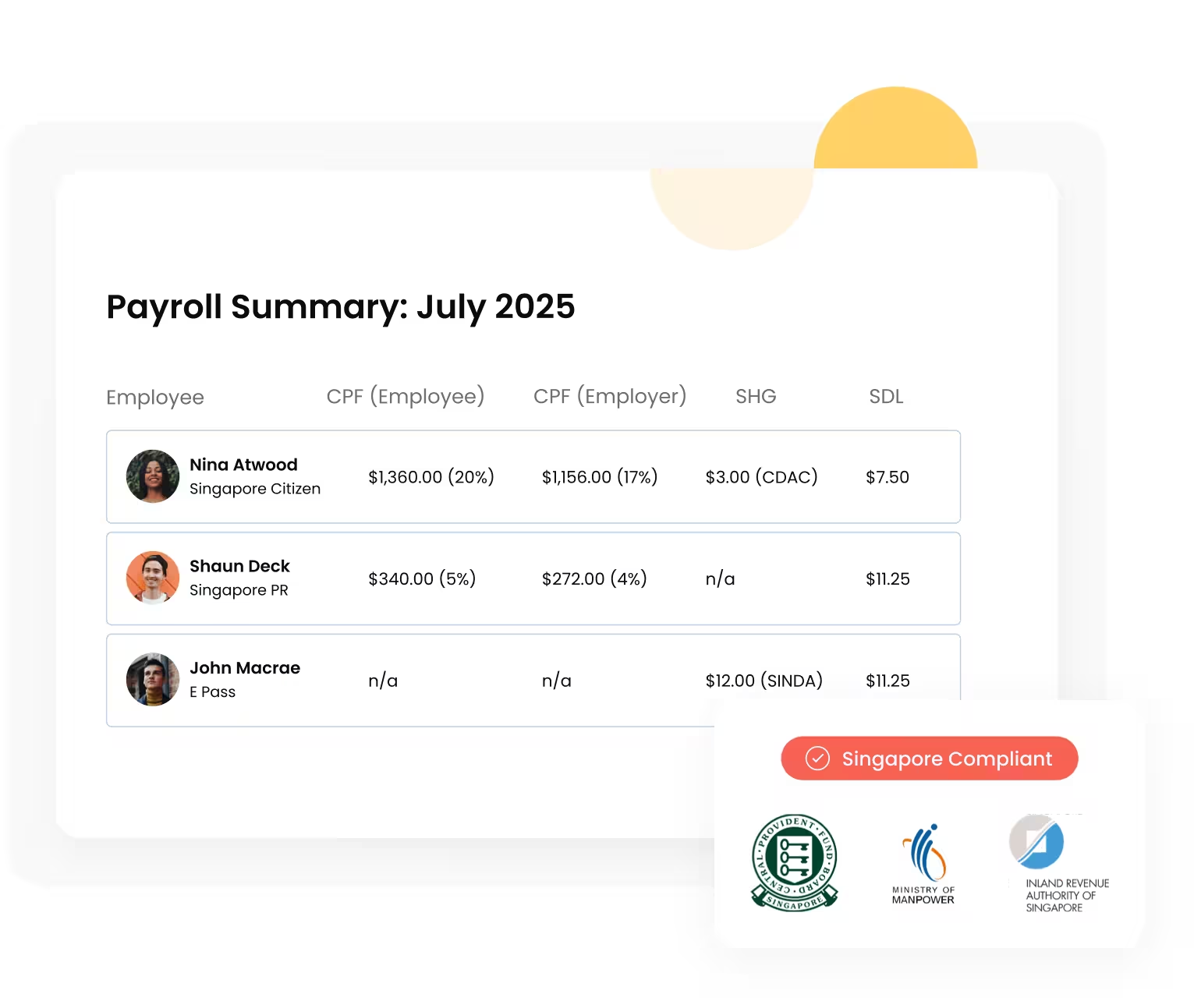
Darwinbox is strongest where it has deep roots, mainly India and Indonesia, where its payroll is native. Its Singapore and Malaysia payroll is newer to market. The bigger difference is the rest of the stack: Omni HR runs native Employer of Record and contractor payments across Asia instead of relying on third-party partners, all from one platform a lean team can manage.
Pricing
Darwinbox pricing is quote-based. For around 100 employees, third-party reports place it near $5 per employee per month, plus an implementation fee that can range from $5,000 to $50,000 depending on scope. Its sweet spot is large enterprises that can absorb that setup cost.
Omni HR starts at $3 per employee per month for Core HR, with add-on modules from $1, so you only pay for what you use.
| Cost | Omni HR | Darwinbox |
|---|---|---|
| Starting price | $3/employee/mo (Core HR) | ~$5/employee/mo (third-party estimate, 100 employees) |
| Add-on modules | From $1 | Bundled, varies by contract |
| Implementation | No published setup fee | $5K to $50K (third-party estimate) |
| Setup | Lightweight, small-team friendly | Longer enterprise rollout |
AI Capabilities
Both platforms are investing in AI. Darwinbox offers Super Agent, an agentic AI layer with an MCP server, built to automate enterprise HR workflows. It is a serious effort aimed at large, complex organizations.
Omni HR brings the same agentic direction to the mid-market with Mino, its AI assistant, plus Connect AI. The difference is scope and overhead: Mino is built to help a lean HR team move faster across HR and Asia payroll without an enterprise rollout behind it. For a 100 to 500 person company, that is usually the more practical kind of AI to adopt.
When to Choose Darwinbox vs Omni HR
| Choose Darwinbox if... | Choose Omni HR if... |
|---|---|
| You have 500 or more employees | You have 100 to 500 employees |
| Your largest operations are in India or Indonesia | Your team is across Singapore, Malaysia, Hong Kong, or the Philippines |
| You have an enterprise budget for setup and rollout | You want lightweight setup and lower total cost |
| You can support a complex, deep feature set | You want a lean platform a small HR team can run |
| You are comfortable using partners for EOR and contractors | You want native EOR and contractor payments across Asia |
Book a demo to see how Omni HR handles proven Asia payroll today.
Further Reading
Frequently Asked Questions
Yes. Darwinbox has launched payroll in Singapore and Malaysia, though it is newer to those markets than its core India and Indonesia coverage. Omni HR also runs native local payroll in both markets. The bigger difference is around it: Omni HR adds native Employer of Record and contractor payments across Asia, while Darwinbox relies on third-party partners for those.
Yes. Darwinbox has launched payroll in Singapore and Malaysia, though it is newer to those markets than its core India and Indonesia coverage. Omni HR also runs native local payroll in both markets. The bigger difference is around it: Omni HR adds native Employer of Record and contractor payments across Asia, while Darwinbox relies on third-party partners for those.
Omni HR is designed for the 100 to 500 employee segment across Asia. Darwinbox is built for large enterprises with 500 or more employees. For a mid-sized team, Omni HR is usually the better fit on price, setup time, and simplicity.
Omni HR is designed for the 100 to 500 employee segment across Asia. Darwinbox is built for large enterprises with 500 or more employees. For a mid-sized team, Omni HR is usually the better fit on price, setup time, and simplicity.
Omni HR starts at $3 per employee per month for Core HR with add-on modules from $1 and no published setup fee. Darwinbox is quote-based, with third-party reports placing it around $5 per employee per month for 100 employees, plus an implementation fee that can run from $5,000 to $50,000.
Omni HR starts at $3 per employee per month for Core HR with add-on modules from $1 and no published setup fee. Darwinbox is quote-based, with third-party reports placing it around $5 per employee per month for 100 employees, plus an implementation fee that can run from $5,000 to $50,000.
Not natively. Darwinbox relies on third-party partners for EOR and contractor payments. Omni HR offers both natively across Asia.
Not natively. Darwinbox relies on third-party partners for EOR and contractor payments. Omni HR offers both natively across Asia.
Omni HR uses a lightweight setup designed for small HR teams, with no published setup fee. Darwinbox rollouts are enterprise projects and usually take longer.
Omni HR uses a lightweight setup designed for small HR teams, with no published setup fee. Darwinbox rollouts are enterprise projects and usually take longer.
On G2, Darwinbox holds a 4.4 out of 5 rating. The most common complaints are slow loading, slow performance, and a steep learning curve, with many customizations needing support. Omni HR holds a 4.8 out of 5 rating.
On G2, Darwinbox holds a 4.4 out of 5 rating. The most common complaints are slow loading, slow performance, and a steep learning curve, with many customizations needing support. Omni HR holds a 4.8 out of 5 rating.
Yes. Darwinbox offers native Philippines payroll, and so does Omni HR, covering SSS, PhilHealth, Pag-IBIG, and BIR. Where they differ is EOR and contractor payments: Omni HR runs these natively across Asia, while Darwinbox uses third-party partners.
Yes. Darwinbox offers native Philippines payroll, and so does Omni HR, covering SSS, PhilHealth, Pag-IBIG, and BIR. Where they differ is EOR and contractor payments: Omni HR runs these natively across Asia, while Darwinbox uses third-party partners.
Yes. Omni HR supports growing teams across Asia with native local payroll, managed payroll in 20+ countries, EOR, and contractor payments, so you can add markets without switching platforms.
Yes. Omni HR supports growing teams across Asia with native local payroll, managed payroll in 20+ countries, EOR, and contractor payments, so you can add markets without switching platforms.
.avif)


.avif)