.png)
Summary. The best EOR for mid-market companies balances transparent, per-employee pricing with enough APAC compliance depth to support growth without forcing a platform switch later. For mid-market teams scaling headcount across APAC, Omni HR offers the strongest combination of compliance depth and bundled HRIS at mid-market-friendly pricing. For companies prioritizing broad global coverage over regional depth, Deel and Remote remain strong general options. This guide compares six EOR providers for mid-market companies across pricing, contract flexibility, scalability, and support model, including a dedicated breakdown of EOR pricing for mid-market teams and what a scalable EOR for growing teams actually requires.
An employer of record (EOR) for mid-market companies is a third-party organization that legally employs your workers in a country where you don't have a registered entity, handling employment contracts, payroll, statutory contributions, and local compliance while you retain full control over day-to-day work. See our guide on how an EOR works for a full breakdown of the model.
Mid-market companies, typically organizations with 100 to 1,000 employees, or fast-scaling teams onboarding their first 20 to 100 international hires, sit in an awkward middle ground when it comes to choosing an EOR. Most EOR listicles are written for one of two audiences: startups hiring contractors, or enterprises negotiating custom, multi-year contracts. An employer of record for mid-market companies needs to do something different: scale cleanly from 20 employees to 200, hold pricing steady without constant renegotiation, and provide APAC compliance depth without the enterprise price tag or the 12-month implementation timeline.
Choosing the wrong provider at this stage can end up costing you double. Once in the monthly EOR pricing for mid-market teams that don’t have the headcount needed to negotiate enterprise discounts, and again in the cost of migrating to a different EOR platform once the team outgrows its current provider chosen for price or simplicity rather than scalability.
How We Evaluate the Best EOR for Mid-Market Companies
We assessed each provider across five criteria that matter specifically to mid-market companies:
Note: Omni HR is included in this list. We built this comparison and hold ourselves to the same criteria as every other provider on it.
Comparison Table: Best EOR for Mid-Market Companies
*Pricing reflects published rates as of August 2026. EOR pricing for mid-market companies can vary by country, headcount tier, and benefits selected. Confirm directly with each provider before budgeting.
The Best EOR Providers for Mid-Market Companies in 2026
1. Omni HR — Best EOR for Mid-Market Teams Scaling Across APAC
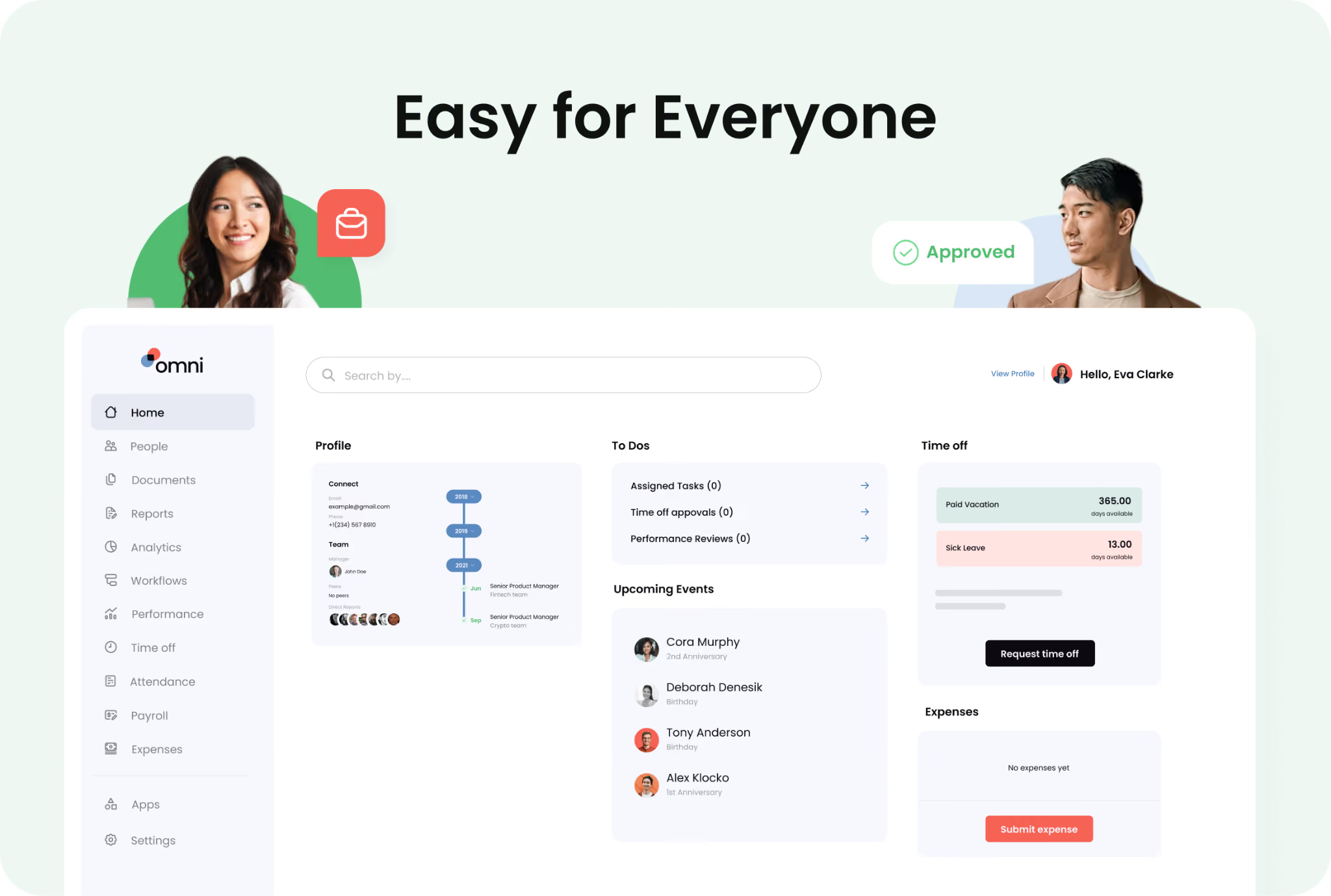
Omni HR is an AI-powered HR and EOR platform built for mid-market and growing teams hiring across APAC. Where global generalists treat it as one region among many, Omni HR is localized at the country level, with statutory calculation engines and payroll rules built in for each market.
This makes Omni HR one of the best options for an employer of record for mid-market companies where Asia-Pacific is a primary or growing hiring region, without the enterprise pricing structure or lengthy implementation timeline that larger platforms require.
Coverage: Singapore, Malaysia, Philippines, India, Indonesia, Hong Kong, Thailand, Vietnam, China, Taiwan, and Australia
Best fit: Mid-market companies scaling headcount across APAC that need an employer of record for mid-market companies with country-level compliance depth built in from day one, not bolted on later.
Mid-market strengths:
- Transparent, published per-employee pricing designed for mid-market budgets, so cost stays predictable as your team scales
- The same platform and pricing structure scales from your first 20 hires to your next 200, without forcing a migration once headcount crosses an arbitrary threshold
- Automated payroll with statutory contributions calculated correctly per market: CPF (Singapore), EPF and SOCSO (Malaysia), SSS, PhilHealth, and Pag-IBIG (Philippines)
- Full HRIS included in the platform, so mid-market teams without a dedicated ops function can manage EOR, payroll, leave, and people data in one place instead of stitching together separate tools
- A dedicated implementation team and named account manager from day one, right-sized for mid-market teams rather than a shared ticket queue
- Mino, Omni's conversational AI analytics agent, lets HR teams query workforce data in plain language without exports or pivot tables, useful for mid-market teams without a dedicated data or analytics function
- Proven outcomes at this stage of growth: SleekFlow reduced payroll processing time by 40%; Lucence cut payroll processing time by 50% while scaling headcount
See why businesses choose Omni
Where to watch: Omni HR's focus is APAC. Mid-market companies with significant headcount in Europe or the Americas will need a second provider or a more global platform for those markets.
2. Deel — Best EOR for Mid-Market Teams Hiring Globally
Deel operates across 150+ countries through a mix of owned entities and local partners, and has built out self-serve tooling that works well for mid-market teams without a large procurement process.
Best fit: Mid-market companies with distributed global headcount where the majority of hiring sits outside Asia-Pacific and breadth of coverage matters more than regional depth.
Mid-market strengths:
- Fast self-serve onboarding, useful for mid-market teams hiring their first international employees without a long sales cycle
- Broad country coverage, so a mid-market company expanding opportunistically doesn't need to switch providers as new markets get added
- Strong integrations with common mid-market HR and finance stacks
Where to watch: In several APAC markets specifically, Deel operates through local partners rather than owned entities, which can create compliance variability that matters more as mid-market headcount in those countries grows.
3. Remote — Best EOR for Compliance-Rigorous Mid-Market Teams
Remote has built owned legal entities in every country it operates in, which means the company is directly liable for employer obligations rather than routing that liability through a third-party partner network.
Best fit: Mid-market companies in privacy-sensitive industries (fintech, healthtech, legal) that need documented, contractual clarity on employment liability in every market, and where budget allows for a premium on compliance certainty.
Mid-market strengths:
- Owned entities model across 90+ markets, which simplifies the compliance story for mid-market legal and finance teams without dedicated in-house counsel
- IP protection clauses included as standard in employment agreements
- Clear documentation on data residency and GDPR alignment
Where to watch: Remote's starting price sits higher than several mid-market-focused competitors, and its APAC coverage, while solid, is less deep than APAC-specialist providers.
4. Multiplier — Best EOR for Budget-Conscious Mid-Market Teams
Multiplier positions itself around simplicity and accessible pricing, with a self-serve platform that mid-market teams can stand up without a lengthy implementation process.
Best fit: Mid-market companies prioritizing EOR pricing for mid-market budgets over deep HRIS functionality, particularly those hiring in a smaller number of markets.
Mid-market strengths:
- Lower starting price point than several competitors, which matters for mid-market companies watching EOR pricing closely at 20 to 50 employees
- No minimum headcount requirement, so a mid-market team can start small and scale without renegotiating
- Straightforward self-serve onboarding for HR teams without a dedicated global mobility function
Where to watch: HRIS functionality is more basic than platforms built HRIS-first, and APAC statutory depth outside a handful of core markets is less proven at scale.
5. Rippling — Best EOR for US-Headquartered Mid-Market Teams
Rippling bundles EOR into a broader workforce management suite covering HRIS, payroll, IT, and benefits. For mid-market companies already running domestic HR on Rippling, adding international EOR through the same platform removes real operational friction.
Best fit: US-headquartered mid-market companies expanding into two to five international markets where Rippling already manages domestic HR.
Mid-market strengths:
- Single platform for domestic HR and international EOR, reducing the number of systems a mid-market ops team has to manage
- Strong automation for onboarding, offboarding, and device provisioning
- Deepest native app integration library of any provider in this comparison
Where to watch: Pricing requires a custom quote on top of the platform subscription, which makes EOR pricing for mid-market companies harder to budget upfront. APAC compliance depth in Southeast Asia is less mature than in North America and Europe.
6. Papaya Global — Best EOR for Consolidating Payroll as Headcount Grows
Papaya Global's strength is consolidated, analytics-first payroll reporting, which becomes more valuable as a mid-market company's international headcount and market count grow simultaneously.
Best fit: Mid-market companies where consolidated payroll visibility across a growing number of markets matters more than deep compliance ownership in any single country.
Mid-market strengths:
- Global payroll consolidation with real-time analytics, useful once a mid-market team is running payroll in more than three or four countries
- Multi-currency payments infrastructure in a single run
- Strong financial reporting for mid-market finance teams managing multi-currency spend without a dedicated FP&A analyst
Where to watch: Papaya operates through a partner network rather than owned entities in most markets, and Southeast Asia compliance depth has been flagged as an area of ongoing development.
How Mid-Market EOR Needs Differ From SMB and Enterprise EOR
An EOR built for a five-person startup hiring one contractor and an EOR built for a 2,000-person enterprise solve different problems than an employer of record for mid-market companies actually needs to solve:
EOR Pricing for Mid-Market Companies
EOR pricing for mid-market companies typically falls in a specific band, distinct from both entry-level contractor tools and enterprise custom quotes.
A few things to watch when evaluating EOR pricing for mid-market companies specifically:
- Volume matters, but less than at enterprise scale. At 20 to 100 employees, most providers won't offer the steep per-seat discounts available at 500+, but published mid-market tiers should still reflect meaningfully better pricing than single-hire contractor rates.
- Contract flexibility affects the real cost. A lower headline price locked into an annual contract can cost more than a slightly higher monthly rate if your mid-market team's headcount needs are still shifting.
- Ask for the fully loaded number, not the platform fee alone. Statutory contributions, benefits, and any setup costs should be quoted together so you can compare EOR pricing for mid-market companies on an apples-to-apples basis.
What to Look For In Scalable EOR for Growing Teams
A scalable EOR for growing teams needs to hold up across two dimensions at once: headcount growth within existing markets, and expansion into new ones.
- Headcount scalability. Ask any provider how their platform and pricing behave as you move from 20 employees to 100 in the same country. A scalable EOR for growing teams should show a clear, published path, not a requirement to renegotiate the entire contract at each threshold.
- Market scalability. Growing mid-market companies rarely expand into one country and stop. Confirm how quickly a new market can be added, whether pricing and compliance logic are consistent across markets, and whether adding a country requires a new implementation project or is closer to flipping a switch.
- When EOR stops being the scalable option. For most mid-market companies, EOR remains the right structure well past their first 50 international hires. The math generally shifts only once a single country's headcount grows large enough that EOR fees start approaching the cost of setting up and maintaining a local entity.
The right employer of record for mid-market companies is one that supports this transition, whether through advisory services or a documented path to entity setup once you outgrow the EOR model in a given market.
APAC EOR for Mid-Market Companies: Why Compliance Depth Matters at This Stage
Mid-market companies expanding into Asia-Pacific face the same compliance complexity as enterprise teams, just without the in-house resources to absorb mistakes.
- Singapore: Employers contribute to the Central Provident Fund (CPF), with contribution rates that vary by employee age and residency status.
- Malaysia: EPF (Employees Provident Fund) and SOCSO (Social Security Organisation) contributions apply, with rates and caps that differ from Singapore's.
- Philippines: SSS (Social Security System), PhilHealth, and Pag-IBIG contributions are mandatory, alongside statutory 13th-month pay.
Missing a filing deadline or miscalculating a statutory contribution creates the same penalty exposure for a 60-person mid-market company as it does for a 6,000-person enterprise. A mid-market team without a dedicated compliance function needs an employer of record for mid-market companies that treats this as core platform logic, not a configuration option that requires manual setup per market.
Questions Mid-Market Teams Should Ask Before Signing
1. Does your pricing change as we scale from 20 to 100 employees, and how is that documented?
A scalable EOR for growing teams should be able to answer this with a published rate card, not a vague reference to "custom pricing at volume."
2. Do you operate through owned entities or local partners in [specific country]?
This determines who is legally liable if something goes wrong, and matters even more when your team doesn't have in-house counsel to catch it.
3. What's included in the base price, and what's billed separately?
Ask specifically about setup fees, offboarding fees, and benefits administration before comparing EOR pricing for mid-market companies across providers.
4. What happens if we want to add a new country next quarter?
A scalable EOR for growing teams should have a clear, repeatable process for market expansion, not a project that requires a new sales cycle each time.
5. What's your support model for a team our size?
Confirm whether you get a named contact or a shared queue, and what the documented response time looks like for a payroll error.
How to Choose the Best EOR for Your Mid-Market Company
For mid-market companies hiring primarily in Europe or the Americas, Deel, Remote, and Rippling remain strong options depending on whether you prioritize breadth, compliance certainty, or consolidation with existing HR tools. Multiplier is worth a look if EOR pricing for mid-market budgets is the deciding factor, and Papaya Global stands out once headcount is spread across enough markets that consolidated payroll reporting becomes the priority.
For mid-market companies where APAC is a core or growing hiring region, Omni HR is built around the pricing, scalability, HRIS, support, and compliance needs mid-market teams actually have, not a global generalist treating the region as an afterthought.
"If you're growing and want an HR system that's easy to use, practical, and well-supported, Omni is a strong choice."
— Maida Choo, Assistant HR Manager at Hello Human
Book a demo with our team to see how a scalable EOR for growing teams actually works in practice.
Frequently Asked Questions
An employer of record (EOR) for mid-market companies is a third-party organization that legally employs your workers in a country where you don't have a registered entity. The EOR handles employment contracts, payroll, statutory contributions, tax filings, and local compliance, while your company retains full control over day-to-day work. Mid-market companies typically use an EOR to hire 20 to 200 international employees without setting up a legal entity in every market.
EOR pricing for mid-market companies is usually published and per-employee, typically ranging from $249 to $599 per employee per month at list rates, plus statutory employer contributions of 15% to 40% on top of gross salary. Enterprise pricing is more often custom-quoted with volume discounts that only apply at 500+ employees, which mid-market companies rarely qualify for.
A scalable EOR for growing teams offers consistent pricing and compliance logic as headcount grows within a market, a documented process for adding new countries without a full re-implementation, and a support model that holds up as the number of employees affected by any single issue increases.
For mid-market companies hiring primarily across Singapore, Malaysia, the Philippines, Indonesia, or Hong Kong, Omni HR offers the deepest native compliance coverage combined with mid-market-friendly pricing and a bundled HRIS. Global-first providers like Deel and Remote are stronger options for mid-market teams hiring primarily outside APAC.
Most mid-market companies stay well-served by an EOR well past their first 50 international hires. The math typically shifts once a single country's headcount reaches roughly 75 or more, at which point EOR fees can approach the cost of setting up and maintaining a local entity.
For small to mid-market companies, EOR costs typically start around $249 to $599 per employee per month at published rates, before statutory employer contributions. Smaller mid-market teams (20 to 50 employees) generally see less negotiating leverage than larger mid-market or enterprise buyers, so published, transparent pricing matters more at this stage than at higher volume tiers where custom quotes and discounts become available.
Not always. Base platform fees usually cover the EOR service itself, while statutory employer contributions (15% to 40% of gross salary, depending on the country) and benefits administration are often quoted separately. Always request a fully loaded cost breakdown before comparing providers.
Yes, though it requires coordination. Employment contracts typically need to be reissued under the new EOR, and payroll continuity should be confirmed in writing before the transition date. This is one reason choosing a scalable EOR for growing teams from the start matters: switching later carries real operational cost.
It depends on the provider. Some employer of record for mid-market companies platforms, including Omni HR, bundle a full HRIS into the EOR service, covering payroll, leave, and people data in one system. Others, such as Multiplier and Papaya Global, offer more limited HRIS functionality, which may require a mid-market team to license a separate system for employees not on EOR.
.png)


.png)