.png)
Summary. HR teams in Singapore, Malaysia, the Philippines, and Indonesia can use 30 AI prompts, organized by workflow, to speed up recruitment, onboarding, performance management, and statutory compliance drafting. The prompts span job descriptions, engagement surveys, and country-specific requirements, including Central Provident Fund (CPF), Employees Provident Fund (EPF), Social Security Organisation (SOCSO), and Social Security System (SSS) contributions. Statutory rates and deadlines still need independent verification, since general-purpose AI isn't connected to live regulatory databases and can raise data privacy risk under Singapore's PDPA or the Philippines' Data Privacy Act. Omni HR's AI agent, Mino, and its native MCP integration replace manual prompting with built-in access to a team's leave policies, statutory requirements, and live HR data from Claude, ChatGPT, or Cursor.
AI prompts for HR are the instructions you give a tool like ChatGPT, Gemini, or Claude to get a useful first draft, summary, or analysis. The more specific your prompt, the better your output.
If you’ve been looking for AI prompts guides, you’ll find that most prompt guides are written for global teams using generic HR examples. If your work involves CPF contributions, EPF deductions, or SSS calculations, it will only take you so far.
In this guide, we provide 30 prompts organized by HR workflow, plus a dedicated section for the statutory complexity that makes HR in Asia uniquely demanding.
How to Write an AI Prompt That Actually Gets You Something Useful
Before you reach for the list, it helps to understand what separates a prompt that saves you 20 minutes from one that generates another round of editing.
The most reliable framework has three parts:
- Context: what you're working on, who the reader is, and any relevant company or market details
- Objective: the specific thing you want — drafting an email, a 10-question survey, a policy summary
- Format: how you want it delivered — bullet points, a table, under 300 words, in numbered steps
Here's the difference in practice:
❌ "Write something about leave policy."
✅ "Write a plain-language summary of our annual leave policy for employees in Malaysia. Cover entitlement, how to apply, approval timelines, and carryover rules. Use clear headings and keep it under 400 words."
One more technique worth adding: include the line "Ask me clarifying questions before drafting if anything is unclear." It turns the process into a working exchange and consistently improves what comes back.
Hiring and Recruitment Prompts
1. Job description
"Draft a job description for a [role] at a [X]-person company in [Singapore/Malaysia/Philippines]. Include role purpose, key responsibilities, required skills, and preferred experience. Use a professional but approachable tone."
2. Behavioural interview questions
"Generate eight behavioural interview questions for a [role] that assess [competencies, e.g. stakeholder management, adaptability, problem-solving]. Include a suggested follow-up question for each."
3. Candidate shortlist briefs
"Summarise these [X] anonymised candidate applications into short briefs. For each, cover: relevant experience, key strengths, potential gaps, and a suggested interview focus area."
4. Inclusive language check
"Review this job description for language that could discourage diverse candidates from applying. Highlight specific phrases, explain why they may be limiting, and suggest alternatives."
5. Passive candidate outreach
"Write a LinkedIn outreach message for a passive candidate in [industry]. The role is [job title] at a [descriptor, e.g. fast-growing fintech]. Keep it under 100 words — concise, professional, and genuinely interesting."
Additional resources: Interview Scorecard Template
Onboarding Prompts
6. 30-60-90 day plan
"Create a 30-60-90 day onboarding plan for a new [role] joining a [X]-person company in [country]. Break it into monthly phases with key goals, check-in milestones, and priority tasks for each period."
7. New hire welcome email
"Write a welcome email from a hiring manager to a new team member starting as [role]. Include their start date, first day logistics, who they'll meet in week one, and a warm sign-off. Tone: warm and professional."
8. Post-onboarding survey
"Create a post-onboarding survey for employees completing their first 90 days. Include 10 questions covering: manager support, role clarity, team integration, and whether they feel set up to succeed. Mix Likert-scale and open-ended formats."
Paired with Omni HR, HR teams can create meaningful surveys in minutes. Once employees fill them up, real-time dashboards show you sentiment, engagement scores, and what’s actually happening across your team right now. Armed with these insights, HR teams can spot problems early and actually follow up.
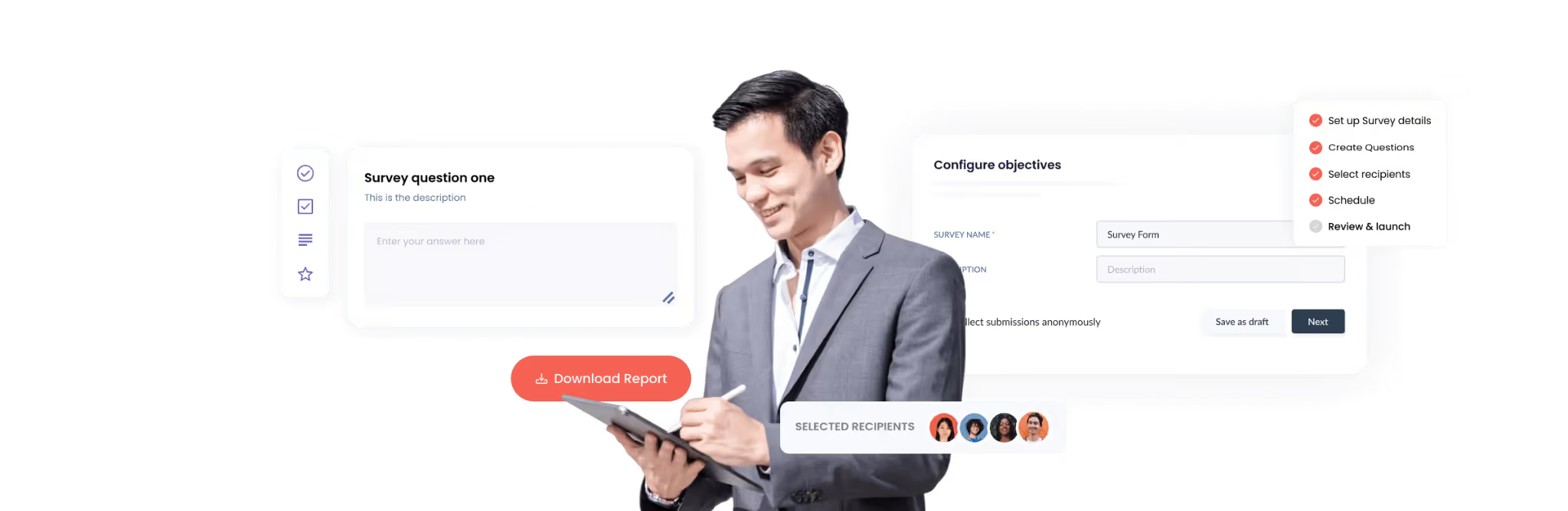
“When surveys are easy to launch and everyone feels heard, teams stop staying silent and start speaking up. That continuous feedback becomes how you actually run.”
- Derek Tan, Head of HR at Milieu Insight
9. Remote onboarding activities
"Suggest 8 virtual onboarding activities for a new remote hire joining a distributed team. For each, give a brief description and the specific outcome it's designed to achieve (e.g., building connection, understanding culture, learning workflows)."
Get started: 15 Onboarding Activities
10. Week one agenda
"Build a day-by-day agenda for a new hire's first week in a [role] at an [industry] company. Include system setup tasks, key meetings, training sessions, and one social touchpoint per day."
Performance Management Prompts
11. 360-degree feedback summary
"Summarise this 360-degree feedback for a mid-level manager. Group findings into: key strengths, areas for development, and patterns across respondents. Pull out 2–3 direct quotes that illustrate each theme."
12. Coaching phrases for managers
"Generate 10 coaching phrases managers can use when giving constructive feedback on [scenario, e.g. missed deadlines, communication issues, strong performance]. Group them by tone: direct, developmental, and encouraging."
13. PIP template
"Create a performance improvement plan (PIP) template for a [role]. Include sections for: identified performance gaps, specific measurable goals, manager and employee responsibilities, timeline, support provided, and acknowledgement signatures."
Get started: Performance Improvement Plan Template
14. Bias check on review comments
"Review these anonymised performance review comments for potential bias — including language that may evaluate personality rather than behaviour, or apply different standards across employees. Flag specific phrases and explain the concern."
15. Rating scale design
"Design a 5-point performance rating scale with clear behavioural descriptions for each level. The goal is to reduce subjectivity across managers. Include 2–3 example behaviours per level."
Employee Engagement Prompts
16. Engagement survey
"Create a 10-question employee engagement survey focused on [theme, e.g. career growth, manager effectiveness, sense of belonging]. Use plain language, avoid leading questions, and include a mix of rating scales and open-ended questions."
17. Open-text feedback analysis
"Analyze these anonymised open-text survey responses and group them into: key themes, notable strengths, areas of concern, and 3 recommended actions for HR to consider."
18. Department engagement action plan
"Our latest engagement survey shows lower-than-average scores in [department] for [theme, e.g. psychological safety, recognition]. Draft a 90-day action plan with specific initiatives, owners, and success measures."
19. Peer recognition messages
"Write 5 peer recognition messages HR can use as templates for recognising employees who [scenario, e.g. supported a colleague during a difficult project, went above and beyond with a client]. Tone: warm, specific, and professional."
20. Team offsite agenda
"Plan a one-day team offsite for a [X]-person team in [city]. Goal: [e.g. rebuild connection after a period of rapid growth]. Include a schedule, activity suggestions, estimated budget range, and a note on any logistics to arrange in advance."
HR Policy and Internal Communications Prompts
21. Plain-language policy summary
"Rewrite this [policy name] in plain English for employees. Use clear headings, avoid legal jargon, and keep it under 500 words. Include: what the policy covers, what employees need to do, and who to contact with questions."
22. Manager guide
"Write a practical guide for people managers on how to run [HR process, e.g. probation reviews, salary review conversations]. Include preparation steps, what to say, what to document, and common mistakes to avoid."
23. Policy change announcement
"Draft an internal announcement about [policy change]. Explain what's changing, why, when it takes effect, and what employees need to do next. Use a clear, positive tone and keep it under 300 words."
24. Process FAQ
"Create an employee FAQ for [new process or system, e.g. new expense reimbursement process, new HRIS launch]. Cover the 8 most likely questions employees will have. Use plain language and include a 'who to contact' note at the end."
25. HR metrics executive summary
"Draft a one-page HR metrics summary for leadership covering [quarter]. Include key data points on: headcount, turnover rate, time-to-hire, engagement score, and training completion. Summarise 3 observations and 2 recommended actions."
APAC-Specific HR Prompts
If your team is managing statutory compliance across Asia, these AI prompts are designed for the actual complexity you're dealing with.
26. CPF explainer (Singapore)
"Write a plain-language explanation of how CPF contributions work for a new employee joining from overseas. Cover the Ordinary Wage ceiling, employee and employer contribution rates, and what the three CPF accounts are used for. Keep it friendly and under 400 words."
Learn more: PR CPF Contribution Rates: What Employers and New PRs Should Know
27. EPF and SOCSO FAQ (Malaysia)
"Create an employee FAQ explaining EPF and SOCSO deductions in Malaysia. Cover what each scheme is for, the contribution rates for employees and employers, and how employees can check their account balances. Use plain language."
28. Statutory registration checklist (Philippines)
"Build an onboarding checklist for a new employee in the Philippines. Include the specific steps for SSS, PhilHealth, and Pag-IBIG registration — what documents are required, where to submit them, and typical processing timelines."
29. BPJS payslip explanation (Indonesia)
"Write a payslip explainer email for employees in Indonesia covering BPJS Ketenagakerjaan and BPJS Kesehatan deductions. Explain what each programme covers, what the deduction rates are, and where employees can find more information. Tone: clear and reassuring."
30. Multi-country leave comparison
"Write a leave entitlement comparison for employees across Singapore, Malaysia, and the Philippines. Cover: annual leave, sick leave, and maternity/paternity leave for each country. Highlight the key differences and note which entitlements are statutory minimums vs. common market practice."
Omni note: These prompts should be used as a starting point. Always verify statutory rates and filing requirements against the latest guidelines before sharing to employees.
What to Watch Out For When Using AI in HR
AI prompts and tools speed up HR work, but three risks need managing before you build them into your workflow:
- Data privacy. Don't paste employee names, IDs, performance scores, or salary data into public AI tools. This can conflict with Singapore's PDPA and the Philippines' Data Privacy Act. Confirm your AI usage policy with legal first.
- Statutory accuracy. AI tools aren't connected to live regulatory databases. Contribution rates, income thresholds, and filing deadlines change often. Verify figures against official sources before using them in employee communications.
- Bias in outputs. AI trained on Western HR data can miss APAC workplace norms and local management culture. Review outputs before they reach employees or managers.
Where Omni HR and Mino Come In
AI prompts are genuinely useful for drafting. But the moment your work moves from writing to doing, running payroll, processing leave, onboarding a new hire across Singapore and Malaysia simultaneously, a prompt isn't enough. You need a system that already knows the rules.
That's where Mino, Omni's AI agent, is different from general-purpose AI. Mino is built into Omni HR and already understands your team's data, your leave policies, and the statutory requirements for each country you operate in. Ask Mino to surface upcoming deadlines or summarise headcount changes across your APAC entities, no prompt engineering required, because the context is already there.
For teams that live inside AI tools like Claude, ChatGPT, or Cursor, Omni HR also offers a native MCP (Model Context Protocol) integration. It connects those tools directly to live Omni HR data, so you can query employee records, lifecycle changes, and time off without leaving your AI workflow or exporting a single spreadsheet.
Omni HR automates statutory compliance across Singapore, Malaysia, the Philippines, and Indonesia, so your team can move from running payroll manually across five spreadsheets to having a single system that handles the logic and lets you focus on the work that actually needs your judgment. Book your demo today to learn more.
Frequently Asked Questions
An AI prompt is the instruction you give an AI tool to get a specific output — a draft, summary, analysis, or plan. Effective HR prompts include three elements: context (what you're working on and who it's for), objective (what you want the tool to produce), and format (how it should be structured). The more specific your prompt, the more useful the output.
The most useful hiring prompts generate job descriptions, behavioural interview questions, candidate shortlist summaries, and inclusive language checks. For best results, include the role title, seniority level, key competencies, and your target market in the prompt. Always review AI-generated job descriptions for accuracy before posting.
Avoid pasting identifiable employee data such as names, ID numbers, salary figures, or performance details into public AI tools. Review all outputs for bias before sharing with managers or employees. Never use AI-generated statutory rates without verifying them against current regulations. Build an internal AI usage policy so your team has clear guidelines.
ChatGPT and similar tools require you to provide all the context in your prompt. Mino, Omni's AI agent, is connected directly to your HR data, company policies, and statutory requirements — so it can answer questions like "what are our leave balances for Q3?" or "flag anyone approaching their probation review date" without you having to prompt it from scratch. It's the difference between a general-purpose assistant and one that already knows your team.
.png)


.png)