.png)
Summary. As businesses expand in Vietnam, managing Vietnam's social insurance compliance can become increasingly complex. This government-mandated system supports employees through key life events like retirement, illness, and unemployment, but frequent legislative updates make manual tracking risky. In 2025, new changes include broader mandatory coverage, pension reform, stricter penalties, and a shift to a reference-level-based calculation. Staying compliant not only protects your business from fines but also enhances employee trust and satisfaction. Implementing HR software like Omni is essential for automating contributions, keeping accurate records, and ensuring end-to-end compliance with evolving regulations.
More than financial contributions, social insurance is an effort to provide employees in Vietnam with stability and societal welfare. It exists to safeguard individuals against financial hardships, and it’s constantly amended to ensure that.
As an employer, keeping up with these changes is both necessary and strategic. On the one hand, social insurance benefits the holistic well-being of your employees in Vietnam, increasing their job satisfaction levels and boosting their performance.
On the other hand, it keeps your business compliant and saves you on penalties. According to data from Vietnam Social Security (VSS), “In 2022, the Vietnam social insurance sector presides over and works with relevant parties to carry out examinations and inspections at 36,065 units, detecting 74,000 violations related to objects and premium rates.” They retrieved about VND 200 billion from the violating individuals, so the stakes are high.
Since the Vietnam social insurance system is constantly updated, it’s important to take note of these regulations to keep your business compliant in 2025.
Hiring in Vietnam? Check out our hiring guide here for more info.
What is the Vietnam Social Insurance System?
Social insurance in Vietnam is a government-regulated system and a safety net for workers, helping them maintain their living standards across various life stages, such as old age, sickness, unemployment, and childbearing, with financial support. In that sense, it promotes their social welfare.
Social insurance is part of a bigger net: the Vietnam Social Security Declaration. Below are the three types of mandatory insurance under VSS along with their coverage:
- Social Insurance (SI): This type covers Vietnam social insurance benefits, such as sick leave, maternity leave, pension allowance, allowances for work-related accidents and occupational diseases, and mortality allowance.
- Health Insurance (HI): This insurance type covers medical examinations and inpatient and outpatient treatments at authorized medical establishments.
- Unemployment Insurance (UI): Unemployment insurance covers employees who lost their jobs temporarily and directs them to training and job search resources.
What are the key legislative changes in 2025?
Because it’s both hard and necessary to keep up with the constant VSS changes, here are the key legislative changes for social insurance vietnam this year below.
Expansion of mandatory social insurance coverage
VSS has expanded the compulsory social insurance pool to cover more workers. These newly covered workers are:
- Controllers, representatives of the state capital, and representatives of enterprise capital who receive salaries.
- Part-timers of at least one-month employment, with a monthly salary equal to or higher than the minimum regional wage.
- Enterprise managers, controllers, state capital representatives, and enterprise capital representatives who don’t receive salaries.
Changes to pension entitlement
Employees are now entitled to pensions after contributing to social insurance for 15 rather than 20 years. And the state now partly ensures social pensions.
Stricter enforcement
To ensure that social insurance contributions are made, the Vietnam Social Security added more strict measures in cases of non-compliance, whether they are late, missed, or evaded payments.
In the past, if employers didn’t comply for 30 days or more, they would have to pay the amount due with a changing interbank interest rate. Now, they must pay the due amount and a fixed rate of 0.03% for each day past the deadline. The situation can get as serious as criminal proceedings for payment evasion.
Introduction of ‘reference level’
Before the social insurance amendments, social insurance rates were calculated based on the base salary or statutory salary, which is the monthly rate that determines the amount of public sector wages. Now, it’s been replaced with the ‘reference level.’
This monetary amount is determined by the government according to the increase in the consumer price index and economic growth, taking the state budget’s capacity and social insurance fund into consideration. Now, you should use that reference level to calculate social insurance contributions and benefits.
Changes to voluntary social insurance
Voluntary social insurance participants can now receive monthly pensions and maternity benefits after fewer years of SI contributions. As such, these post-retirement benefits now cover more individuals.
What are the mandatory Vietnam social insurance contributions in 2025?
Understanding what you must pay under the Vietnam Social Security declaration for employees is tricky because of the various factors at play, such as nationality and salary amount. Below, we help you determine exactly how much you owe on social insurance for each worker to contribute the correct SI amounts and maintain compliance:
Vietnamese employees
The insurance rates for Vietnamese employees and employers are 8% and 17.5% of the gross monthly salary, respectively. As an employer, you subtract the 8% from your employee’s salary.
Foreign employees
Vietnam doesn’t differentiate between Vietnamese and foreign employees in terms of Vietnam’s social insurance. Both are 8% of the gross monthly salary for employees and 17.5% for employers.
Important considerations
- Contributions are based on the employee’s monthly salary, including salary, allowances, and other regular payments.
- There is a salary cap for contributions, typically 20 times the statutory minimum wage or the ‘reference level’ as mentioned above.
- The minimum contribution base is no lower than the regional minimum wage plus 7% for trained jobs.
When are Vietnam social insurance contributions due?
Since they’re percentages of your employees’ salaries, you should make social insurance contributions every month to the VSS, on the last day of the month latest.
Compliance Requirements for Social Insurance Vietnam
Under the Vietnam Social Security Declaration, you must meet some requirements to ensure your business is fully compliant:
- Registration: Employees should submit a dossier according to the VSS regulations to you. Then, you should guide them to fill in a declaration, check and compare it with the dossier, and submit the dossier (with electronic data if present) to the social insurance Vietnam agency.
- Monthly contributions: You must pay monthly insurance contributions on behalf of your employees at the provincial Department of Labor, Invalids and Social Affairs (DoLISA).
- Reporting: You’re required to submit monthly and quarterly reports on social insurance contributions to the relevant authorities.
- Record keeping: You should keep accurate records of documents, such as employment contracts and payroll data.
- Communication with employees: Communicate with your employees to make them aware of their contributions and entitlements. Sending them annual contribution statements solidifies their trust.
- Specific requirements for foreign-invested enterprises: Vietnam social insurance is part of the bigger framework of labor reporting. You’ll need to include social insurance data in the labor reports of your foreign direct investment company.
Vietnam Social Insurance for Foreign Employees
Having an international team with foreign employees comes with specific compliance requirements and exemptions.
To start with, the requirements for foreign employees for Vietnam social insurance are as follows:
- Being an employee in Vietnam with a work permit, a work permit exemption, or another type of permit.
- Having a Vietnamese labor contract of an indefinite or definite term of at least one year.
- Being under the age of 60 for men and 55 for women.
- Not being an intra-company transferee (an employee moved from one branch or subsidiary to another in a different country).
As a result, foreign employees are exempt from statutory social insurance contributions in the following cases:
- They’re internal transfers in your enterprise.
- They’ve reached the retirement age at the signing date.
- International treaties that Vietnam has signed have provisions that state otherwise.
For eligible individuals, contribution rates are, as mentioned earlier, 8% for employees and 17.5% for employers. By paying those, foreign employees can claim a one-off payment from a Vietnam social insurance agency on the amount they’ve contributed if they:
- Have reached retirement age but have not contributed to social insurance for 20 full years.
- Suffer from a fatal disease (regulated by the Ministry of Health).
- Fulfilled conditions for pensions but aren’t living in Vietnam anymore.
Procedures for registration for foreign employees are simple and possible by presenting a completed Vietnam social insurance registration form, their employment contract, and their work permit or professional license. For employees who are yet to receive their social insurance code, they should complete Form TK1-TS.
For eligible foreign employees to receive the one-off social insurance payment, they should send a request to the Vietnam Social Insurance Authority 30 days before their contract or work permit expires.
Penalties for Vietnam Social Insurance Non-Compliance
For late, missed, or evaded social insurance payments, employers will pay the due amount along with a fixed rate of 0.03% for each day past the deadline (according to the owed amount and late payment period).
Best Practices for Vietnam Social Insurance
To have an efficient process, you want to start by registering your employees with the social insurance agency. Then, you need to issue monthly Vietnam social insurance contributions and keep records of everything.
As that can be overwhelming, implementation of HR software to automate payroll and tax or contribution issuance is necessary.
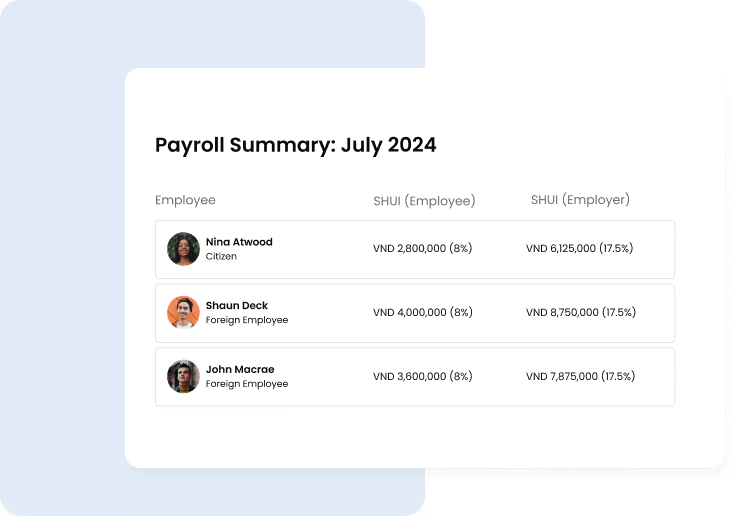
With HR software like Omni, organizations can ensure accurate calculations, timely payments, and compliance with evolving social security regulations.
Last but not least, the VSS offers online portals and digital tools for Vietnam social insurance management, such as the national public portal or the public portal of the VSS. You can also carry out social insurance transactions via the applications of five banks: Vietcombank, MB, BIDV, Vietinbank, and Agribank.
Navigating Vietnam Social Insurance is Easier with the Right HR Tools
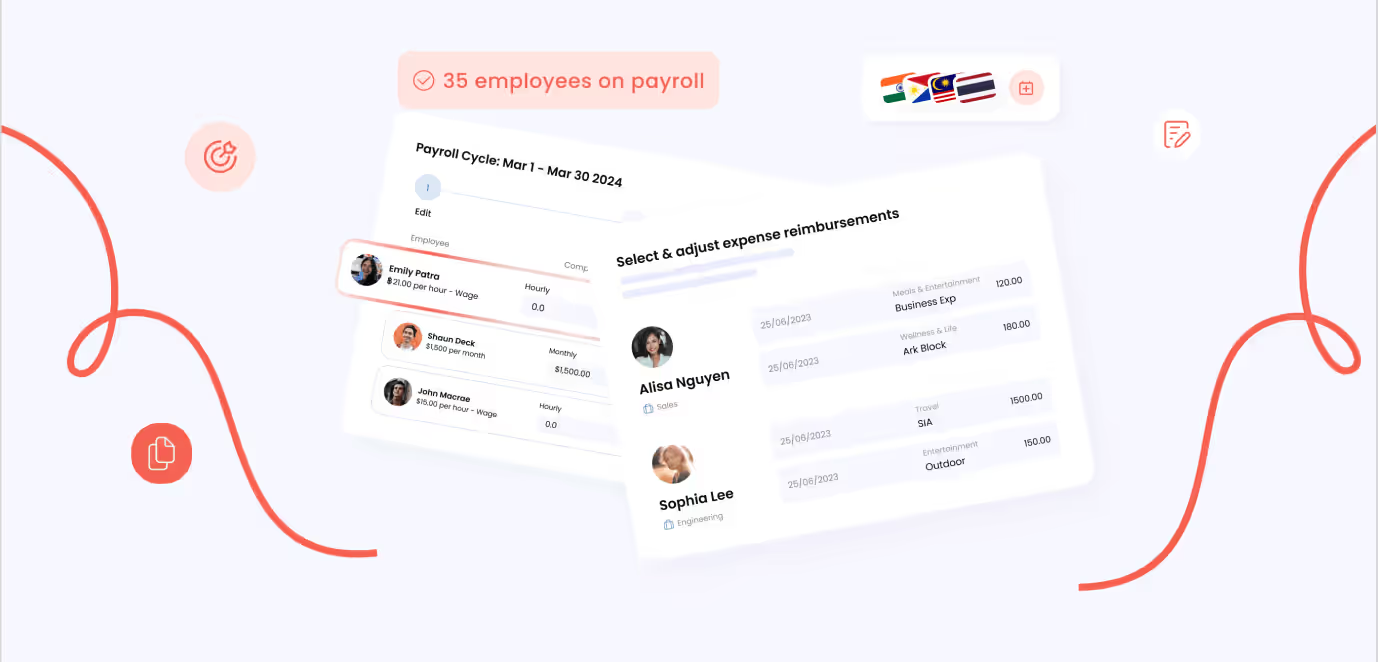
It’s clear that the Vietnam social insurance contribution process is an ever-evolving yet mandatory process for all businesses. Navigating it can be challenging, and staying up to date with the latest regulations is crucial for HR teams to remain compliant.
Omni helps HR teams stay up to date with the latest laws and regulations while streamlining the end-to-end employee management lifecycle. Our comprehensive payroll solution is tailored to Vietnam’s specific requirements. With features like support for Vietnamese dong, automated tax calculations, and instant payroll reports, Omni can help HR teams simplify their payroll processing while ensuring compliance.
Chat with our team to learn more!
Start your 7-day free trial today and see how Omni can simplify the intricacies and complexities of Vietnam payroll and minimize the costs associated with common errors.
.png)


.png)