





















.png)
Summary. Managing teams in China requires a clear understanding of China social insurance obligations under the Ministry of Human Resources and Social Security (MOHRSS), as contribution rates, ceilings, and regulations vary widely by city for both local and foreign employees. China’s mandatory social insurance system, also known as China social security, is structured around the Five Insurances and One Fund (五险一金), covering pension, medical, unemployment, work-related injury, maternity insurance, and the Housing Fund, and non-compliance can lead to fines, payroll errors, and negative records under China’s social credit system. Employers must navigate registration, monthly contributions, filings, and record-keeping, while foreign employees may be subject to partial exemptions under bilateral agreements. Tools like Omni HR streamline payroll, contributions, Housing Fund calculations, and tax filings, enabling companies to stay compliant with China social insurance and MOHRSS requirements, maintain accurate records, and reduce risk while supporting employee financial security.
Employers managing teams in China must navigate complex employment regulations, particularly regarding mandatory social insurance contributions. Different rules and contribution rates apply to local and foreign employees, and requirements vary widely by city. Beijing, Shanghai, Shenzhen, and smaller cities each have their own contribution ceilings, rates, and practices.
To stay compliant, companies need to clearly understand their China social insurance responsibilities under the Ministry of Human Resources and Social Security (MOHRSS) and how these rules affect their workforce. This guide breaks down China’s Five Insurances and One Fund (五险一金) system, highlights common compliance mistakes, and explains how to manage China's social security efficiently and compliantly.
Does China have social security?
Yes. China has a mandatory social insurance system, also known as social security, which provides financial security for employees and their families during retirement, unemployment, illness, work-related injury, and childbirth. The system is administered by MOHRSS, a government body under the State Council responsible for labor policies, standards, and regulations.
Participation in China's social security is compulsory for all Chinese employees and their employers, including most foreign employees working in China. The scheme consists of five types of insurance: pension, medical, maternity, work-related injury, and unemployment, plus the Housing Fund, which only Chinese nationals are required to contribute to.
Understanding the Five Insurances and One Fund (五险一金)
Below, we explore components of China’s social security—the five insurances and one fund (五险一金) system and their contribution rates:
Pension insurance (养老保险)
This type of China social insurance provides financial support to elderly employees after retirement. Once a worker reaches the legal retirement age (typically 60 for men and 50 to 55 for women) and completes retirement registration with their employer, they can apply for their pension benefits. Pension insurance is one of the core components of Five Insurances and One Fund (五险一金) regulated by the MOHRSS.
Employer contribution: Around 15-16%
Employee Contribution: Around 8%
Unemployment insurance (失业保险)
China's social insurance system offers temporary financial assistance to employees who lose their jobs involuntarily. Its purpose is to reduce the financial impact of unemployment and support economic stability. In some regions, it also includes reemployment services such as skills training and job placement assistance so laid-off employees can find new jobs as soon as possible. This benefit is part of China’s broader social security framework.
Employer contribution: 0.5% to 0.8%
Employee Contribution: Around 0.2-0.5%
Medical insurance (医疗保险)
With China’s vast population, access to healthcare is vital. Medical insurance helps cover employees’ healthcare costs for illness or non-occupational injuries to promote employee well-being, productivity, and reduce absenteeism. In most cities, maternity insurance is now merged into medical insurance, reflecting ongoing reforms under MOHRSS. According to Xinhua, China has announced plans to make childbirth essentially free under the national insurance system by 2026, ensuring that basic childbirth medical costs are fully covered by insurance programs nationwide.
It typically covers:
- Hospitalization and outpatient expense: Partial coverage for treatment costs.
- Critical illness: Additional coverage for expensive treatments.
- Maternity expenses: Costs related to pregnancy, childbirth, and maternity leave.
Employer contribution: 5% to 9.8%
Employee contribution: Around 2%
Work-related injury insurance (工伤保险)
Work injury insurance protects employees who suffer workplace injuries or occupational diseases. It covers medical costs, provides income security during recovery, and, in case of death, covers funeral expenses and survivor benefits. Coverage includes injuries sustained during regular work hours, work-related travel, company activities or training, and certain public service activities like disaster relief. Claiming benefits can be complex, as employees must provide documentation proving the injury occurred at work.
Employer contribution: 0.2 to 1.9% (depending on industry risk level)
Employee contribution: 0%, fully paid by the employer
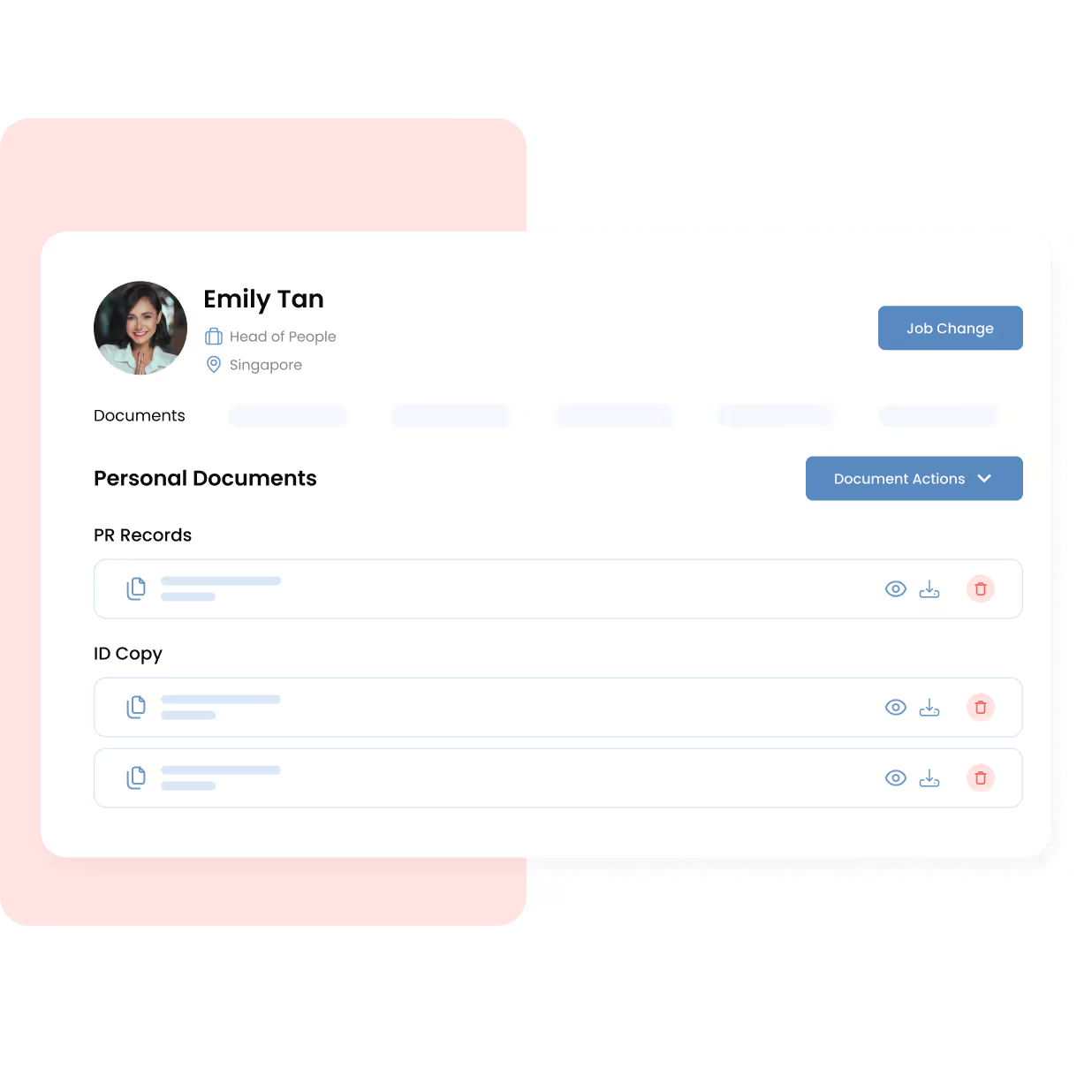
Managing all the required documentation for claims can be time-consuming, but tools like Omni HR’s document management system can help streamline the process, making it easier for HR teams to securely store, track, and retrieve employee injury records while ensuring compliance.
Maternity insurance (生育保险)
China social insurance covers medical expenses and salary during maternity leave for female employees. Benefits include maternity medical expenses (such as checkups, surgeries, family planning, hospitalization, and medications for pregnancy and childbirth) and maternity allowances to compensate for income loss.
In most cities, maternity insurance is now included under medical insurance, meaning employers pay a combined medical insurance rate, while employees do not make separate maternity contributions.
Employer contribution: 0%-1% (if still listed separately)
Employee contribution: 0%, fully paid by the employer
Housing fund (住房公积金)
The Housing Provident Fund (HPF) helps employees save for housing-related expenses, including home purchases, rent, renovations, and mortgage repayment. Unlike other China social insurance schemes, contributions from both employers and employees are deposited into individual accounts. The fund is administered at the municipal level, so rules and rates vary by city.
Both employers and employees contribute equally to the Housing Provident Fund. The contribution rate may differ by city and typically does not exceed 12%, making it a key pillar of Five Insurances and One Fund (五险一金).
Employer’s contribution rate: 5%-12%
Employee’s contribution rate: 5%-12%
Additional notes
Generally, an employee’s China social insurance contributions are based on their average monthly salary from the preceding year, including basic salary, bonuses, allowances, and subsidies. The Chinese government sets regional minimum and maximum contribution bases. For example, in Shenzhen, the minimum monthly base is RMB 4,492, and the maximum is RMB 27,501.
Contribution rates can also vary by industry, with higher-risk sectors such as manufacturing typically subject to higher employer contributions. For companies asking, “Does China have social security?”, the answer is yes—China operates a comprehensive social insurance system under MOHRSS, distinct from but sometimes linked to administrative compliance mechanisms such as China’s social credit system.
Additional reading: Employee Financial Wellness Programs & Benefits
How Employers Manage China's Social Insurance
As an employer, here are your obligations when managing China's social insurance:
Registration: Register both foreign and local employees with the local Social Insurance Bureau and the Housing Fund Bureau within 30 days of hiring. Employees are assigned a Social Security number and card, which they’ll use to access benefits such as medical treatment and pharmacy services.
Monthly reporting and contributions: Employers are responsible for calculating, withholding, and submitting both employer and employee contributions each month. This includes reporting employees’ salary bases and applying local contribution rates by the deadline.
Recordkeeping: Employers must maintain accurate payroll and social security records for inspections and regulatory audits.
Salary base adjustments: At least once a year, update your contribution bases to reflect changes in average wages according to local minimum and maximum caps.
Penalties for noncompliance: Late or incorrect payments can lead to fines or labor disputes. Repeated infractions may harm your company's reputation and make hiring harder in the future.
China Social Insurance for Foreign Employees
Foreign employees in China are generally required to participate in the social insurance system if they hold valid work permits or employment contracts. This requirement is set out under national regulations, though social insurance is administered and enforced at the local level, meaning implementation can vary by city or province.
In major cities such as Beijing and Shanghai, participation in China’s social insurance system is typically enforced as compulsory for foreign employees. In other locations, enforcement may be less consistent in practice, with some local authorities not strictly requiring participation in all China social insurance categories, such as unemployment or maternity insurance.
Foreign employees may also qualify for partial exemptions if their home countries have bilateral social security agreements with China. These agreements are designed to prevent double contributions in China and the employee’s home country and usually apply to specific China social security insurance items, most commonly pension contributions, for a defined period, subject to proof of overseas coverage.
Housing Provident Fund participation is generally not mandatory for foreign employees, although voluntary contributions may be permitted in certain cities. As local interpretations and enforcement practices differ, employers and employees should always verify city-specific requirements to ensure compliance and avoid costly assumptions.
Common China Social Insurance Compliance Mistakes to Avoid
Late registration or filings
Failing to register employees or submit required reports on time can result in fines, late payment fees, and increased regulatory scrutiny. In some cases, employees may temporarily lose access to medical or other benefits, leading to complaints and reduced trust. Delays can also cause inaccurate records and disputes during payroll audits or internal HR inspections.
Incorrect contribution calculations
China social insurance contributions are based on vital payroll information such as salaries, bonuses, allowances, and locally required rates. Applying the wrong salary base or outdated local rates can lead to underpayments or overpayments. And since rules vary by city and are updated regularly, even small errors can trigger back payments, penalties, and employee dissatisfaction.
Misclassification of employees
Classifying employees as independent contractors to avoid social insurance obligations violates Chinese labor law. Companies may face fines and be required to make payments for missed contributions. Misclassification can also damage employee trust and disrupt business operations, especially during labor inspections or disputes.
Understanding China’s Social Credit System and Payroll Compliance
China’s Corporate Social Credit System (CSCS) is a government-led, data-driven compliance framework that forms part of China’s social credit system, recording and sharing regulatory compliance data for all businesses registered in China. Rather than operating as a single numerical score, the system aggregates compliance records from multiple authorities, including the MOHRSS (Ministry of Human Resources and Social Security), tax bureaus, and other central and local regulators.
It collects two main types of information:
- Public credit information: Fines, legal judgments, business licenses, and official records from regulatory agencies, central and local governments, and courts.
- Market credit information: Company financials, management practices, and contract compliance from consumers, industry associations, third-party credit rating agencies, and the company itself.
The social credit system tracks and evaluates corporate compliance across taxation, labor, China social insurance, and regulatory reporting. For employers, errors in payroll or China social insurance contributions and filings can lower your company’s credit standing.
Additionally, the CSCS is connected to a reward-and-penalty system. Companies with strong compliance across taxation, labor, and social insurance obligations may appear on “red lists,” gaining benefits such as streamlined administrative procedures or reduced inspection frequency. On the other hand, serious or repeated violations related to payroll or Five Insurances and One Fund (五险一金) compliance may result in blacklisting, leading to heightened regulatory scrutiny, restricted government approvals, and potential limitations on financing or business activities.
How Omni HR Manages China Social Insurance
Managing China's social insurance can be complex, with city-specific contribution rates, statutory ceilings, and evolving MOHRSS regulations to navigate. Mistakes in payroll calculations, delayed filings, or mismanaged employee records can lead to penalties, regulatory scrutiny, and even impact your company’s standing under China’s social credit system.
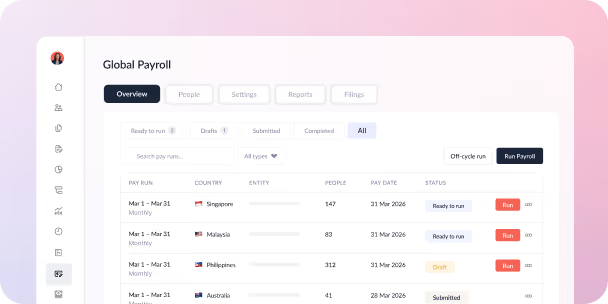
Omni HR streamlines the entire process, helping employers stay fully compliant while reducing administrative burden and risk:
- Monthly payroll calculations compliant with statutory requirements
- Administration of mandatory China social insurance contributions (pension, medical, unemployment, maternity, work injury)
- Calculation, filing, and payment of Housing Fund (五险一金) contributions
- Preparation and submission of monthly Individual Income Tax (IIT) filings and annual IIT reconciliation
- Accurate record-keeping for local and foreign employees
- Automated reporting aligned with MOHRSS and local social security requirements

With Omni HR, companies can confidently manage China social insurance obligations, ensure timely contributions and reporting, and maintain a strong compliance profile, reducing risk while supporting employee financial security and benefits management.
Frequently Asked Questions
1. Does China have social security for employees?
Yes. China has a mandatory social insurance system, also called China social security, which provides financial protection for retirement, medical needs, unemployment, work-related injuries, and maternity. Contributions are managed through the Five Insurances and One Fund (五险一金), with the MOHRSS (Ministry of Human Resources and Social Security) overseeing compliance.
2. What are the Five Insurances and One Fund (五险一金)?
The system includes:
- Pension insurance – retirement support
Medical insurance – healthcare and maternity coverage - Unemployment insurance – financial support during job loss
- Work-related injury insurance – protection for workplace injuries or occupational diseases
- Maternity insurance – salary and medical coverage during maternity leave
- Housing Fund – employee savings for housing-related expenses
3. Are foreign employees required to contribute to China's social insurance?
Yes. Foreign employees with valid work permits are generally required to participate. Partial exemptions may apply if their home country has a bilateral social security agreement with China. Participation in the Housing Fund is usually voluntary for foreign employees, depending on the city.
4. Who manages China's social insurance compliance?
The MOHRSS oversees China's social insurance at the national level, while local Social Insurance Bureaus and Housing Fund Bureaus handle city-specific administration, contribution rates, filings, and enforcement.
5. What are common compliance mistakes with China social insurance?
Frequent errors include:
- Late registration or delayed filings
- Incorrect contribution calculations
- Misclassification of employees to avoid obligations
Such mistakes can result in fines, penalties, and negative records under China’s social credit system.
6. How does China’s social credit system affect payroll and social insurance compliance?
Corporate compliance is tracked under the Corporate Social Credit System (CSCS). Repeated or serious violations, including payroll or social insurance non-compliance, can lead to blacklisting, stricter inspections, restricted government approvals, and limitations on financing or business activities. Strong compliance, on the other hand, may place companies on “red lists,” offering streamlined processes and fewer inspections.
7. How can Omni HR help manage China’s social insurance?
Omni HR automates payroll calculations, manages contributions for Five Insurances and One Fund (五险一金), and ensures accurate record-keeping for both local and foreign employees. It supports monthly payroll, Housing Fund filings, and Individual Income Tax (IIT) preparation and submission, helping employers stay aligned with MOHRSS and local China social security requirements while reducing compliance risks.



.avif)
.avif)