.png)
Summary. Participation in EPFO continues to grow as formal employment rises, with 1.458 million new members added in March 2025, reflecting stronger job creation and awareness of retirement savings. Provident Fund India contributions are mandatory for salaried employees, with both employee and employer contributing 12% of basic salary plus dearness allowance, while the employer’s share is split between EPF and the Employees’ Pension Scheme. Managing these contributions alongside TDS and accurately issuing Form 16 can be complex, but Omni HR simplifies the process by automating payroll, ensuring statutory compliance, and generating accurate records for EPFO contributions, TDS deductions, and Form 16 issuance, reducing errors and saving HR teams time while maintaining financial transparency.
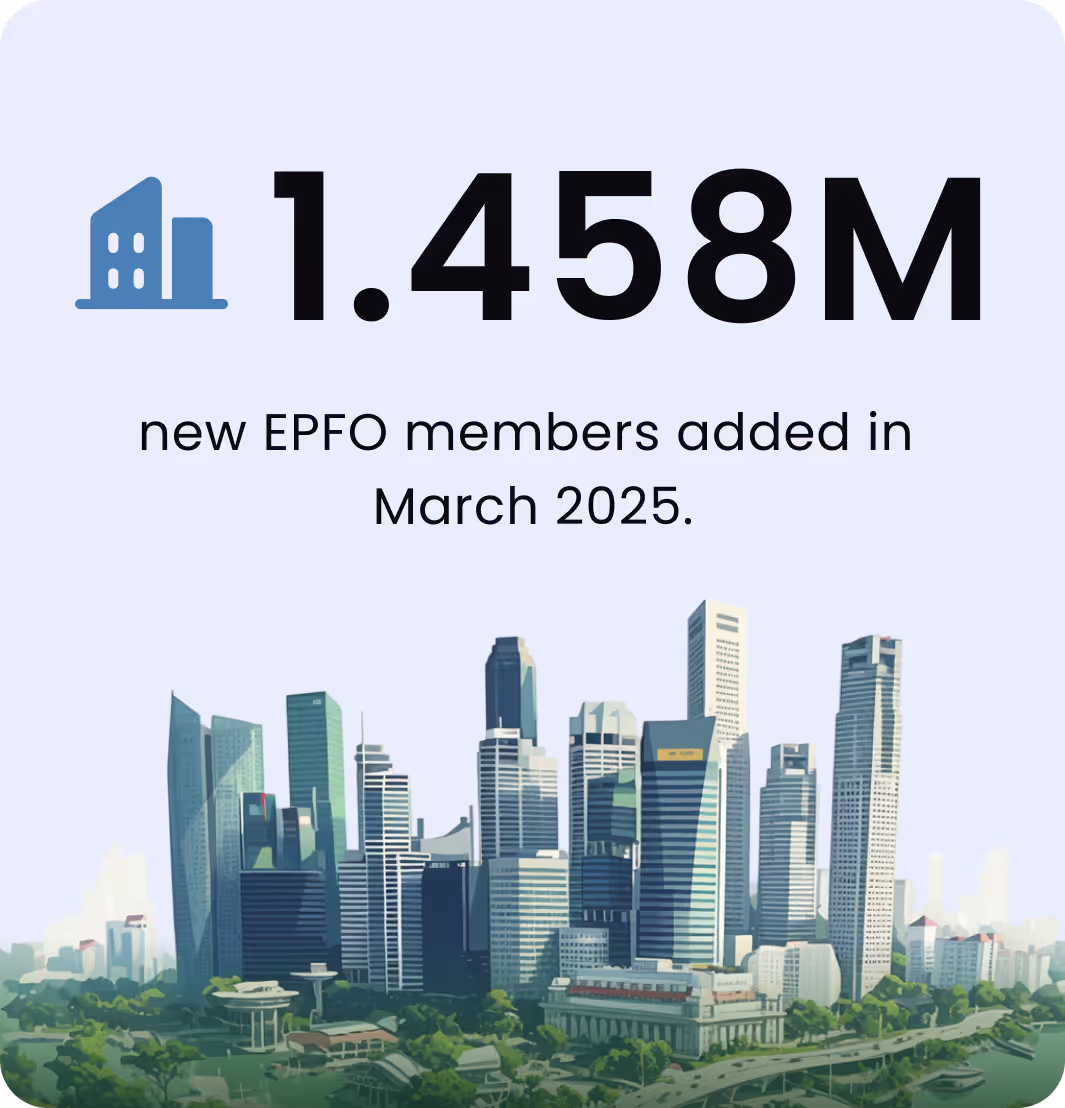
In India, participation in the Employees’ Provident Fund (EPF) continues to rise as formal employment expands. In March 2025, the EPFO recorded a net addition of 1.458 million new members, highlighting increased job creation and greater awareness of retirement savings among the workforce.
While EPF contributions are a statutory certainty for salaried employees, understanding how these deductions intersect with income tax compliance can be overwhelming, especially during tax season. Between tracking EPF contributions, interpreting deductions, and ensuring accurate reporting, the process quickly becomes complex for both employees and employers.
Thankfully, statutory documents like Form 16 help remove much of the guesswork by summarising taxable income and confirming that tax has been correctly deducted and deposited on your behalf. In this guide, we break down the key terms you’ll hear this tax season, like EPF, Form 16, and TDS. We’ll explain who’s eligible for these forms, why they matter, and how they relate to your salary and EPF contributions. We’ll also clear up common misunderstandings so you know exactly what’s what.
What is EPFO and the Employees’ Provident Fund (EPF)?
The Employee’s Provident Fund Organization (EPFO) is one of India’s main social security organizations, managed by the Ministry of Labour and Employment.
The Employees’ Provident Fund (EPF) itself is governed by a tripartite body called the Central Board of Trustees (CBT), which includes representatives from the Government (both central and state), employees, and employers. The Board oversees three schemes with the support of the EPFO, one of which is the Employees’ Provident Fund (EPF) Scheme 1952.
The EPF is a retirement savings scheme available to all salaried employees in India. It’s funded through contributions from both employees and employers to provide long-term financial security after retirement.
Currently, contributions are set at 12% of the basic salary plus dearness allowance (DA) from both the employee and the employer, with the employer’s share split between EPF and EPS.
What Is Form 16, and Why Does It Matter?
Form 16 is an official Tax Deducted at Source (TDS) certificate, issued by your employer under Section 203 of the Income Tax Act, 1961.
In simple terms, it shows how much income you earned during the financial year and confirms that your employer deducted and deposited the right amount of tax with the Income Tax Department on your behalf.
Having Form 16 makes filing your income tax return easier because you can enter your salary details automatically and accurately. Even if extra TDS was deducted, you can use Form 16 to claim a refund. It also serves as proof of income when applying for a loan, visa, or for financial planning.
But what makes Form 16 valid as proof of income or tax payment? Its contents hold the answers. This certificate is composed of two parts, covered below.
Part A
Part A of Form 16 contains details about the taxes deducted and deposited, along with key information about you and your employer. It includes:
- Name and Address: Your and your employer’s names and addresses
- TAN: The Tax Deduction and Collection Account Number (TAN) for your employer, used for TDS filing
- PAN: Your and your employer’s Permanent Account Numbers (PAN)
- TDS Summary: A monthly breakdown of the tax deducted and deposited with the government
Part B
Part B is an annexure to Part A that gives a detailed breakdown of your salary, exemptions, taxable income, and deductions. It includes:
- Breakup of Salary Components: Basic salary, allowances, like House Rent Allowance (HRA) and Leave Travel Allowance (LTA), medical allowances, and other perquisites
- Salary Summary: Your gross salary, including basic pay and other allowances
- Deductions: Deductions under the Income Tax Act, including investments and exemptions, such as contributions to the Employee Provident Fund India under Section 80C.
- Total Income: Your total taxable income (after accounting for exemptions and deductions)
- Tax Calculations: The income tax payable by you
- Relief: Any relief applicable under Section 89 of the Income Tax Act
How TDS Works with EPFO and Provident Fund Contributions
When it comes to Provident Fund India contributions, the standard rate is 12% of your basic salary plus dearness allowance (DA) for both employees and employers. Your EPFO account automatically receives these contributions, which secure your long-term retirement savings.
The employer’s contribution is split between EPF and the Employees’ Pension Scheme (EPS), with the EPS portion capped at 1,250 rupees per month for salaries above 15,000 rupees, while the remaining amount continues to the EPF account.
For example:
Basic salary = 20,000 rupees
- Employee EPF contribution = 12% x 20,000 = 2,400 rupees
- Employer total contribution = 12% x 20,000 = 2,400 rupees
- EPS portion (capped) = 1,250 rupees
- The remaining contribution goes into EPF
TDS on EPFO and pension payments
TDS rules apply when withdrawing funds from EPFO accounts or receiving a pension. Governed by Section 192A of the Income Tax Act, TDS is applicable if EPF withdrawal happens before completing five years of continuous service and the withdrawal exceeds 50,000 rupees.
- With PAN: TDS rate = 10%
- Without PAN: TDS rate = maximum marginal rate (~34.608%)
Example:
If you are 65 and receive an EPFO pension of 5,500 rupees per month with PAN, 550 rupees will be deducted as TDS.
TDS deducted on salary or pension may be reflected in Form 16 or other TDS certificates, depending on the payer.
Exemptions from TDS on Provident Fund India
No TDS is deducted in these cases:
- Withdrawal ≤ 50,000 rupees
- Transfer of PF from one account to another
- Termination due to illness, business closure, project completion, or other unavoidable reasons
- Submission of Form 15G/15H with PAN when the total income is below the taxable limit
EPF Passbook vs Form 16: Key Differences for Provident Fund India
Since both documents relate to your earnings, many people confuse the EPF Passbook with Form 16. Here’s a look at the main differences between them:
The confusion often arises because EPFO uses several numbered forms (such as Form 31 for advances), but these are not the same as Form 16, which is strictly a TDS certificate for salary income issued by employers.
Who Gets Form 16 and When From EPFO-Registered Employers
As a salaried employee, you receive Form 16 if you’re eligible. If your salary exceeds the taxable limit mentioned earlier, your employer deducts TDS and provides you with Form 16 as proof. If your salary falls below the taxable limit and no TDS is deducted, your employer is not required to issue Form 16. In such cases, you may request a salary or income certificate for record-keeping or loan applications instead.
How often do you receive Form 16? If you stay with the same EPFO-registered employer for the full year, you receive it annually. If you change jobs during the year, you’ll need to request separate Form 16s from each EPFO-registered employer covering the period you worked there.
The form is issued every year by 15 June at the latest, following the end of the financial year. For example, you can expect your Form 16 for FY 2025-26 by 15 June 2026. If you don’t receive it by the deadline, you should reach out to your employer.
Related TDS Forms and EPF Compliance
Now that you understand EPFO Form 16, it helps to know about related TDS forms and other forms needed for EPF compliance:
Form 15G & 15H
Both Forms 15G and 15H are self-declarations that allow you to claim exemptions from TDS.
Form 15G is meant for individuals under 60 years who don’t have taxable income. It helps prevent TDS on interest income from bank fixed deposits, recurring deposits, and on taxable EPF withdrawals, provided the individual’s final tax liability is NIL. For example, if you’re a 22-year-old and your only income in FY 2025–26 was 2,35,000 rupees earned from a fixed deposit, submitting Form 15G ensures that no TDS is deducted, letting you retain the full interest amount.
Form 15H works similarly for individuals aged 60 or above. For example, a 64-year-old Indian citizen with a NIL final tax liability for FY 2025–26 can apply for Form 15H and avoid TDS on interest earned from bank deposits when it exceeds 50,000 rupees in a financial year.
Form 16A
While Form 16 is issued by your employer to prove your income and the TDS deducted, Form 16A is issued by banks, tenants, or other financial institutions for TDS on non-salary income sources, such as rent, professional fees, or commissions. Unlike Form 16, which comes once a year, Form 16A is issued quarterly.
For instance, if you earn interest on a fixed deposit, your bank issues Form 16A as proof of TDS. Similarly, if you rent out a property, your tenant issues Form 16A for TDS deducted on rent.
How Omni HR Manages EPFO
Managing EPFO, TDS, and Form 16 requires more than understanding rules, it depends on consistent execution across monthly payroll runs, statutory filings, and year-end tax processes. For HR teams, this often means balancing accuracy, compliance, and timelines while handling frequent changes like new hires, salary revisions, or off-cycle payments.
Omni HR supports EPFO compliance by combining India-specific payroll workflows with managed services, helping organizations calculate contributions accurately, meet statutory deadlines, and maintain clear, centralized payroll records without relying on manual tracking or disparate systems.
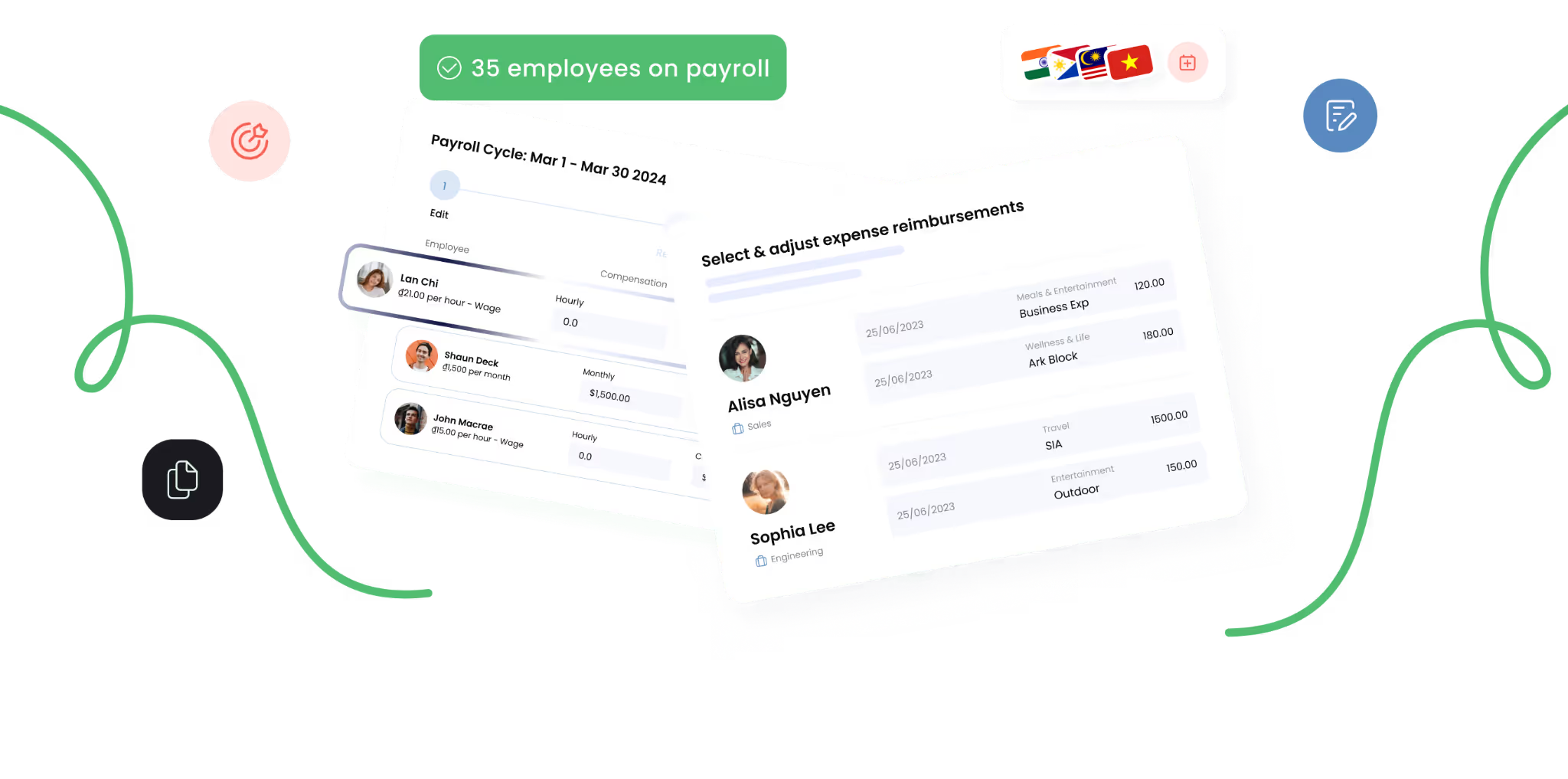
With Omni, your organization can:
- Run monthly payroll calculations in line with statutory requirements.
- Distribute payslips securely via email and our employee portal.
- Process unlimited off-cycle payroll runs without additional complexity.
- Submit monthly EPFO and ESI contributions accurately and on time.
- Prepare statutory statements for professional tax, Provident Fund India, and ESI.
- Collect income tax declarations and validate investment proofs annually.
- Recompute employee taxes at year's end to ensure accurate TDS reporting.
- File quarterly e-TDS returns through the TRACES portal.
- Issue Form 16 to employees in the subsequent financial year.
"Payroll calculations that used to take three to five working days can now be done in half the time with Omni."
— Tengku Mohaizad, Group Head of HR Asia at Inspire Brands Asia
By streamlining these processes, HR teams can focus on what matters most while staying compliant with Provident Fund India and tax regulations. Learn how Omni can simplify payroll and EPFO compliance for your organization.
Frequently Asked Questions
1. What is EPFO, and how does it work?
The Employees’ Provident Fund Organization (EPFO) is a statutory body under the Ministry of Labour and Employment in India that manages the Employees’ Provident Fund (EPF) scheme. Through EPFO, both employees and employers contribute to the Provident Fund India, helping workers build long-term retirement savings. Contributions are credited to individual EPF accounts on a monthly basis.
2. What is Form 16, and why is it important for EPFO contributions?
Form 16 is a TDS certificate issued by your employer under Section 203 of the Income Tax Act. It summarizes your annual taxable income, the TDS deducted, and taxes deposited with the government. Form 16 is essential for filing your income tax return and serves as proof of contributions to Provident Fund India and other taxable components of your salary.
3. How are EPF contributions calculated in India?
Employee and employer contributions to EPFO are typically 12% of basic salary plus dearness allowance (DA). The employer’s share is split between EPF and the Employees’ Pension Scheme (EPS), with the EPS portion capped for salaries above 15,000 rupees. These contributions form part of your Provident Fund India savings.
4. What is TDS on EPF withdrawals and EPFO pension payments?
TDS applies to EPF withdrawals before completing five years of continuous service if the withdrawal exceeds 50,000 rupees:
- With PAN: 10% TDS
- Without PAN: maximum marginal rate (~34.608%)
TDS may also be deducted on EPFO pension payments, and the amount deducted can be adjusted while filing your income tax return.
5. Are there exemptions from TDS on Provident Fund India contributions?
Yes. TDS is not deducted in these cases:
- EPF withdrawals ≤ 50,000 rupees
- Transfer of PF from one account to another
- Termination due to illness, business closure, or unavoidable reasons
- Submission of Form 15G/15H with PAN when the total income is below the taxable limit
6. What is the difference between the EPF Passbook and Form 16?
- EPF Passbook: Issued by EPFO; records contributions and balances in your Provident Fund India account; helps with retirement planning and tracking.
- Form 16: Issued by your employer; shows income, TDS deducted, and taxes deposited; used to file your income tax return.
7. Who receives Form 16 and when?
Employees whose salary exceeds the taxable limit and for whom TDS has been deducted receive Form 16 annually, usually by 15 June following the end of the financial year. If an employee changes jobs, each employer issues a separate Form 16 for the period worked.
8. What is Form 16A, and how is it different from Form 16?
Banks or other financial institutions issue Form 16A for TDS on non-salary income, such as interest, rent, or professional fees. Unlike Form 16, which is issued annually for salaries and EPFO contributions, Form 16A is issued quarterly.
9. How can Omni HR help with EPFO, TDS, and Form 16 compliance?
Omni HR automates payroll calculations, manages EPFO and ESI contributions, validates income tax declarations, files e-TDS returns, and issues Form 16 to employees. This ensures HR teams stay compliant with Provident Fund India regulations and reduces errors in monthly payroll and statutory filings.
.png)


.png)