.png)
Summary. Thinking about company registration in Singapore? While it’s easy to file paperwork through ACRA company registration or even an ACRA sole proprietorship, the real challenge comes after you register a business in Singapore: navigating payroll, CPF contributions, and ongoing compliance. Many entrepreneurs weighing business registration Singapore packages or forming a company in Singapore find that setting up a company in Singapore directly gives them ownership, but adds heavy compliance costs. Omni offers an alternative with our Employer of Record (EOR) solution, allowing you to bypass incorporation and start hiring in days. Instead of juggling multiple business registration packages, you get a streamlined way to expand while Omni manages payroll, contracts, and compliance for you.
You’re thinking of registering a company in Singapore, but here’s what most company registration Singapore packages leave out: the complexities of compliance.
While Singapore makes it simple to file paperwork, there’s more to it than filling out forms. Without understanding Accounting and Corporate Regulatory Authority (ACRA) regulations, work pass requirements, and post-registration obligations, you risk costly mistakes.
This guide gives you a complete roadmap for company registration Singapore, covering entity types, compliance essentials, and how Omni’s Employer of Record (EOR) services can fast-track your setup.
Why Singapore for Your Business
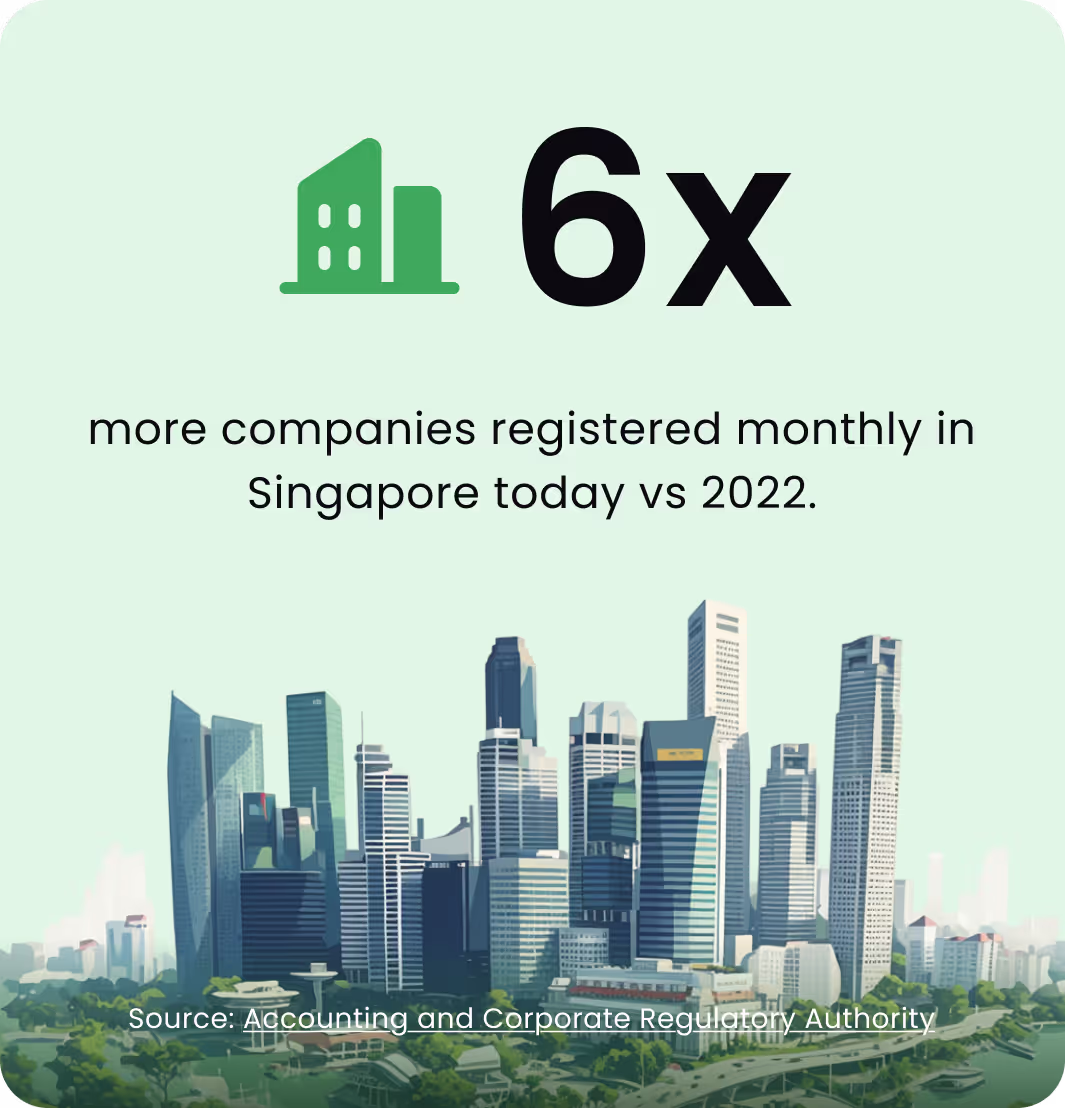
According to data from ACRA, more than 60,000 companies were being registered in Singapore every month in 2022. Today, that figure has increased more than sixfold, past 400,000 monthly registrations. This is no surprise, as Singapore consistently ranks as one of the world’s easiest places to set up a company. Its advantages rest on four pillars:
1. Unmatched economic and political stability
A business owner’s primary fear is unpredictability. Singapore offers the opposite. For decades, Singapore has consistently been ranked among the top 4 least corrupt countries in the world. Forming a company in Singapore means no hidden costs, no bribery, and a level playing field. Your investment and operations are protected by a world-renowned stable government, consistent policies, and a zero-tolerance stance towards corruption. This eliminates a massive layer of risk that exists in most other countries.
2. Favourable tax environment
Singapore's tax system is deliberately engineered to reward business growth and international expansion, allowing you to keep more of your hard-earned capital. The headline corporate tax rate is a highly competitive flat 17%. Crucially, there is no capital gains tax, making it an ideal location for investors, founders, and holding companies. Furthermore, its vast network of over 85 Double Taxation Agreements (DTAs) ensures profits are not taxed twice, providing seamless and tax-efficient access to global markets.
Read next: Employer’s Manual for Taxation in Singapore
3. Global and diverse talent pool
Talent is critical when setting up a company in Singapore. Singapore attracts and cultivates the best. Its local population, whose students consistently rank 1 globally in PISA rankings for core competencies, is supplemented by a highly attractive environment for global talent. The workforce is highly educated, multilingual, and productive, with Singapore consistently ranking in the global top 10 for talent competitiveness. This ensures companies can find the precise skills they need to innovate and scale.
4. Gateway to APAC markets
While a small domestic market, Singapore's true value is as a strategic springboard into the world's fastest-growing economic region. It provides trusted, seamless access to giants like China, India, and Indonesia through its central role in massive trade agreements like the Regional Comprehensive Economic Partnership (RCEP).
Company Registration Singapore Essentials
If you’re planning on setting up a company in Singapore, you must register with ACRA. This is the foundation of company registration Singapore, giving you a Unique Entity Number (UEN). The process is streamlined and can typically be completed online within a few hours, provided all required documents and information are prepared in advance.
Business structure options
There are four main types of business structure. Here’s how they compare:
In summary, Private Limited Companies (Pte Ltds) are the most popular choice when it comes to forming a company in Singapore, offering limited liability protection, a separate legal identity, and access to corporate tax benefits and exemptions.
Limited Liability Partnerships (LLP) are best suited for professional services firms, as they provide a separate legal entity and limited liability protection, while still taxing profits at the partners’ personal income tax rates.
ACRA sole proprietorships, though the simplest and cheapest to set up, carry unlimited personal liability, are taxed at the owner’s personal rate, and are generally not recommended for foreigners or anyone setting up a company in Singapore and planning to scale significantly.
ACRA company registration
The ACRA company registration process is famously efficient. Here’s how it works:
1. Choose your business structure: Decide between a sole proprietorship, partnership, or Pte Ltd.
2. Apply for a company name: Submit your desired name through the online ACRA BizFile+ portal. Approval is typically instant.
3. Prepare documentation: This includes details of shareholders, directors, the company secretary, and a registered local office address.
4. Apply: File the incorporation application via BizFile+. Approval is often granted within hours.
5. Receive documents: Upon approval, you will instantly receive a Certificate of Incorporation and a Unique Entity Number (UEN).
Required documents and timelines
- Company name approval: instant to 14 days if referred.
- Incorporation processing: usually within 1 business day.
- Documents: ID/passport of directors and shareholders, proof of registered address, and company constitution.
Beyond Registration: Employment Compliance
Completing company registration Singapore is only the first step. The next step is preparing for employees. Singapore has strict compliance rules that every employer must follow:
- MoM work permit requirements: Businesses must secure the correct work pass (e.g., Employment Pass, S Pass, Work Permit) from the Ministry of Manpower (MoM) for any foreign employee. Each pass type has strict eligibility criteria based on salary, qualifications, and employer quotas.
- CPF employer obligations: All employers must contribute to the Central Provident Fund (CPF), a national social security savings plan, for their Singaporean and Permanent Resident employees. Contribution rates are tiered based on the employee's age and salary, and payments must be made monthly.
- Employment Act compliance basics: The Employment Act stipulates core provisions for all employees, including guidelines on working hours, rest days, and salary payment. It also mandates key benefits like annual leave and sick leave, with more comprehensive protections covering rank-and-file employees.
Your First Hire Checklist
Now that you’ve followed the steps to company registration Singapore, what’s next? Getting your first hire. Here’s what you need to know about hiring in Singapore.
Pre-employment setup requirements
Before you can legally make an offer, you must have the correct entity and compliance frameworks in place. This includes manpower planning, fair job advertising, and shortlisting based on merit while avoiding discriminatory practices.
Employers must also conduct pre-employment checks, such as verifying qualifications, references, and medical exams, and ensure that candidates are legally eligible to work (with the correct work pass). Finally, the phase concludes with the issuance of a compliant employment contract and preparation for onboarding.
Relevant reading: Enterprise Onboarding Software That Supports the Full Employee Lifecycle
Onboarding workflow preparation
A smooth onboarding process is critical for compliance and employee experience. This involves preparing the employment contract as per the Employment Act, setting up payroll systems for salary and CPF contributions, and organizing mandatory sign-ups for Singapore's national health insurance (MediShield Life) and pension fund (CPF).
Gallup research shows that when managers take an active role in onboarding, employees are 3-4 times more likely to rate their experience as exceptional, a clear reminder that building an effective workflow after setting up a company in Singapore is essential for both compliance and engagement.
We've created an onboarding checklist that includes templates and best practices for onboarding. Use this to improve and guide your onboarding process.
What to Plan Beyond Your First Employee
After forming a company in Singapore, one of the biggest decisions employers make is whether to hire directly (set up your own legal entity, handle payroll, taxes, compliance, and HR processes yourself) or to use an Employer of Record (EOR), a third-party provider that becomes the legal employer, while you manage the day-to-day work relationship. This choice affects how quickly one can scale, how much admin/compliance risk they take on, and their long-term HR strategy.
When to consider EOR vs direct employment
- When sole proprietorship structures become limiting: If your business is moving beyond its earliest stage, running everything under a sole proprietorship can be restrictive. An EOR helps you professionalize hiring quickly without the immediate burden of incorporating a local company.
- Multi-location hiring considerations: An EOR is the most efficient solution for multi-location hiring, as it instantly manages country-specific employment laws, taxes, and compliance without requiring you to set up a legal entity in each country. This allows for rapid, de-risked global expansion, while direct entity establishment is only justified for long-term, deep investment in a specific market.
- HR system scalability: EORs provide ready-made HR infrastructure such as payroll, benefits, compliance support, and contracts that scale with you as you add more employees. Direct hiring requires you to build these systems in-house, which can make sense if you plan for sustained growth in Singapore and want tighter control over your HR operations.
Manual Company Registration Singapore vs EOR
Choosing between manual company registration Singapore and an EOR depends on your goals. Direct ACRA register company processes offer control, but EOR streamlines compliance. Many foreign entrepreneurs find that an EOR reduces the risks tied to company registration Singapore. The table below gives a short summary of the differences between both options.
While direct company registration Singapore gives you control and ownership, it comes with high compliance responsibilities. With Omni as your EOR, you skip incorporation and start hiring in days instead of weeks, ideal for businesses expanding quickly.
Manual company registration cost vs EOR
See How Omni Supports Business Registration in Singapore
Exploring company registration in Singapore often starts with deciding whether to go through the full ACRA company registration process or to look for faster alternatives. While many entrepreneurs choose to register a business in Singapore through ACRA, whether as a sole proprietorship or when forming a company in Singapore, this route requires handling payroll, CPF contributions, and statutory filings on your own.
For businesses that want speed, flexibility, and reduced risk, Omni HR offers a smarter solution. Our EOR service allows you to bypass the complexity of setting up a company in Singapore while still hiring employees legally and compliantly. Let Omni handle everything from ACRA register company requirements to ongoing payroll and HR compliance, so you can focus on market entry and growth.
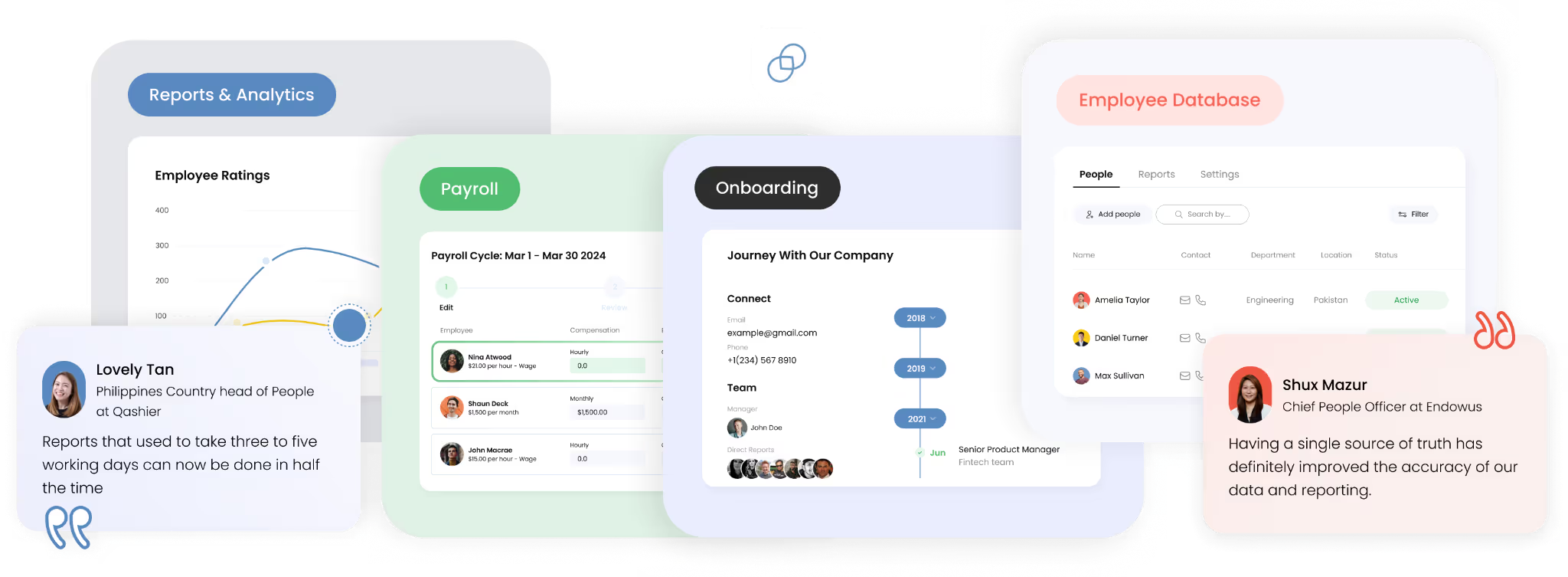
If you are still weighing the benefits of business registration in Singapore and exploring a faster route through an EOR, book your demo with our team today to learn more.