Stay Ahead with Omni: Key HR Compliance Updates in Asia Q2 2026

11
min Read
11
min Read
Save this article for future use
Download PDF

Summary. Q2 2026 brings major compliance changes across eight Asian markets: expanded parental leave and retirement age increases in Singapore, doubled Employment Pass salary thresholds in Malaysia, India's landmark Four Labour Codes implementation, pension security cap increases in Indonesia, tax bracket simplification in Vietnam, and minimum wage adjustments in Hong Kong. HR teams must restructure salary components, update leave policies, reconfigure payroll systems, and prepare for mid-year regulatory changes.

Q2 2026 HR Compliance Updates Across Asia

Q2 introduces significant legislative changes affecting leave policies, employment pass requirements, tax structures, and minimum wages. Organizations must act now to update systems and policies before these deadlines.

Q2 Compliance Update Snapshot

Country Update Effective Date
Singapore Shared Parental Leave expansion to 10 weeks 1 April 2026
Retirement age increase to 64 1 July 2026
Re-employment age increase to 69 1 July 2026
Malaysia Revised Employment Pass salary requirements 1 June 2026
Philippines Regional minimum wage monitoring Ongoing Q2 2026
Thailand BOI and Social Security compliance Ongoing
Indonesia PKWT and foreign worker compliance Ongoing
Revised maximum wage cap for Pension Security 1 March 2026
Hong Kong Statutory minimum wage increase 1 May 2026
Vietnam Progressive tax rate reform 1 July 2026
India New Labour Codes implementation 1 April 2026

Singapore

Key updates:

  • 10 weeks shared parental leave — effective 1 April 2026
  • Retirement and re-employment age increase — effective 1 July 2026

Shared Parental Leave expansion

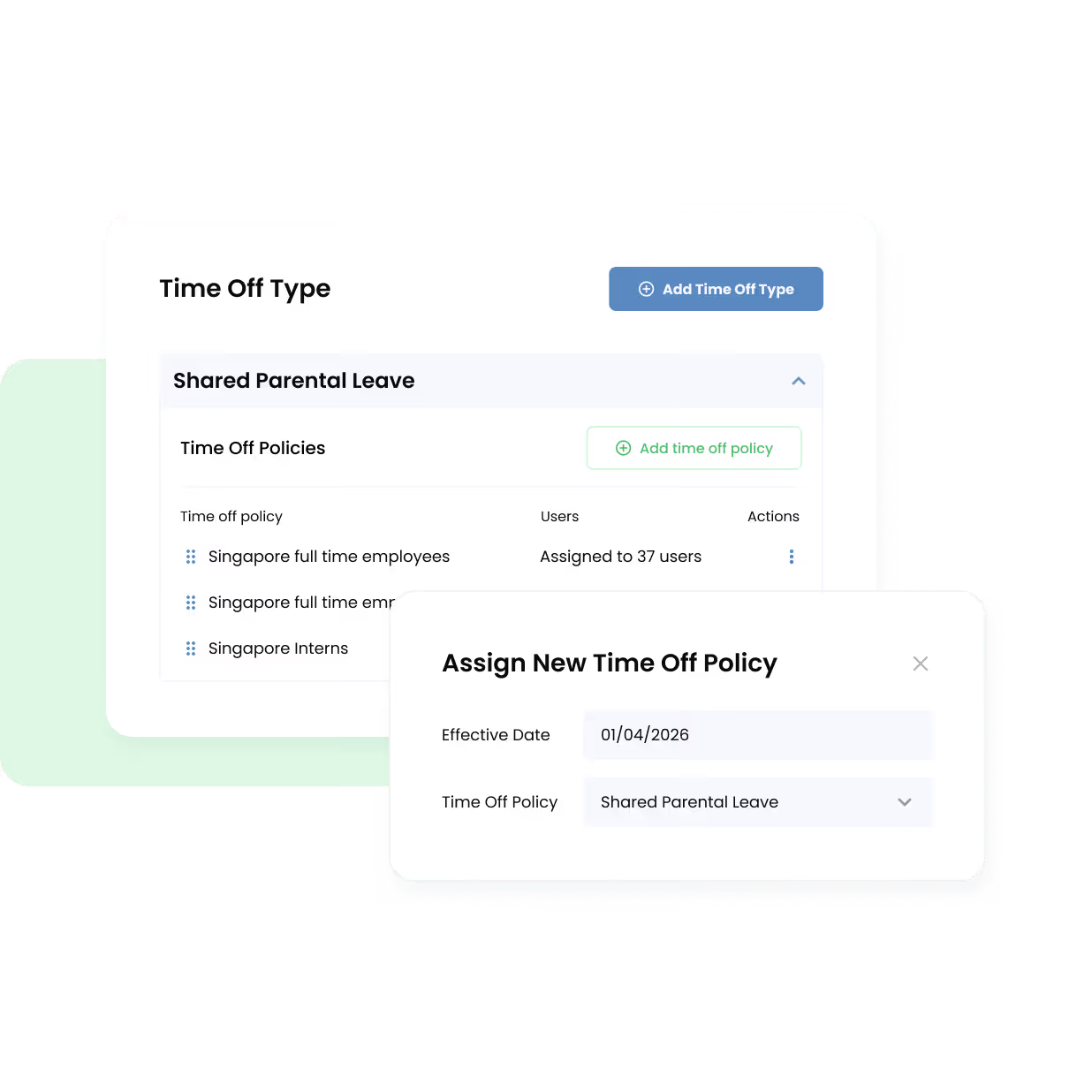
Shared Parental Leave (SPL) increases from 6 weeks to 10 weeks for children born on or after 1 April 2026. Each parent gets 5 weeks by default, with flexibility to reallocate between parents.

This replaces the previous arrangement where mothers could transfer up to 4 weeks of maternity leave to fathers. Combined with 16 weeks of maternity leave and 4 weeks of paternity leave, families now have 30 weeks of government-paid leave.

Leave Type Duration Notes
Government-Paid Maternity Leave 16 weeks For mothers
Government-Paid Paternity Leave 4 weeks For fathers
Shared Parental Leave (NEW) 10 weeks 5 weeks per parent by default, reallocatable
Total Paid Leave 30 weeks Combined family entitlement

Eligibility: Both parents and the child must be Singapore citizens.

Action required:

  • Update leave policies and employee handbooks before 1 April
  • Configure HRIS to track 10-week SPL allocation and transfers between parents
  • Train managers on new allocation rules
  • Communicate changes to employees planning families
How Omni helps: Track SPL entitlements, manage leave transfers between parents, and generate reports showing leave balances and government reimbursement claims.
compliance updates q2 2026

Retirement and re-employment age increases

Effective 1 July 2026, retirement and re-employment ages increase by one year:

Age Type Previous New (from 1 July 2026)
Retirement age 63 years 64 years
Re-employment age 68 years 69 years

Employers must offer re-employment to eligible employees turning 64, with written offers extended at least 3 months before their 64th birthday.

Action required:

  • Identify employees turning 63-64 in Q2-Q3 2026
  • Extend re-employment offers at least 3 months before they turn 64
  • Update employment contracts, HR policies, and workforce planning documents
  • Budget for extended employment periods
  • Review succession planning strategies

Learn more: How Omni HRIS Makes Succession Planning Actionable

How Omni helps: Track employee birth dates, send automated reminders for re-employment offer deadlines, and generate reports on senior workers approaching retirement age.

Malaysia

Revised employment pass salary requirements

Effective 1 June 2026, EP minimum salaries increase significantly across all categories:

EP Category Previous Minimum New Minimum (from 1 June 2026) Validity Period Special Requirements
Category I RM 10,000/month RM 20,000/month Standard None
Category II RM 5,000-9,999/month RM 10,000-19,999/month Up to 10 years Mandatory succession plan
Category III RM 3,000-4,999/month RM 5,000-9,999/month Up to 5 years Mandatory succession plan

Impact: Expatriate employment costs will increase substantially. Categories II and III now require documented succession plans to ensure knowledge transfer to Malaysian nationals.

Action required:

  • Audit all current and planned expatriate salaries by May 2026
  • Adjust compensation packages to meet new thresholds or risk EP rejection
  • Develop succession plans for EP Categories II and III
  • Update budget forecasts for higher expatriate costs
  • Coordinate with legal teams on contract amendments
How Omni helps: Track expatriate salaries automatically, flag employees below new thresholds, and generate succession planning reports for Categories II and III.

Philippines

Regional minimum wage monitoring

Regional Tripartite Wages and Productivity Boards (RTWPBs) may issue new wage orders during Q2 2026. Wage increases vary by region and sector, with potential retroactive compliance.

Action required:

  • Subscribe to DOLE announcements for all operating regions
  • Assign weekly monitoring of RTWPB announcements
  • Prepare payroll systems for mid-year wage adjustments
  • Budget for possible retroactive payments
  • Update regional wage tables immediately when orders are issued

Thailand

Q2 compliance reminders

Requirement Details
BOI foreign staff salaries Executive: THB 150,000
Management: THB 75,000+
Operations: THB 50,000+
Social Security contributions Salary cap: THB 17,500
Max contribution: THB 875 per party
Thai workforce ratio 70%+ for manufacturing companies with 100+ employees
Social Security reporting 6-month reporting cycle for all employees

Action required:

  • Conduct a mid-year audit of foreign worker salaries
  • Verify Thai staff percentage requirements
  • Review Q2-Q3 work permit renewals
How Omni helps: Track foreign worker salaries, monitor workforce nationality ratios, and automate Social Security contribution calculations.
compliance updates q2 2026

Indonesia

Revised maximum wage cap for Pension Security contributions

Effective 1 March 2026, the maximum wage cap for Jaminan Pensiun (Pension Security/JP) contributions increases from IDR 10,457,400 to IDR 11,086,300.

This annual adjustment is mandated by Article 29 of Government Regulation No. 45 of 2015, which requires the maximum wage ceiling to be adjusted based on the previous year's GDP growth rate using the formula:

New Wage Ceiling = Previous Wage Ceiling × (1 + Previous Year's GDP)
Component Amount
Previous wage ceiling IDR 10,457,400
2025 GDP growth rate 5.11%
New wage ceiling (from 1 March 2026) IDR 11,086,300

Impact: Employees earning above the new ceiling will see increased JP contributions based on the higher cap, affecting both employer and employee contribution calculations.

Action required:

  • Update payroll systems to reflect IDR 11,086,300 wage ceiling by 1 March 2026
  • Recalculate JP contributions for employees earning above the previous cap
  • Adjust BPJS Ketenagakerjaan remittance amounts
  • Communicate changes to affected high-earning employees
  • Budget for increased employer JP contributions
How Omni helps: Update contribution calculations based on the new wage ceiling, flag employees affected by the cap increase, and generate BPJS Ketenagakerjaan remittance reports with accurate amounts.

Q2 compliance reminders

Requirement Details Action Timeline
PKWT contracts Verify compliance with the 5-year maximum limit Audit Q2-Q3 2026 expirations
KITAS renewal Begin the process 60 days before expiry Track expiry dates
DKP-TKA payments US$100 per foreign worker monthly Reconcile headcount monthly
RPTKA validity Foreign Worker Utilization Plans current Verify and renew as needed

Action required:

  • Audit PKWT contracts expiring in Q2-Q3 2026
  • Track KITAS expiry dates with 60-day lead time
  • Reconcile monthly DKP-TKA payments with foreign worker headcount
How Omni helps: Track PKWT contract duration with automated alerts 6 months before 5-year threshold, monitor KITAS expiries with 90/60/30-day reminders, and generate monthly DKP-TKA payment reports.

Hong Kong

New statutory minimum wage rate

Subject to approval, the statutory minimum wage increases from HK$42.10 to HK$43.10 per hour. Once approved, this rate becomes effective 1 May 2026. This is the first rate under Hong Kong's new annual review mechanism based on inflation and economic growth.

Coverage:

Category Status
Standard employees Covered
Student interns Exempt during exempt student employment periods
Work experience students Exempt during exempt student employment periods
Employees with disabilities Covered (can invoke productivity assessment)

Action required:

  • Update payroll systems to HK$43.10/hour by 1 May 2026
  • Review all salaries to ensure compliance
  • Adjust compensation for employees below the new minimum
  • Recalculate monthly salaries for hourly/daily-rated workers
  • Communicate changes before 1 May
  • Update employment contracts and offer letters
How Omni helps: Automatically update minimum wage rates, track employees below the new threshold, and recalculate salaries for hourly and daily-rated workers.

Vietnam

Progressive tax rate reform

Effective 1 July 2026, personal income tax brackets will be simplified from 7 to 5 brackets. The National Assembly passed the amended law on 10 December 2025.

New tax brackets (from 1 July 2026):

Bracket Taxable Income (VND) Previous Threshold Tax Rate Change
1 Up to 10 million Up to 5 million 5% Threshold doubled
2 Above 10-30 million Above 5-10 million 10% Wider bracket
3 Above 30-60 million Above 10-18 million 20% Combined from 15% & 20%
4 Above 60-100 million Above 32-52 million 30% Combined from 25% & 30%
5 Over 100 million Over 80 million 35% Threshold increased

Impact: Wider tax brackets mean lower effective tax rates for most employees, increasing take-home pay. The shift from 7 to 5 brackets simplifies payroll processing.

Action required:

  • Prepare payroll systems for mid-year tax calculation changes (1 July 2026)
  • Monitor for official decree with implementation details
  • Calculate tax impact across salary bands
  • Plan employee communications explaining new rates
  • Budget for payroll system reconfiguration in Q2
How Omni helps: Automatically apply new tax brackets from 1 July, recalculate tax withholding for all employees, and generate tax impact reports by salary band.

India

New Labor Codes implementation

India's Four Labour Codes consolidate 29 central labour laws into four comprehensive codes. These represent the most significant labour law reform in India in decades.

The Four Labor Codes:

Code Key Focus Areas
Code on Wages, 2019 Wage payment, minimum wages, bonus, and wage definitions
Industrial Relations Code, 2020 Employment terms, layoffs, retrenchment, and dispute resolution
Code on Social Security, 2020 Provident Fund, gratuity, and employee benefits
Occupational Safety, Health and Working Conditions Code, 2020 Workplace safety, working conditions, and contractual employment

Implementation status: The central government has notified the codes for establishments under its jurisdiction. State-specific rules are still under finalization, with most states expected to notify their rules by mid-March 2026.

1. Wage structure restructuring (Code on Wages, 2019)

New requirement: Basic wages must constitute at least 50% of the total gross salary.

What constitutes gross salary: Total compensation excluding variable pay, performance bonuses, incentives, and expense reimbursements.

Component Previous Practice New Requirement
Basic wage minimum No statutory minimum % Minimum 50% of gross salary
Calculation base Varies by company Standardized across India

Impact: Companies with lower basic wage percentages must restructure salary components before 1 April 2026, which will cascade into higher statutory contributions (PF, gratuity, ESI).

2. Gratuity changes (Code on Social Security, 2020)

Fixed-term employees: The 5-year continuous employment condition no longer applies to fixed-term contract employees.

Employee Type Previous Rule New Rule
Permanent employees 5 years of continuous service No change
Fixed-term employees 5 years of continuous service Payable after 1 year of continuous service

Impact: Companies employing fixed-term workers face significantly higher gratuity liabilities. Many organizations may convert fixed-term contracts to permanent employment to manage costs.

Gratuity calculation: Will be computed on "Wages" as defined in the Code (minimum 50% of gross), not just basic salary as currently practiced.

3. Provident Fund changes (Code on Social Security, 2020)

Calculation change: PF will be computed on "Wages" (as defined in the Code) instead of basic salary only.

Aspect Previous New
Calculation base 12% of basic salary 12% of "Wages" (50%+ of gross)
Wage ceiling Rs. 15,000/month The same ceiling continues
Inspection period Open-ended Restricted to 5 years

Impact: Higher PF contributions for both employers and employees due to expanded wage definition.

Learn more: EPFO & Form 16: Understanding Provident Fund India

4. Maternity benefit (Occupational Safety, Health and Working Conditions Code, 2020)

No material changes from the current Maternity Benefits Act. The six-week prohibition on work immediately following delivery, miscarriage, or medical termination remains unchanged.

5. Employee compensation

Wages for compensation calculations will follow the amended definition, potentially increasing compensation amounts.

Action required:

Immediate (by mid-March 2026):

  • Audit current salary structures to identify employees with basic wages below 50% of gross
  • Develop compliant salary restructuring plans
  • Calculate impact on PF, gratuity, and other statutory contributions
  • Review all fixed-term employment contracts
  • Assess the gratuity liability increase for fixed-term employees
  • Decide on conversion strategy (fixed-term to permanent)

By 1 April 2026:

  • Implement restructured salary components
  • Update employment contracts to reflect new wage definitions
  • Reconfigure payroll systems for new PF and gratuity calculations
  • Update HR policies and employee handbooks
  • Communicate changes to all employees
  • Adjust budget forecasts for increased statutory contributions

Ongoing:

  • Monitor state-specific rule notifications
  • Ensure compliance with state rules as they are published
  • Maintain documentation for the 5-year inspection period

Stay Compliant and Confident with Omni HR

Q2 2026 brings substantial changes: SPL expansions, retirement age increases, doubled EP salary thresholds, tax restructuring, minimum wage adjustments and more. Managing these manually creates compliance risk and administrative burden.
compliance updates q2 2026

With Omni, HR leaders can streamline HR legal compliance across all jurisdictions:

  • Automated policy updates reflect regulatory changes across all markets
  • Real-time dashboards track leave entitlements, work pass expiries, and wage thresholds
  • Multi-country payroll handles tax bracket changes and minimum wage adjustments
  • Workflow automation sends reminders for re-employment offers and EP renewals
  • Audit-ready reporting for labor inspections and internal reviews

Schedule your product tour today and see how Omni can simplify your Q2 2026 HR compliance process.

Q2 2026 HR Compliance Updates Across Asia

Q2 introduces significant legislative changes affecting leave policies, employment pass requirements, tax structures, and minimum wages. Organizations must act now to update systems and policies before these deadlines.

Q2 Compliance Update Snapshot

Country Update Effective Date
Singapore Shared Parental Leave expansion to 10 weeks 1 April 2026
Retirement age increase to 64 1 July 2026
Re-employment age increase to 69 1 July 2026
Malaysia Revised Employment Pass salary requirements 1 June 2026
Philippines Regional minimum wage monitoring Ongoing Q2 2026
Thailand BOI and Social Security compliance Ongoing
Indonesia PKWT and foreign worker compliance Ongoing
Revised maximum wage cap for Pension Security 1 March 2026
Hong Kong Statutory minimum wage increase 1 May 2026
Vietnam Progressive tax rate reform 1 July 2026
India New Labour Codes implementation 1 April 2026

Singapore

Key updates:

  • 10 weeks shared parental leave — effective 1 April 2026
  • Retirement and re-employment age increase — effective 1 July 2026

Shared Parental Leave expansion

Shared Parental Leave (SPL) increases from 6 weeks to 10 weeks for children born on or after 1 April 2026. Each parent gets 5 weeks by default, with flexibility to reallocate between parents.

This replaces the previous arrangement where mothers could transfer up to 4 weeks of maternity leave to fathers. Combined with 16 weeks of maternity leave and 4 weeks of paternity leave, families now have 30 weeks of government-paid leave.

Leave Type Duration Notes
Government-Paid Maternity Leave 16 weeks For mothers
Government-Paid Paternity Leave 4 weeks For fathers
Shared Parental Leave (NEW) 10 weeks 5 weeks per parent by default, reallocatable
Total Paid Leave 30 weeks Combined family entitlement

Eligibility: Both parents and the child must be Singapore citizens.

Action required:

  • Update leave policies and employee handbooks before 1 April
  • Configure HRIS to track 10-week SPL allocation and transfers between parents
  • Train managers on new allocation rules
  • Communicate changes to employees planning families
How Omni helps: Track SPL entitlements, manage leave transfers between parents, and generate reports showing leave balances and government reimbursement claims.
compliance updates q2 2026

Retirement and re-employment age increases

Effective 1 July 2026, retirement and re-employment ages increase by one year:

Age Type Previous New (from 1 July 2026)
Retirement age 63 years 64 years
Re-employment age 68 years 69 years

Employers must offer re-employment to eligible employees turning 64, with written offers extended at least 3 months before their 64th birthday.

Action required:

  • Identify employees turning 63-64 in Q2-Q3 2026
  • Extend re-employment offers at least 3 months before they turn 64
  • Update employment contracts, HR policies, and workforce planning documents
  • Budget for extended employment periods
  • Review succession planning strategies

Learn more: How Omni HRIS Makes Succession Planning Actionable

How Omni helps: Track employee birth dates, send automated reminders for re-employment offer deadlines, and generate reports on senior workers approaching retirement age.

Malaysia

Revised employment pass salary requirements

Effective 1 June 2026, EP minimum salaries increase significantly across all categories:

EP Category Previous Minimum New Minimum (from 1 June 2026) Validity Period Special Requirements
Category I RM 10,000/month RM 20,000/month Standard None
Category II RM 5,000-9,999/month RM 10,000-19,999/month Up to 10 years Mandatory succession plan
Category III RM 3,000-4,999/month RM 5,000-9,999/month Up to 5 years Mandatory succession plan

Impact: Expatriate employment costs will increase substantially. Categories II and III now require documented succession plans to ensure knowledge transfer to Malaysian nationals.

Action required:

  • Audit all current and planned expatriate salaries by May 2026
  • Adjust compensation packages to meet new thresholds or risk EP rejection
  • Develop succession plans for EP Categories II and III
  • Update budget forecasts for higher expatriate costs
  • Coordinate with legal teams on contract amendments
How Omni helps: Track expatriate salaries automatically, flag employees below new thresholds, and generate succession planning reports for Categories II and III.

Philippines

Regional minimum wage monitoring

Regional Tripartite Wages and Productivity Boards (RTWPBs) may issue new wage orders during Q2 2026. Wage increases vary by region and sector, with potential retroactive compliance.

Action required:

  • Subscribe to DOLE announcements for all operating regions
  • Assign weekly monitoring of RTWPB announcements
  • Prepare payroll systems for mid-year wage adjustments
  • Budget for possible retroactive payments
  • Update regional wage tables immediately when orders are issued

Thailand

Q2 compliance reminders

Requirement Details
BOI foreign staff salaries Executive: THB 150,000
Management: THB 75,000+
Operations: THB 50,000+
Social Security contributions Salary cap: THB 17,500
Max contribution: THB 875 per party
Thai workforce ratio 70%+ for manufacturing companies with 100+ employees
Social Security reporting 6-month reporting cycle for all employees

Action required:

  • Conduct a mid-year audit of foreign worker salaries
  • Verify Thai staff percentage requirements
  • Review Q2-Q3 work permit renewals
How Omni helps: Track foreign worker salaries, monitor workforce nationality ratios, and automate Social Security contribution calculations.
compliance updates q2 2026

Indonesia

Revised maximum wage cap for Pension Security contributions

Effective 1 March 2026, the maximum wage cap for Jaminan Pensiun (Pension Security/JP) contributions increases from IDR 10,457,400 to IDR 11,086,300.

This annual adjustment is mandated by Article 29 of Government Regulation No. 45 of 2015, which requires the maximum wage ceiling to be adjusted based on the previous year's GDP growth rate using the formula:

New Wage Ceiling = Previous Wage Ceiling × (1 + Previous Year's GDP)
Component Amount
Previous wage ceiling IDR 10,457,400
2025 GDP growth rate 5.11%
New wage ceiling (from 1 March 2026) IDR 11,086,300

Impact: Employees earning above the new ceiling will see increased JP contributions based on the higher cap, affecting both employer and employee contribution calculations.

Action required:

  • Update payroll systems to reflect IDR 11,086,300 wage ceiling by 1 March 2026
  • Recalculate JP contributions for employees earning above the previous cap
  • Adjust BPJS Ketenagakerjaan remittance amounts
  • Communicate changes to affected high-earning employees
  • Budget for increased employer JP contributions
How Omni helps: Update contribution calculations based on the new wage ceiling, flag employees affected by the cap increase, and generate BPJS Ketenagakerjaan remittance reports with accurate amounts.

Q2 compliance reminders

Requirement Details Action Timeline
PKWT contracts Verify compliance with the 5-year maximum limit Audit Q2-Q3 2026 expirations
KITAS renewal Begin the process 60 days before expiry Track expiry dates
DKP-TKA payments US$100 per foreign worker monthly Reconcile headcount monthly
RPTKA validity Foreign Worker Utilization Plans current Verify and renew as needed

Action required:

  • Audit PKWT contracts expiring in Q2-Q3 2026
  • Track KITAS expiry dates with 60-day lead time
  • Reconcile monthly DKP-TKA payments with foreign worker headcount
How Omni helps: Track PKWT contract duration with automated alerts 6 months before 5-year threshold, monitor KITAS expiries with 90/60/30-day reminders, and generate monthly DKP-TKA payment reports.

Hong Kong

New statutory minimum wage rate

Subject to approval, the statutory minimum wage increases from HK$42.10 to HK$43.10 per hour. Once approved, this rate becomes effective 1 May 2026. This is the first rate under Hong Kong's new annual review mechanism based on inflation and economic growth.

Coverage:

Category Status
Standard employees Covered
Student interns Exempt during exempt student employment periods
Work experience students Exempt during exempt student employment periods
Employees with disabilities Covered (can invoke productivity assessment)

Action required:

  • Update payroll systems to HK$43.10/hour by 1 May 2026
  • Review all salaries to ensure compliance
  • Adjust compensation for employees below the new minimum
  • Recalculate monthly salaries for hourly/daily-rated workers
  • Communicate changes before 1 May
  • Update employment contracts and offer letters
How Omni helps: Automatically update minimum wage rates, track employees below the new threshold, and recalculate salaries for hourly and daily-rated workers.

Vietnam

Progressive tax rate reform

Effective 1 July 2026, personal income tax brackets will be simplified from 7 to 5 brackets. The National Assembly passed the amended law on 10 December 2025.

New tax brackets (from 1 July 2026):

Bracket Taxable Income (VND) Previous Threshold Tax Rate Change
1 Up to 10 million Up to 5 million 5% Threshold doubled
2 Above 10-30 million Above 5-10 million 10% Wider bracket
3 Above 30-60 million Above 10-18 million 20% Combined from 15% & 20%
4 Above 60-100 million Above 32-52 million 30% Combined from 25% & 30%
5 Over 100 million Over 80 million 35% Threshold increased

Impact: Wider tax brackets mean lower effective tax rates for most employees, increasing take-home pay. The shift from 7 to 5 brackets simplifies payroll processing.

Action required:

  • Prepare payroll systems for mid-year tax calculation changes (1 July 2026)
  • Monitor for official decree with implementation details
  • Calculate tax impact across salary bands
  • Plan employee communications explaining new rates
  • Budget for payroll system reconfiguration in Q2
How Omni helps: Automatically apply new tax brackets from 1 July, recalculate tax withholding for all employees, and generate tax impact reports by salary band.

India

New Labor Codes implementation

India's Four Labour Codes consolidate 29 central labour laws into four comprehensive codes. These represent the most significant labour law reform in India in decades.

The Four Labor Codes:

Code Key Focus Areas
Code on Wages, 2019 Wage payment, minimum wages, bonus, and wage definitions
Industrial Relations Code, 2020 Employment terms, layoffs, retrenchment, and dispute resolution
Code on Social Security, 2020 Provident Fund, gratuity, and employee benefits
Occupational Safety, Health and Working Conditions Code, 2020 Workplace safety, working conditions, and contractual employment

Implementation status: The central government has notified the codes for establishments under its jurisdiction. State-specific rules are still under finalization, with most states expected to notify their rules by mid-March 2026.

1. Wage structure restructuring (Code on Wages, 2019)

New requirement: Basic wages must constitute at least 50% of the total gross salary.

What constitutes gross salary: Total compensation excluding variable pay, performance bonuses, incentives, and expense reimbursements.

Component Previous Practice New Requirement
Basic wage minimum No statutory minimum % Minimum 50% of gross salary
Calculation base Varies by company Standardized across India

Impact: Companies with lower basic wage percentages must restructure salary components before 1 April 2026, which will cascade into higher statutory contributions (PF, gratuity, ESI).

2. Gratuity changes (Code on Social Security, 2020)

Fixed-term employees: The 5-year continuous employment condition no longer applies to fixed-term contract employees.

Employee Type Previous Rule New Rule
Permanent employees 5 years of continuous service No change
Fixed-term employees 5 years of continuous service Payable after 1 year of continuous service

Impact: Companies employing fixed-term workers face significantly higher gratuity liabilities. Many organizations may convert fixed-term contracts to permanent employment to manage costs.

Gratuity calculation: Will be computed on "Wages" as defined in the Code (minimum 50% of gross), not just basic salary as currently practiced.

3. Provident Fund changes (Code on Social Security, 2020)

Calculation change: PF will be computed on "Wages" (as defined in the Code) instead of basic salary only.

Aspect Previous New
Calculation base 12% of basic salary 12% of "Wages" (50%+ of gross)
Wage ceiling Rs. 15,000/month The same ceiling continues
Inspection period Open-ended Restricted to 5 years

Impact: Higher PF contributions for both employers and employees due to expanded wage definition.

Learn more: EPFO & Form 16: Understanding Provident Fund India

4. Maternity benefit (Occupational Safety, Health and Working Conditions Code, 2020)

No material changes from the current Maternity Benefits Act. The six-week prohibition on work immediately following delivery, miscarriage, or medical termination remains unchanged.

5. Employee compensation

Wages for compensation calculations will follow the amended definition, potentially increasing compensation amounts.

Action required:

Immediate (by mid-March 2026):

  • Audit current salary structures to identify employees with basic wages below 50% of gross
  • Develop compliant salary restructuring plans
  • Calculate impact on PF, gratuity, and other statutory contributions
  • Review all fixed-term employment contracts
  • Assess the gratuity liability increase for fixed-term employees
  • Decide on conversion strategy (fixed-term to permanent)

By 1 April 2026:

  • Implement restructured salary components
  • Update employment contracts to reflect new wage definitions
  • Reconfigure payroll systems for new PF and gratuity calculations
  • Update HR policies and employee handbooks
  • Communicate changes to all employees
  • Adjust budget forecasts for increased statutory contributions

Ongoing:

  • Monitor state-specific rule notifications
  • Ensure compliance with state rules as they are published
  • Maintain documentation for the 5-year inspection period

Stay Compliant and Confident with Omni HR

Q2 2026 brings substantial changes: SPL expansions, retirement age increases, doubled EP salary thresholds, tax restructuring, minimum wage adjustments and more. Managing these manually creates compliance risk and administrative burden.

compliance updates q2 2026

With Omni, HR leaders can streamline HR legal compliance across all jurisdictions:

  • Automated policy updates reflect regulatory changes across all markets
  • Real-time dashboards track leave entitlements, work pass expiries, and wage thresholds
  • Multi-country payroll handles tax bracket changes and minimum wage adjustments
  • Workflow automation sends reminders for re-employment offers and EP renewals
  • Audit-ready reporting for labor inspections and internal reviews

Schedule your product tour today and see how Omni can simplify your Q2 2026 HR compliance process.

No items found.
No items found.
Which countries do you support?

Full HR & Payroll coverage for Philippines, Singapore, Malaysia, Hong Kong, and Indonesia. Each market has local support teams and built-in compliance features.

How does pricing work as we scale?

Starting at $3/employee/month for core features. Volume-based discounts are available for growing teams. Book a demo for custom pricing.

How do you handle security?

Enterprise-grade security with ISO 27001, GDPR certifications, and local data residency options.

How long is implementation?

4 weeks average. Includes free data migration, setup, and team training. No hidden fees.

What makes Omni different from global HR platforms?

Built specifically for Asia with local payroll processing, same-day support in Asia time zones, and 40% lower cost than global alternatives.