











Heading

13
min Read
13
min Read
Save this article for future use
Download PDF

Heading 1

Heading 2

Heading 3

Heading 4

Heading 5
Heading 6

Lorem ipsum dolor sit amet, consectetur adipiscing elit, sed do eiusmod tempor incididunt ut labore et dolore magna aliqua. Ut enim ad minim veniam, quis nostrud exercitation ullamco laboris nisi ut aliquip ex ea commodo consequat. Duis aute irure dolor in reprehenderit in voluptate velit esse cillum dolore eu fugiat nulla pariatur.

Block quote

Ordered list

  1. Item 1
  2. Item 2
  3. Item 3

Unordered list

  • Item A
  • Item B
  • Item C

Text link

Bold text

Emphasis

Superscript

Subscript

Heading 1

Heading 2

Heading 3

Heading 4

Heading 5
Heading 6

Lorem ipsum dolor sit amet, consectetur adipiscing elit, sed do eiusmod tempor incididunt ut labore et dolore magna aliqua. Ut enim ad minim veniam, quis nostrud exercitation ullamco laboris nisi ut aliquip ex ea commodo consequat. Duis aute irure dolor in reprehenderit in voluptate velit esse cillum dolore eu fugiat nulla pariatur.

Block quote

Ordered list

  1. Item 1
  2. Item 2
  3. Item 3

Unordered list

  • Item A
  • Item B
  • Item C

Text link

Bold text

Emphasis

Superscript

Subscript

Requirements for hiring foreign talent in Malaysia aren't hard to find. A dozen sources will walk you through the checklist. What's harder to find is an honest account of why the process keeps breaking down — even when teams follow the rules.

Part of the problem is terminology. Terms like work permit Malaysia, Malaysia work visa, Employment Pass Malaysia, and e-PLKS get used interchangeably, as if they're the same thing. They are not. They're distinct layers of the same system, and when you don't understand how those layers connect, applications stall, approvals drag on, and compliance issues quietly accumulate.

This guide covers the full permit Malaysia landscape, from Employment Pass Malaysia and ESD Malaysia to e-PLKS and the Malaysia foreign worker visa check process. We’ll also show how HR systems like Omni helps HR teams manage permit tracking, renewal alerts, and compliance documentation in one place so nothing slips through the cracks.

What is a permit in Malaysia?

A permit Malaysia, more commonly known as a Malaysia work permit, is the legal authorization that allows foreign nationals to live and work in Malaysia under a specific employer. The definition is straightforward. The structure behind it is what most teams miss.

In Malaysia, work authorization is not employee-owned. It is employer-sponsored and employer-controlled. 

That means the permit is tied directly to:

  • The company hiring the individual
  • The specific role they were approved for
  • The duration granted by the authorities

Change any one of these, and the permit is affected. Permits are non-transferable, moving to a new employer or extending past the approved period requires a fresh application. 

Officially, the Immigration Department holds oversight. For those hiring foreign workers, your HR team will spend most of their time dealing with ESD (Expatriate Services Division) Malaysia for skilled hires and e-PLKS for foreign worker management. Knowing which permit Malaysia handles what, and when each one enters the picture, is what keeps the process from becoming a coordination mess.​​​​​​​​​​​​​​​​

Read next: Global Hiring Guide: Malaysia

How does a permit differ from a Malaysia work visa?

This is one of the most misunderstood areas, and it’s where many HR workflows break early.

A Malaysia work visa is not the same thing as a Malaysia work permit, even though people use them interchangeably.

  • A Malaysia work visa allows entry into the country.
  • A Malaysia work permit (or pass) allows the person to stay and work legally once they are inside. 

Think of it as a two-step sequence:

  1. Approval is granted for a specific pass (for example, an Employment Pass Malaysia)
  2. A Malaysia work visa is issued so the individual can enter the country
  3. Upon arrival, the pass is endorsed in their passport

At that point, they are legally employed.

Here’s a clearer comparison:

Term Function When it applies
Malaysia work visa Entry into Malaysia Before arrival
Malaysia work permit/pass Legal right to work After arrival
Employment Pass Malaysia Specific type of work permit for skilled hires After arrival

What types of permit Malaysia options are available for foreign workers?

Pass Type Who it’s for Skill level Duration
Employment Pass Malaysia Professionals, executives, specialists High 1–5 years depending on category
Temporary Employment Pass (Work Permit) Sector-based foreign workers Semi-/low-skilled 1–2 years
Professional Visit Pass Short-term assignments Skilled (temporary) Up to 12 months

Employment Pass

When hiring skilled professionals like a backend engineer from India, a product manager from Singapore, or a senior designer from Vietnam, the Employment Pass Malaysia is the standard route. It’s designed for roles requiring real expertise, with specific salary and qualification thresholds. 

The pass is issued under three categories. 

  • Category I: covers roles with a fixed monthly salary of RM10,000 and above, valid for up to 5 years.
  • Category II: covers salaries between RM5,000 to RM9,999, valid for up to 2 years.
  • Category III: covers salaries between RM3,000 and RM4,999, valid for 1 year and limited to specific approved sectors.

Applications go through ESD Malaysia, so your company needs to be properly registered first. Once your team understands the system, approvals become smoother and timelines more predictable.

Temporary Employment Pass / Work Permit

When mentioning “Malaysia work permit,” it is usually referring to this. It applies to foreign workers in operational roles such as manufacturing, construction, or agriculture. 

Think of hiring machine operators from Indonesia or site workers from Bangladesh. It’s a more controlled system with quotas and nationality limits. Everything must be tracked in e-PLKS from renewals to levy payments to avoid compliance issues later.

Professional Visit Pass

This type of permit Malaysia sits between short-term work and full employment. It works well for temporary assignments such as bringing in a technical consultant to set up a system for over three months, or a specialist trainer to run onboarding sessions for your local team. 

It’s ideal when the work is limited in scope and duration. However, if the role becomes ongoing, you’ll need to switch to a proper Employment or Temporary Pass.

What are ESD Malaysia and e-PLKS?

You need to understand these two systems to grasp Malaysia’s work authorization process. They serve different purposes, and using the wrong one is a common failure point when applying for a permit Malaysia.

Expatriate Services Division (ESD)

ESD Malaysia is where Employment Pass workflows live. Registering your company here is the required first step as only registered companies are eligible to apply for an Employment Pass Malaysia. This includes:

  • Creating a company profile
  • Submitting corporate documentation
  • Getting approval to hire expatriates

Once approved, all expatriate applications are submitted and tracked through this system. This becomes part of your hiring infrastructure.

e-PLKS

e-PLKS (Electronic Permit for Foreign Workers) is the system used to manage foreign workers under the Temporary Employment Pass. It handles:

  • Worker records
  • Levy payments
  • Renewals
  • Compliance tracking

Unlike ESD Malaysia, e-PLKS is ongoing and operational. It’s where your teams maintain visibility over workforce compliance. If you’re managing a large foreign workforce, this is where things stay under control. 
malaysia work visa

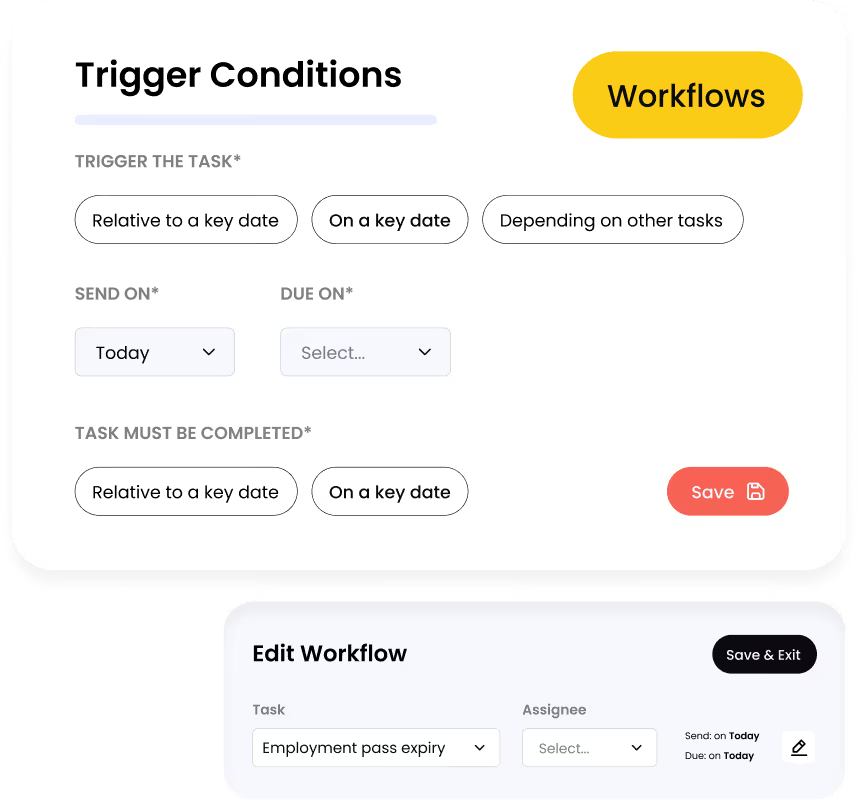
HR teams using Omni can add permit expiry data and renewal timelines directly to employee records, reducing the risk of compliance gaps that come from managing ESD Malaysia and e-PLKS data separately. 

What are the key requirements for getting a Malaysia work permit or work visa?

Applications don’t fail randomly. They fail because either the employer or employee’s information is inaccurate, incomplete, or ineligible.

Employer requirements

Before anything else, understand that the authorities are assessing your company, not just the hire. Being a registered entity in Malaysia is the baseline, but the more important factor is whether your business activity clearly supports the role you’re hiring for. A mismatch raises questions immediately. 

The most crucial part of any permit Malaysia application is your justification for hiring a foreign national. You need to demonstrate why this role is best filled from outside Malaysia. Explaining that you need someone with experience scaling FinTech products across Southeast Asian markets is more specific and easy to defend than to stating “we need to hire a designer”.

Vague justifications can slow down approvals. Specific, business-tied reasoning keeps the process moving.

Employee requirements

What matters on the candidate's side depends on the type of permit Malaysia you’re applying for.

For an Employment Pass Malaysia, everything needs to align including qualifications, experience, role, and salary to form a coherent picture. A senior-level title paired with junior experience, or a below-market salary will raise flags immediately. 

For foreign workers under the Malaysia work permit system, the requirements are more rigid. The role needs to fall within a permitted sector, the workers needs to come from an approved source country, and all documentation needs to be consistent throughout.

Most delays often come from small inconsistencies, not missing documents. A mismatch in job title or an unclear job scope is often enough to hold things up. Clarity and consistency across both sides are what keep applications moving. 

This is where having structured hiring documentation pays off before the application stage. 
permit malaysia

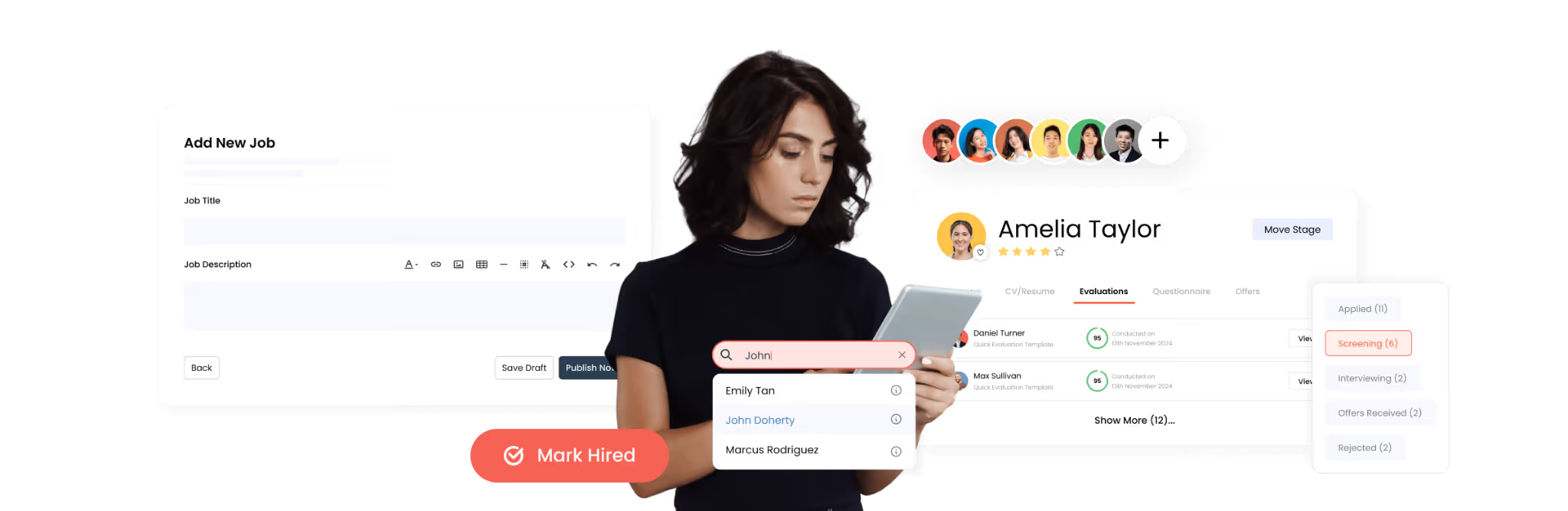
Omni's ATS helps your team build clear, consistent job descriptions from day one, with defined titles, responsibilities, and requirements that carry through directly into offer letters and employment contracts. When every document in the chain tells the same story, there's far less room for the kind of inconsistencies that slow permit Malaysia approvals down.

How to apply for a permit Malaysia?

Step 1: Register with ESD Malaysia

Go to the ESD Malaysia portal and set up your company profile. Upload all required business documents and secure approval before doing anything else. The ESD Malaysia registration is the gateway to any Employment Pass Malaysia application.

Step 2: Submit the correct application

Choose the right route: 

  • Employment Pass Malaysia for skilled hires with qualifying salary and experience.
  • Malaysia work permit (Temporary Employment Pass) for sector-based foreign workers.
  • Professional Visit Pass for short-term or project-based assignments.

Prepare documents where the job title, salary, and role description all align consistently before submitting. 

Step 3: Wait for authority approval

Check application status regularly. If authorities request additional documents, respond immediately. Most delays happen at this stage, and response time directly affects your overall timeline. 

Step 4: Visa issuance and passport endorsement

Once approved, the candidate receives a Malaysia work visa to enter the country. After arrival, complete the endorsement in their passport. Legal employment begins only after this step is complete.

Step 5: Post-arrival compliance via e-PLKS (where applicable)

For foreign workers under the Temporary Employment Pass, manage everything in e-PLKS:

  • Register worker records promptly after arrival
  • Set up levy payment schedules
  • Track permit expiry dates from day one
  • Log any changes in employment details

How can HR complete a Malaysia foreign worker visa check?

Check What to verify Where to look
Pass validity Expiry date, pass category, approved role ESD Malaysia (EP) or e-PLKS (work permit)
Document consistency Passport details match system records Employee passport + HR records
Employment details Role, salary, and employer unchanged since approval Internal HR system

How to run the check: 

  • Tie it to your HR calendar by conducting checks at onboarding, at each renewal milestone, and whenever employment details change.
  • Use the right system. Employment Pass records live in ESD Malaysia whereas foreign worker records live in e-PLKS.
  • Verify against the passport and confirm that system records and passport details match exactly.
  • Set expiry reminders at 90,60, and 30 days. This gives your team enough lead time to prepare renewal documents without rushing.

A proactive Malaysia foreign worker visa check surfaces risks before they become compliance problems and protects both the employee and the company.

What are the most common mistakes when managing Malaysia work permits and visas?

Confusing EP vs work permit

  • The Employment Pass Malaysia is for skilled professionals earning above the salary threshold.
  • The Malaysia work permit (Temporary Employment Pass) is for sector-based foreign workers.
  • Applying through the wrong route leads to outright rejection, not just delays.

Using the wrong system

  • ESD Malaysia handles expatriate applications and Employment Pass records.
  • e-PLKS manages foreign worker permits, levy payments, and renewals.
  • Keeping these mapped correctly in your HR workflow prevents tracking gaps and compliance blind spots.

Missing renewal deadlines

  • Work passes expire and are not renewed automatically.
  • A lapsed permit Malaysia creates immediate legal exposure for both employer and employee.
  • Starting renewals at 90 days out gives enough buffer to handle document requests without risking a compliance gap.

Non-compliance with quotas

  • Foreign worker hiring under the Malaysia work permit system is subject to government quotas by sector and nationality
  • Quota checks belong at the start of the hiring process, not after the role has been offered
  • Confirming availability early prevents wasted preparation time and stalled approvals

Effectively Manage Work Visa and Permit in Malaysia

Managing permit Malaysia compliance at scale comes down to systems. Teams that stay ahead aren't necessarily doing more but building the right processes and tools to handle it consistently.
malaysia work permit

At Omni, we built our platform to handle exactly this kind of compliance work. Here's what that looks like in practice:

  • Centralised document management for Employment Pass Malaysia records from ESD Malaysia, foreign worker data from e-PLKS, and Professional Visit Pass documentation, all in one place, so nothing expires unnoticed.
  • Automated renewal alerts that notify your team before every permit expiry, so you stay ahead without manual tracking.
  • Structured onboarding workflows that capture the right employee data from day one, keeping records consistent across ESD Malaysia and e-PLKS.
  • ATS functionality that helps you build clear, defensible job descriptions upstream, so documentation stays consistent from the first job post to the final contract.

Managing foreign worker compliance in Malaysia involves a lot of moving parts. Omni brings them together so your team spends more time on growth, not your to-do list. 
Book my personalized demo

Frequently Asked Questions

1. What is a permit Malaysia? 

A permit Malaysia, formally called a Malaysia work permit, is the legal authorization that allows a foreign national to live and work in Malaysia under a specific employer. It is employer-sponsored, tied to a specific role and duration, and requires a fresh application if any of those details change.

2. What is the difference between a Malaysia work visa and a Malaysia work permit? 

A Malaysia work visa grants entry into the country. A Malaysia work permit grants the legal right to stay and work once inside. They are separate documents issued at different stages — the visa comes first, and the permit is endorsed upon arrival.

3. How long does it take to get an Employment Pass Malaysia? 

Processing through ESD Malaysia generally takes several weeks once all documents are in order. Incomplete applications or weak justifications for the hire are the most common causes of delay.

4. What is ESD Malaysia? 

ESD Malaysia is the government portal where companies register to hire skilled foreign workers and submit Employment Pass Malaysia applications. Company registration and approval on ESD Malaysia are required before any EP application can be filed.

5. What is e-PLKS used for? 

e-PLKS (Electronic Permit for Foreign Workers) is the system for managing Temporary Employment Pass holders — primarily semi-skilled and low-skilled foreign workers. It handles worker records, levy payments, renewals, and ongoing compliance tracking.

6. What triggers a Malaysia foreign worker visa check? 

A Malaysia foreign worker visa check should be conducted during onboarding, at each permit renewal milestone, and whenever employment details such as role, salary, or work location change. Building it into a quarterly compliance review keeps your team consistently ahead of any expiry risks.

7. What are the salary thresholds for an Employment Pass Malaysia? 

  • Category I requires a fixed monthly salary of RM10,000 and above, valid for up to 5 years. 
  • Category II covers RM5,000 to RM9,999, valid for up to 2 years. 
  • Category III covers RM3,000 to RM4,999, valid for 1 year and limited to certain approved sectors.

8. What happens if a permit Malaysia expires without renewal? 

A foreign worker whose permit has lapsed is considered undocumented under Malaysian law, creating legal liability for both the individual and the employer. Employers found in violation may face fines and restrictions on future foreign worker applications. Starting renewals well in advance is the most reliable way to avoid this outcome.

No items found.
No items found.
Which countries do you support?

Full HR & Payroll coverage for Philippines, Singapore, Malaysia, Hong Kong, and Indonesia. Each market has local support teams and built-in compliance features.

How does pricing work as we scale?

Starting at $3/employee/month for core features. Volume-based discounts are available for growing teams. Book a demo for custom pricing.

How do you handle security?

Enterprise-grade security with ISO 27001, GDPR certifications, and local data residency options.

How long is implementation?

4 weeks average. Includes free data migration, setup, and team training. No hidden fees.

What makes Omni different from global HR platforms?

Built specifically for Asia with local payroll processing, same-day support in Asia time zones, and 40% lower cost than global alternatives.

Global HR Insights
HR Compliance

HR's Guide to Malaysia Work Permit

Table of Contents
>
See OmniHR in action
Schedule a personalized demo today to see how we help mid- market teams.
Get a Demo

Summary. Hiring foreign talent in Malaysia is less a paperwork problem than a systems problem. Most compliance failures trace back to the same root cause: HR teams conflating distinct authorization layers, such as the Malaysia work visa, the Malaysia work permit, and the Employment Pass Malaysia, without understanding how they relate or which government system governs each. The permit Malaysia framework operates through two parallel channels: ESD Malaysia for skilled expatriate hires and e-PLKS for sector-based foreign workers, each with its own application logic, timelines, and renewal obligations. Getting this right requires more than following a checklist. It requires building hiring documentation, onboarding workflows, and compliance tracking that stay consistent from the first job description to post-arrival endorsement, because in Malaysia's employer-sponsored system, a mismatch at any stage is enough to stall an approval or trigger a compliance gap.

See OmniHR in action
Schedule a personalized demo today to see how we help mid- market teams.
Get a Demo

Requirements for hiring foreign talent in Malaysia aren't hard to find. A dozen sources will walk you through the checklist. What's harder to find is an honest account of why the process keeps breaking down — even when teams follow the rules.

Part of the problem is terminology. Terms like work permit Malaysia, Malaysia work visa, Employment Pass Malaysia, and e-PLKS get used interchangeably, as if they're the same thing. They are not. They're distinct layers of the same system, and when you don't understand how those layers connect, applications stall, approvals drag on, and compliance issues quietly accumulate.

This guide covers the full permit Malaysia landscape, from Employment Pass Malaysia and ESD Malaysia to e-PLKS and the Malaysia foreign worker visa check process. We’ll also show how HR systems like Omni helps HR teams manage permit tracking, renewal alerts, and compliance documentation in one place so nothing slips through the cracks.

What is a permit in Malaysia?

A permit Malaysia, more commonly known as a Malaysia work permit, is the legal authorization that allows foreign nationals to live and work in Malaysia under a specific employer. The definition is straightforward. The structure behind it is what most teams miss.

In Malaysia, work authorization is not employee-owned. It is employer-sponsored and employer-controlled. 

That means the permit is tied directly to:

  • The company hiring the individual
  • The specific role they were approved for
  • The duration granted by the authorities

Change any one of these, and the permit is affected. Permits are non-transferable, moving to a new employer or extending past the approved period requires a fresh application. 

Officially, the Immigration Department holds oversight. For those hiring foreign workers, your HR team will spend most of their time dealing with ESD (Expatriate Services Division) Malaysia for skilled hires and e-PLKS for foreign worker management. Knowing which permit Malaysia handles what, and when each one enters the picture, is what keeps the process from becoming a coordination mess.​​​​​​​​​​​​​​​​

Read next: Global Hiring Guide: Malaysia

How does a permit differ from a Malaysia work visa?

This is one of the most misunderstood areas, and it’s where many HR workflows break early.

A Malaysia work visa is not the same thing as a Malaysia work permit, even though people use them interchangeably.

  • A Malaysia work visa allows entry into the country.
  • A Malaysia work permit (or pass) allows the person to stay and work legally once they are inside. 

Think of it as a two-step sequence:

  1. Approval is granted for a specific pass (for example, an Employment Pass Malaysia)
  2. A Malaysia work visa is issued so the individual can enter the country
  3. Upon arrival, the pass is endorsed in their passport

At that point, they are legally employed.

Here’s a clearer comparison:

Term Function When it applies
Malaysia work visa Entry into Malaysia Before arrival
Malaysia work permit/pass Legal right to work After arrival
Employment Pass Malaysia Specific type of work permit for skilled hires After arrival

What types of permit Malaysia options are available for foreign workers?

Pass Type Who it’s for Skill level Duration
Employment Pass Malaysia Professionals, executives, specialists High 1–5 years depending on category
Temporary Employment Pass (Work Permit) Sector-based foreign workers Semi-/low-skilled 1–2 years
Professional Visit Pass Short-term assignments Skilled (temporary) Up to 12 months

Employment Pass

When hiring skilled professionals like a backend engineer from India, a product manager from Singapore, or a senior designer from Vietnam, the Employment Pass Malaysia is the standard route. It’s designed for roles requiring real expertise, with specific salary and qualification thresholds. 

The pass is issued under three categories. 

  • Category I: covers roles with a fixed monthly salary of RM10,000 and above, valid for up to 5 years.
  • Category II: covers salaries between RM5,000 to RM9,999, valid for up to 2 years.
  • Category III: covers salaries between RM3,000 and RM4,999, valid for 1 year and limited to specific approved sectors.

Applications go through ESD Malaysia, so your company needs to be properly registered first. Once your team understands the system, approvals become smoother and timelines more predictable.

Temporary Employment Pass / Work Permit

When mentioning “Malaysia work permit,” it is usually referring to this. It applies to foreign workers in operational roles such as manufacturing, construction, or agriculture. 

Think of hiring machine operators from Indonesia or site workers from Bangladesh. It’s a more controlled system with quotas and nationality limits. Everything must be tracked in e-PLKS from renewals to levy payments to avoid compliance issues later.

Professional Visit Pass

This type of permit Malaysia sits between short-term work and full employment. It works well for temporary assignments such as bringing in a technical consultant to set up a system for over three months, or a specialist trainer to run onboarding sessions for your local team. 

It’s ideal when the work is limited in scope and duration. However, if the role becomes ongoing, you’ll need to switch to a proper Employment or Temporary Pass.

What are ESD Malaysia and e-PLKS?

You need to understand these two systems to grasp Malaysia’s work authorization process. They serve different purposes, and using the wrong one is a common failure point when applying for a permit Malaysia.

Expatriate Services Division (ESD)

ESD Malaysia is where Employment Pass workflows live. Registering your company here is the required first step as only registered companies are eligible to apply for an Employment Pass Malaysia. This includes:

  • Creating a company profile
  • Submitting corporate documentation
  • Getting approval to hire expatriates

Once approved, all expatriate applications are submitted and tracked through this system. This becomes part of your hiring infrastructure.

e-PLKS

e-PLKS (Electronic Permit for Foreign Workers) is the system used to manage foreign workers under the Temporary Employment Pass. It handles:

  • Worker records
  • Levy payments
  • Renewals
  • Compliance tracking

Unlike ESD Malaysia, e-PLKS is ongoing and operational. It’s where your teams maintain visibility over workforce compliance. If you’re managing a large foreign workforce, this is where things stay under control. 

malaysia work visa

HR teams using Omni can add permit expiry data and renewal timelines directly to employee records, reducing the risk of compliance gaps that come from managing ESD Malaysia and e-PLKS data separately. 

What are the key requirements for getting a Malaysia work permit or work visa?

Applications don’t fail randomly. They fail because either the employer or employee’s information is inaccurate, incomplete, or ineligible.

Employer requirements

Before anything else, understand that the authorities are assessing your company, not just the hire. Being a registered entity in Malaysia is the baseline, but the more important factor is whether your business activity clearly supports the role you’re hiring for. A mismatch raises questions immediately. 

The most crucial part of any permit Malaysia application is your justification for hiring a foreign national. You need to demonstrate why this role is best filled from outside Malaysia. Explaining that you need someone with experience scaling FinTech products across Southeast Asian markets is more specific and easy to defend than to stating “we need to hire a designer”.

Vague justifications can slow down approvals. Specific, business-tied reasoning keeps the process moving.

Employee requirements

What matters on the candidate's side depends on the type of permit Malaysia you’re applying for.

For an Employment Pass Malaysia, everything needs to align including qualifications, experience, role, and salary to form a coherent picture. A senior-level title paired with junior experience, or a below-market salary will raise flags immediately. 

For foreign workers under the Malaysia work permit system, the requirements are more rigid. The role needs to fall within a permitted sector, the workers needs to come from an approved source country, and all documentation needs to be consistent throughout.

Most delays often come from small inconsistencies, not missing documents. A mismatch in job title or an unclear job scope is often enough to hold things up. Clarity and consistency across both sides are what keep applications moving. 

This is where having structured hiring documentation pays off before the application stage. 

permit malaysia

Omni's ATS helps your team build clear, consistent job descriptions from day one, with defined titles, responsibilities, and requirements that carry through directly into offer letters and employment contracts. When every document in the chain tells the same story, there's far less room for the kind of inconsistencies that slow permit Malaysia approvals down.

How to apply for a permit Malaysia?

Step 1: Register with ESD Malaysia

Go to the ESD Malaysia portal and set up your company profile. Upload all required business documents and secure approval before doing anything else. The ESD Malaysia registration is the gateway to any Employment Pass Malaysia application.

Step 2: Submit the correct application

Choose the right route: 

  • Employment Pass Malaysia for skilled hires with qualifying salary and experience.
  • Malaysia work permit (Temporary Employment Pass) for sector-based foreign workers.
  • Professional Visit Pass for short-term or project-based assignments.

Prepare documents where the job title, salary, and role description all align consistently before submitting. 

Step 3: Wait for authority approval

Check application status regularly. If authorities request additional documents, respond immediately. Most delays happen at this stage, and response time directly affects your overall timeline. 

Step 4: Visa issuance and passport endorsement

Once approved, the candidate receives a Malaysia work visa to enter the country. After arrival, complete the endorsement in their passport. Legal employment begins only after this step is complete.

Step 5: Post-arrival compliance via e-PLKS (where applicable)

For foreign workers under the Temporary Employment Pass, manage everything in e-PLKS:

  • Register worker records promptly after arrival
  • Set up levy payment schedules
  • Track permit expiry dates from day one
  • Log any changes in employment details

How can HR complete a Malaysia foreign worker visa check?

Check What to verify Where to look
Pass validity Expiry date, pass category, approved role ESD Malaysia (EP) or e-PLKS (work permit)
Document consistency Passport details match system records Employee passport + HR records
Employment details Role, salary, and employer unchanged since approval Internal HR system

How to run the check: 

  • Tie it to your HR calendar by conducting checks at onboarding, at each renewal milestone, and whenever employment details change.
  • Use the right system. Employment Pass records live in ESD Malaysia whereas foreign worker records live in e-PLKS.
  • Verify against the passport and confirm that system records and passport details match exactly.
  • Set expiry reminders at 90,60, and 30 days. This gives your team enough lead time to prepare renewal documents without rushing.

A proactive Malaysia foreign worker visa check surfaces risks before they become compliance problems and protects both the employee and the company.

What are the most common mistakes when managing Malaysia work permits and visas?

Confusing EP vs work permit

  • The Employment Pass Malaysia is for skilled professionals earning above the salary threshold.
  • The Malaysia work permit (Temporary Employment Pass) is for sector-based foreign workers.
  • Applying through the wrong route leads to outright rejection, not just delays.

Using the wrong system

  • ESD Malaysia handles expatriate applications and Employment Pass records.
  • e-PLKS manages foreign worker permits, levy payments, and renewals.
  • Keeping these mapped correctly in your HR workflow prevents tracking gaps and compliance blind spots.

Missing renewal deadlines

  • Work passes expire and are not renewed automatically.
  • A lapsed permit Malaysia creates immediate legal exposure for both employer and employee.
  • Starting renewals at 90 days out gives enough buffer to handle document requests without risking a compliance gap.

Non-compliance with quotas

  • Foreign worker hiring under the Malaysia work permit system is subject to government quotas by sector and nationality
  • Quota checks belong at the start of the hiring process, not after the role has been offered
  • Confirming availability early prevents wasted preparation time and stalled approvals

Effectively Manage Work Visa and Permit in Malaysia

Managing permit Malaysia compliance at scale comes down to systems. Teams that stay ahead aren't necessarily doing more but building the right processes and tools to handle it consistently.

malaysia work permit

At Omni, we built our platform to handle exactly this kind of compliance work. Here's what that looks like in practice:

  • Centralised document management for Employment Pass Malaysia records from ESD Malaysia, foreign worker data from e-PLKS, and Professional Visit Pass documentation, all in one place, so nothing expires unnoticed.
  • Automated renewal alerts that notify your team before every permit expiry, so you stay ahead without manual tracking.
  • Structured onboarding workflows that capture the right employee data from day one, keeping records consistent across ESD Malaysia and e-PLKS.
  • ATS functionality that helps you build clear, defensible job descriptions upstream, so documentation stays consistent from the first job post to the final contract.

Managing foreign worker compliance in Malaysia involves a lot of moving parts. Omni brings them together so your team spends more time on growth, not your to-do list. 
Book my personalized demo

Frequently Asked Questions

1. What is a permit Malaysia? 

A permit Malaysia, formally called a Malaysia work permit, is the legal authorization that allows a foreign national to live and work in Malaysia under a specific employer. It is employer-sponsored, tied to a specific role and duration, and requires a fresh application if any of those details change.

2. What is the difference between a Malaysia work visa and a Malaysia work permit? 

A Malaysia work visa grants entry into the country. A Malaysia work permit grants the legal right to stay and work once inside. They are separate documents issued at different stages — the visa comes first, and the permit is endorsed upon arrival.

3. How long does it take to get an Employment Pass Malaysia? 

Processing through ESD Malaysia generally takes several weeks once all documents are in order. Incomplete applications or weak justifications for the hire are the most common causes of delay.

4. What is ESD Malaysia? 

ESD Malaysia is the government portal where companies register to hire skilled foreign workers and submit Employment Pass Malaysia applications. Company registration and approval on ESD Malaysia are required before any EP application can be filed.

5. What is e-PLKS used for? 

e-PLKS (Electronic Permit for Foreign Workers) is the system for managing Temporary Employment Pass holders — primarily semi-skilled and low-skilled foreign workers. It handles worker records, levy payments, renewals, and ongoing compliance tracking.

6. What triggers a Malaysia foreign worker visa check? 

A Malaysia foreign worker visa check should be conducted during onboarding, at each permit renewal milestone, and whenever employment details such as role, salary, or work location change. Building it into a quarterly compliance review keeps your team consistently ahead of any expiry risks.

7. What are the salary thresholds for an Employment Pass Malaysia? 

  • Category I requires a fixed monthly salary of RM10,000 and above, valid for up to 5 years. 
  • Category II covers RM5,000 to RM9,999, valid for up to 2 years. 
  • Category III covers RM3,000 to RM4,999, valid for 1 year and limited to certain approved sectors.

8. What happens if a permit Malaysia expires without renewal? 

A foreign worker whose permit has lapsed is considered undocumented under Malaysian law, creating legal liability for both the individual and the employer. Employers found in violation may face fines and restrictions on future foreign worker applications. Starting renewals well in advance is the most reliable way to avoid this outcome.

Frequently Asked Questions

Which countries do you support?

Full HR & Payroll coverage for Philippines, Singapore, Malaysia, Hong Kong, and Indonesia. Each market has local support teams and built-in compliance features.

How does pricing work as we scale?

Starting at $3/employee/month for core features. Volume-based discounts are available for growing teams. Book a demo for custom pricing.

How do you handle security?

Enterprise-grade security with ISO 27001, GDPR certifications, and local data residency options.

How long is implementation?

4 weeks average. Includes free data migration, setup, and team training. No hidden fees.

What makes Omni different from global HR platforms?

Built specifically for Asia with local payroll processing, same-day support in Asia time zones, and 40% lower cost than global alternatives.

Future-proof your leadership bench.
Stop guessing who is ready for promotion. Use OmniHR to identify, nurture, and retain your top performers with data-driven succession planning.
Book a Demo