
















.png)
Summary. Workforce decisions carry real financial stakes as replacing a single employee costs between 50% and 200% of their annual salary, and a missed attrition signal costs you, someone you didn't want to lose. AI in human resources analytics changes that equation by moving your team from end-of-quarter reporting to continuous, predictive insight. This guide covers what AI-powered analytics means in practice, the four use cases where HR teams see the fastest return, and a five-step framework for getting started.
Workforce decisions have always been high-stakes. Hiring the wrong person costs time and money. According to Gallup, replacing an employee can cost between 50% and 200% of their annual salary, and that’s before you account for productivity loss, team disruption, and the time your managers spend covering the gap. Missing an early sign of disengagement costs you someone you didn't want to lose. Building a headcount plan on assumptions that don't hold costs the business a quarter, sometimes more.
AI in human resources analytics changes that equation. By continuously analyzing workforce data across hiring, performance, retention, and skills, AI-powered analytics enable HR teams to spot patterns earlier, forecast outcomes more accurately, and act before small problems become costly ones. This is exactly the problem Mino is built to solve. Omni's AI agent lets HR teams ask workforce questions in plain language — headcount trends, attrition signals, DEI benchmarks, hiring velocity — and get answers back as charts or live dashboards in seconds, right inside the platform where your data already lives.
.avif)
In this guide, we’ll walk you through what AI in HR analytics actually means in practice, why it matters for modern HR teams, and how to start putting it to work.
What is AI in Human Resources analytics?
AI in human resources analytics refers to the use of machine learning to collect, process, and interpret workforce data. Rather than relying on static spreadsheets or end-of-quarter reports, your team can use AI-powered analytics to surface patterns across thousands of data points. This goes from hiring pipelines and engagement surveys to performance reviews and compensation benchmarks, all in real time.
In practice, this means moving from descriptive analytics ("here's what happened") to predictive and prescriptive analytics ("here's what's likely to happen, and here's what to do about it").
AI should sharpen your HR team’s judgment. When an HR business partner wants to understand why a particular team has seen elevated attrition over six months, AI can isolate the contributing variables (manager tenure, span of control, compensation drift, internal mobility rates) in minutes rather than weeks.
Why are AI-powered analytics important for HR teams?
The case for AI-powered analytics is driven by pressures most HR teams are already feeling. Three shifts in particular have made traditional approaches to workforce data increasingly inadequate.
Increasing workforce complexity. The modern workforce is more distributed, contract-heavy, and multigenerational than it was a decade ago. Managing headcount across geographies, employment types, and skill profiles generates more data than traditional HR systems were built to handle. AI in Human Resources enables the analysis of that complexity at scale.
The need for real-time insights. Business decisions no longer wait for annual engagement surveys or quarterly workforce reviews. When a business unit is scaling fast or facing a retention spike, your team needs insight now, not in thirty days when the report is ready.
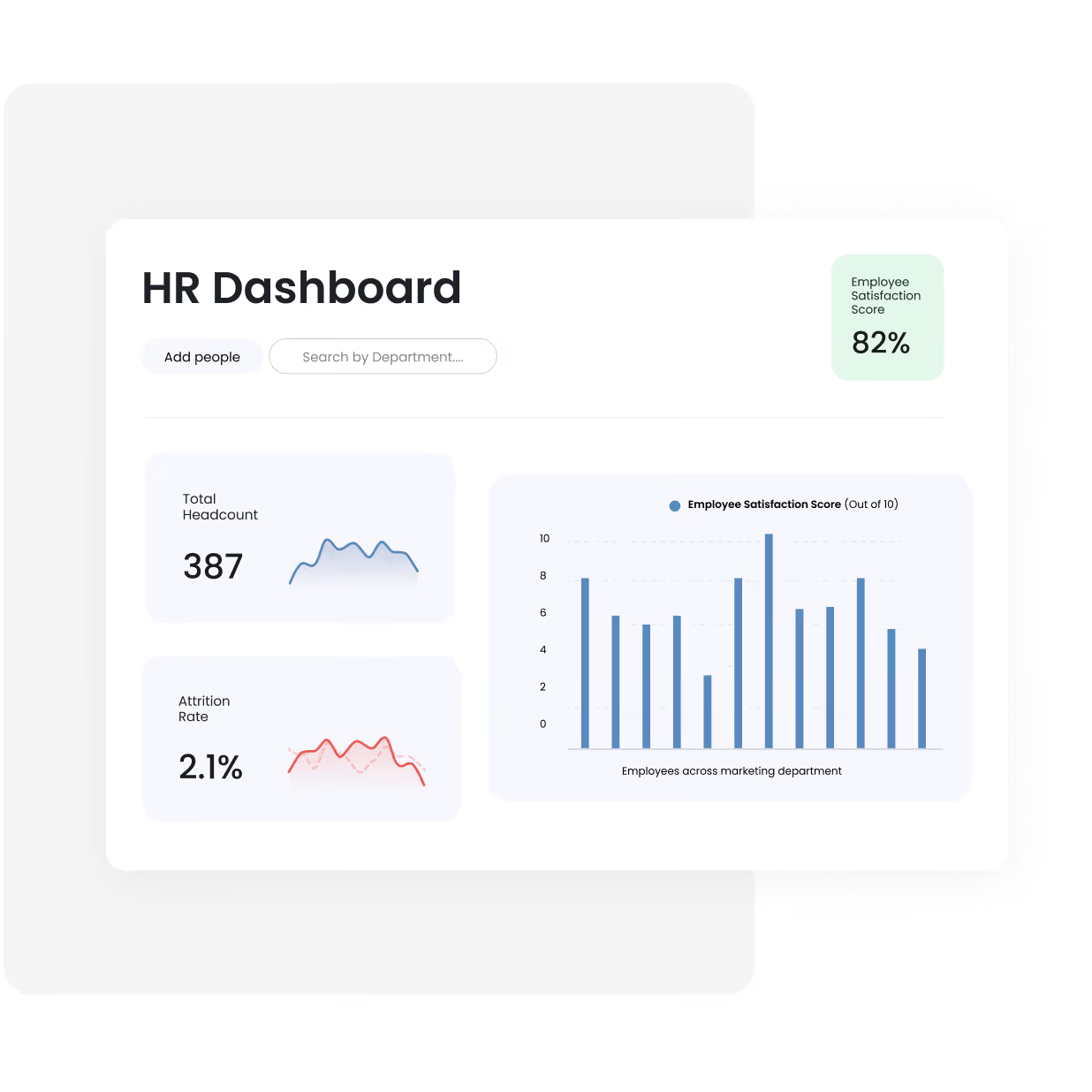
Before implementing Omni, the team at IHRP spent 30-40% of their time on routine administrative tasks, leaving almost no capacity for meaningful analytics. After switching to Omni’s reporting and analytics module, they achieved 48% in cost savings.
AI-powered analytics can flag anomalies and trends as they emerge, giving HR leaders the lead time to act.
The shift from reactive to proactive HR. Historically, HR has been called in after a problem surfaces — someone resigns, a team underperforms, a hiring process stalls. AI in HR analytics changes the timeline. By identifying attrition risk signals before employees disengage, or surfacing skills gaps before a product launch, HR becomes a forward-looking function rather than a responsive one.
The Insight222 People Analytics Trends 2025/26 report found that 52% of companies now report measurable business improvements from people analytics investment. This shift is increasingly expected by leadership teams who want HR to operate as a strategic partner, not an administrative function.
How to use AI in HR analytics?
Understanding the value of AI in HR analytics is one thing, but putting it into practice is another. Here's how to move from concept to implementation in a way that's structured, scalable, and grounded in real HR workflows.
1. Centralize and prepare HR data
AI models are only as good as the data they run on. Before introducing any analytics tooling, your team needs to audit what data exists, where it lives, and how clean it is. Common data sources include:
- HRIS (the core employee record system)
- Applicant tracking system (ATS) — hiring pipeline and candidate data
- Learning management system (LMS) — training completion and certification records
- Performance management platform — review scores and OKR progress
- Payroll data — compensation, tenure, and promotion history
- Engagement survey results — sentiment and satisfaction signals
Data governance should be addressed here, too. Establish who owns HR data, how long it's retained, who can access which datasets, and how employee privacy is protected — particularly for sensitive attributes like health-related leave or performance improvement plan history. Omni centralizes all of the above into one connected system, so your analytics models have clean, consistent data to work from rather than five separate exports that don't match.
2. Identify key HR use cases for AI analytics
Rather than trying to deploy AI across all HR functions at once, start by mapping the decisions your team makes most frequently and where better data would change outcomes. High-value use cases tend to cluster around four areas: talent acquisition, retention, performance, and workforce planning.
For each candidate use case, ask:
- Do we have the data to support this?
- Is this decision currently made on intuition alone, or do we already have some analytical foundation to build on?
- Is the business impact significant enough to justify the implementation effort?
This prioritization exercise keeps AI adoption grounded in actual HR challenges rather than technology for its own sake.
3. Apply AI-powered analytics to generate insights
Once data is centralized and use cases are prioritized, AI models can be applied to generate insights. This may involve:
- Supervised machine learning models trained on historical data — for example, a retention risk model trained on the characteristics of employees who left versus those who stayed
- Natural language processing (NLP) — software that reads and interprets unstructured text — applied to open-ended survey responses or exit interview notes. For teams conducting interviews and 1:1s virtually, an AI note taker can automatically transcribe and structure these conversations, giving NLP models cleaner, more complete text data to work with.
- Clustering algorithms — which group employees with similar characteristics or risk profiles together — to identify distinct workforce segments
At this stage, your team is typically working with a data science partner, an analytics vendor, or an AI-enabled HR platform with pre-built models.
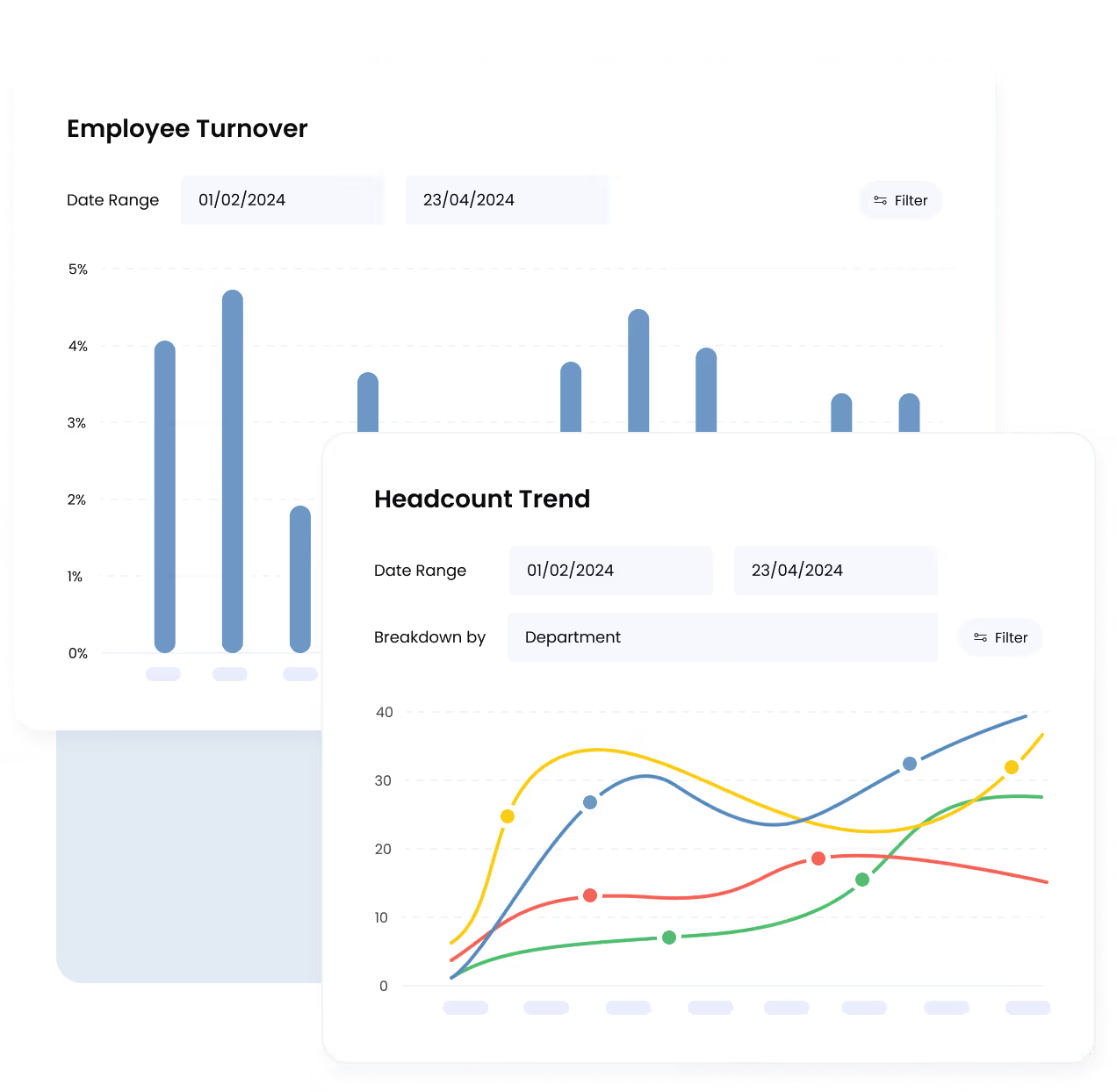
Omni's Reports & Analytics module includes pre-built dashboards for headcount, attrition, and DEI — so growing teams can start generating insights without building models from scratch. For teams that want to go further, Mino lets you skip the dashboard entirely and ask questions in plain language. Instead of navigating to a report, you ask: "What's our attrition trend in Malaysia this quarter?" and get a chart back in seconds.
4. Translate AI insights into HR decisions
The value of AI analytics isn't in the model — it's in what HR does with the output. An attrition risk score sitting in a dashboard that no manager ever sees has no business impact. The implementation work here is about building decision workflows around AI outputs.
Building human review into these workflows is essential. AI outputs should inform HR decisions, not automate them without oversight — particularly in high-stakes situations like performance management or termination, where a human needs to review the full context before acting.
Omni's performance module keeps review data, payroll records, and attendance history in one place, so managers have the full picture before making any call. Mino makes this even more immediate — managers can ask about a specific team's performance or headcount movement in natural language and get an answer on the spot, without waiting on an HR report to be pulled.
5. Continuously monitor and refine AI models
AI models degrade over time. The conditions under which a retention model was trained may shift significantly — a new compensation strategy, a change in manager population, an economic downturn — and a model built on pre-shift data may generate increasingly unreliable outputs without anyone noticing.
Build a review cadence into your AI analytics program. Track whether model predictions are proving accurate. Compare outcomes for employees flagged as high-risk versus those who weren't. Audit model outputs for fairness and bias, particularly when models are used in talent acquisition or performance contexts where protected class characteristics could inadvertently influence scoring.
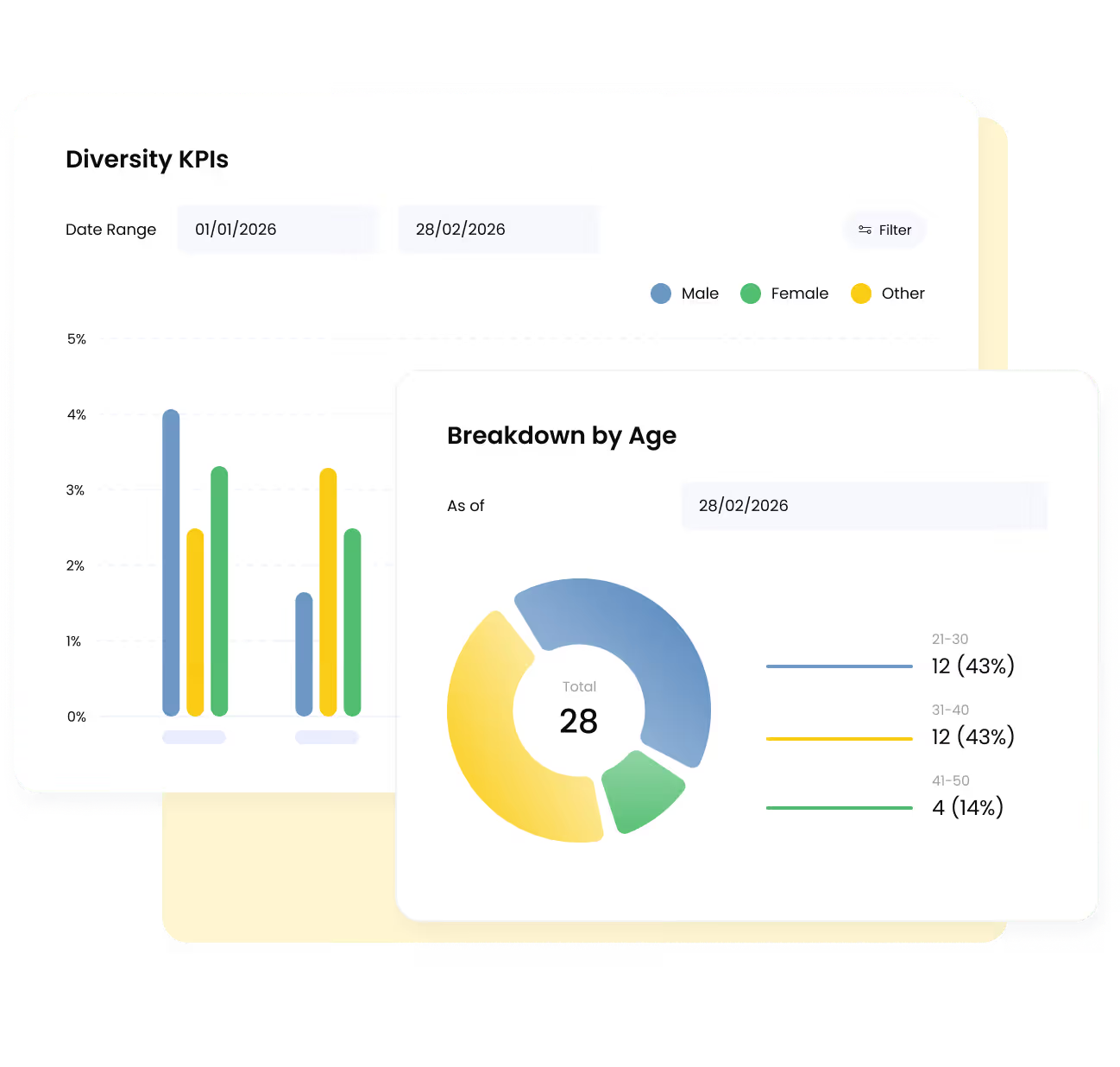
Omni's custom report builder lets your team track prediction accuracy over time and pull demographic breakdowns to flag any patterns that warrant a closer look.
What are real-world use cases of AI in HR analytics?
Recruitment and talent acquisition
How it works: AI analyzes historical hiring data to identify which sourcing channels, interview configurations, or candidate profiles predict long-term success. Omni's ATS ranks applicants against a success profile drawn from your past hires.
Outcome: Shorter time-to-fill, lower cost-per-hire, and pipelines prioritized by fit rather than volume.
Employee retention and engagement
How it works: Attrition prediction models combine variables like tenure, promotion history, compensation relative to market, manager changes, and engagement survey responses to generate individual flight risk scores delivered to HRBPs on a rolling basis. Hello Human reduced attrition by 15% after implementing Omni's analytics-driven platform. With Mino, those same attrition signals are accessible in plain language — HR teams can ask about flight risk patterns across departments and get back an instant view, without building a custom report first.
Outcome: Proactive retention conversations with at-risk employees before disengagement becomes resignation
Performance management
How it works: AI identifies calibration inconsistencies across managers, flagging teams that are systematically over- or under-rated. Omni's performance module connects review data with attendance and payroll records, so evaluations are grounded in the full employee picture.
Outcome: L&D teams prioritize programs with demonstrated impact; promotions and salary decisions become data-backed
Workforce planning and skills analysis
How it works: AI maps the skills employees have demonstrated — through project history, certifications, and performance data — against the skills the business will need in the next 12 to 24 months.
Outcome: Hiring plans, internal mobility programs, and reskilling investments tied to where the business is actually going
How Can HR Teams Get Started With AI-powered Analytics?
Knowing where to begin is often the biggest barrier to AI adoption in HR. Getting started doesn't require a data science team or a full platform overhaul — it requires the right sequence of steps.
- Build a strong foundation. Audit your current data infrastructure before evaluating any tools. The most sophisticated analytics platform won't produce reliable output on top of fragmented, inconsistent HR data. Prioritize integration and data quality work first — Omni consolidates HRIS, payroll, and performance data in one place, so the foundation is already there.
- Start with high-impact use cases. Pick one or two problems where the business case is clear and the data is accessible. Attrition modeling and recruiting funnel analysis are common starting points because the data is typically available and the ROI is measurable.
- Choose the right AI tools. Evaluate whether you need a standalone people analytics platform, an AI layer within your existing HRIS, or custom modeling. The right answer depends on your team's technical capacity, data maturity, and the complexity of your use cases. See our guide to the best AI tools for HR to compare options.
- Upskill your team. HR professionals don't need to become data scientists, but they do need enough analytical fluency to interpret model outputs, ask good questions about methodology, and push back when something doesn't look right. Invest in foundational data literacy training for HRBPs and HR operations staff.
- Maintain governance and oversight. Establish clear policies for how AI outputs are used in HR decisions, who has access to employee-level analytics data, how models are audited for bias, and how employees are informed about data use. Governance isn't a constraint on AI adoption — it's what makes adoption sustainable.
How Modern HR Platforms Enable AI-Powered Analytics for Better Decisions
AI-powered analytics are only as effective as the platform they run on. For growing HR teams, the challenge isn't a shortage of workforce data — it's that data lives in too many places to be useful. Payroll sits in one system, performance reviews in another, engagement survey results somewhere else entirely. When those systems don't connect, meaningful analysis becomes a manual exercise before any real insight can be drawn.
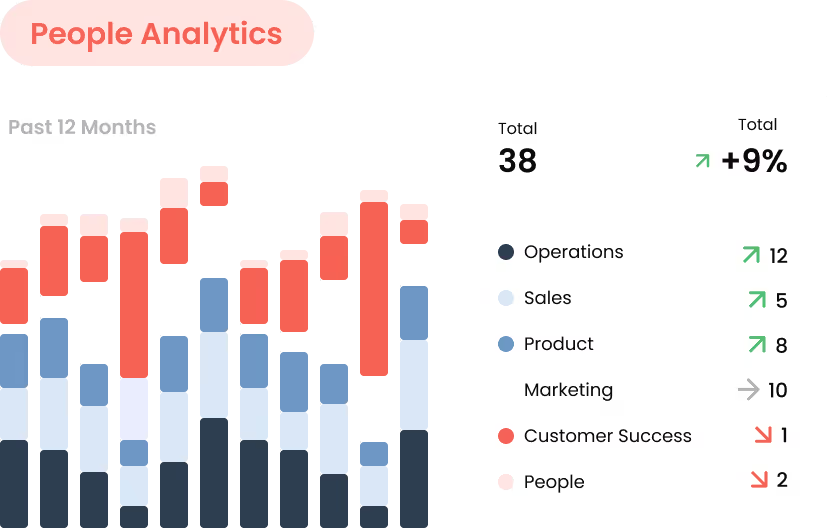
Omni's reports and analytics module surfaces headcount trends, attrition patterns, and DEI metrics in one place, giving HR leaders the data they need to act early rather than react late. And with our AI agent, Mino, that data becomes conversational. Ask your workforce questions in plain language — and get back charts, trend lines, and live dashboards instantly. No exporting. No waiting. Just ask, and Mino gets to work.
For HR teams across Asia ready to put AI-powered analytics to work, Omni provides the connected foundation to make it possible. Book a demo with our team today and see how our analytics and reporting work.
Frequently Asked Questions
AI in human resources analytics is the use of machine learning to collect, process, and interpret workforce data in real time — moving HR from end-of-quarter reporting to continuous, predictive insight. It surfaces patterns across hiring, retention, performance, and workforce planning before they become problems. Omni's Reports & Analytics module gives HR teams this visibility without needing a dedicated data science team.
AI is applied across four core HR functions: predicting which employees are at risk of leaving, identifying which hiring channels produce the highest-quality candidates, flagging calibration inconsistencies in performance reviews, and mapping current workforce skills against future business needs. Omni's analytics dashboards surface these insights continuously so HRBPs can act before disengagement becomes resignation.
AI-powered HR analytics use machine learning — rather than static formulas or manual analysis — to identify non-obvious workforce patterns and generate predictive outputs like flight risk scores or hiring success likelihoods. Unlike traditional HR reporting, Omni connects payroll, performance, and engagement data in one platform, so insights reflect the full employee picture rather than a single data point.
Yes. You don't need a data science team to get value from AI analytics — you need the right platform. Modern HRIS solutions now include built-in analytics built for lean HR functions. Omni is designed specifically for growing companies across Asia, giving teams of any size access to attrition tracking, headcount trend analysis, and custom dashboards without enterprise-level cost or implementation complexity.
The primary benefits are speed, accuracy, and proactivity. AI helps your team identify issues — disengagement, skills gaps, hiring bottlenecks — before they become expensive. For Omni customers, those improvements are concrete: Hello Human reduced attrition by 15%, and IHRP achieved 48% in cost savings after implementing Omni's analytics-driven HR platform.



.avif)
.avif)