
























.png)
Summary. India's new labour codes are more than a documentation update. They are a structural shift in how wages are defined, how statutory contributions are calculated, and who qualifies for benefits like gratuity under the new labour code 2025. The 50% wage rule closes a longstanding salary structuring practice, fixed-term employees gain gratuity rights they previously lacked, and PF contribution bases are set to increase across the board. Because implementation of the new labour laws in India is state-dependent, there is no single compliance deadline. The obligation is ongoing, and the organisations that manage it well will treat the new labour codes as a systems problem instead of a checklist.
India, home to over 1.4 billion people, attracts businesses with its populous and skilled workforce. However, hiring and managing employees compliantly requires a clear understanding of the country’s labour laws.
These regulations govern everything from wages and employee rights to working hours, workplace safety, and dispute resolution. Over time, the labour laws in India became increasingly complex, creating significant compliance burdens through multiple registrations, licences, and filings. To address this, the government introduced the four labour codes to simplify compliance and modernize the system.
While these codes are enacted at the central level, their implementation depends on individual states finalizing their rules. Since states are at different stages of notification, businesses— especially those operating across multiple locations—may face varying operational codes. This creates added compliance risks, where oversights or inconsistencies can lead to penalties, operational disruptions, and reputational damage.
In this guide, we break down India’s new labour codes and what they mean for your business, including their impact on payroll, employment contracts, and ongoing compliance.
What are the new labour codes in India?
Labour laws in India are designed to protect employees' rights, ensure workplace fairness, and maintain quality employer-employee relationships. They cover critical aspects of employment, including working hours, wages, social security contributions, workplace safety, and protection against discrimination.
However, evolving work models and new forms of employment led to the need for a simpler regulatory framework. In response, the Indian government consolidated and rationalized 29 central labour laws into four labour codes, which govern employment, wages, worker benefits, and workplace safety.
These include:
- The Code on Wages, 2019
- The Industrial Relations Code, 2020
- The Code on Social Security, 2020, and
- The Occupational Safety, Health and Working Conditions Code (OSH), 2020
These new labour codes 2025 aim to modernize outdated regulations, improve worker protection, and simplify compliance for businesses operating in India.
While the central government establishes the overarching legislation, implementation depends on individual states. For the codes to become operational, each state must draft and notify its own rules. This is because key functions such as registration, inspection, and enforcement are handled at the state level. As a result, HR teams must monitor both central and state-level requirements to remain compliant.
Different states are at various stages of implementation. Some, such as Gujarat and Arunachal Pradesh, have notified final rules under all four codes. While others—including Karnataka, Tamil Nadu, and Maharashtra—have finalized rules under the code of wages, with others still in draft. Other states are at varying stages of notification. For example, Uttar Pradesh published its draft rules under the OSH code in March 2026.
Read next: India’s Income Tax Act 2025 & Income Tax Rules 2026: What HR Teams Need to Know
What are the four new labour codes in India?
How will wage structures change under the new Labour Code 2025?
Under the new labour laws in India, particularly the Code on Wages, 2019, the biggest change to wage structures is the standardized definition of “wages.” The definition includes basic pay, dearness allowance (DA), and retaining allowance, and excludes components such as house rent allowance (HRA), conveyance allowance, Employer Provident Fund contributions, and statutory bonuses.
However, these exclusions are capped. If allowances and other excluded components exceed 50% of total remuneration, the excess must be added back to wages for statutory calculations. In effect, this means that basic wages must make up at least 50% of total compensation.
This change limits the earlier practice of structuring salaries with a low basic pay and high allowances to reduce statutory contributions. Now, employers may need to increase the basic salary component and rebalance allowances to comply with the 50% rule. Where the basic wage falls below the threshold, certain allowances will automatically be reclassified as wages until the 50% threshold is met.
As a result, both employers and employees may contribute more to PF, gratuity, and ESI. While the overall gross salary or cost to company (CTC) may remain unchanged, employees may see a slight reduction in take-home pay. However, offset by higher long-term social security benefits and retirement savings.
Key changes under the Code on Wages include:
- A uniform definition of wages applied across all statutory calculations and labour laws in India.
- A requirement that wages make up at least 50% of total remuneration.
- Introduction of a national floor wage, with states allowed to set higher minimum wages, not lower.
- Expansion of minimum wage coverage to all workers, including the unorganised sector.
- Mandates that overtime be paid at no less than twice the normal wage rate.
- Periodic revision of minimum wages at least every five years, based on skill level and location.
What are the gratuity changes under the new labour laws in India 2025?
India’s Social Security Code refines the framework for gratuity to be more inclusive, especially for gig workers and fixed-term employees (FTE) who previously had limited access to this benefit.
Fixed-term employees are now entitled to gratuity upon contract termination to be received on a pro-rata basis after one year of continuous service. For full-time employees, the standard rule remains unchanged: gratuity is payable after five years of continuous service, unless employment ends due to death or disability.
Gratuity continues to be calculated at 15 days’ wages per year of service. However, due to the revised definition of wages under the new labour laws in India, gratuity payouts may be higher since the base used for calculation may increase.
The Social Security Code also changes how the gratuity ceiling is determined. Instead of a fixed statutory limit under the previous Payment of Gratuity Act, the Central Government now sets the applicable ceiling, which is currently ₹2,000,000. Employers may offer higher gratuity benefits if agreed upon in employment terms.
Once gratuity becomes payable, employers must determine the amount, notify the employee and the relevant authority, and make payment within 30 days. Payment delays will attract interest penalties.
How will Provident Fund (PF) contributions change under the new labour code?
Under the reformed labour laws in India, PF now applies universally to all establishments with 20 or more employees, regardless of industry. Previously, coverage was limited to select sectors under the old EPF Act, 1952. But now, full-time employees can receive the same social security benefits, including PF, as permanent employees. Contribution rates remain 12% each from employee and employer.
Since wages must constitute at least 50% of total remuneration, the base used to calculate PF contributions is likely to increase. For employees, this could mean a slight reduction in take-home pay, as a larger portion of their salary is directed toward PF. However, it also leads to higher long-term retirement savings, as more money goes into their provident fund account over time.
Read Next: EPFO & Form 16: Understanding Provident Fund India
Are there any changes to maternity benefits under the new labour laws in India?
Yes. Under the new labour laws in India, maternity benefits are governed by the Code on Social Security, 2020, which consolidates provisions from the earlier Maternity Benefit Act, 1961. While most core entitlements remain unchanged, the new Labour Code 2025 also extends coverage to the unorganized sector and gig workers.
The Code retains key protections for women employees, including:
- Paid leave in cases of miscarriage or medical termination of pregnancy
- Additional leave for pregnancy-related illness
- Continued benefits in the event of death
- Protection against dismissal during maternity leave
Women are still entitled to 26 weeks of paid maternity leave for the first two children, with up to eight weeks allowed before delivery. And the entitlement remains 12 weeks of paid leave for the third child onwards, adoptive mothers, and commissioning mothers.
To qualify for maternity benefits, a woman must:
- Be employed in establishments with 10 or more employees.
- Have worked for at least 80 days in the 12 months preceding the expected delivery date.
For adoption or commissioning, the leave begins from the date the child is handed over.
How will employee compensation calculations change under the new labour code?
The new labour codes change how employee compensation is calculated due to the uniform definition of wages. Since basic pay, dearness allowance, and retaining allowance must constitute at least 50% of total remuneration, the base used for statutory calculations is likely to increase. As a result, the final amount payable to employees may increase even if the employee’s total salary package remains unchanged.
The impact also extends to termination compensation and injury claims, where payouts are tied to wages. With a higher wage component, employees may receive larger compensation payouts in such cases.
When will the new labour codes be implemented in India?
India’s four new labour codes were notified and brought into effect on 21 November 2025. However, the rollout is gradual rather than immediate, as the central and state governments must finalize their respective rules before the codes become fully operational.
While the central government has issued the overarching framework, states are still adopting their own implementation guidelines at different stages. Until states notify and enforce their rules, existing labour laws may continue to apply in practice.
As a result, there is no single nationwide implementation date. The new labour laws in India are expected to be rolled out progressively, potentially through 2026 and beyond, once the remaining states complete implementation.
What should HR teams do to prepare for the new labour laws in India?
Review and update salary structures
- Audit current salary structures to ensure compliance with the 50% wage rule
- Identify employees whose basic wages fall below the required threshold
- Assess the impact of revised wage definitions on PF, gratuity, and ESI contributions

This is where having a centralized employee database pays off. With Omni, you can easily pull compensation information across your entire workforce in one place, making it significantly easier to identify which employees fall below the 50% threshold before it becomes a compliance issue.
Update employment contracts and workforce strategy
- Review all existing employment contracts (fixed-term and permanent)
- Update contracts to reflect the revised definition of “wages” under the new labour code
- Reassess hiring strategies, including the use of fixed-term vs permanent employees
- Evaluate increased gratuity liabilities for fixed-term roles
Adjust payroll systems and calculations
- Reconfigure payroll systems to align with updated wage definitions
- Ensure PF contributions are calculated based on “wages” (not just basic salary)
- Update gratuity calculations to reflect the new structure
- Validate compliance across all employee categories
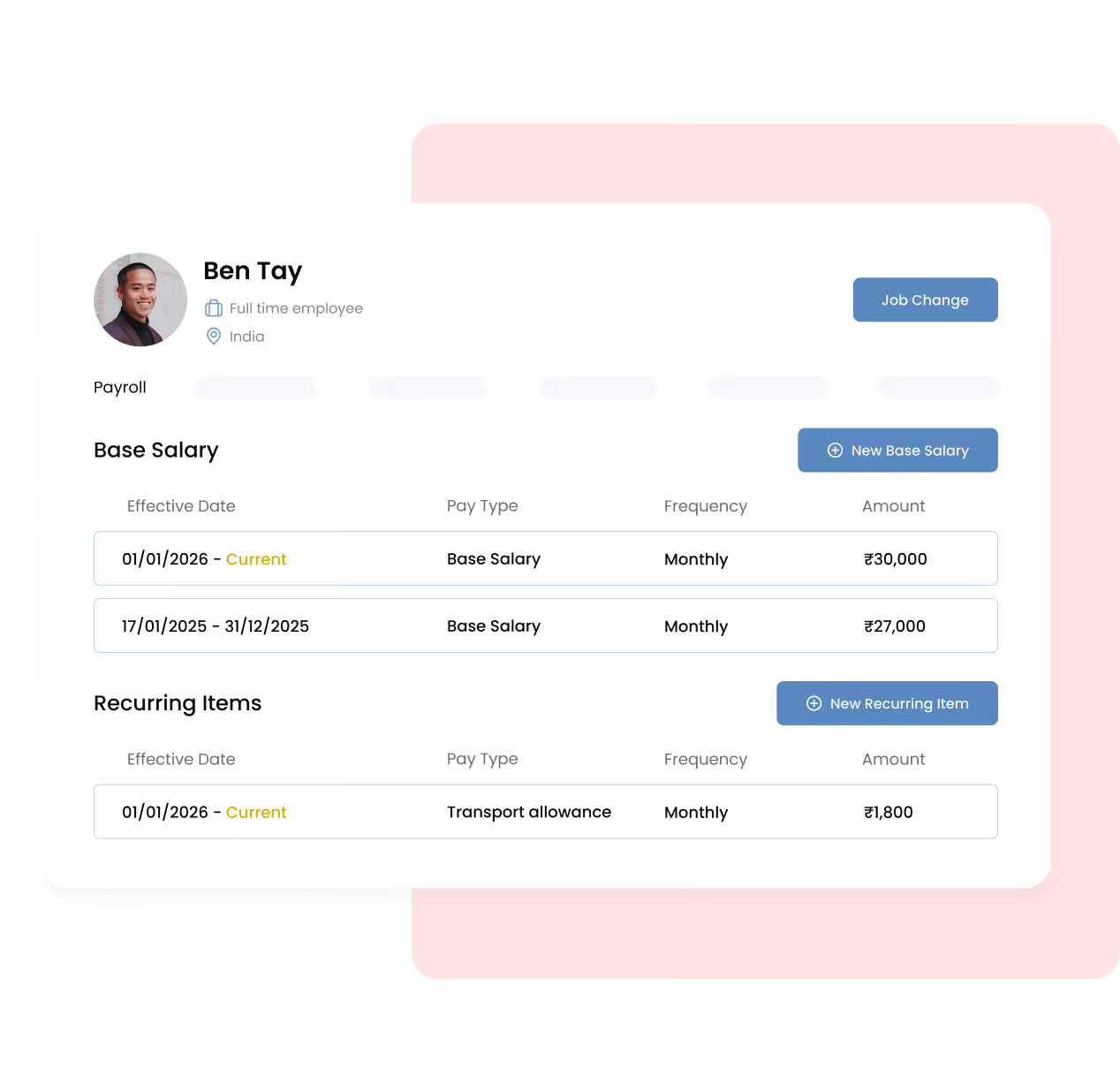
Payroll reconfiguration is where errors are most likely to occur during the transition period. Omni’s payroll module allows you to update wage and contribution bases directly, so calculations stay consistent across all employee categories without manual intervention at each pay cycle.
Update HR policies and internal communication
- Revise HR policies and employee handbooks to reflect the new labour laws in India 2025
- Communicate salary structure and benefit changes clearly to employees
- Train HR and payroll teams on updated compliance requirements
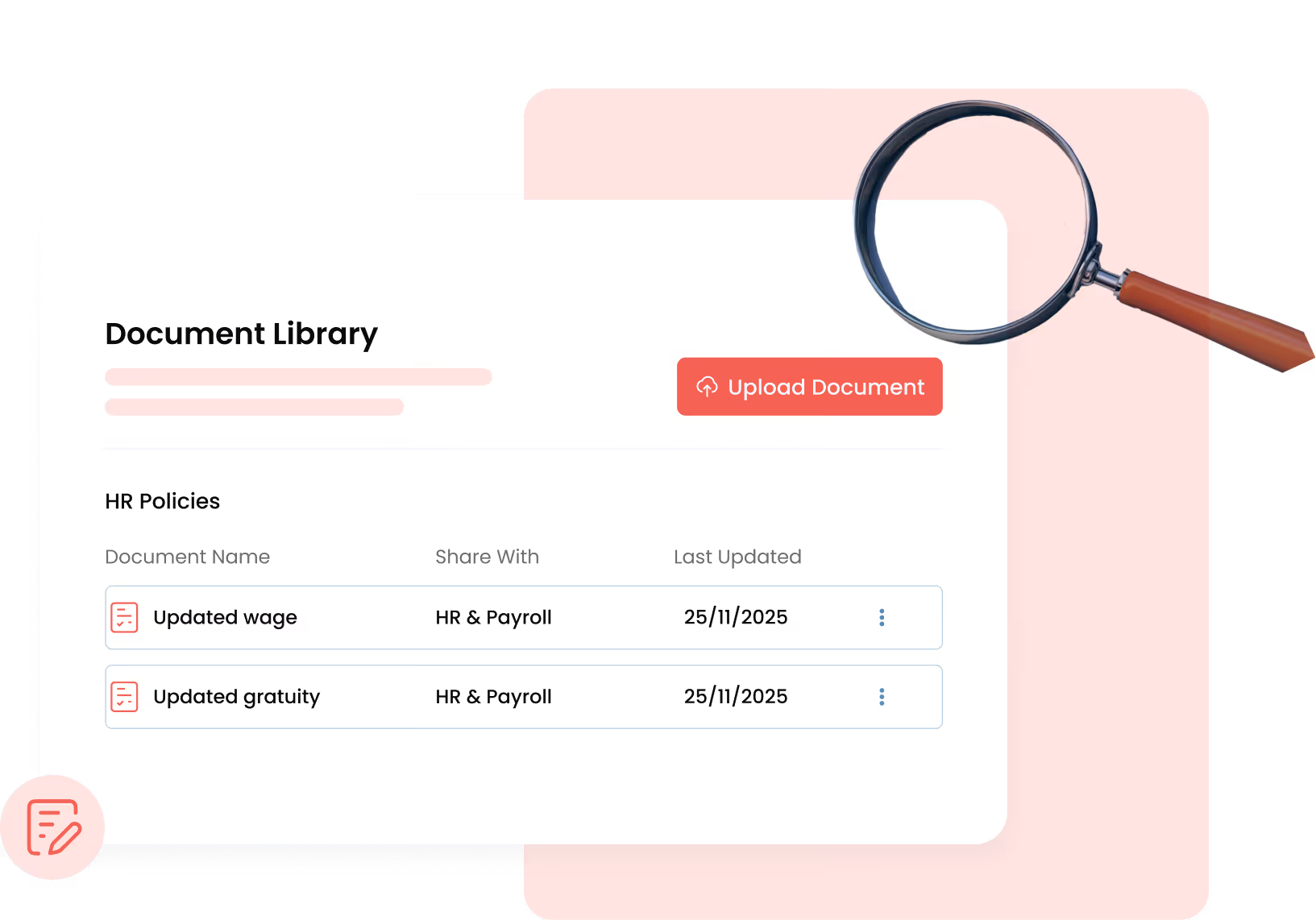
Omni’s document management and onboarding workflows make it straightforward to update and redistribute revised HR policies with version control and acknowledgement tracking, so you have a clear record of who has received and reviewed the updated materials.
Maintain ongoing compliance and monitoring
- Monitor state-specific rule updates under the new labour codes
- Maintain proper documentation for compliance and inspections (up to 5 years)
- Conduct regular internal audits to ensure continued adherence
- Stay updated on regulatory changes impacting labour laws in India
How Omni HR Supports HR Teams Navigating New Labour Laws in India
India's new labour codes introduce changes to how wages are defined, how statutory contributions are calculated, and how employment contracts are structured. For HR teams managing these changes across multiple employee categories and states, the administrative load is significant, and the margin for error is narrow.
At Omni, we built our platform to take on this kind of compliance work, so your team can stay ahead of the new labour laws in India 2025 without rebuilding processes from scratch each time.
Here's what that looks like in practice:
- Centralised employee records that give you a complete, audit-ready view of compensation structures, employment contracts, and statutory contribution histories across your entire workforce
- Payroll automation that recalculates PF, gratuity, and ESI based on updated wage definitions under the new labour code, ensuring contributions are accurate across all employee categories from the first pay cycle after any regulatory change
- Document management with version control so updated employment contracts, revised policies, and employee acknowledgements are stored, tracked, and ready for inspection at any time
- Automated onboarding workflows that capture the right employment details from day one, including fixed-term contract parameters and gratuity eligibility, keeping records consistent and compliant with the new labour codes
- Audit trails and compliance documentation are maintained automatically, so your team is always prepared for state-level inspections without last-minute file chasing
India's labour code rollout is gradual and state-dependent, so compliance requirements will continue to evolve through 2026 and beyond. Omni gives your HR team the systems to stay current, so changes in labour laws in India translate into updated workflows rather than compliance gaps.
Schedule your product tour and see how Omni supports HR teams managing new labour code compliance across India and the rest of Asia.
Frequently Asked Questions
The new labour laws in India 2025 consolidate 29 central labour laws into four codes: the Code on Wages 2019, the Industrial Relations Code 2020, the Code on Social Security 2020, and the Occupational Safety, Health and Working Conditions Code 2020. They aim to modernise worker protections, simplify compliance, and standardise how wages, contributions, and employment conditions are governed across India. States are at different stages of implementation, so requirements may vary depending on where your business operates.
Under the Code on Wages 2019, basic pay, dearness allowance, and retaining allowance must constitute at least 50% of an employee's total remuneration. If allowances and excluded components exceed 50% of total compensation, the excess is reclassified as wages for statutory calculations. This directly affects PF, gratuity, and ESI contributions, and limits the earlier practice of structuring salaries with a low basic pay and high allowances to reduce statutory obligations.
Under the new labour laws in India, PF coverage now applies universally to all establishments with 20 or more employees, regardless of industry. Contribution rates remain at 12% each from employee and employer, but the base used for calculation is likely to increase due to the revised definition of wages under the new Labour Code 2025. This means employees may see a slight reduction in take-home pay, offset by higher long-term retirement savings. Omni's payroll module can be configured to reflect updated wage and statutory contributions, ensuring PF calculations stay accurate from the first affected pay cycle.
Yes. Under the Code on Social Security 2020, fixed-term employees are entitled to gratuity on a pro-rata basis upon contract termination after one year of continuous service. This is a significant change from the previous five-year threshold that applied only to permanent employees. The calculation remains at 15 days' wages per year of service, though the revised definition of wages under the new labour code may result in higher payouts than under the previous framework.
India's new labour codes were notified on 21 November 2025, but full implementation depends on individual states finalising their own rules. States are at different stages: some, like Gujarat and Arunachal Pradesh, have notified rules under all four codes, while others are still in draft stages. There is no single nationwide implementation date, and the rollout is expected to continue progressively through 2026 and beyond. HR teams should monitor both central and state-level updates to stay on top of what the new labour laws in India mean for their specific locations.



.avif)
.avif)