



















.png)
%20(1).png)


HiBob is a modern, engagement-focused HRIS. But it does not offer native payroll in Singapore. If you need CPF, IRAS, and SDL handled in the same system as your HR, there are platforms that do both without the two-system workaround.
Why This Guide Exists
HiBob (also called "Bob") is one of the most well-designed HR platforms on the market. The interface is clean and modern. The engagement features, social feeds, kudos, surveys, and people analytics, are genuinely strong. For companies that prioritize employee experience and culture, HiBob looks like an obvious choice.
But if you run HR in Singapore, HiBob has a fundamental gap: it does not offer native payroll in Asia.
No CPF calculations. No SDL deductions. No IRAS filing. No FWL. No MOM reporting. HiBob's payroll capability is limited to the UK, Israel, and select European markets. For Singapore, you need a separate payroll provider.
That means two systems. Double data entry. Manual syncing between your HRIS and your payroll provider. And when something goes wrong during your CPF submission or IRAS filing, you are troubleshooting across two vendors instead of one.

Quick Comparison
PlatformBest ForSG Payroll (CPF, IRAS, SDL)Multi-Country AsiaG2 RatingStarting Price
Omni HR
Growing teams that need HR and payroll across Asia in one platformYes, native since launchLocal payroll in SG, MY, HK, PH. Managed payroll for 20+ countries. EOR and contractor payments.4.8/5$3/employee/mo
Darwinbox
Why Singapore Teams Look for HiBob Alternatives
HiBob does not lose customers because the product is bad. It loses them because the product is incomplete for Singapore.
No native Singapore payroll
This is the fundamental issue. HiBob's Payroll Hub connects to external payroll providers like ADP, Gusto, PayFit, and Xero. It syncs data. But it does not process payroll.
For Singapore, that means you need a separate provider for CPF contributions (which vary by age bracket), SDL deductions, IRAS filing (IR8A, IR8S, Appendix 8A), FWL calculations, and MOM reporting. Your HRIS and your payroll live in two different systems.
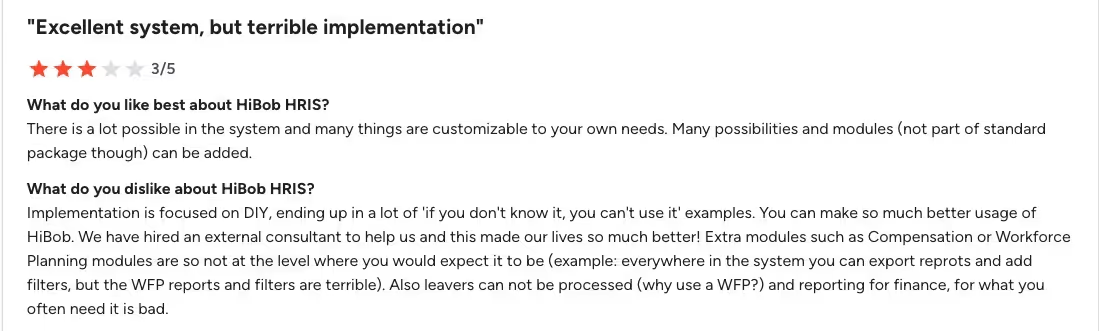
Multiple G2 reviewers note that HiBob's integrations still require "manual workarounds" and that the platform "would be stronger with more robust integrations, particularly with payroll and ATS systems."

Expensive for an incomplete solution
HiBob does not publish pricing. Third-party estimates range from $8 to $25 per employee per month, with implementation fees of 10 to 20 percent of the annual contract.
For a 200-person Singapore company at $16 per employee per month, that is approximately $38,400 per year for HRIS alone. Add a separate Singapore payroll provider at $5 to $10 per employee per month, and your total HR and payroll stack could run $50,000 to $62,000 per year.
Omni HR provides both HR and payroll in one platform for $3 per employee per month, with payroll as a $1 add-on. For the same 200-person team, that is $9,600 per year. The cost difference is significant.
Engagement-first, not operations-first
HiBob excels at employee engagement: social feeds, shoutouts, kudos, surveys, mood tracking, and people analytics. These are genuinely useful features for building company culture.
But for Singapore HR teams, the operational gaps matter more day to day. No native payroll. Limited workflow customization. Reporting that G2 reviewers describe as needing workarounds. An org chart that some users find clunky at scale.

1. Omni HR
Best for: Growing Singapore companies that want HR, payroll, compliance, and recruitment in one platform.
Omni HR was built for Asia from day one. It is not a Western HRIS trying to bolt on Asian compliance. Every feature, from payroll to performance reviews to ATS, was designed with Southeast Asian businesses in mind.
What sets it apart from HiBob
One platform instead of two (or three)
The biggest advantage of Omni HR over HiBob is simplicity. With HiBob, a Singapore team typically needs two or three systems: HiBob for HRIS, a separate payroll provider for CPF and IRAS, and potentially a separate ATS for recruitment. That is multiple vendors, multiple contracts, multiple integrations to maintain, and multiple places where data can fall out of sync.
With Omni HR, HR records, payroll processing, compliance filing, and recruitment live in the same system. When you promote an employee, their salary change flows automatically into the next payroll run. When you hire a candidate through the ATS, their onboarding flows directly into the employee database.
Multi-country payroll and EOR
HiBob does not offer payroll in any Asian market, EOR services, or contractor payments. If your Singapore company hires someone in Malaysia or the Philippines, HiBob cannot help.
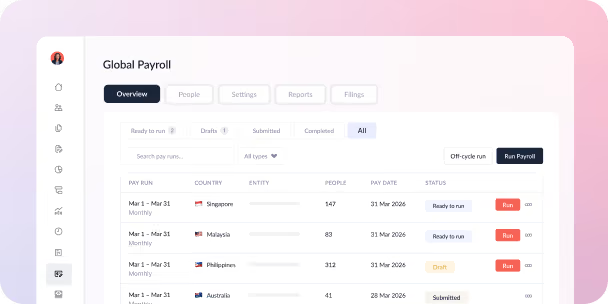
Omni HR runs native local payroll in four countries: Singapore, Malaysia, Hong Kong, and the Philippines. For the rest of Asia, managed payroll services cover over 20 countries. Omni HR also provides Employer of Record services and contractor payments across the region.
Fraction of the total cost
For a 200-person Singapore team:
HiBob plus a separate payroll provider: approximately $50,000 to $62,000 per year.
Omni HR with HR and payroll in one platform: approximately $9,600 per year.
The savings are not marginal. They are transformational for a growing company's budget.
Omni HR pricing starts at $3 per employee per month for Core HR. Payroll, performance, and other modules are available as add-ons at $1 each. Implementation is free, and most teams are up and running within 2 to 4 weeks.
Book a demo to see how Omni HR replaces your HRIS, payroll, and ATS in one platform.
2. Darwinbox
Best for: Large enterprises with 500+ employees that need deep workforce management and are willing to invest in an enterprise-grade platform.
Darwinbox is a comprehensive HCM that covers core HR, recruitment, performance, attendance, and payroll. It has earned a spot on Gartner's Magic Quadrant and is used by large enterprises like Starbucks and Singlife.
Darwinbox announced native Singapore payroll in September 2025, launching in early 2026. This means their SG payroll is very new compared to Omni HR's proven track record. The platform is designed for companies with 500 or more employees, with custom pricing that starts around $5 per employee per month plus implementation fees of $5,000 to $50,000.
For teams in the 100 to 500 employee range, Darwinbox's enterprise complexity and pricing may be more than what is needed. G2 reviewers consistently flag slow loading times and a steep learning curve. For smaller, faster-moving teams, Omni HR offers a more practical fit.
3. Employment Hero
Best for: Small teams with Australian roots that are expanding into Southeast Asia.
Employment Hero started in Australia and has been growing its presence in SEA. The platform covers core HR, onboarding, and basic payroll. Singapore payroll is available through partners rather than natively, which adds a layer of complexity.
Core HR starts at $7 per employee per month, with payroll at $8. The platform has an Australian-centric feel that can be noticeable in areas like leave policies and compliance workflows.
For teams that need deep Singapore compliance and multi-country flexibility, Omni HR offers a more tailored experience at a lower price point.
4. PeopleCentral
Best for: Singapore-only SMEs that need straightforward local payroll with PSG grant eligibility.
PeopleCentral is a Singapore-native cloud HRMS built specifically for local businesses. It handles CPF, SDL, and IRAS compliance natively, with automated payroll, leave management, attendance tracking, and employee self-service. It is PSG pre-approved, which means eligible Singapore SMEs can claim up to 50% of implementation costs through the Productivity Solutions Grant.
PeopleCentral is a solid choice for companies that operate exclusively in Singapore and want a system designed entirely around local requirements. Users describe it as straightforward and efficient, particularly for payroll processing.
The limitation is scale and geographic scope. PeopleCentral does not offer multi-country payroll, EOR, or contractor payments. If your Singapore company is expanding into Malaysia, the Philippines, or other Asian markets, you will need a second platform. Omni HR provides the same Singapore compliance plus the ability to scale across Asia without switching systems.
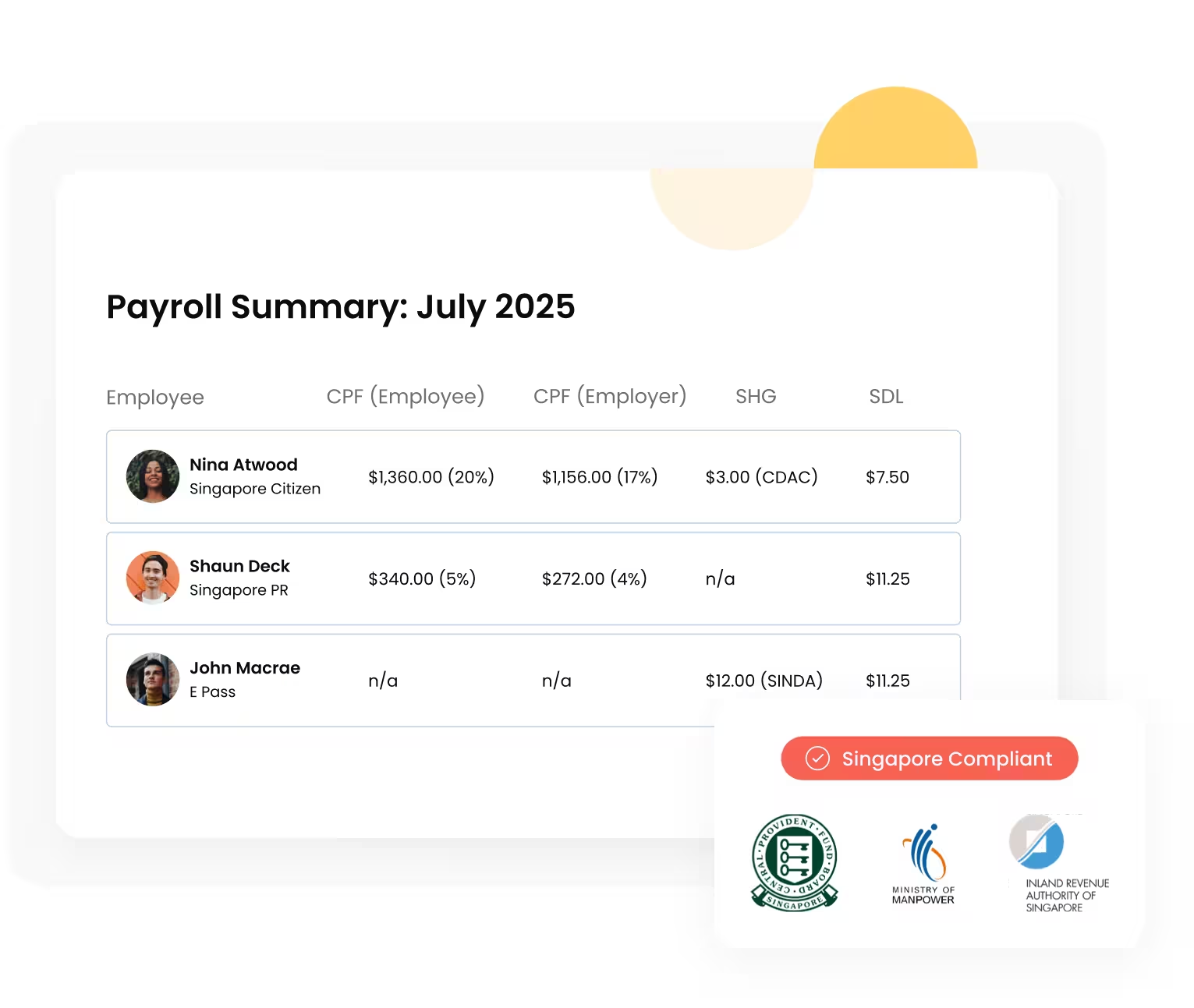
Singapore Compliance and Payroll: Who Actually Handles It
The core question is not "does the platform integrate with payroll?" It is "does the platform process payroll?" Here is the difference.
When to Choose HiBob vs Omni HR
Choose HiBob if...Choose Omni HR if...Employee engagement and culture tools are your top priorityYou need HR and payroll in one system, not twoYou already have a Singapore payroll provider you are happy withYou want native CPF, IRAS, SDL, and FWL without a separate vendorYou operate primarily in the UK or Europe where HiBob has native payrollYou operate in Singapore or across Southeast AsiaBudget is not a primary concernYou want transparent pricing at $3/employee/mo with free implementationYou do not plan to expand into Asian marketsYou want to hire, pay, and manage employees and contractors across all of Asia
Further Reading
Frequently Asked Questions
No. HiBob's native payroll is limited to the UK, Israel, and select European markets. For Singapore, you need a separate payroll provider to handle CPF, SDL, IRAS, and FWL. HiBob offers a Payroll Hub that syncs data to external providers, but it does not process payroll itself.
No. HiBob's native payroll is limited to the UK, Israel, and select European markets. For Singapore, you need a separate payroll provider to handle CPF, SDL, IRAS, and FWL. HiBob offers a Payroll Hub that syncs data to external providers, but it does not process payroll itself. Omni HR processes Singapore payroll natively.
HiBob does not publish pricing. Third-party estimates range from $8 to $25 per employee per month, with implementation fees of 10 to 20 percent of the annual contract. This does not include the cost of a separate Singapore payroll provider. Omni HR starts at $3 per employee per month with payroll included as a $1 add-on and free implementation.
HiBob does not publish pricing. Third-party estimates range from $8 to $25 per employee per month, with implementation fees of 10 to 20 percent of the annual contract. This does not include the cost of a separate Singapore payroll provider. Omni HR starts at $3 per employee per month with payroll included as a $1 add-on and free implementation.
HiBob recently added Bob Hiring as an ATS module, but many teams still integrate with separate ATS platforms like Greenhouse or Lever. Omni HR includes a built-in ATS that covers the full journey from job posting to offer letter within the same platform.
HiBob recently added Bob Hiring as an ATS module, but many teams still integrate with separate ATS platforms like Greenhouse or Lever. Omni HR includes a built-in ATS that covers the full journey from job posting to offer letter within the same platform.
No. HiBob does not offer native payroll in any Asian market. For Singapore, Malaysia, Hong Kong, the Philippines, or any other country in Asia, you need a separate payroll provider. Omni HR offers native local payroll in four Asian countries plus managed payroll for over 20 more.
No. HiBob does not offer native payroll in any Asian market. For Singapore, Malaysia, Hong Kong, the Philippines, or any other country in Asia, you need a separate payroll provider. Omni HR offers native local payroll in four Asian countries plus managed payroll for over 20 more.
G2 reviewers frequently mention that HiBob's payroll integrations still require manual workarounds, that workflows and reporting customization are limited, and that the platform would benefit from more robust integrations with payroll and ATS systems. Some users also note that the org chart becomes clunky at scale.
G2 reviewers frequently mention that HiBob's payroll integrations still require manual workarounds, that workflows and reporting customization are limited, and that the platform would benefit from more robust integrations with payroll and ATS systems. Some users also note that the org chart becomes clunky at scale.
Yes. Omni HR provides Employer of Record services across Asia, allowing companies to hire employees in countries where they do not have a legal entity. HiBob does not offer EOR or contractor payment services.
Yes. Omni HR provides Employer of Record services across Asia, allowing companies to hire employees in countries where they do not have a legal entity. HiBob does not offer EOR or contractor payment services.
Yes. Omni HR provides free migration support with a dedicated Customer Success Manager. Most teams complete the transition within 2 to 4 weeks with no disruption to operations.
Yes. Omni HR provides free migration support with a dedicated Customer Success Manager. Most teams complete the transition within 2 to 4 weeks with no disruption to operations. Book a demo to discuss your migration timeline.
Omni HR is used by SaaS companies, fintechs, BPOs, professional services firms, and other growing businesses across Asia. The platform has industry-specific workflows for high-volume hiring, shift management, and multi-country compliance.
Omni HR is used by SaaS companies, fintechs, BPOs, professional services firms, and other growing businesses across Asia. The platform has industry-specific workflows for high-volume hiring, shift management, and multi-country compliance. See customer stories from Singapore teams.



.avif)
.avif)