How to Compute Overtime Pay in the Philippines

7
min Read
7
min Read
Save this article for future use
Download PDF

Summary. Overtime pay in the Philippines is governed by the Labor Code and compensates employees for working beyond regular hours. Employees working on regular days earn 25% extra per hour, while those working on rest days or holidays receive up to 50% more. Overtime pay eligibility excludes managerial and field personnel, along with certain small establishments. The formula for computing overtime pay involves determining the employee's hourly rate, applying the relevant overtime rate, and calculating the total for extra hours worked. Employers must ensure fair compensation, maintain accurate records, and manage overtime responsibly to avoid employee burnout and legal violations.

A study found that 71% of employees worked overtime at least once a week. While this can boost productivity, failing to compensate your employees for these extra hours violates a major Philippines labor law. 

ADP Research Institute reports that unpaid overtime increased from an average of 7.3 hours a week in 2020 to 9.2 hours per week in 2021. This trend is concerning in a country like the Philippines, where protecting employees and ensuring fair compensation are priorities.

When it comes down to how to compute overtime pay Philippines, it can be complex for HR professionals and business owners, especially if they are not familiar with the labor laws. Manual methods can be time-consuming and prone to errors.

This guide explains how to compute overtime pay Philippines, helping you navigate this process and ensuring compliance with labor laws.

What is overtime pay?

Overtime pay is a crucial component of how to compute overtime pay and is mandated by Philippine labor law, governed by the Labor Code, as it compensates employees for working beyond regular hours. The law stipulates normal work hours of eight per day or 48 per week, with overtime pay rates varying depending on the day.

Under current Labor Code and DOLE rules, overtime pay rates vary based on the day and type of work performed:

  • Work beyond eight hours on a regular workday: additional 25% of the regular hourly rate (i.e., hourly rate × 1.25).
  • Work beyond eight hours on a rest day or a special non-working holiday: additional 30% on top of the applicable rate (effectively ~169% of base hourly rate for OT hours).
  • On regular holidays, employees receive at least 200% of their daily wage for up to eight hours, and any overtime beyond that is subject to an additional 30% premium on top of the holiday rate (effectively 260% of base hourly rate).
  • If a regular holiday falls on a rest day, the premiums stack further according to DOLE rules.

This compensation is designed to protect employees from exploitation and ensure fair pay. HR teams and employers should foster transparency in their company culture. The essence of overtime pay is to protect employees from exploitation and ensure they receive fair compensation for their work. Understanding how to compute overtime pay rates accurately is essential to avoid errors.

What are the types of overtime pay?

In the Philippines, there are specific labor laws governing overtime pay. These regulations determine the computation for overtime and state the types of overtime pay and the different rates for regular days, special days, rest days, and holidays. 

1. Regular day overtime 

Overtime work beyond eight hours on a regular workday is compensated at 125% of the hourly rate.

2. Rest day overtime 

What is RDOT meaning in work? RDOT is compensated at a 30% premium for the first 8 hours, with hours beyond 8 stacked to ~169% of the regular hourly rate.

3. Special holiday overtime 

When employees work beyond eight hours on declared special non‑working holidays, the overtime rate includes a 30% premium on top of the 130% base special holiday rate (~169% of base pay).

4. Regular holiday overtime

Work beyond eight hours on a regular holiday like Christmas, Eid'l Fitr, Maundy Thursday, Christmas, or New Year’s Day earns 200% of base pay for the first 8 hours, with overtime beyond that at 260% of base hourly rate.

Download the Philippines Public Holiday Calendar

5. Night shift and overlapping premiums

For hours worked between 10:00 PM and 6:00 AM, employees are entitled to a night shift differential of at least 10% of the hourly rate, which can stack with overtime and holiday premiums.

Who is eligible for overtime?

overtime pay formula

To learn how to compute overtime pay Philippines, it is important to first understand who is eligible for overtime. Regular employees are eligible for overtime pay. However, exceptions include:

  • Managerial employees

These are employees whose main job involves supervising the company, a department, or other management team members. Managerial employees aren’t entitled to overtime pay when they exceed eight working hours.

  • Field personnel

This refers to non-agricultural employees who carry out their duties outside the principal place of business. They’re not eligible because their actual work hours in the field aren’t certain. 

Other employees not eligible for overtime, as provided under Article 82 of the Labor Code, include:

  • The employer’s family members depend on them for support.
  • Domestic helpers
  • Individuals in the personal service of another
  • Workers are paid by results determined by the Secretary of Labor in appropriate regulations.

When can employers require overtime work?

The Labor Code spells out the requirement for overtime work Philippines and provides a legal framework for fair compensation. Per the code, employers can request overtime work during:

  • National emergencies

The National Assembly or the Chief Executive can declare a national emergency during situations that threaten the nation's security, economy, or welfare. Such emergencies include natural disasters, terrorist attacks, economic crises, and public health emergencies. You can request overtime work during this period.

  • Local emergencies

Demand extra work during certain events threatening public safety, health, or property within a particular city, state, or town. Such local emergencies include natural disasters, power outages, pandemics, or other unforeseen emergencies.

  • Urgent tasks on machines, installations, or equipment

When your company’s machines, installations, or equipment need urgent fixing, you’re entitled to demand extra hours.

  • Prevent loss or damage to perishable goods

Request additional working hours when needed to avoid the loss or damage of certain goods. However, you must be sure the situation requires overtime work by considering the nature of the perishable goods, how urgent they are, and the likely consequences of not acting on time.

  • Abnormal pressure of work due to special circumstances

Ask employees to work overtime when there's much extra work due to special situations. This request should be made when alternatives like outsourcing tasks, hiring makeshift workers, or adjusting schedules are difficult to adopt.

  • Completion of work needed before the regular 8-hour workday

Employees can work extra hours if needed to complete or continue a task started before the eighth hour to avoid serious problems for business operations. 

Can employees request or refuse overtime work?

Employees can request overtime to extend their working hours beyond the regular schedule, but approval depends on factors like labor laws, operational needs and company policies. 

HR teams consider factors such as performance, availability, budget, workload, and staffing levels when granting these requests.

Overtime work in the Philippines is voluntary, and employers should not compel employees to work beyond their standard hours. Compulsory overtime is allowed only during emergencies, imminent losses, or critical business situations. Refusal to work additional hours during such circumstances may lead to disciplinary actions or termination. 

How to compute overtime pay Philippines?

Paying for overtime has the advantage of boosting employee productivity. The additional compensation enhances employee engagement, motivating employees to strive harder to achieve goals. Ultimately, this approach ensures that every hour worked is fairly compensated in accordance with the law.

However, it all begins with an accurate overtime pay formula to properly show you how to compute overtime pay. This process may appear complex at first glance. For example, you cannot simply calculate overtime pay by multiplying additional hours worked by a fixed rate. Instead, you must adhere to the specific regulations that govern how to compute overtime pay Philippines.

1. Determine the regular hourly rate

The first step on how to compute overtime pay Philippines is to set the hourly rate. As we established previously, the standard working hours in the Philippines are eight hours per day or 48 hours per week. So, to get the regular hourly rate, work with the employee’s salary or daily wage.

Read next: Philippines Minimum Wage Guide for Employers

Say you’re in the Davao region, and your company is in the non-plantation agricultural sector. The Philippine minimum wage for this sector is PHP 457 per day. To get the hourly rate, divide the daily wage by eight hours.

For example: PHP 457/8= PHP 57.125 as hourly rate.

On the other hand, you’ll have to determine the daily wage if you're working based on salaries. 

For example: if an employee earns PHP 50,000 monthly and works 22 days per month, the daily wage would be:

PHP 50,000 / 22 = PHP 2272.727

Now, to get the hourly rate, divide the daily wage by 8:

PHP 2,272.727 / 8 = PHP 284.09 

2. Identify the applicable overtime rate

Up next on how to compute overtime pay, identify the applicable overtime rate, which typically ranges from 125% to 200% of the employee’s regular wage rate, with higher rates during rest days and holidays. 

Since the overtime rate depends on the type of overtime, here are examples of applicable rates per day:

  • Regular workday overtime: additional 25% (i.e., hourly rate × 1.25 for overtime hours).
  • Rest day or special non‑working holiday overtime: additional 30% premium (i.e., effective rate of 130% of hourly for OT hours) with the overtime portion paid at an additional 30% on that rate.
  • Overtime on a regular holiday: holiday rate for first eight hours is 200% of the daily rate; overtime beyond that is paid at an additional 30% on top of the holiday rate (effective 260% of base hourly rate).
  • Night shift differential: at least 10% of the hourly rate for work between 10:00 PM and 6:00 AM, which may stack with overtime and holiday premiums.

3. Calculate the overtime hours

The next step on how to compute overtime pay is to calculate the extra hours worked for overtime pay. For example, if an employee worked overtime for a day, that would be eight hours. If they worked an additional two hours, the overtime would be two hours. This information is crucial for the subsequent steps in the overtime pay formula.

4. Compute the overtime pay

Compute the overtime pay depending on the applicable OT rate. 

For example, using the 25% overtime rate for a regular workday:

Multiply the hourly rate by 125%, that is 1.25. 

If the base hourly rate is PHP 100, the overtime pay per hour will be PHP 125.

5. Add up the total overtime pay

The final step on how to compute overtime pay Philippines is to add up the total overtime pay. 

If an employee works two extra hours on a regular workday at an hourly rate of PHP 100, their overtime pay would amount to PHP 125 X 2, totalling an additional PHP 250 to their regular wage. Working two hours for five days in a week would result in an additional of PHP 1250 to their regular wage by the end of the week.

Calculating overtime pay for night shift employees

Employees who work between 10:00 pm and 6:00 am are entitled to a night shift differential (NSD) of at least 10% of their regular hourly wage.

In this case, the steps above to compute overtime pay for night-shift employees still apply.

For example, if an employee worked two additional hours during a night shift and their hourly wage was PHP 100, it’ll amount to:

PHP 

100 x 10% = PHP 10 + PHP 100 = PHP 110 as the NSD rate.

PHP 110 x 1.25 = PHP 137.50 as the overtime rate.

PHP 137.50 x 2 hours = PHP 275 as overtime pay.

Ways to Ensure Responsible Overtime Practices

how to compute overtime pay Philippines

Overtime can boost productivity and income in a company. However, knowing how to compute overtime pay Philippines is just the beginning; effectively managing the process is equally important. 

Failure to manage extra working hours properly can lead to serious consequences, including a lack of work-life balance, employee burnout, reduced engagement, and ironically, lower productivity.

To mitigate these risks, consider these steps to manage your employees’ overtime effectively: 

Plan and schedule work effectively

Forecast workload changes by reviewing past data and business trends. This prepares you and leaves enough room to add extra working hours to the company’s schedule. Then, set realistic goals and delegate tasks based on importance and urgency for better execution.

Compensate employees fairly

Fair compensation is a fundamental aspect of the Philippine labor code and a key driver of employee motivation. By following the steps outlined on how to compute overtime pay Philippines, your company will give employees fair payment for additional hours worked.

Maintain clear communication and accurate records

Effective communication is essential in any organization. Internal communication channels should facilitate this to ensure employees provide prompt responses and feedback. It’s also important to align communication with your company values. Use channels such as newsletters, emails, communication apps, and 1-on-1 meetings to enhance communication and involve everyone, including remote workers.

Additionally, maintaining accurate records of employees on your payroll is crucial. Managing performance ensures alignment with your company’s remuneration and goals. Secure employee records allow HR teams to easily access employment contracts and necessary documents to assist with how to compute overtime pay Philippines and other wage adjustments. This approach helps in developing a company culture that fosters employee satisfaction and growth.

Promote healthy work-life balance

Maintaining a healthy work-life balance is a crucial aspect for employee well-being, productivity, and job satisfaction. Encourage employees to manage their time effectively and prioritize their health, relationships, and interests outside of work. 

Provide support through flexible work arrangements, rest periods, clear communication of expectations, time off, and activities that enhance mental, physical, and emotional well-being.

Optimize Overtime Management with Omni
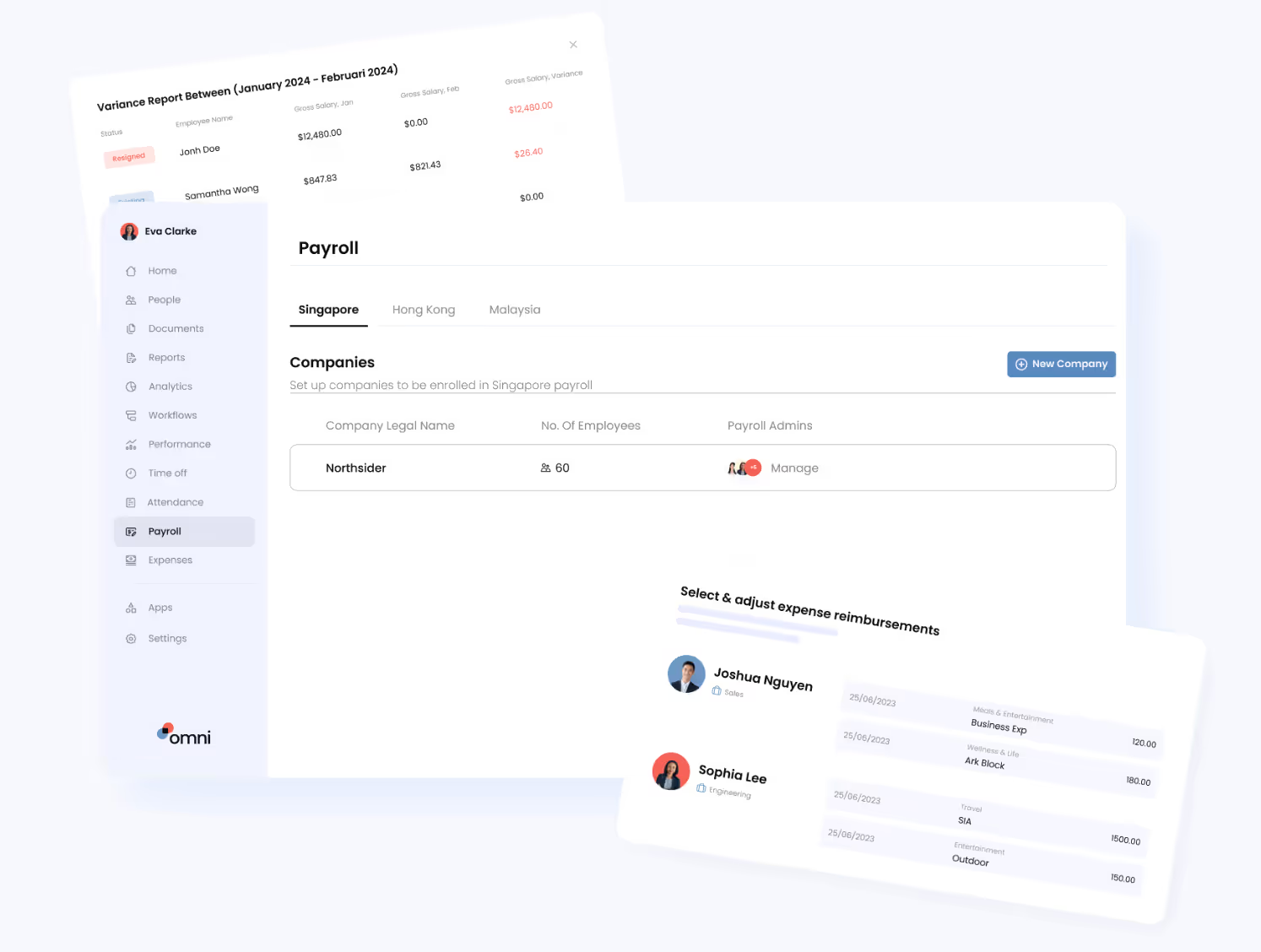
Ensuring accuracy in computing overtime pay is crucial for both employees and employers. It not only helps in complying with labor laws but also fosters trust and fairness in the workplace. 

Additionally, optimizing overtime management with HR tools like Omni can streamline processes, reduce errors, and improve overall efficiency on how to compute overtime pay Philippines. 

Omni's comprehensive HRIS supports Philippines payroll with features like support for Philippine peso, automated tax calculations, and managed SSS, PhilHealth and Pag-IBIG contributions, Omni can help HR simplify the overtime pay formula and ensure compliance to the Labor Code with ease. 

Book a demo with us today and see how Omni can simplify the intricacies and complexities on how to compute overtime pay in the Philippines and minimize the costs associated with common errors.

Try out Omni for 7 days today!

A study found that 71% of employees worked overtime at least once a week. While this can boost productivity, failing to compensate your employees for these extra hours violates a major Philippines labor law. 

ADP Research Institute reports that unpaid overtime increased from an average of 7.3 hours a week in 2020 to 9.2 hours per week in 2021. This trend is concerning in a country like the Philippines, where protecting employees and ensuring fair compensation are priorities.

When it comes down to how to compute overtime pay Philippines, it can be complex for HR professionals and business owners, especially if they are not familiar with the labor laws. Manual methods can be time-consuming and prone to errors.

This guide explains how to compute overtime pay Philippines, helping you navigate this process and ensuring compliance with labor laws.

What is overtime pay?

Overtime pay is a crucial component of how to compute overtime pay and is mandated by Philippine labor law, governed by the Labor Code, as it compensates employees for working beyond regular hours. The law stipulates normal work hours of eight per day or 48 per week, with overtime pay rates varying depending on the day.

Under current Labor Code and DOLE rules, overtime pay rates vary based on the day and type of work performed:

  • Work beyond eight hours on a regular workday: additional 25% of the regular hourly rate (i.e., hourly rate × 1.25).
  • Work beyond eight hours on a rest day or a special non-working holiday: additional 30% on top of the applicable rate (effectively ~169% of base hourly rate for OT hours).
  • On regular holidays, employees receive at least 200% of their daily wage for up to eight hours, and any overtime beyond that is subject to an additional 30% premium on top of the holiday rate (effectively 260% of base hourly rate).
  • If a regular holiday falls on a rest day, the premiums stack further according to DOLE rules.

This compensation is designed to protect employees from exploitation and ensure fair pay. HR teams and employers should foster transparency in their company culture. The essence of overtime pay is to protect employees from exploitation and ensure they receive fair compensation for their work. Understanding how to compute overtime pay rates accurately is essential to avoid errors.

What are the types of overtime pay?

In the Philippines, there are specific labor laws governing overtime pay. These regulations determine the computation for overtime and state the types of overtime pay and the different rates for regular days, special days, rest days, and holidays. 

1. Regular day overtime 

Overtime work beyond eight hours on a regular workday is compensated at 125% of the hourly rate.

2. Rest day overtime 

What is RDOT meaning in work? RDOT is compensated at a 30% premium for the first 8 hours, with hours beyond 8 stacked to ~169% of the regular hourly rate.

3. Special holiday overtime 

When employees work beyond eight hours on declared special non‑working holidays, the overtime rate includes a 30% premium on top of the 130% base special holiday rate (~169% of base pay).

4. Regular holiday overtime

Work beyond eight hours on a regular holiday like Christmas, Eid'l Fitr, Maundy Thursday, Christmas, or New Year’s Day earns 200% of base pay for the first 8 hours, with overtime beyond that at 260% of base hourly rate.

Download the Philippines Public Holiday Calendar

5. Night shift and overlapping premiums

For hours worked between 10:00 PM and 6:00 AM, employees are entitled to a night shift differential of at least 10% of the hourly rate, which can stack with overtime and holiday premiums.

Who is eligible for overtime?

overtime pay formula

To learn how to compute overtime pay Philippines, it is important to first understand who is eligible for overtime. Regular employees are eligible for overtime pay. However, exceptions include:

  • Managerial employees

These are employees whose main job involves supervising the company, a department, or other management team members. Managerial employees aren’t entitled to overtime pay when they exceed eight working hours.

  • Field personnel

This refers to non-agricultural employees who carry out their duties outside the principal place of business. They’re not eligible because their actual work hours in the field aren’t certain. 

Other employees not eligible for overtime, as provided under Article 82 of the Labor Code, include:

  • The employer’s family members depend on them for support.
  • Domestic helpers
  • Individuals in the personal service of another
  • Workers are paid by results determined by the Secretary of Labor in appropriate regulations.

When can employers require overtime work?

The Labor Code spells out the requirement for overtime work Philippines and provides a legal framework for fair compensation. Per the code, employers can request overtime work during:

  • National emergencies

The National Assembly or the Chief Executive can declare a national emergency during situations that threaten the nation's security, economy, or welfare. Such emergencies include natural disasters, terrorist attacks, economic crises, and public health emergencies. You can request overtime work during this period.

  • Local emergencies

Demand extra work during certain events threatening public safety, health, or property within a particular city, state, or town. Such local emergencies include natural disasters, power outages, pandemics, or other unforeseen emergencies.

  • Urgent tasks on machines, installations, or equipment

When your company’s machines, installations, or equipment need urgent fixing, you’re entitled to demand extra hours.

  • Prevent loss or damage to perishable goods

Request additional working hours when needed to avoid the loss or damage of certain goods. However, you must be sure the situation requires overtime work by considering the nature of the perishable goods, how urgent they are, and the likely consequences of not acting on time.

  • Abnormal pressure of work due to special circumstances

Ask employees to work overtime when there's much extra work due to special situations. This request should be made when alternatives like outsourcing tasks, hiring makeshift workers, or adjusting schedules are difficult to adopt.

  • Completion of work needed before the regular 8-hour workday

Employees can work extra hours if needed to complete or continue a task started before the eighth hour to avoid serious problems for business operations. 

Can employees request or refuse overtime work?

Employees can request overtime to extend their working hours beyond the regular schedule, but approval depends on factors like labor laws, operational needs and company policies. 

HR teams consider factors such as performance, availability, budget, workload, and staffing levels when granting these requests.

Overtime work in the Philippines is voluntary, and employers should not compel employees to work beyond their standard hours. Compulsory overtime is allowed only during emergencies, imminent losses, or critical business situations. Refusal to work additional hours during such circumstances may lead to disciplinary actions or termination. 

How to compute overtime pay Philippines?

Paying for overtime has the advantage of boosting employee productivity. The additional compensation enhances employee engagement, motivating employees to strive harder to achieve goals. Ultimately, this approach ensures that every hour worked is fairly compensated in accordance with the law.

However, it all begins with an accurate overtime pay formula to properly show you how to compute overtime pay. This process may appear complex at first glance. For example, you cannot simply calculate overtime pay by multiplying additional hours worked by a fixed rate. Instead, you must adhere to the specific regulations that govern how to compute overtime pay Philippines.

1. Determine the regular hourly rate

The first step on how to compute overtime pay Philippines is to set the hourly rate. As we established previously, the standard working hours in the Philippines are eight hours per day or 48 hours per week. So, to get the regular hourly rate, work with the employee’s salary or daily wage.

Read next: Philippines Minimum Wage Guide for Employers

Say you’re in the Davao region, and your company is in the non-plantation agricultural sector. The Philippine minimum wage for this sector is PHP 457 per day. To get the hourly rate, divide the daily wage by eight hours.

For example: PHP 457/8= PHP 57.125 as hourly rate.

On the other hand, you’ll have to determine the daily wage if you're working based on salaries. 

For example: if an employee earns PHP 50,000 monthly and works 22 days per month, the daily wage would be:

PHP 50,000 / 22 = PHP 2272.727

Now, to get the hourly rate, divide the daily wage by 8:

PHP 2,272.727 / 8 = PHP 284.09 

2. Identify the applicable overtime rate

Up next on how to compute overtime pay, identify the applicable overtime rate, which typically ranges from 125% to 200% of the employee’s regular wage rate, with higher rates during rest days and holidays. 

Since the overtime rate depends on the type of overtime, here are examples of applicable rates per day:

  • Regular workday overtime: additional 25% (i.e., hourly rate × 1.25 for overtime hours).
  • Rest day or special non‑working holiday overtime: additional 30% premium (i.e., effective rate of 130% of hourly for OT hours) with the overtime portion paid at an additional 30% on that rate.
  • Overtime on a regular holiday: holiday rate for first eight hours is 200% of the daily rate; overtime beyond that is paid at an additional 30% on top of the holiday rate (effective 260% of base hourly rate).
  • Night shift differential: at least 10% of the hourly rate for work between 10:00 PM and 6:00 AM, which may stack with overtime and holiday premiums.

3. Calculate the overtime hours

The next step on how to compute overtime pay is to calculate the extra hours worked for overtime pay. For example, if an employee worked overtime for a day, that would be eight hours. If they worked an additional two hours, the overtime would be two hours. This information is crucial for the subsequent steps in the overtime pay formula.

4. Compute the overtime pay

Compute the overtime pay depending on the applicable OT rate. 

For example, using the 25% overtime rate for a regular workday:

Multiply the hourly rate by 125%, that is 1.25. 

If the base hourly rate is PHP 100, the overtime pay per hour will be PHP 125.

5. Add up the total overtime pay

The final step on how to compute overtime pay Philippines is to add up the total overtime pay. 

If an employee works two extra hours on a regular workday at an hourly rate of PHP 100, their overtime pay would amount to PHP 125 X 2, totalling an additional PHP 250 to their regular wage. Working two hours for five days in a week would result in an additional of PHP 1250 to their regular wage by the end of the week.

Calculating overtime pay for night shift employees

Employees who work between 10:00 pm and 6:00 am are entitled to a night shift differential (NSD) of at least 10% of their regular hourly wage.

In this case, the steps above to compute overtime pay for night-shift employees still apply.

For example, if an employee worked two additional hours during a night shift and their hourly wage was PHP 100, it’ll amount to:

PHP 

100 x 10% = PHP 10 + PHP 100 = PHP 110 as the NSD rate.

PHP 110 x 1.25 = PHP 137.50 as the overtime rate.

PHP 137.50 x 2 hours = PHP 275 as overtime pay.

Ways to Ensure Responsible Overtime Practices

how to compute overtime pay Philippines

Overtime can boost productivity and income in a company. However, knowing how to compute overtime pay Philippines is just the beginning; effectively managing the process is equally important. 

Failure to manage extra working hours properly can lead to serious consequences, including a lack of work-life balance, employee burnout, reduced engagement, and ironically, lower productivity.

To mitigate these risks, consider these steps to manage your employees’ overtime effectively: 

Plan and schedule work effectively

Forecast workload changes by reviewing past data and business trends. This prepares you and leaves enough room to add extra working hours to the company’s schedule. Then, set realistic goals and delegate tasks based on importance and urgency for better execution.

Compensate employees fairly

Fair compensation is a fundamental aspect of the Philippine labor code and a key driver of employee motivation. By following the steps outlined on how to compute overtime pay Philippines, your company will give employees fair payment for additional hours worked.

Maintain clear communication and accurate records

Effective communication is essential in any organization. Internal communication channels should facilitate this to ensure employees provide prompt responses and feedback. It’s also important to align communication with your company values. Use channels such as newsletters, emails, communication apps, and 1-on-1 meetings to enhance communication and involve everyone, including remote workers.

Additionally, maintaining accurate records of employees on your payroll is crucial. Managing performance ensures alignment with your company’s remuneration and goals. Secure employee records allow HR teams to easily access employment contracts and necessary documents to assist with how to compute overtime pay Philippines and other wage adjustments. This approach helps in developing a company culture that fosters employee satisfaction and growth.

Promote healthy work-life balance

Maintaining a healthy work-life balance is a crucial aspect for employee well-being, productivity, and job satisfaction. Encourage employees to manage their time effectively and prioritize their health, relationships, and interests outside of work. 

Provide support through flexible work arrangements, rest periods, clear communication of expectations, time off, and activities that enhance mental, physical, and emotional well-being.

Optimize Overtime Management with Omni

Ensuring accuracy in computing overtime pay is crucial for both employees and employers. It not only helps in complying with labor laws but also fosters trust and fairness in the workplace. 

Additionally, optimizing overtime management with HR tools like Omni can streamline processes, reduce errors, and improve overall efficiency on how to compute overtime pay Philippines. 

Omni's comprehensive HRIS supports Philippines payroll with features like support for Philippine peso, automated tax calculations, and managed SSS, PhilHealth and Pag-IBIG contributions, Omni can help HR simplify the overtime pay formula and ensure compliance to the Labor Code with ease. 

Book a demo with us today and see how Omni can simplify the intricacies and complexities on how to compute overtime pay in the Philippines and minimize the costs associated with common errors.

Try out Omni for 7 days today!

No items found.
No items found.
Which countries do you support?

Full HR & Payroll coverage for Philippines, Singapore, Malaysia, Hong Kong, and Indonesia. Each market has local support teams and built-in compliance features.

How does pricing work as we scale?

Starting at $3/employee/month for core features. Volume-based discounts are available for growing teams. Book a demo for custom pricing.

How do you handle security?

Enterprise-grade security with ISO 27001, GDPR certifications, and local data residency options.

How long is implementation?

4 weeks average. Includes free data migration, setup, and team training. No hidden fees.

What makes Omni different from global HR platforms?

Built specifically for Asia with local payroll processing, same-day support in Asia time zones, and 40% lower cost than global alternatives.