.png)
Summary. Payroll software for BPO companies has to survive client ramps, multi-site shift patterns, and statutory compliance across every delivery market at once, which is a different job than payroll for a single-entity company with steady headcount. This guide compares 8 payroll software for BPO options on statutory compliance depth, high-volume processing, multi-client data segmentation, EOR flexibility for new delivery markets, and pricing transparency, so outsourcing and BPO leaders can choose a BPO payroll software that holds up at scale.
Choosing BPO payroll software is not the same problem as choosing payroll for a single-entity company that adds a few hires a year. A mid-size outsourcing firm might onboard hundreds of agents in a single month for a new client ramp, process payroll across three or four statutory jurisdictions at once, and need every payroll record segmented by client account for billing and reporting, all while managing attrition rates that would alarm almost any other industry.
That combination is why generic "best payroll software" lists tend to fall short for outsourcing operators. A payroll system for BPO companies needs to handle bulk onboarding without breaking, apply the right shift differentials and overtime rules for 24/7 delivery centers, and keep client-account data separate for accurate billing, on top of getting statutory filings right in every market where agents sit. Get pay wrong for a shift-based, high-turnover workforce, and it becomes a retention problem before it becomes a compliance one.
In this guide, we compare payroll for outsourcing firms across the criteria that actually matter for BPO operations, not just general HR functionality, so you can shortlist a BPO payroll software platform that fits how your delivery centers actually run.
Read next: How Integrated HR Software Streamlines BPO Operations
Note: Omni HR is included in this list. We built this comparison and hold ourselves to the same criteria as every other provider.
How We Evaluated These Platforms
Choosing the right BPO payroll software comes down to fit, so we assessed each platform on five criteria that matter most for BPO and outsourcing operations specifically:
- Statutory payroll compliance across delivery markets. Does the platform natively calculate and file SSS, PhilHealth, Pag-IBIG, and BIR (Philippines), EPF and SOCSO (Malaysia), PF and ESI (India), CPF (Singapore), and other local requirements automatically, or does depth drop off outside one home market?
- High-volume payroll processing. Can the platform handle bulk onboarding for client ramps, shift differentials, night-shift premiums, and overtime calculations without manual workarounds?
- Multi-client data segmentation. Can payroll data be segmented and reported by client account or cost center, so BPOs can bill accurately and give clients visibility into their own delivery team's costs?
- EOR and global hiring flexibility. If a client wins new business that requires staffing a delivery site in a country where the BPO has no entity yet, can the platform (or a connected EOR service) support hiring there without a multi-month setup? This is one of the biggest differentiators between generic payroll for outsourcing firms and platforms actually built for BPO growth.
- Pricing transparency at scale. Is per-employee or tiered pricing published, or does it require a sales call, particularly once headcount moves from hundreds to thousands of seats?
Ratings are based on publicly available product information, vendor documentation, and pricing pages as of this update. Where a vendor doesn't publish pricing, we note it as "Custom quote" rather than estimating a figure.
Comparison Table: Best Payroll Software for BPO
1. Omni HR
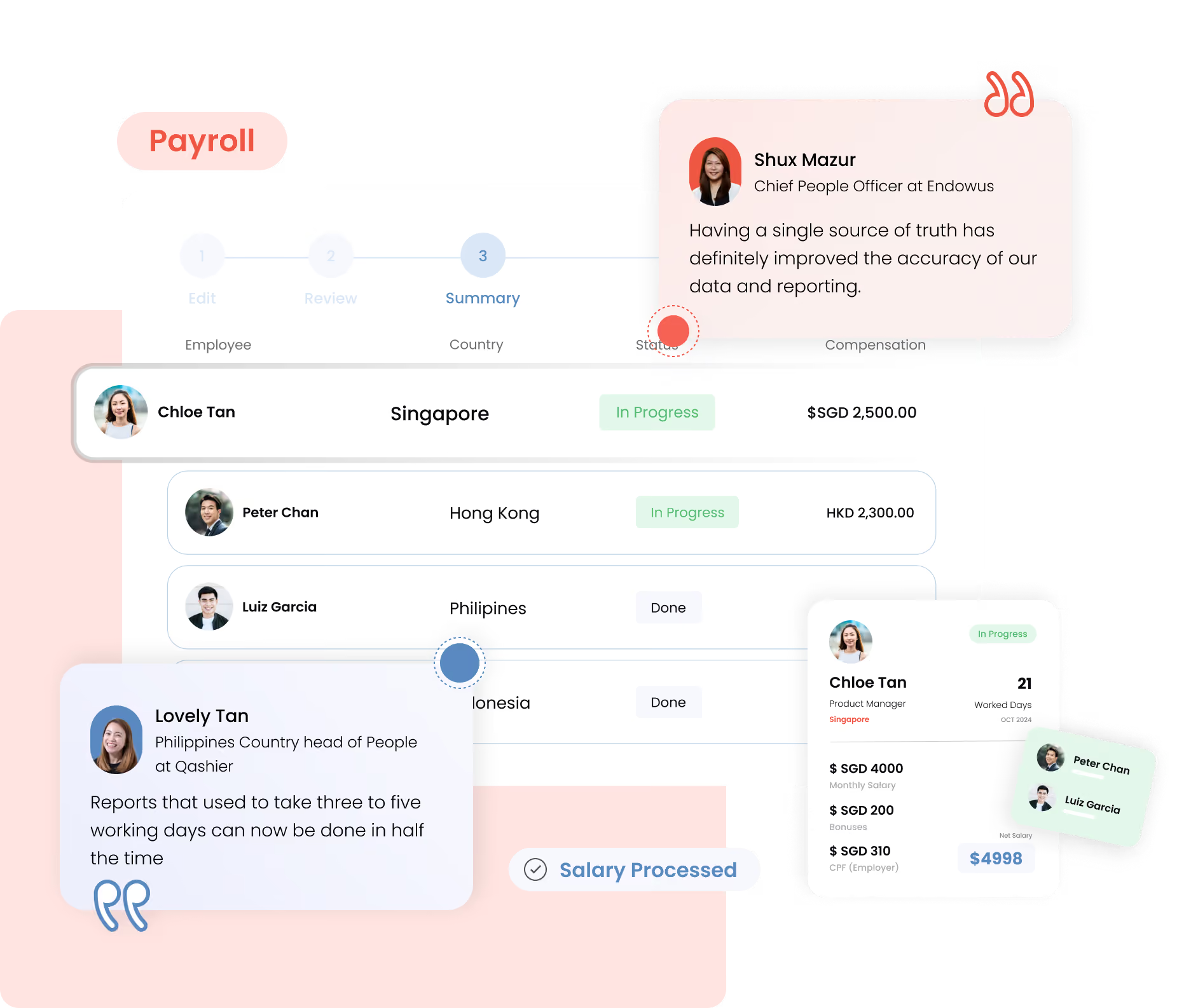
Omni HR is a full-suite HRIS and payroll platform designed for growing companies operating across Asia, including BPO teams running delivery centers in multiple APAC markets. Its native payroll software supports Singapore, Malaysia, Hong Kong, and the Philippines, while Managed Payroll Services extends coverage to 20+ countries.
"Omni has helped us a lot in terms of the statutory, especially when we look at CPF contributions when we pay out bonuses because in Singapore there's additional contribution kept beyond the statutory benefit."
— Jack Ang, Head of People at Lucence
Best for: BPOs and outsourcing firms with delivery centers across Asia that want statutory payroll, HR management, and multi-country workforce administration in one platform.
Key features
- Native payroll compliance for Singapore, Malaysia, Hong Kong, and the Philippines
- Automated payroll calculations and statutory filing
- Digital payslips and accounting integrations
- Multi-country payroll management
- Reporting across entities, countries, and departments
- Core HR, attendance, leave, performance, recruitment, and expense management
- Managed Payroll Services for 20+ countries
Pros
- Strong payroll localization for BPOs operating across key Asian markets
- Full HR lifecycle in one platform, reducing the number of systems HR teams need to manage
- Published Core HR and payroll pricing
- APAC-focused implementation and support
Cons
- Native payroll coverage is narrower than global payroll platforms such as Deel, Papaya Global, ADP, and UKG
- Companies with delivery operations outside Omni's native payroll markets may need Managed Payroll Services or another payroll provider
- EOR and managed payroll are separate services from the native payroll module
Pricing:
- Core HR starts at US$3/employee/month
- Payroll Software starts from US$2–4/employee/month
- Managed Payroll Services starts from US$15/employee/month.
2. Deel
Deel is a global workforce platform combining global payroll, Employer of Record, contractor management, and HR tools. Its Global Payroll offering is designed for companies that already have entities in the countries where they operate, while EOR allows companies to hire without establishing their own local entity.
Best for: BPOs managing geographically distributed delivery operations that need payroll alongside EOR and contractor services.
Key features
- Global payroll across 150+ countries
- EOR employment in 130+ countries
- Contractor management and payments
- Bulk onboarding and global payments
- Automated payroll compliance and tax administration
- HR and workforce management tools
Pros
- Broad international coverage
- Useful for BPOs combining direct employees, contractors, and EOR workers
- Strong infrastructure for entering new delivery markets quickly
- Global payroll, EOR, and contractor management available from one platform
Cons
- Global Payroll pricing is not publicly listed
- Payroll delivery and employment models vary by country
- EOR can be substantially more expensive than running payroll through an entity the BPO already owns
Pricing: Global Payroll: Custom quote. EOR: from US$599/employee/month.
3. Sprout Solutions
Sprout Solutions is a Philippines-focused payroll and HR platform with deep local compliance coverage. Its payroll offering supports Philippine tax and statutory requirements while integrating payroll with timekeeping and broader HR processes, making it particularly relevant to BPOs with substantial Philippine delivery operations.
Best for: Philippines-first BPOs and outsourcing companies that prioritize local payroll depth over multi-country payroll.
Key features
- BIR, SSS, PhilHealth, and Pag-IBIG payroll compliance
- Multiple pay computation types
- Time and attendance for shift-based operations
- Employee self-service and HR tools
- Payroll processing and government filing support
Pros
- Deep, Philippines-specific statutory compliance
- Strong fit for shift-based and BPO payroll operations
- Established Philippine payroll and HR platform
Cons
- Primarily focused on the Philippines rather than multi-country payroll
- BPOs expanding across Southeast Asia will need additional payroll infrastructure for other markets
- Less suitable than global platforms for highly distributed international workforces
Pricing: Payroll Starter starts at PHP 7,900/month for 10 employees.
4. Darwinbox
Darwinbox is an enterprise HCM platform covering Core HR, payroll, talent management, workforce management, and employee experience. It has significant adoption among large organizations across India and Southeast Asia, making it relevant to BPOs and ITES companies managing complex, multi-country workforces.
Best for: Larger BPOs and enterprises with complex multi-country HR operations that want payroll embedded in a broader HCM platform.
Key features
- Enterprise Core HR and payroll
- Multi-country HR operations
- Performance and talent management
- Workforce analytics
- Configurable workflow automation
- Employee self-service
Pros
- Broad enterprise HCM functionality beyond payroll
- Strong presence across India and Southeast Asia
- Designed for complex organizational structures and large workforces
Cons
- Enterprise-oriented implementation can be heavier than a payroll-first platform
- Pricing is not publicly listed
- Payroll localization should be validated market by market during procurement rather than assumed from regional coverage
Pricing: Custom quote.
5. ADP
ADP provides global payroll through its GlobalView Payroll and Celergo offerings. GlobalView is designed for large multinational organizations and supports payroll across 40+ countries, while Celergo extends ADP's global payroll reach to more than 140 countries.
Best for: Large multinational BPOs that want a global payroll provider with established infrastructure and local payroll expertise.
Key features
- Global payroll through GlobalView and Celergo
- Local payroll compliance and regulatory support
- Workforce reporting and analytics
- Employee self-service
- Integration with broader ADP HR solutions
Pros
- Long-established payroll infrastructure
- Strong fit for large multinational BPOs
- Broad international payroll coverage through multiple ADP solutions
- Large compliance and payroll-services organization
Cons
- Primarily positioned toward larger organizations
- Global payroll involves different ADP solutions depending on country and workforce size
- Implementation and commercial complexity can be higher than mid-market payroll platforms
Pricing: Custom quote.
6. Papaya Global
Papaya Global is a global payroll and workforce payments platform designed for companies managing employees across multiple countries. Its Payroll Plus offering provides managed global payroll, centralized workforce data, standardized gross-to-net reporting, statutory payments, and payroll analytics across 160+ countries.
Best for: Mid-market and enterprise BPOs managing complex international payroll that need centralized financial and workforce visibility.
Key features
- Fully managed global payroll
- Payroll compliance across 160+ countries
- Automated statutory payments
- Centralized workforce data
- Standardized gross-to-net reporting
- Global payments and payroll analytics
- Employee payslip distribution
Pros
- Strong global payroll and payments infrastructure
- Useful for BPO finance teams managing payroll costs across many countries
- Centralized reporting across international payroll operations
- Published pricing for Payroll Plus
Cons
- More payroll- and payments-focused than a complete HRIS
- Broader HR functions may require integrations
- Enterprise-oriented functionality may be more than smaller BPOs need
Pricing: Payroll Plus starts at US$29/employee/month.
7. Multiplier
Multiplier is an international employment and payroll platform focused on helping companies hire and pay workers across multiple countries. Its offering combines global payroll, EOR, contractor management, benefits, and localized compliance, making it particularly relevant to BPOs expanding delivery operations into new markets.
Best for: BPOs expanding internationally that need payroll and employment infrastructure more than a comprehensive talent-management suite.
Key features
- Global payroll
- Employer of Record services
- Contractor management
- Localized benefits and compliance
- International workforce administration
Pros
- Strong fit for international BPO expansion
- Combines payroll and EOR capabilities
- Particularly relevant when a BPO needs to enter a country before establishing its own entity
Cons
- Core HRIS functionality is narrower than full-suite HCM platforms
- EOR remains a major part of the product proposition
- Pricing varies by country, workforce type, and contract structure
Pricing: Custom quote.
8. UKG
UKG combines payroll, workforce management, HR, and employee experience, with a particularly strong position in complex hourly and shift-based environments. Its UKG One View offering supports global payroll across 160+ countries, connecting local payroll providers while giving organizations centralized payroll visibility and standardized workflows.
Best for: Large BPOs where shift scheduling, workforce management, and global payroll visibility are as important as payroll processing.
Key features
- Global payroll across 160+ countries
- Centralized global payroll visibility
- Time and attendance
- Complex pay rules, including shift differentials and weighted-average overtime
- Workforce management and scheduling
- Employee self-service
- AI-powered payroll capabilities through UKG Pro Pay with Workforce AI
Pros
- Strong workforce management for 24/7 and shift-based operations
- Global payroll visibility across countries and providers
- Advanced scheduling, attendance, and labor analytics
- Sophisticated payroll and workforce-management capabilities
Cons
- Global payroll may involve local payroll providers rather than a single native payroll engine in every country
- Enterprise-oriented implementation and pricing
- May be more complex than needed for smaller BPOs seeking straightforward APAC payroll
Pricing: Custom quote.
Choose the Right Payroll Software for Your BPO
The right platform depends on where your delivery centers are today, and where the next client contract might send you:
Book a demo to see how Omni HR handles multi-country payroll compliance and client-account reporting for BPOs operating across APAC.
Frequently Asked Questions
The best payroll software for BPO companies depends on where delivery centers are located. BPOs concentrated in the Philippines often do best with Philippines-native platforms like Sprout Solutions, while BPOs with delivery teams spread across multiple APAC markets typically need a platform like Omni HR that handles statutory compliance across several countries natively.
Payroll for outsourcing firms has to handle bulk onboarding for client ramps, shift differentials and overtime for 24/7 operations, statutory compliance across every delivery market at once, and payroll data segmented by client account for accurate billing. Standard payroll software built for a single-entity company usually isn't designed for that combination.
Some platforms support this natively through entity, site, or cost-center reporting, which lets a BPO show a client exactly what their delivery team costs. This is worth confirming directly with a vendor before shortlisting, since depth varies significantly by platform.
Pricing ranges from published per-employee rates (Omni HR from $2–4/employee/month for payroll, Papaya Global from $29/employee/month) to custom enterprise quotes for platforms like Deel, ADP, and Darwinbox. BPOs evaluating vendors at scale should ask directly whether pricing changes as headcount grows from hundreds to thousands of seats.
It's one of the most important factors, but not the only one. High-volume processing, multi-client segmentation, and EOR flexibility for new delivery markets all matter for BPO operations specifically, beyond just getting statutory filings right in existing markets.