





















.png)
Summary. By exploring qualitative vs quantitative examples, HR leaders can understand the performance gap between roles with easily measurable outputs, like sales, and knowledge or creative roles, where impact is indirect and collaborative. Reliance on subjective reviews for these hard-to-measure positions introduces bias, erodes trust, and increases turnover. The solution lies in blending quantitative metrics (objective outcomes) with structured qualitative metrics (behavioral and competency-based feedback) and making them transparent. Modern platforms like Omni HR streamline this process, enabling organizations to fairly evaluate every role, reduce bias, and close the performance gap with data-driven, continuous performance management.
In the quest for high-performing teams, HR leaders often face a fundamental disparity: measuring success in some roles is straightforward, while in others it feels like an exercise in guesswork. Sales performance can be quantified instantly (deals closed, revenue generated, pipeline velocity, etc.), providing clear, objective data. But how do you objectively measure the success of a Product Designer, a Backend Engineer, or an HR Strategist?
This challenge creates the performance gap: a wide disparity between how easily quantitative metrics (numbers and figures) can be applied to commercial teams versus the heavy reliance on qualitative metrics (subjective feedback and anecdotal evidence) for knowledge-based and creative roles.
The true cost of this imbalance is devastating: subjective reviews breed bias, erode employee trust, and make high performers in hard-to-measure roles feel undervalued, ultimately leading to higher turnover and compliance risk.
This comprehensive guide will help you understand the root causes of the performance measurement gap by exploring qualitative vs quantitative examples across different departments. More importantly, we will provide a clear, actionable framework—going beyond simply applying commercial metrics everywhere—to thoughtfully combine quantitative measurement with structured qualitative feedback, ensuring that every employee's true impact is accurately recognized, developed, and rewarded.
Learn more: 12 Employee Recognition Examples For Year-Round Engagement
Part 1: Understanding the Performance Measurement Gap
Why Some Roles Are Easy to Measure (And Others Aren't)
The ease of measurement is not a reflection of a role's importance, but rather the nature of its outputs and the infrastructure built around it.
The nature of commercial roles: Direct line of sight from action to outcome
In commercial, client-facing, and operational roles, there is a clear, short line of sight from an individual's action to a measurable business outcome.
- Sales: Success metrics are inherently quantifiable: calls made, meetings booked, deals closed, and revenue generated.
- Customer success: Value is measured in accounts managed, renewals secured, and quantifiable impacts like expansion revenue or churn reduction.
These roles were practically built with measurement in mind because their activities directly interact with the financial ledger. The abundance of quantitative metrics makes evaluating these roles straightforward.
The challenge of knowledge work: Indirect and collaborative value creation
In contrast, roles centered on creation, strategy, and problem-solving produce value that is indirect, collaborative, and often realized only after long delays. This is where the performance gap becomes most visible.
- Engineering: One person's code quality depends on another's architecture decisions, and their impact is often buried deep within the product. Their success is a function of system stability, not individual output speed, making qualitative metrics essential for fair assessment.
- Product/Creative roles: The success of a product feature or marketing campaign plays out over months or years, making innovation and strategic planning hard to quantify until the outcome is realized. These roles prioritize complex problem-solving over simple, predictable outputs.
The infrastructure gap: Sales has CRMs, but what does engineering have?
The performance gap is exacerbated by technology: commercial teams benefit from decades of tooling designed specifically for measurement, while non-commercial teams typically do not.
Your CRM automatically tracks pipeline velocity and generates predictive reports using quantitative metrics. But who is reliably tracking code quality metrics, design system adherence, or the efficiency gains from an HR policy update?
Non-commercial roles often lack standardized tracking systems that connect daily work to strategic outcomes, forcing managers to rely on incomplete data when writing reviews.
The Real Cost of Relying on "Gut Feelings"
When objective quantitative metrics are missing, managers rely on subjective judgment and memory, allowing cognitive biases to creep into the performance review process, which has serious repercussions across the organization.
Bias creeps in: Without objective measures, subjective preferences dominate
Without objective measures, qualitative metrics become dangerously subjective, leading to inconsistent, unfair, and indefensible outcomes. Understanding these qualitative vs quantitative examples of bias is crucial:
- The "recency effect": Managers tend to recall and over-emphasize interactions from the last 6-8 weeks, causing months of consistent high performance to be overlooked if the employee struggled at the end of the period.
- Affinity bias: Managers naturally rate people they personally like, or those who share similar communication styles, more highly.
- Visibility bias: Employees who work quietly or remotely, or whose job outputs are hard to show off (like infrastructure maintenance), are frequently overlooked in favor of loud or client-facing performers.
- Inconsistency across managers: Five managers inevitably develop five different, uncalibrated standards for what "exceeds expectations" means, resulting in employees doing similar work receiving drastically different ratings.
These biases widen the performance gap, making fair evaluation nearly impossible without a structured approach that balances qualitative metrics with quantitative metrics.
Employee trust erodes: When people can't see how they're measured, they disengage
When the criteria for success are opaque, employee trust disappears. The lack of transparency leads to fatal questions: "I don't know what good looks like here" or "My rating is based on my manager's mood, not my work."
- Promotion and compensation decisions feel arbitrary and unfair.
- High performers leave because they cannot effectively prove their impact outside of their manager's subjective opinion, leading to disengagement and turnover.
Read more: The Employee Promotion Guide
Legal and compliance risks: Subjective reviews are harder to defend
Subjective reviews create significant legal and compliance risks, particularly in the context of compensation and termination, especially critical for APAC companies operating across multiple regulatory environments.
- Disparate impact concerns: Inconsistent application of performance standards can lead to concerns about disparate impact across demographic groups.
- Difficulty justifying decisions: When performance is based entirely on "gut feeling," it becomes extremely difficult to justify terminations or Performance Improvement Plans (PIPs) during internal review or legal challenge.
- Compensation equity issues: Justifying an increase in salary for an employee is much easier when gauged by objective metrics.
Free resource: Performance Improvement Plan (PIP) Template
Part 2: Why Traditional Solutions Fall Short
When facing the performance gap for knowledge and creative roles, HR departments typically resort to two flawed traditional solutions, both of which fail to solve the underlying problems of bias and inconsistency evident in qualitative vs quantitative examples.
Forcing Commercial Metrics onto Non-Commercial Roles
The temptation is powerful: since quantitative metrics work so well for sales, let's simply apply similar number-based goals everywhere else.
Why it backfires: The mismatch of output and value
This approach fundamentally fails because it attempts to measure activity or output instead of actual impact or value. When individuals are judged by quantitative metrics that don't reflect their core mission, they optimize for the wrong things, resulting in perverse incentives and poor organizational outcomes:
- Engineers' gaming commits: An engineer may rush code or commit frivolous changes just to boost their "lines of code written" or "commit count," resulting in lower code quality and system instability.
- Customer support focusing on speed: Support agents focus intensely on short "handle times" and "tickets closed" rather than taking the time needed to truly solve complex customer issues, leading to low customer satisfaction scores and repeat issues.
- HR rushing targets: HR staff focus solely on hitting low "time-to-fill" metrics by hiring candidates quickly, often compromising on quality, fit, and retention in the process.
The lesson is clear: you cannot measure creativity, strategic thinking, and complex problem-solving—the hallmarks of knowledge work—the same way you measure predictable sales outputs.
Relevant reading: 10 Key Metrics to Measure in Your Recruitment Process
Giving Up on Measurement Entirely
The opposite flaw is the retreat into purely qualitative reviews under the assumption that "These roles are too complex to measure." This mindset, often driven by frustration with the difficulty of defining metrics, is the excuse that enables bias and widens the performance gap.
Why purely qualitative reviews don't work at scale:
While rich, narrative feedback is essential, relying solely on qualitative metrics proves unworkable as a company grows:
- Manager bandwidth limitations: Compiling detailed, narrative-based reviews for every team member becomes an overwhelming administrative burden for managers, often pushing the task to the last minute and ensuring the recency effect dominates.
- Inconsistency multiplies as you grow: Without any objective guardrails, managers rate performance based on their personal rubric. A rating of "Meets Expectations" from one manager might be a "High Performer" rating from another, and this inconsistency multiplies as the number of managers increases, eroding compensation equity and fairness.
- Can't identify patterns or improvement opportunities: When all data is anecdotal ("John is great at collaborating"), the company loses the ability to aggregate, analyze, and identify systemic performance patterns, skill gaps, or long-term improvement opportunities across the organization.
The solution to the performance gap is neither to force quantitative measurement everywhere nor to surrender to pure subjectivity. The middle ground requires a thoughtful and systematic blending of both qualitative vs quantitative examples into one cohesive, data-driven framework.
Part 3: How to Bridge the Performance Gap
Bridging the divide between the measurable and the non-measurable requires changing your approach, your process, and your tools. The goal is to make the subjective objective by adding structure, data, and context, combining quantitative metrics with structured qualitative metrics.
Principle 1: Every Role Has Measurable Outcomes (You Just Have to Find Them)
The first step is a philosophical one: shift your focus from measuring activities (e.g., hours worked, tickets replied to) to measuring impact (e.g., problems solved, efficiency gained). This requires intellectual rigor, but it is achievable for any role, effectively narrowing the performance gap.
Three questions to identify measurable outcomes for any role
To help managers define metrics that genuinely matter, use this framework to identify both quantitative metrics and appropriate qualitative metrics:
- What does success look like for this role over 3–6 months? (Focus on tangible results, not just tasks.)
- What would be different in the organization if this person truly excelled? (Focus on the positive change they create, e.g., fewer bugs, faster delivery, more efficient workflows.)
- What existing data could indicate that difference? (Find objective sources like system logs, survey results, or platform data.)
Examples across different role types:
These qualitative vs quantitative examples demonstrate how to balance both measurement approaches:
Principle 2: Combine Quantitative Metrics with Structured Qualitative Assessment
The most effective performance systems operate on a blended model. We recommend a framework where quantitative metrics form the foundation, and the qualitative assessment provides the necessary context and coaching opportunities.
The 70/30 Framework
- 70% objective metrics: Performance anchored primarily to agreed-upon, measurable outcomes using quantitative metrics.
- 30% structured subjective feedback: Manager feedback focused on how results were achieved (behaviors, competencies, collaboration), backed by specific examples using structured qualitative metrics.
Making qualitative feedback more objective
The key is to give structure to the subjective portion of the review to reduce bias and close the performance gap:
- Use competency frameworks: Base feedback on defined competencies (e.g., "Effective Collaboration," "Strategic Problem-Solving"), each with specific, observable behavioral examples. This structures your qualitative metrics.
- Collect multi-source feedback: Gather reviews from peers, direct reports, and cross-functional partners to combat affinity bias and visibility bias.
- Require specific examples: Mandate that managers provide specific, documented examples of behavior, rather than general impressions (e.g., Instead of: "Sarah has great leadership skills," use: "Sarah successfully mediated the disagreement between Engineering and Product on the QA timeline, enabling an on-time deployment.")
- Rate against defined standards: Train managers to rate performance against clear rubrics for each competency level ("Beginner," "Proficient," "Master"), not against other people in the cohort.
By structuring qualitative metrics this way, you reduce the subjectivity that creates the performance gap while preserving the nuance that quantitative metrics alone cannot capture.
Principle 3: Make Metrics Transparent and Collaborative
A performance system fails if employees feel metrics are arbitrary, secret, or dropped on them without warning. You must foster a culture where both quantitative metrics and qualitative metrics are conversation starters, not gotcha moments. This transparency is essential to closing the performance gap.
Setting metrics with employees, not for them
- Involve team members: Involve team members in defining what success looks like for their roles. This creates buy-in and ensures the metrics are practical and relevant to the actual work.
- Adjust metrics: Review and adjust metrics regularly as roles, projects, and business needs evolve. A metric that made sense six months ago may be obsolete now.
- Real-time visibility: Make current performance against agreed-upon metrics visible in real-time, not just during the annual review.
Building a feedback-rich culture
Performance reviews should formalize a conversation that is already happening regularly, bridging the performance gap through ongoing dialogue:
- Regular check-ins: Implement mandatory, structured check-ins (e.g., monthly 1:1s) that use both quantitative metrics and qualitative metrics as conversation starters, replacing the anxiety of annual surprises.
- Celebrate improvements: Focus on celebrating metric improvements and growth, not just the outcome. This encourages continuous development and de-risks experimentation.
Principle 4: Invest in the Right Infrastructure
You cannot manage complex, blended measurement systems using paper forms and spreadsheets. Effectively addressing the performance gap requires a purpose-built HR infrastructure that can handle both quantitative metrics and qualitative metrics at scale.
You need measurement tools beyond spreadsheets
The right software closes the infrastructure gap by integrating data sources and reducing the administrative burden on managers, allowing them to focus on meaningful evaluation rather than data collection.
- Integrated systems: You need systems that pull data automatically from the sources where work happens (project management tools, code repositories, CRM, support tickets) to calculate the objective quantitative metrics.
- Automation: Automation is crucial to reduce manager admin burden, freeing them up to focus on the high-value, subjective coaching required for the 30% qualitative portion.
What modern HR platforms can do
Modern HR platforms, like Omni, are specifically designed to manage this complexity at scale, providing practical solutions to bridge the performance gap:
- Connect performance data: Automatically pull and aggregate performance data from various tools (Jira, GitHub, Zendesk, Salesforce) to give a holistic, objective view of performance using quantitative metrics.
- Customize metrics: Customize and define role-specific metrics by team, department, or individual, ensuring that an engineer isn't being measured by a product manager's standard. Support both quantitative metrics and structured qualitative metrics.
- Track trends over time: Generate insights that track performance trends across the entire organization, helping leaders identify systemic issues or high-performing cohorts without manual reporting.
- Generate insights: Automatically generate actionable reports that cross-reference quantitative data with structured qualitative feedback, moving beyond simply storing data to generating true intelligence about the performance gap in your organization.
Closing the Performance Gap
The performance gap is not an unsolvable problem; it’s a design challenge that modern HR leaders can easily overcome with the right framework and tools.
The disparity between easily measured commercial roles and complex knowledge work exists because we’ve historically lacked the infrastructure and methodology to properly evaluate diverse contributions. But that’s changing.
By establishing clear links between strategic impact and measurable data, and by layering structured qualitative feedback onto that foundation, you eliminate the reliance on "gut feelings." When your organization has consistent, defensible performance data, you reduce legal risk and build a culture of transparency and trust.
Action steps to get started
- Audit your current performance review process: Identify where the performance gap is most visible in your organization. Are scale ratings too clustered? Are certain departments consistently rated lower? Where are qualitative metrics being applied inconsistently?
- Choose one non-commercial role to pilot: Select a single, hard-to-measure role family (e.g., Product Design or Infrastructure Engineering) to experiment with.
- Apply the principles above: Use the "Three Questions" framework to redefine their success metrics, shifting from activity-based measurement to impact-based measurement. Establish a clear balance of quantitative metrics and structured qualitative metrics.
- Implement the 70/30 framework: Start with 70% objective, measurable outcomes, and 30% structured behavioural feedback. Train managers on how to deliver both types of assessment effectively.
- Make it collaborative: Involve your pilot group in defining what success looks like. Their buy-in is essential for success.
How Omni HR Helps You Bridge the Gap
Closing the performance gap requires more than good intentions; it requires the right infrastructure. Omni HR is designed to help growing APAC companies manage the complexity of modern performance management without adding administrative burden.
Customizable review cycles and templates
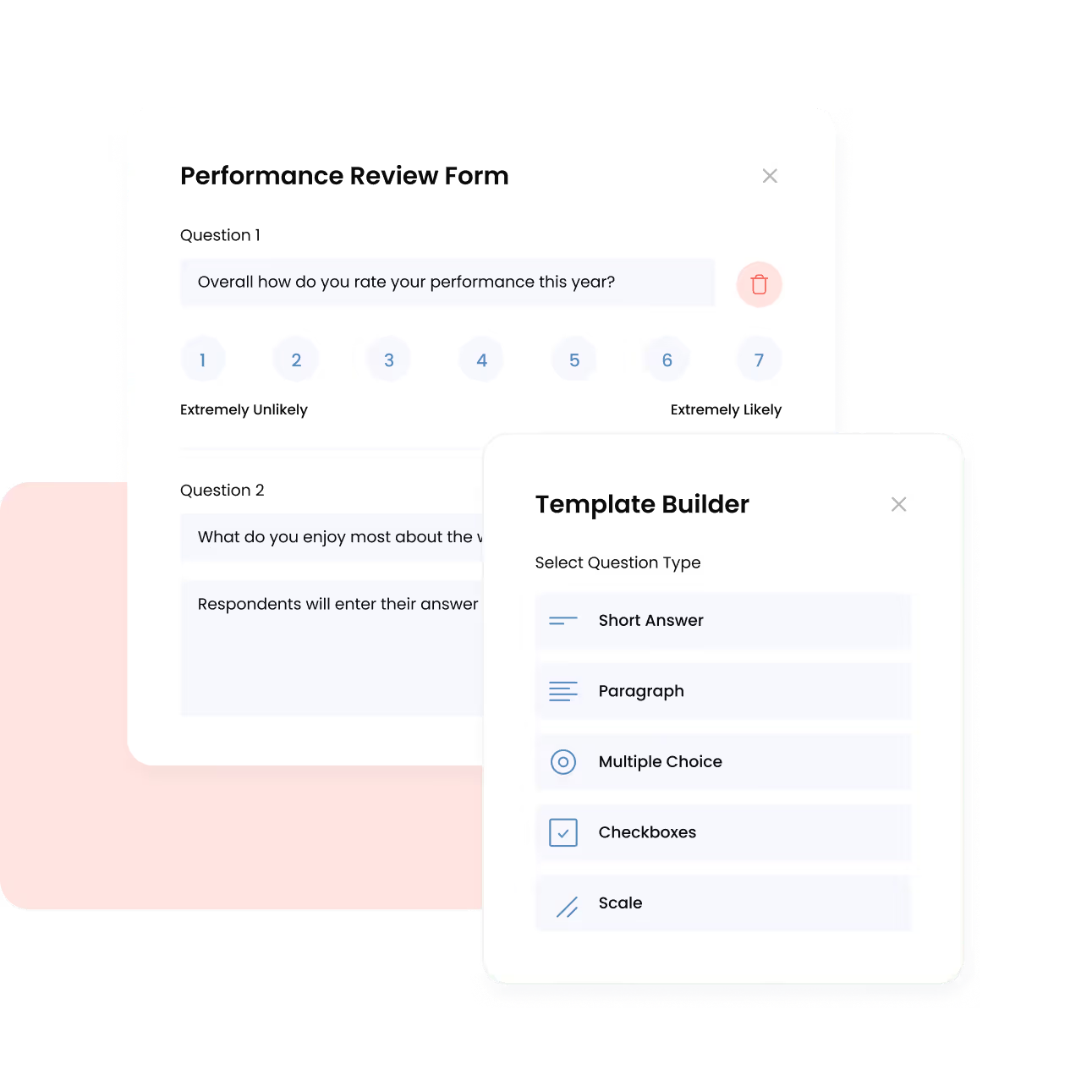
Create role-specific evaluation frameworks that balance quantitative metrics with structured qualitative metrics. Whether you are evaluating engineers, designers, or operations teams, Omni lets you customize templates that reflect what success actually looks like.
Real-time progress tracking and goal alignment
Bridge the performance gap by making success visible throughout the year, not just during annual reviews. With OKR and goal-setting features, employees can see exactly where they stand against agreed-upon objectives, while managers can identify where support is needed before it becomes an issue.
“Because Omni has the progression visualization in OKRs, we can actually go in at a quarter or even a midpoint review before the final review to take a look at where help is needed. We’re able to easily track and notice when an employee is not hitting a KPI and check in to see if they’re facing some barriers. It's a good tool for sense-checking with your team members.”
— Wenna Lee, HR Manager at IHRP
360° feedback and calibration tools
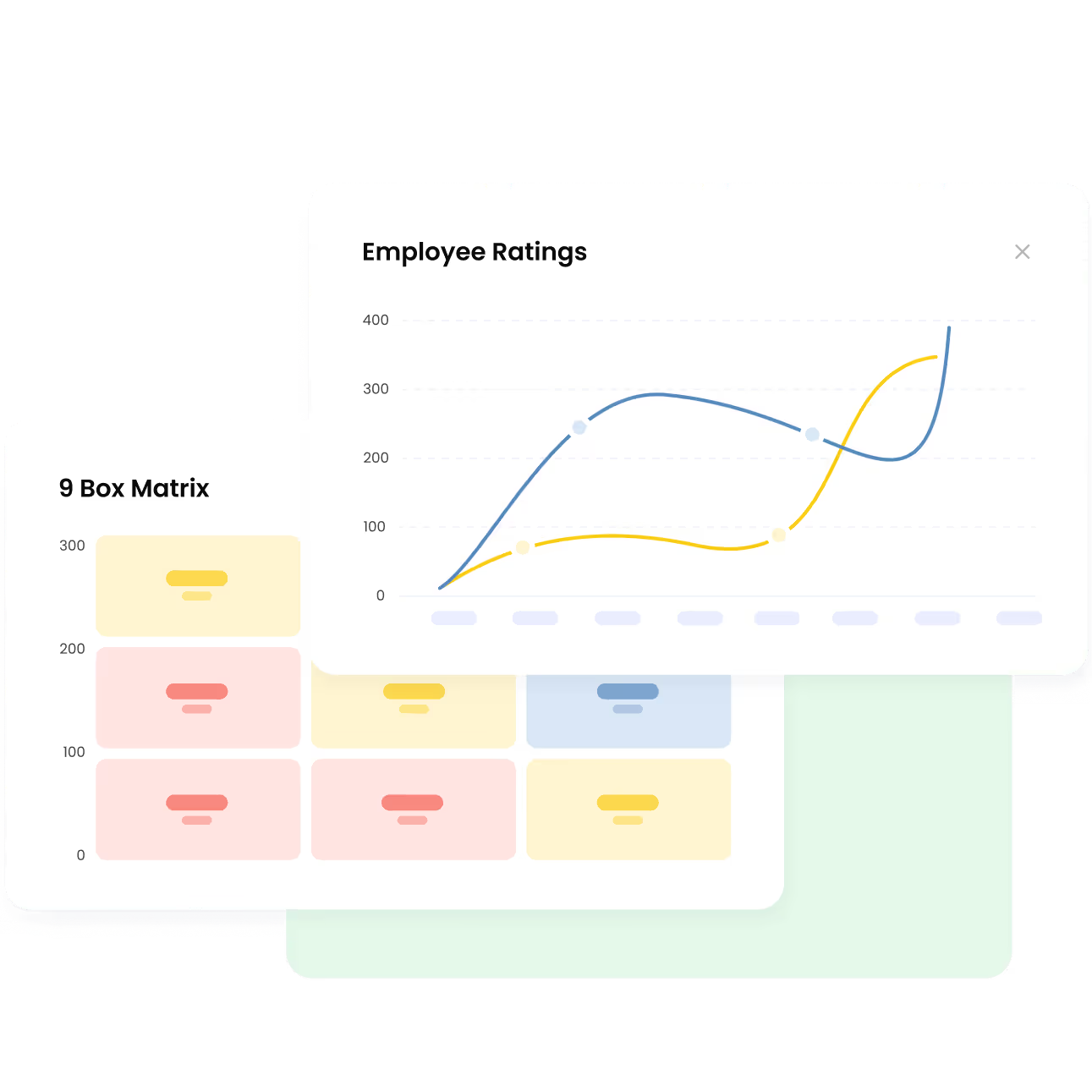
Eliminate affinity bias and visibility bias by collecting structured qualitative metrics from multiple perspectives. 360° feedback ensures that quiet contributors, remote workers, and behind-the-scenes performers get recognized for their true impact, not how visible they are to their direct manager.
Automated workflow and completion tracking
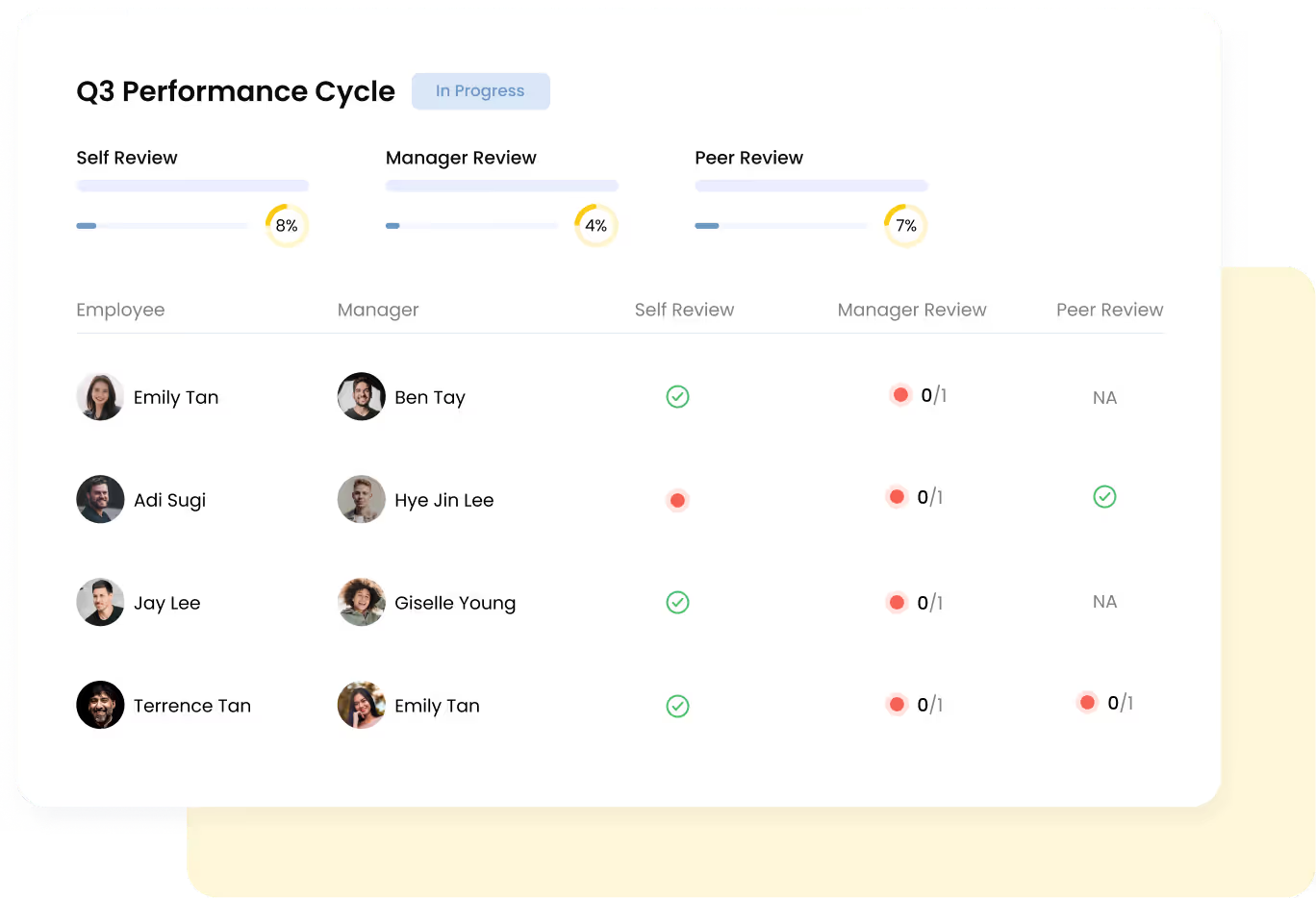
No more last-minute scrambles or lost reviews. Omni automatically routes reviews to the right people, sends reminders, and tracks completion status in real-time, reducing the administrative burden that leads managers to rely on recent memory.
"What's great about Omni is that I can easily see from my end those who have not completed their reviews. With this information, I can either reach out to the employee or their managers to get them to complete it within the approved timeframe."
— Rhoanne Therese Jamelo, HR Generalist at ScaleForge
Built for continuous performance conversations
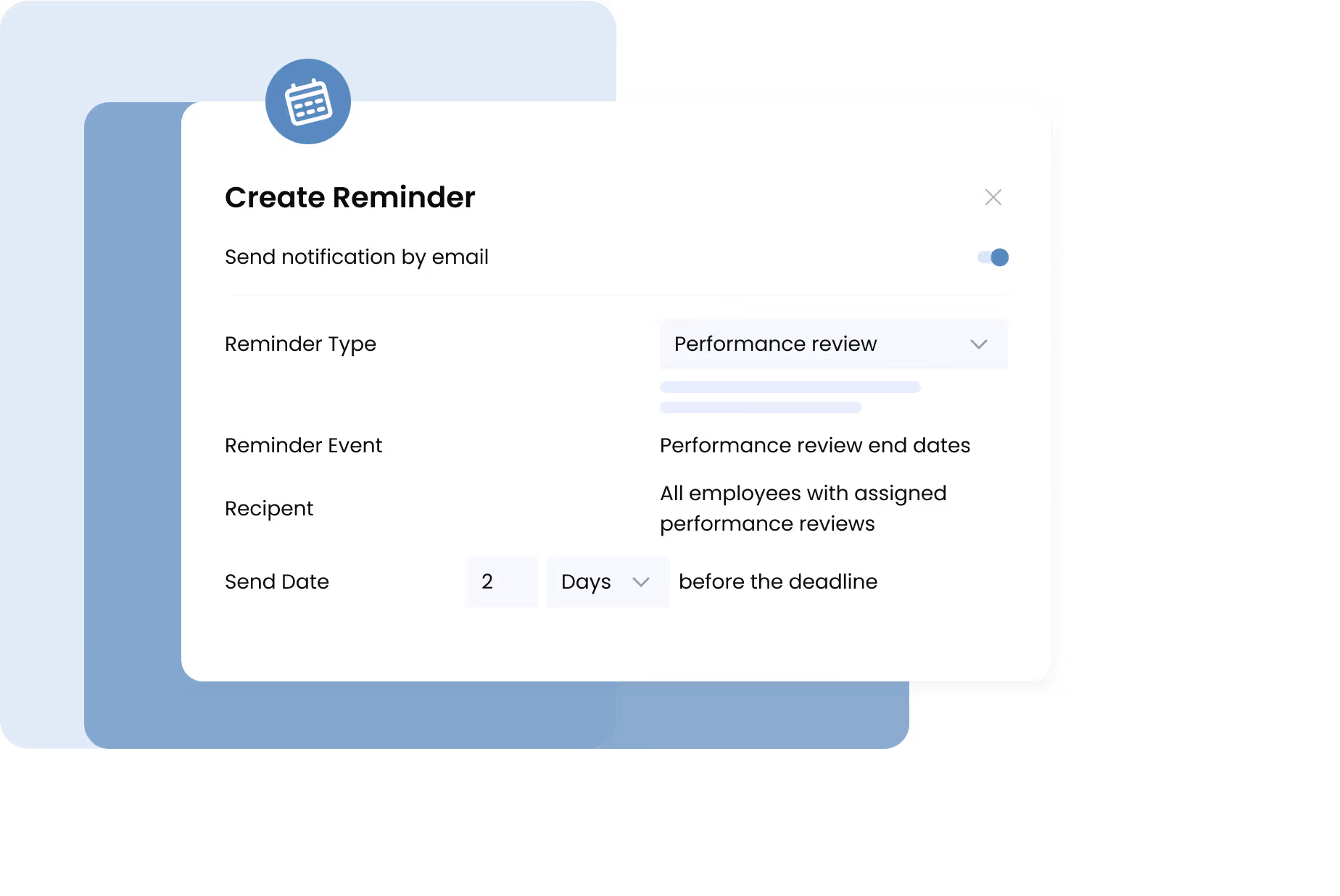
The most effective way to close the performance gap is to make feedback ongoing, not annual. Omni supports regular check-ins, continuous goal updates, and milestone tracking, transforming performance management from a once-a-year event into an ongoing dialogue.
Ready to bridge your performance gaps? See how Omni’s flexible, Asia-built platform can help your growing company evaluate every role daily. Book a demo with our team today.



.avif)
.avif)