.png)
Summary. Skill-based hiring is reshaping the talent landscape in Singapore, yet 74% of employers still struggle to fill roles with the right capabilities. The Career Conversion Programme (CCP) Singapore addresses this gap by helping businesses reskill mid-career talent into growth roles while offering salary support and training subsidies through the CCP grant. With enhanced funding caps of up to 90% salary support and expanded eligibility across 30 sectors, CCP Singapore enables companies to reduce hiring costs, build an agile workforce, and strengthen retention, while empowering employees to transition into future-proof careers. For HR leaders, leveraging the Career Conversion Programme Singapore is a practical way to bridge skill shortages, meet manpower needs, and future-ready their workforce.
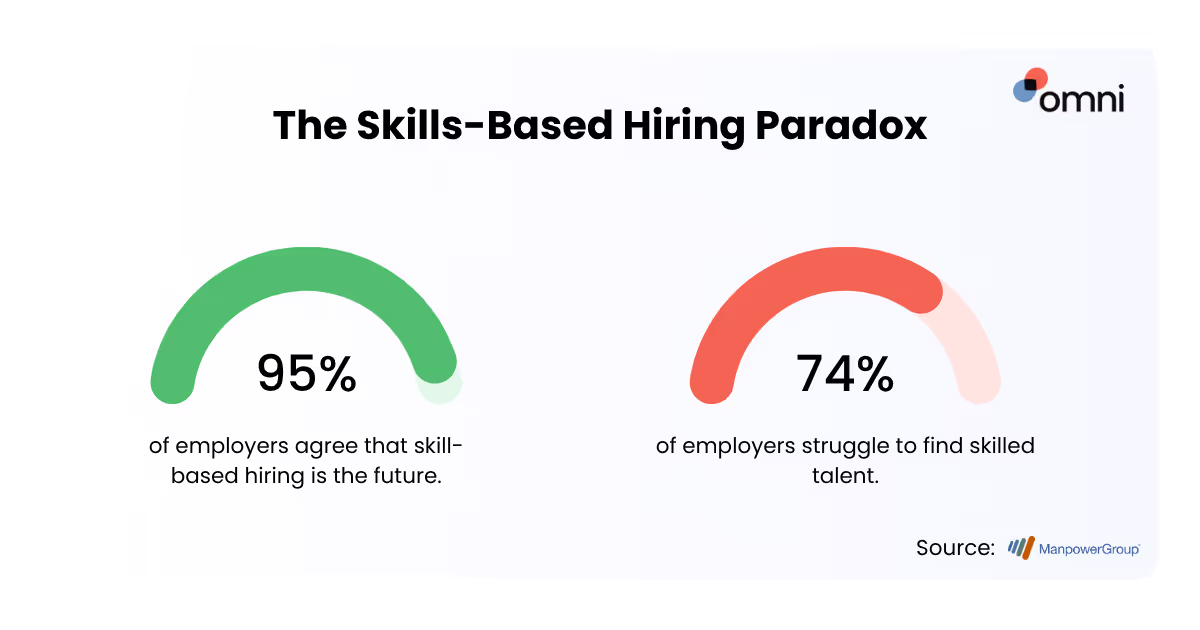
CCP Singapore is becoming increasingly relevant as an overwhelming 95% of employers agree that skill-based hiring is the future. Rather than fixating on degrees and credentials, HR managers are prioritising candidates with demonstrated abilities, whether gained through self-learning, bootcamps, or hands-on projects. But with this shift comes a problem: 74% of employers struggle to find skilled talent. This talent shortage poses a challenge: how do you bridge skill gaps to meet manpower needs while managing costs?
The Career Conversion Programme Singapore is an effective solution. It’s designed to help businesses broaden their talent pool by reskilling employees into new roles. In this guide, we break down the essentials of CCP Singapore, including its benefits, support levels, eligibility requirements, and how to apply for it.
What is the Career Conversion Programme (CCP) Singapore?
The Career Conversion Programme Singapore is an initiative by Workforce Singapore (WSG) designed to help workers gain skills to transition into new careers. Through CCP Singapore, employers receive salary support and training subsidies to either hire mid-career jobseekers or reskill existing employees into new job roles with good, longer-term prospects.
This means businesses can fill skill gaps more quickly, reduce hiring costs, and even consider candidates who may not initially meet every requirement, as they can bridge the skill gap through on-the-job training.
Employees aren’t left out. CCP Singapore supports mid-career workers in transitioning into growth sectors, such as healthcare, ICT, Manufacturing, and early childhood education, even if they lack prior industry experience.
To make the programme more impactful, the Ministry of Manpower (MOM) announced enhancements in 2024. Salary support caps were raised: from S$6,000 to S$7,500 per month for long-term unemployed workers eligible for up to 90% salary support, and from S$4,000 to S$5,000 per month for other participants eligible for up to 70% support. This increase further alleviates the bulk of training costs for employers and reduces financial risks.
Eligibility also widened: The Career Conversion Programme no longer only covers workers in vulnerable jobs but now includes any employee being reskilled into growth jobs under the Industry Transformation Maps (ITMs) or Jobs Transformation Maps (JTMs). This means workers don’t need to wait for their jobs to be threatened; they can move into future-proof sectors earlier and thrive.
Today, WSG offers the CCP grant across about 30 sectors, and its impact is clear: Over the past five years, nearly 7,000 employers and more than 37,000 workers have benefited from the scheme.
Read next: Top SME Grants in Singapore for 2025: PSG, BGP and More Explained
Key Features & Structure of CCP Singapore
Below, we examine the different aspects of the CCP programme.
Types of CCP
CCP offers three modes, depending on your business needs:
- Place-and-Train: You hire the mid-career individual and train them for the new role.
- Attach-and-Train: Participants receive industry-relevant training and work attachments first. After the training, you may hire eligible trainees who meet your performance standards.
- Redeployment / Job Redesign (JR) Reskilling: For existing employees whose roles may be at risk, this mode allows you to reskill them into growth roles within your company. It helps them stay relevant and adapt to organisational changes and evolving business needs.
Structure & Duration
The Career Conversion Programme Singapore typically comprises a structured On-the-Job (OJT) training delivered by hiring employers and external training providers. Its duration ranges between three and six months, depending on the programme and job requirements.
Participant Duties
For CCP Singapore to drive impact, everyone involved, including trainees, employers, and government/ programme partners, has a role to play. Here’s a quick look at what’s expected from each side:
Trainees
- Commit to training: Actively participate in both formal courses and on-the-job learning.
- Job mobility: Be willing to switch from their previous roles to new ones, even if they’re in a different sector.
- Adhere to CCP Singapore requirements: Trainees must not be shareholders, related to the company owners, or already enrolled in other WSG-funded programmes.
- Apply new skills: Practice what they’ve learned to succeed in new or redesigned roles and contribute to Singapore's economy.
Employers
- Provide job or placement opportunities: Hire or reskill mid-career talent into growth roles under CCP Singapore.
- Support training: Offer structured on-the-job training, mentorship, and guidance.
- Co-fund government aid: Use WSG’s salary support to offset training costs and salaries while co-funding the remaining salary.
- Ensure job placement: Place trainees in growth roles with longer-term prospects after training.
Government/Program partners
- Ease costs: Offer salary support and training subsidies.
- Design training frameworks: Develop industry-relevant CCP tracks that align with career trajectories.
- Maintain standards: Monitor programme quality so both employers and employees benefit.
- Facilitate partnerships: Connect employers with training providers and industry bodies for smooth connections.
CCP Grant
The CCP Grant provides employer funding through two tiers of salary support to encourage workforce training and development.
Under the standard rate, employers can receive up to 70% of an employee’s monthly salary for the duration of the training, capped at S$5,000 per month.
With the enhanced rate, the support increases to 90% of an employee’s monthly salary, capped at S$7,500 per month, which is available for long-term unemployed citizens or PRs, as well as mature citizens or PR trainees.
Eligibility & Requirements for Employers and Trainees
Participating companies and mid-career individuals must meet these requirements to qualify for the CCP Singapore:
Employer eligibility criteria
Place-and-Train and JR Reskilling
- Be registered or incorporated in Singapore.
- Offer an employment contract that is either permanent or at least one year long and directly related to the CCP role, with a salary that matches market rates.
- Commit to the CCP Singapore training arrangements for the selected mid-career individuals.
- Commit to working with WSG or its appointed partners on CCP administrative requirements.
- For JR Reskilling CCPs, submit your business transformation plan to the appointed programme partners for evaluation.
- May offer either full-time or flexi-load working arrangements (e.g. part-time employment) that are eligible under CCP support.
Attach-and-Train
- Be registered or incorporated in Singapore.
- Offer full-time attachment roles directly relevant to identified Attach-and-Train CCP jobs.
- Commit to the training arrangements of this mode.
- Commit to working with WSG or its appointed partners on CCP administrative matters.
Trainee eligibility
The mid-career individuals must be:
- A Singapore Citizen or Permanent Resident.
- Minimum 21 years old.
- Graduated or completed National Service for at least two years.
- For new hires, the CCP job role must be significantly different from their previous roles.
- For existing hires, the new role must be a growth job listed under ITM or JTM.
- While CCP Singapore generally requires career conversion, individuals who have not been employed for at least two years before the programme may apply for roles similar to their previous jobs.
Besides the general criteria, some CCPs may have course-specific or employer-specific requirements. In general, applicants should not be shareholders, recent ex-employees of the company or related entities, or relatives of the company’s shareholders. Additionally, they must not be enrolled in other government-funded programmes during the CCP training.
How to Apply for CCP Singapore
- Visit the WSG Career Conversion Programme portal to find the programmes that best suit your company’s needs and employees' career paths.
- Register your interest by filling out the CCP interest form. A programme partner will follow up on your submission.
- Submit the required documentation, including your company registration documents, employment contract, employee details, proposed OJT training schedule, and your business transformation plan if you’re going for the redeployment CCP.
Key Benefits of CCP for Employers
Enrolling employees for the CCP Singapore offers businesses these perks and more:
Cost savings
With CCP Singapore, you don’t have to bear the full cost of reskilling. As mentioned, the Career Conversion Programme provides salary support of up to 90% for three to six months, along with funding to offset training fees and remuneration. This takes a huge financial commitment off your budget, so you save on both training and recruitment costs while still building an agile workforce.
Access to a broader talent pool
CCP Singapore expands your hiring options beyond candidates who fully meet the job requirements. With the training support, you can consider talent who may not have direct work experience, but bring transferable skills and are willing to learn. This helps you fill positions faster with greater flexibility. For example, a manufacturing company may hire a professional from a different industry and reskill them into a growth role.
Upskilled workforce
CCP Singapore equips employees with practical, role-specific skills that prepare them to confidently take on new or redesigned positions within the company. This gives you a competent workforce that meets evolving business and industry demands while supporting employee growth.
Improved employee loyalty/retention
According to Gallup, “career growth opportunities" is the number one reason people give for changing jobs. Deloitte adds that 66% of workers prefer to join and stay with organizations that value their skills over credentials. The message is clear: When employees don’t see growth, they start looking elsewhere. But the Career Conversion Programme Singapore helps you avoid such cases. Through structured reskilling and career development, your employees gain new opportunities, giving them stronger reasons to stay loyal and committed to your company.
Employer branding
By participating in CCP Singapore, your company shows a commitment to employee growth. This strengthens your reputation in the job market as a supportive employer compliant with Singapore’s national initiatives. The result? You’ll find it easier to attract and retain top talent who value learning and long-term career growth.
Relevant reading: The Employer's Guide to Singapore's Overseas Market Immersion Programme
Challenges & Risks in Implementing CCP Singapore
Identifying quality training partners
While the Career Conversion Programme Singapore offers structured reskilling pathways, some programme providers may not fully understand your industry-specific needs. This can result in generic training that doesn’t give your employees the exact skills they need to thrive in their roles.
To get the best results, carefully evaluate providers and confirm their training content and delivery match your company's goals and workforce needs.
Ensuring trainees transition successfully into roles
Though the CCP provides structured training, employees may still find it difficult adjusting to new job scopes and workplace cultures, especially if they’re moving from different industries.
Without the right support, both employers and employees risk missing out on the full benefits of the CCP grant. Employers must therefore provide on-the-job support and clear career pathways to help new hires apply their skills confidently.
Learn more: How to Build an Employee Development Program
Managing commitment (salary, job guarantee) risks
Under the Career Conversion Programme Singapore, employers are required to provide fair wages and offer trainees at least a year-long role. While this is an essential investment in talent, it can be risky, especially since new hires may take longer to adjust or even struggle in their roles. The best way to cushion this risk is to support employees with guidance and patience as they grow into their positions.
Monitoring compliance and reporting requirements
Employers must keep detailed records of CCP training plans, trainee progress, salary payments, and other vital paperwork. This can be an additional workload for HR teams who already juggle daily tasks. In extreme cases, employees may be burnt out and miss crucial deadlines, which can cause delayed CCP grant fundings or trigger compliance wires.
Best Practices to Maximise CCP Singapore Grant Success
Implementing CCP Singapore requires thoughtful planning. Without the right approach, you may face mismatches between business goals and trainee outcomes. Here are the best practices to get the most out of the programme:
- Identify roles likely to face future shortages or transformation and reskill workers early for smoother conversion.
- Design training and OTJ schedules effectively with SMART goals and milestones to track progress effectively.
- Assign mentors, managers, and teammates to help mid-career trainees adjust and settle into their new roles.
- Track key metrics like performance, retention, satisfaction, and ROI to see what’s working.
- Provide regular feedback and check-ins so trainees feel supported and stay motivated throughout the programme.
- Maintain accurate records of training logs, contracts, and payroll to meet compliance and reporting requirements.
CCP vs Other Singapore Grants
Unlike other Singaporean upskilling initiatives, such as the Workforce Skills Qualifications (WSQ) and SkillsFuture, which focus mainly on skills training, the Career Conversion Programme Singapore goes a step further. It combines structured training and job placement to equip employees with hands-on experience for full career transitions.
CCP is preferable when you need to fill roles faster by hiring or reskilling mid-career talent into new or redesigned roles. SkillsFuture and WSQ can serve as supplementary support, as they’re great for improving specific skills without switching careers. When combined, CCP and these schemes complement each other: SkillsFuture and WSQ offer continuous learning while CCP drives career mobility.
How Omni HR Supports CCP Singapore Management
Managing the Career Conversion Programme can be complex, from tracking training progress to ensuring compliance with CCP grant claim requirements. Omni helps streamline this process by providing end-to-end visibility and automation across the entire employee lifecycle.
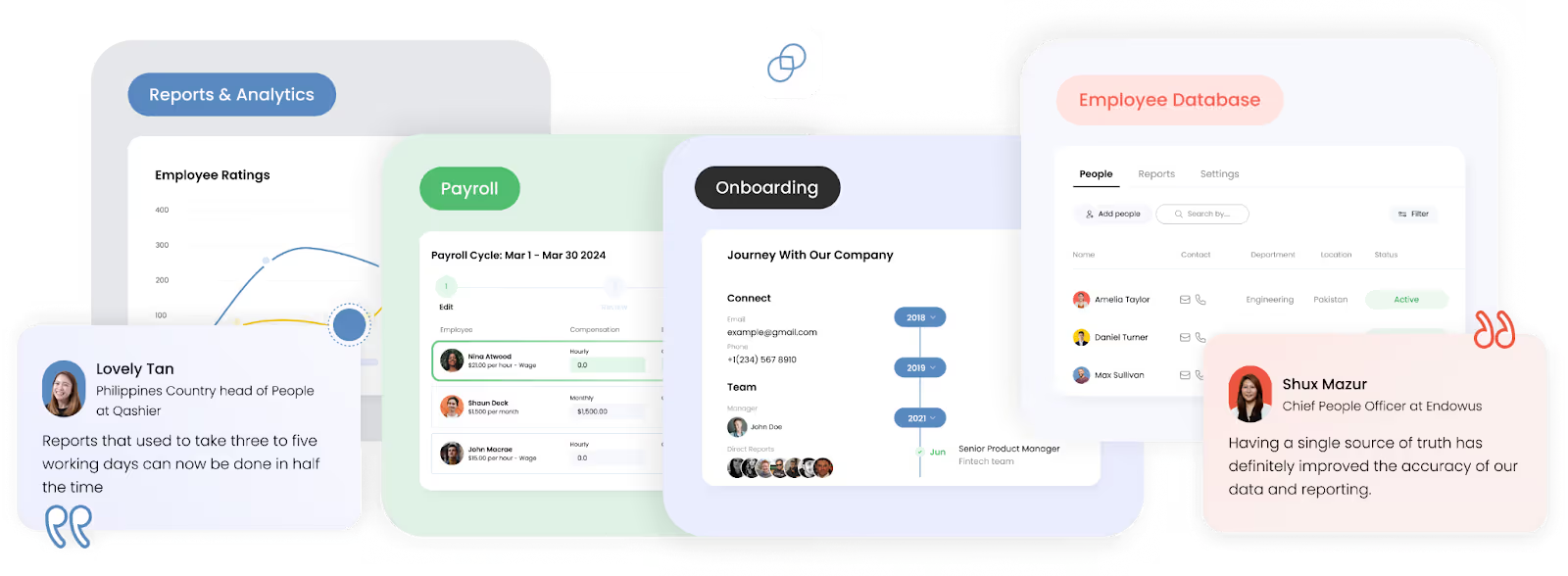
- Tools for tracking trainee progress and outcomes: With Omni, HR teams can monitor each trainee’s development through the employee dashboard. Managers can log performance milestones, skill assessments, and completion status to ensure participants are meeting training objectives and successfully transitioning into their new roles.
- Document management made simple: CCP requires employers to maintain proper documentation — from training contracts and assessments to OJT logs. Omni’s centralised document management makes it easy for HR to store these files, stay audit-ready, and meet WSG’s reporting requirements without drowning in paperwork.
- Budget vs. actual insights: Omni’s reports and analytics dashboards give HR and Finance teams shared visibility into salary support, training subsidies, and internal costs. This allows companies to track CCP grant claims against actual spend, forecast ROI, and plan workforce budgets more effectively.
- Workflow automation for compliance and reporting: Omni automates repetitive administrative tasks, such as sending reminders for claim submission deadlines, triggering compliance checks, and generating reports for WSG or internal stakeholders. This reduces the risk of missed deadlines, ensures smoother grant disbursement, and frees HR teams to focus on supporting employees.
By integrating these tools, Omni not only simplifies CCP Singapore management but also ensures employers maximise the programme’s benefits while minimising administrative overhead.
.png)