




















.png)
Summary. Q4 2026 is a busy quarter for HR compliance across APAC. On 1 October, two deadlines arrive at once: Thailand's Employee Welfare Fund finally goes live, and Malaysia retires its old SOCSO submission format. In Australia, health and care employers need to reclassify staff, not just update payroll rates. In Indonesia, a new Manpower Law is due by 31 October with major changes to contracts, outsourcing, and severance. The Philippines has regional minimum wage increases in December, the UAE's Emiratisation target is due by year-end, and Singapore is in its final preparation year before the Workplace Fairness Act takes effect. Hong Kong is in its first full year of two significant employment law changes. Here's your market-by-market guide.
What Are the Key HR Compliance Changes in APAC for Q4 2026?
The major Q4 2026 compliance changes across APAC are:
- Australia: HPSS Award new classification structure and first pay increase for health professionals; SCHADS Award ~15% interim pay rise for Schedule E home care disability workers — both from first full pay period on or after 1 October 2026
- Hong Kong: First full enforcement year of the 468-rule and MPF offset abolition — ongoing compliance, not a transition
- Indonesia: New standalone Manpower Law expected by 31 October 2026; fixed-term contracts, outsourcing, and severance rules all under revision
- Malaysia: PERKESO retires the old SOCSO single-Act text file format — new combined SOCSO + EIS format mandatory from 1 October 2026
- Philippines: Bicol Region (Region V) minimum wage second tranche — non-agriculture daily rate rises to PHP 480 from 1 December 2026
- Singapore: Workplace Fairness Act preparation — Q4 is the last full year before enforcement begins around end-2027
- Thailand: Employee Welfare Fund mandatory contributions begin 1 October 2026 for employers with 10+ employees
Q4 2026 Compliance Snapshot
Australia
Key Updates
- HPSS Award — new classification structure and first pay increase for health professionals — first full pay period on or after 1 October 2026
- SCHADS Award — ~15% interim pay rise for Schedule E home care disability workers — first full pay period on or after 1 October 2026
What is changing under the HPSS Award from October 2026?
The Fair Work Commission finalised a new classification structure and minimum pay rates for health professionals under the Health Professionals and Support Services Award 2020 (HPSS Award) in its decision [2026] FWCFB 123, handed down 26 May 2026.
The changes take effect from the first full pay period starting on or after 1 October 2026, following a gender-based undervaluation review that found health professionals had been systematically underpaid.
This is not a standard rate update. The entire Level 1 classification structure for health professionals is replaced, and the new minimum rates then phase in over five annual stages. The first increase will happen on 1 October 2026 and further increases every 30 June 2027 through 2030.
What do employers need to do under the HPSS Award?
The new structure is built on qualifications and experience rather than job titles, which means every health professional covered by the Award must be reviewed and reclassified against:
- The standard minimum qualification for their profession, referenced to Australian Qualifications Framework (AQF) levels set out in the new Schedule B
- Years of experience in the relevant profession (not tenure with current employer)
- Duties performed
This reclassification exercise needs to be completed before the October pay period. Employers who skip it are not just missing a rate update, they are potentially applying the wrong classification from the first day of the new structure.
Note: Some changes to dental assistants and pathology collectors under the HPSS Award already commenced from 1 April 2026. If those roles have not yet been reviewed, that shortfall is already accruing.
What is changing under the SCHADS Award from October 2026?
In a separate decision ([2026] FWCFB 137, handed down 1 June 2026), the Fair Work Commission addressed gender-based undervaluation of work in the social, community, home care, and disability services sector. Home care disability workers employed under Schedule E of the SCHADS Award receive an interim pay increase of approximately 15% from the first full pay period on or after 1 October 2026.
A complete structural overhaul — replacing Schedules B, C, E, and F with a single integrated Final Classification Structure — follows for all SCHADS employees on 1 October 2027.
Action required:
- HPSS: Complete staff reclassification before the October pay period; confirm each employee's AQF qualification level, years of relevant professional experience, and duties against the new structure
- SCHADS: Model the wage cost impact of the ~15% Schedule E increase and update payroll from the first full pay period on or after 1 October 2026
- Monitor the Fair Work Commission case page for any final determination amendments before running the updated payroll
- Begin planning now for the October 2027 SCHADS reclassification project as translating every award employee into the new structure is a significant exercise that will not happen quickly
For official award determinations and current pay rates, refer to the Fair Work Commission and the Fair Work Ombudsman.
Hong Kong
Key Update
- 468-rule and MPF offset abolition — first full enforcement year
What are the ongoing obligations employers need to manage in Q4?
Hong Kong entered 2026 with two significant employment law changes already in force, and Q4 is the quarter where initial compliance adjustments have had months to bed in, making it the right time to confirm everything is working correctly.
The 468-rule (effective 18 January 2026):
The Employment (Amendment) Ordinance 2025 replaced the previous "418" continuous contract test with a new "468" rule.
Under the new standard, an employee qualifies for continuous contract protection if they work at least 68 hours across any four consecutive weeks. Previously, the test required at least 18 hours per week for four consecutive weeks, which excluded many part-time workers.
The practical impact is significant. Workers who previously failed the weekly 18-hour threshold but worked 68 or more hours across the same four-week period are now entitled to continuous contract benefits, including annual leave, sick leave, maternity and paternity benefits, severance pay, and long-service payments. These protections can no longer be withheld simply because hours were distributed unevenly across the month.
The MPF offset abolition (effective 1 May 2025, now fully in force through 2026):
Employers can no longer use Mandatory Provident Fund employer contributions to offset severance payments (SP) or long-service payments (LSP). These obligations must now be funded directly from company resources. Any termination occurring in 2026 must be calculated without applying the MPF offset — employers who have not updated their termination cost models should do so now.
Read more: Understanding Hong Kong's 2025 MPF Offset Changes
Action required:
- Confirm your payroll and HR systems track cumulative hours over rolling four-week periods, not just weekly hours
- Audit part-time and variable-hours workers to identify anyone now qualifying for continuous contract benefits who was previously excluded
- Update termination cost calculations to reflect the MPF offset abolition — severance and long-service payments are now funded entirely from employer resources
- Ensure employment contracts, offer letters, and internal HR policies reflect the current rules
For guidance on continuous contract obligations and MPF requirements, refer to the Labour Department and the MPFA.
How Omni Helps
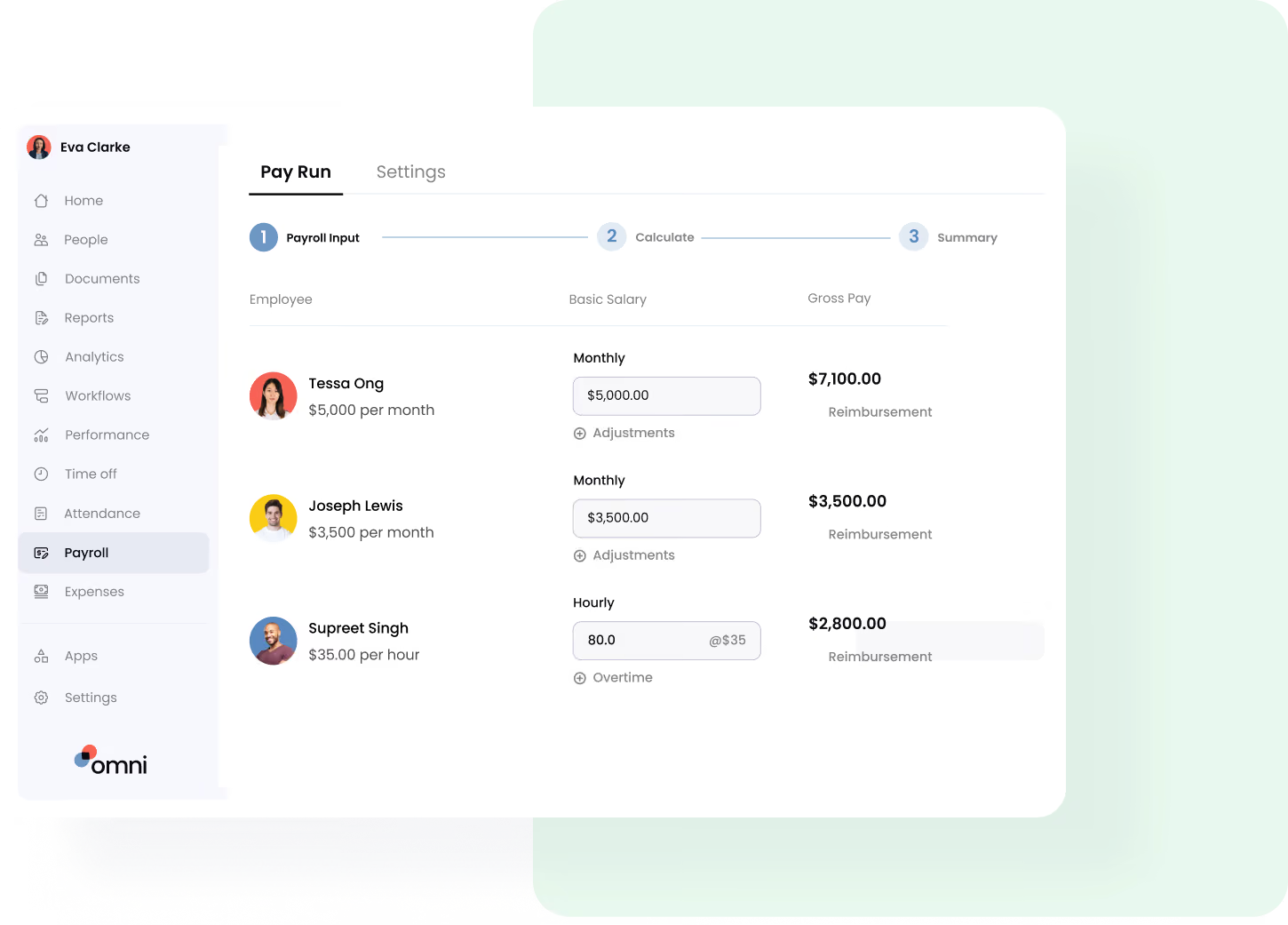
Omni's Hong Kong payroll manages MPF contributions and tracks employee eligibility automatically. Use our MPF calculator for quick contribution checks, and set up automated alerts for employees approaching continuous contract thresholds under the new 468-rule.
Indonesia
Key Update
- New standalone Manpower Law — Constitutional Court deadline 31 October 2026
What is the new Manpower Law and why is it happening?
Indonesia's employment framework is undergoing its most significant overhaul in over two decades. In Decision No. 168/PUU-XXI/2023, handed down on 31 October 2024, the Constitutional Court found that the employment provisions within the 2023 Job Creation Law conflicted with the original 2003 Manpower Law and with the Constitution. It gave lawmakers two years to separate those provisions into a dedicated standalone Manpower Law, with a hard deadline of 31 October 2026.
Indonesia's House of Representatives confirmed in July 2026 that Commission IX was fast-tracking deliberation on the bill, which spans 19 chapters and 224 articles. The government has publicly targeted October 2026 as the completion date, and the President has directed the Ministry of Manpower (Kementerian Ketenagakerjaan) to ensure the law is signed before the deadline.
What is the new law expected to cover?
The direction of the legislation has been clearly signalled through the deliberation process, and the already-in-force Ministerial Regulation No. 7 of 2026 has begun narrowing outsourcing ahead of the new law. Employers should prepare for changes across several key areas:
- Fixed-term contracts (PKWT): The current five-year maximum duration is under discussion for reduction, partly in line with Indonesia's labour commitments under its trade agreement with the United States. HR teams with workers on rolling fixed-term contracts should review their exposure now.
- Outsourcing arrangements: Building on Regulation 7/2026 which already restricts outsourcing to supporting functions and requires user companies to ensure provider compliance, the new law is expected to narrow permissible outsourcing further. Administrative sanctions apply for violations under the current regulation.
- Severance and termination: The law is expected to restructure termination procedures around bipartite negotiation, and revise severance, service pay, and termination compensation formulas.
- Foreign worker requirements: Prioritisation of Indonesian workers before expatriates, and tightened work permit (RPTKA) and stay permit (KITAS) obligations, are expected to be codified.
- Wage structures: Sectoral minimum wages, determined at the provincial and district/city level, are expected to be reinforced in line with the Constitutional Court's restoration of those protections.
Read more: Indonesia Employment Law Explained
Action required:
- Audit your fixed-term contract portfolio and flag agreements approaching or exceeding current limits
- Review all outsourcing arrangements against the already-in-force Regulation 7/2026
- Ensure HR and legal teams are ready to assess and respond quickly once the law is signed — implementing regulations will follow, but some obligations may apply immediately
- Monitor Kementerian Ketenagakerjaan for the enacted law, implementing regulations, and official guidance
Malaysia
Key Update
- PERKESO combined SOCSO + EIS text file format mandatory — effective 1 October 2026
What is changing on 1 October 2026?
Malaysia's SOCSO Lindung 24 Jam scheme (formally the Skim Kemalangan Bukan Bencana Kerja) launched on 1 June 2026, extending social security protection to cover employees outside working hours. The scheme and its contribution obligations have been active since mid-year, but Q4 brings a separate and urgent technical deadline: PERKESO permanently retires the old single-Act SOCSO text file format.
From 1 October 2026, all employers must submit SOCSO contribution records using the new combined SOCSO + EIS text file format via PERKESO's ASSIST portal. The old format will not be accepted for October contributions or any submissions thereafter. There are no exceptions and no grace period.
PERKESO encouraged employers to begin using the new format from June 2026 to ensure a smooth transition. If your payroll system or provider has not been updated yet, this is urgent.
What does the new combined format cover?
The new combined file incorporates SOCSO contributions, EIS contributions, and SKBBK (Lindung 24 Jam) contributions in a single submission through ASSIST 2.0. Payroll systems need to generate this file correctly.
What else should employers know about Lindung 24 Jam?
Following a Cabinet decision on 10 July 2026, Lindung 24 Jam participation is now voluntary for Malaysian employees. Employees who opted out during the declaration window (13 July–31 August 2026) should have submitted their "TIDAK MENYERTAI" forms, which employers must retain on file.
Foreign employees remain mandatory contributors at 0.75% of monthly wages in Years 1–2, rising to 1.00% in Years 3–5 and 1.25% from Year 6 onward. The employer's existing SOCSO contribution rate of 1.75% is unchanged.
Action required:
- Confirm with your payroll provider or system that the new combined SOCSO + EIS file format is ready to generate in ASSIST 2.0
- Update employee records to reflect any opt-out declarations received from Malaysian staff
- Ensure you are accurately tracking which employees (particularly foreign workers) remain mandatory SKBBK contributors
- Submit October 2026 contributions using the new format, the remittance deadline is 15 November 2026
For official submission guidance and the latest PERKESO circulars, refer to perkeso.gov.my.
How Omni Helps
Omni's Malaysia payroll automates EPF, SOCSO, and EIS contributions in a single workflow. The combined SOCSO + EIS submission format for ASSIST 2.0 is supported, and Lindung 24 Jam deductions for mandatory contributors are tracked alongside your existing PERKESO obligations.
Philippines
Key Update
- Bicol Region (V) minimum wage second tranche — effective 1 December 2026
What is changing with Philippines minimum wages in Q4 2026?
The Philippines does not operate a single national minimum wage. Regional Tripartite Wages and Productivity Boards (RTWPBs) set wage floors by region, and several 2026 wage orders are structured in tranches with staggered effective dates.
The Q4 headline date is 1 December 2026, when the Bicol Region (Region V) second tranche takes effect, raising the non-agriculture daily minimum wage to PHP 480. Employers with staff in Bicol need this rate in place before the December payroll run.
Also in effect for Q4 from prior tranches:
The Davao Region (Region XI) second tranche took effect on 1 September 2026, raising the non-agricultural daily minimum wage to PHP 540 and the agricultural rate to PHP 525. If you have operations in Davao, confirm that September payroll applied the updated rates.
Looking ahead to January 2027:
NCR employers should also note that the second tranche of Wage Order NCR-27 raises the non-agricultural daily minimum wage from PHP 755 to PHP 780. It will come into effect on 20 January 2027. This affects 13th-month pay calculations for the 2026 tax year and early-year payroll planning for the NCR.
Read next: How to Compute 13th Month Pay in the Philippines
Are there other regional increases to watch?
If your operations span multiple Philippine regions, each location follows its own wage order and schedule. Employers should also be aware of potential wage distortion, where mandatory minimum wage increases compress the gap between salary tiers across an organisation. The NWPC advises proactively reviewing and correcting distortions when new wage orders take effect.
Non-compliance carries penalties including mandatory back wages, administrative fines of up to PHP 100,000 per violation, and the risk of double-indemnity awards for underpayment.
Action required:
- Update payroll for Bicol Region (V) employees to PHP 480/day from 1 December 2026
- Confirm Davao Region (XI) payroll was updated to PHP 540/day from 1 September 2026
- Audit all Philippine regions where you have employees against the current RTWPB wage orders
- Check for and address wage distortion across salary tiers following any minimum wage increase
- Begin planning for the NCR second tranche taking effect 20 January 2027
For the current consolidated wage rate table, refer to the National Wages and Productivity Commission.
How Omni Helps
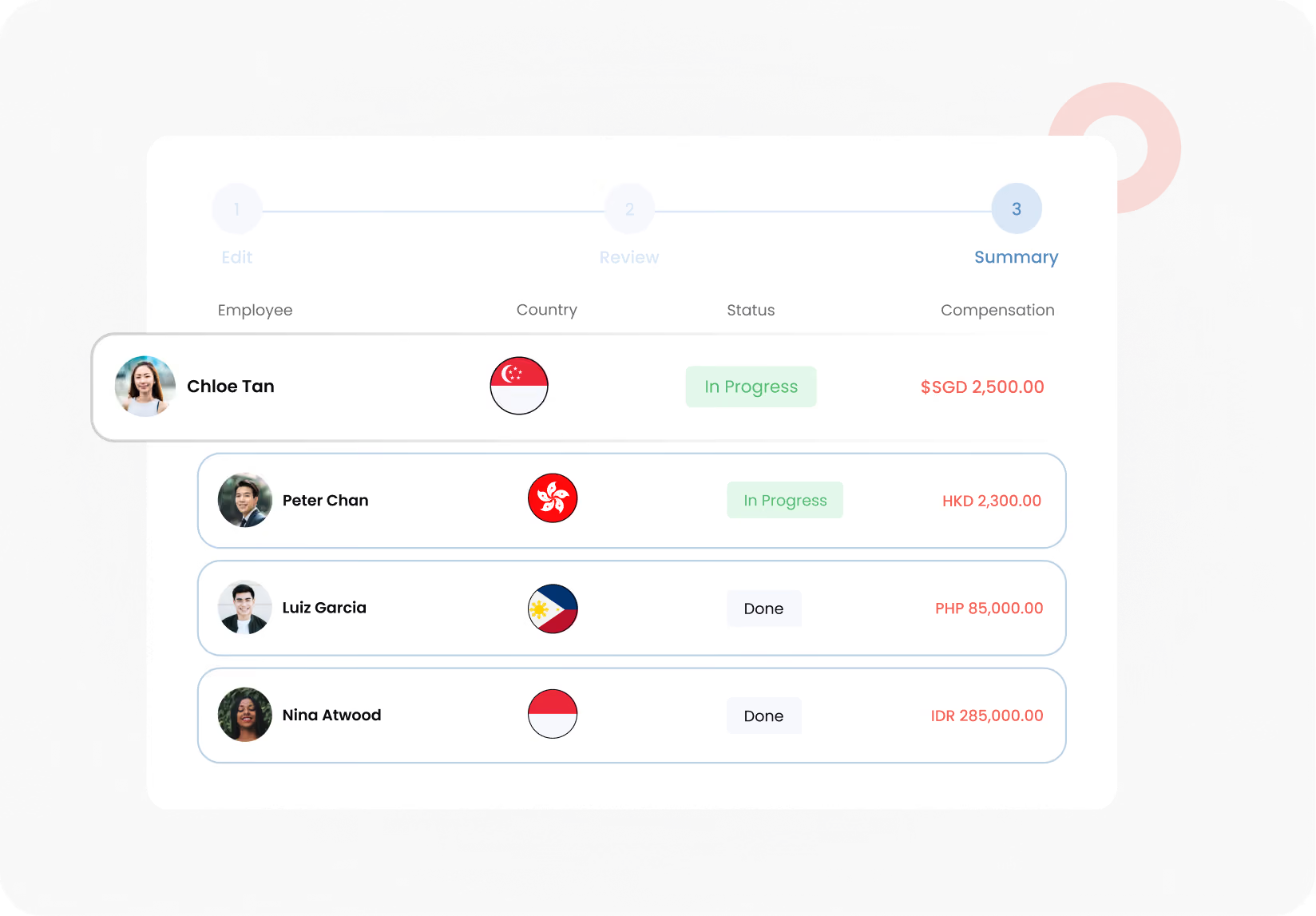
Manage Philippines payroll across multiple regions in one platform, apply the correct regional wage floor per employee location, and generate compliance reports for DOLE audit readiness. Use our SSS calculator for quick contribution checks.
Singapore
Key Update
- Workplace Fairness Act — Q4 2026 is the last full preparation year before enforcement
What is the Workplace Fairness Act and when does it take effect?
Singapore's Workplace Fairness Act (WFA) was passed in two stages:
- Workplace Fairness Bill on 8 January 2025
- Dispute-resolution bill on 4 November 2025
The Act is expected to come into full effect by the end of 2027, giving employers time to review their HR policies, update workplace practices, and prepare for the new workplace fairness requirements.
The WFA applies first to employers with 25 or more employees and covers five protected characteristics: age, sex, marital status, caregiving status, and nationality.
Under the Act:
- Job advertisements must not specify or imply a preference for candidates based on any protected characteristic. For example, a listing that says "Chinese speaker preferred" (where Mandarin proficiency is not a genuine occupational requirement), or screens by age or gender, will breach the WFA
- Interview and hiring decisions must be documentable as free from protected-characteristic bias
- Every covered employer must have a written grievance-handling procedure for workplace fairness complaints, with confidentiality protections for complainants
- Employees who raise complaints are protected from retaliation
Breaches can cost up to SGD 50,000 per violation, with claims heard at the new Tripartite Fair Employment Practices Tribunal. The Tripartite Guidelines on Fair Employment Practices remain enforceable in the interim; the WFA adds statutory teeth and individual legal remedies on top.
Read more: Singapore Workplace Fairness Act 2025: What Every Employer Needs to Know
Use Q4 to:
- Audit job advertisement templates and remove any preferences based on age, nationality, gender, language, or marital status that are not genuine occupational requirements
- Review interview scorecards, shortlisting processes, and promotion frameworks for undocumented bias
- Build or formalise your written grievance procedure with the required confidentiality protections
- Train hiring managers on what the WFA requires and what it prohibits
For the latest guidance on the WFA's commencement timeline and compliance expectations, refer to the Ministry of Manpower and the Tripartite Alliance for Fair and Progressive Employment Practices (TAFEP).
Thailand
Key Update
- Employee Welfare Fund mandatory contributions — effective 1 October 2026
What is Thailand's Employee Welfare Fund?
The Employee Welfare Fund (EWF) is a mandatory savings scheme established under Section 126 of Thailand's Labour Protection Act B.E. 2541 (1998) that provides a lump-sum payment to employees upon termination, retirement, or death. Though the fund was created in 1998, it was never implemented until now.
The Thai Cabinet approved a one-year postponement of mandatory EWF contributions, moving the start date from 1 October 2025 to 1 October 2026. With Q4 approaching, the fund is now live and preparation needs to happen immediately if it hasn't already.
Who must contribute to the Employee Welfare Fund?
Beginning 1 October 2026, both employer and employee must contribute 0.25% of the employee's monthly wages to the EWF. The mandate applies to all private-sector employers with 10 or more employees who do not already operate a qualifying registered provident fund.
Employers must withhold the employee's contribution from monthly wages and remit both shares to the relevant Provincial Office of Labour Protection and Welfare (or the Bangkok Office for Bangkok-based employers) by the 15th of the following month. Late payments attract a surcharge of 5% per month on the unpaid balance.
Does a provident fund exempt you from the EWF?
Yes. Employers who already provide a qualifying registered provident fund under the Provident Fund Act B.E. 2530 (1987) are generally exempt from EWF contributions. If your organisation does not currently offer a provident fund, it is worth evaluating whether to establish one as provident fund contributions carry significant tax advantages for both employers and employees that EWF contributions do not.
Action required:
- Determine whether your organisation is exempt through an existing qualifying provident fund
- If not exempt: register employees with the EWF before 1 October 2026 and update payroll systems for the 0.25% deduction
- Set up monthly remittance to your Provincial Labour Office by the 15th of each month
- Communicate the new payroll deduction to employees ahead of the first affected pay run
- Budget for the additional employer cost in Q4 financial plans
How Omni Helps
We support payroll in Thailand with automated statutory deduction calculations. EWF contribution tracking and remittance reporting for the 1 October deadline are managed within the same payroll workflow, keeping your Labour Protection and Welfare obligations accurate and on time.
Stay Compliant and Confident with Omni HR
Managing simultaneous compliance changes across these markets is exactly where manual processes and legacy systems break down. Q4 is the quarter where compliance preparation and year-end HR operations collide, and falling behind on either creates real risk.
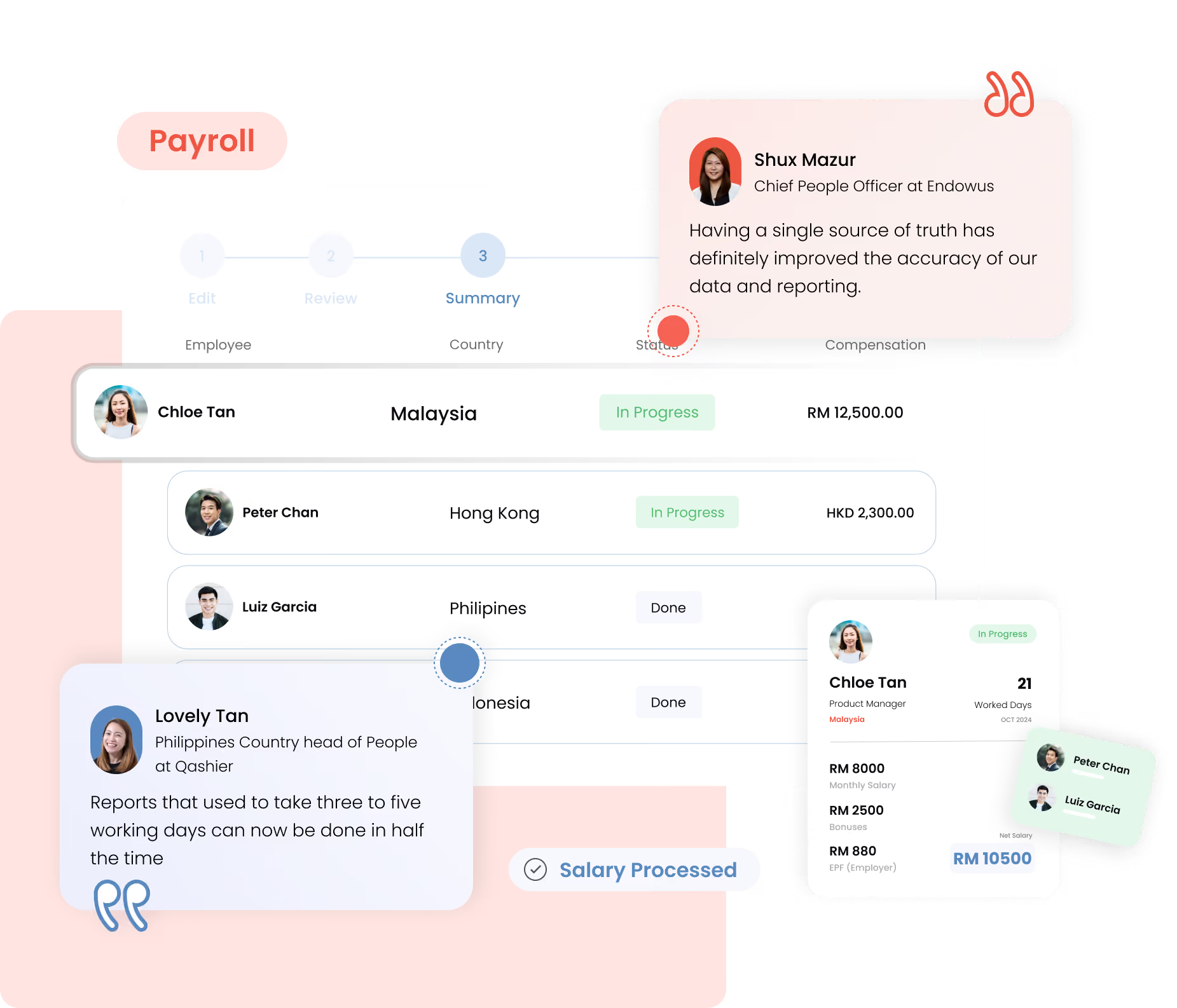
With Omni, your HR and payroll compliance keeps pace with every regulatory change:
- Automated payroll updates reflect statutory rate and threshold changes across all markets
- Real-time dashboards track pass expiries, wage floors, EWF registration, and Emiratisation headcounts
- Multi-country payroll handles combined SOCSO submissions, award rate changes, and minimum wage adjustments in one place
- Workflow automation sends reminders for filing deadlines, statutory submissions, and year-end compliance checkpoints
- Audit-ready reporting for labour inspections, government filings, and internal reviews
Schedule your product tour today and see how Omni can simplify your Q4 2026 APAC HR compliance.
Frequently Asked Questions
Indonesia's new Manpower Law is the most structurally significant development. The Constitutional Court has mandated a standalone law by 31 October 2026, and the bill covers fixed-term contracts, outsourcing, severance, foreign worker requirements, and wage structures, touching virtually every employment arrangement in the country. Employers with fixed-term workers or outsourced staff should begin reviewing their exposure now, without waiting for the final text.
Mandatory EWF contributions begin on 1 October 2026 for all private-sector employers with 10 or more employees. Employers and employees each contribute 0.25% of monthly wages, rising to 0.50% from 2031. Employers who already provide a qualifying registered provident fund under the Provident Fund Act B.E. 2530 are generally exempt.
From 1 October 2026, all employers must submit SOCSO contribution records using the new combined SOCSO + EIS text file format via PERKESO's ASSIST 2.0 portal. The old single-Act format is no longer accepted. Payroll systems that have not yet been updated to generate the new format need to be addressed urgently before the October submission deadline of 15 November.
The HPSS Award introduces a new classification structure and first-stage pay increases for health professionals from the first full pay period on or after 1 October 2026, requiring employers to reclassify staff by AQF qualification and years of experience. Separately, SCHADS Award Schedule E home care disability workers receive an interim ~15% pay increase from the same date, ahead of a full classification restructure in October 2027.
Employers with staff in the Bicol Region (Region V) must update payroll to PHP 480/day for non-agriculture workers by 1 December 2026. Davao Region (Region XI) should already be updated to PHP 540/day from 1 September 2026. NCR employers should also be planning for the second tranche of Wage Order NCR-27, which raises the daily non-agriculture rate to PHP 780 on 20 January 2027.
The Workplace Fairness Act is Singapore's first statutory anti-discrimination law, covering five protected characteristics: age, sex, marital status, caregiving status, and nationality. It was passed in two parts in January and November 2025, and is expected to come into full force around end-2027. Q4 2026 is the last full preparation year for employers with 25 or more staff to audit hiring practices, build written grievance procedures, and train managers.
The 468-rule replaced the old 418 continuous contract test on 18 January 2026. An employee now qualifies for statutory benefits such as annual leave, sick leave, maternity/paternity, severance, and long-service payments if they work at least 68 hours across any four consecutive weeks, even if some individual weeks fall below 17 hours. Employers should confirm their payroll and HR systems are tracking hours on a rolling four-week aggregate basis, not a weekly basis, and that any part-time workers newly qualifying under the rule are receiving their full statutory entitlements.



.avif)
.avif)