

















.png)
Summary. Mid-market companies in APAC, roughly 200 to 1,000 employees, need an HRIS that can handle native statutory compliance across markets like Singapore, Malaysia, and the Philippines, and scale alongside headcount without forcing a re-platforming project down the line. This guide compares 8 HRIS platforms for mid-market APAC, Omni HR, Deel, Paycom, Papaya Global, Oyster, HiBob, Darwinbox, and BambooHR, on statutory compliance depth, HRIS breadth, scalability, implementation cost, and pricing transparency, with a decision framework to help growing companies find the right fit.
For mid-market companies dealing with roughly 200 to 1,000 employees, finding the right HRIS is easier said than done. HRIS for mid-market in APAC must be able to handle native statutory compliance across markets like Singapore, Malaysia, Philippines, Thailand, and scale alongside headcount instead of needing to find another vendor.
In this guide, we compare 8 HRIS for growing companies to help mid-market APAC teams find the right fit.
Note: Omni HR is included in this list. We built this comparison and hold ourselves to the same criteria as every other provider.
How We Evaluated These Platforms
We compared each platform on five criteria that matter most for mid-market HRIS buyers in APAC:
1. APAC statutory compliance
Does the platform calculate and file statutory contributions, tax withholding, and mandated leave natively in the countries where the company employs people, or handle it through an Employer of Record model or third-party partners?
2. HRIS breadth
Does the platform cover the full employee lifecycle, core HR, payroll, attendance, leave, and performance, in one system, or is it built around a narrower use case like global contractor payments?
3. Scalability from 200 to 1,000 employees
Can the platform grow with the company without hitting a wall that forces a re-platforming project at 600 or 800 employees?
4. Implementation cost and speed
What does it take, in time and budget, for a mid-market team without a dedicated systems department to get live?
5. Pricing transparency
Is pricing published, or does it require a sales call to find out?
Ratings are based on publicly available product information, vendor documentation, and pricing pages as of this update. Where a vendor doesn't publish pricing, we note it as "Custom quote" rather than estimating a figure.
Comparison Table: Best HRIS for Mid-Market APAC
The 8 Best HRIS Platforms for Mid-Market APAC
1. Omni HR
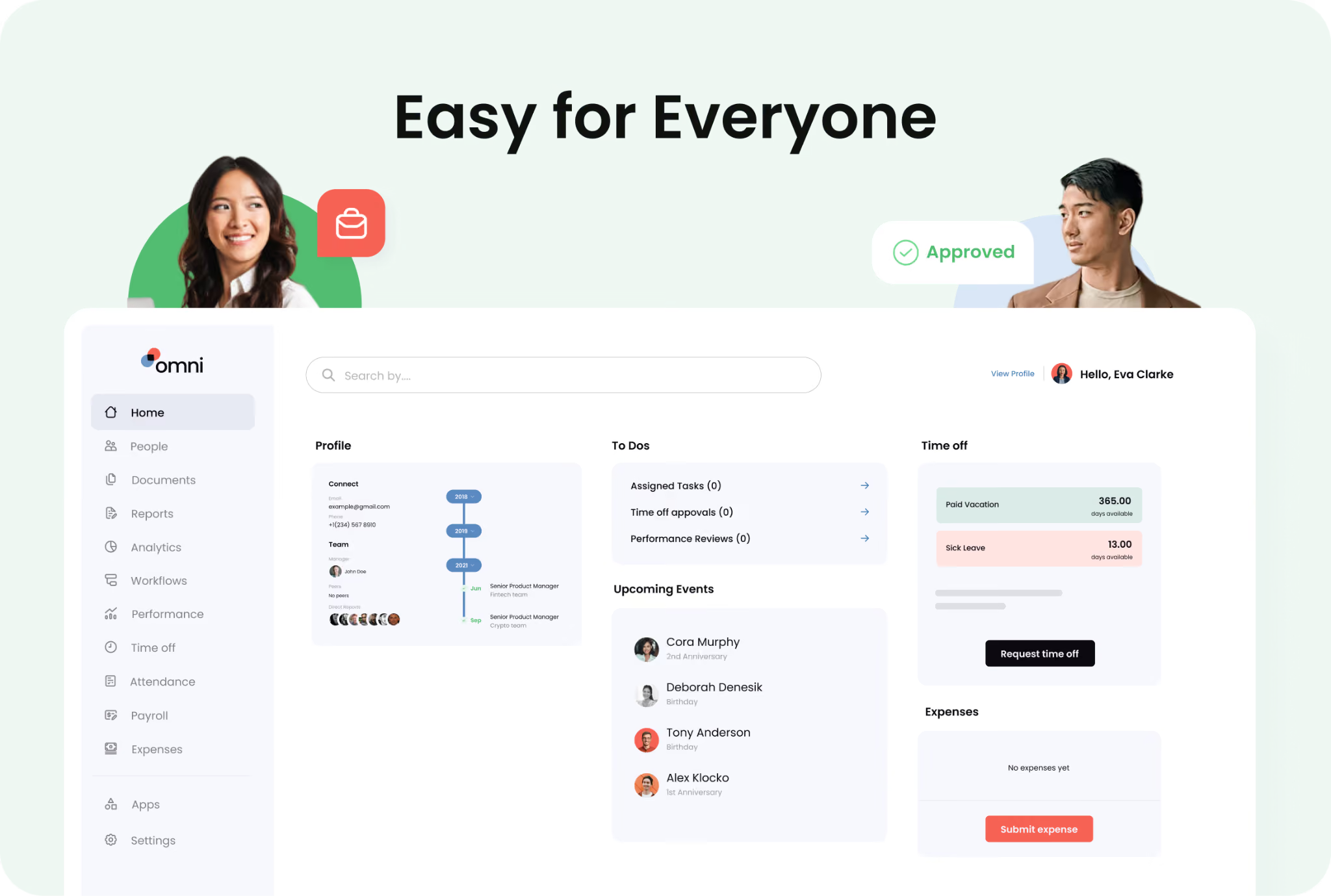
Omni HR is a full-suite HRIS and payroll platform designed for growing companies operating across Asia-Pacific. It combines Core HR, payroll, attendance, leave, performance, recruitment, reporting, and employee self-service in one system, with localized payroll and statutory compliance for key APAC markets including Singapore, Malaysia, the Philippines, Hong Kong, and Indonesia.
Best for: Mid-market companies with employees already established across APAC that want native regional payroll and HR capabilities in one platform.
"If you're growing and want an HR system that's easy to use, practical, and well-supported, Omni is a strong choice."
— Maida Choo, Assistant HR Manager at Hello Human
Key features
- Native EPF, SOCSO, EIS, and PCB support for Malaysia
- Native SSS, PhilHealth, Pag-IBIG, and BIR support for the Philippines
- CPF, SDL, and IR8A support for Singapore
- Payroll and HR data connected in one system
- Core HR, attendance, leave, performance, and recruitment
- Mino, Omni HR's AI agent and Omni HR MCP
- Employee self-service through web and mobile
- Multi-country payroll and multi-currency support
Pros
- Strong native statutory payroll capabilities across key APAC markets
- Full HR lifecycle in one platform
- Payroll draws directly from HR, attendance, and leave data, reducing manual reconciliation
- Designed around the operational requirements of APAC-based companies
Cons
- Best suited to companies with a meaningful APAC workforce rather than organizations seeking a primarily US- or Europe-focused HR platform
- Smaller third-party ecosystem than the largest global HCM vendors
- Enterprises with highly specialized global requirements should confirm country and workflow coverage during evaluation
Pricing: From $3 per employee per month
Find a pricing plan for your budget
2. Deel
Deel is a global workforce platform combining HR, payroll, contractor management, talent, and international employment services. Its HR functionality can also be used independently of its international employment services, making it relevant to companies managing a combination of direct employees and internationally distributed workers. Deel currently publishes pricing for several products, including Deel HR at no charge and Deel Payroll starting at $29 per employee per month.
Best for: Mid-market companies managing a distributed workforce across multiple countries and prioritizing global workforce administration.
Key features
- Core HR and employee management
- Global payroll
- Contractor management
- Benefits administration
- Talent and workforce management
- Compliance workflows
- AI-assisted HR and compliance capabilities
Pros
- Broad international workforce coverage
- Modular product structure
- Strong option for organizations managing different worker types
- Published pricing for several products
Cons
- Its product breadth is centered heavily on global workforce management
- Country-level payroll capabilities should be evaluated individually rather than assumed to be identical across markets
- For companies with established APAC entities, a regionally specialized HRIS may provide deeper local payroll functionality
Pricing: From $5 per employee per month
3. Paycom
Paycom is a US-focused HCM platform that combines payroll, HR, talent, time management, and employee self-service in a single database. Its Beti product uses automation and AI-assisted payroll review to help employees identify and resolve payroll issues before payroll is finalized.
Best for: US-focused mid-market organizations that want payroll, HR, time, and talent management in one HCM platform.
Key features
- Single-database HCM
- Payroll processing
- Time and attendance
- Talent acquisition and management
- Performance management
- Employee self-service
- Beti payroll automation
Pros
- Strong connection between HR and payroll data
- Employee-driven payroll review can reduce payroll corrections
- Broad HCM functionality for US organizations
Cons
- Not designed around native APAC statutory payroll
- Less suitable for companies whose primary requirement is multi-country APAC HR administration
- Pricing requires a sales process
Pricing: Custom quote
4. Papaya Global
Papaya Global is a global payroll and workforce management platform designed to consolidate payroll operations, workforce payments, compliance, and reporting across multiple countries. Its focus is primarily on global payroll infrastructure and workforce operations rather than replacing every HR function in a full HRIS.
Best for: Mid-market and enterprise organizations that need centralized visibility and administration across complex multi-country payroll operations.
Key features
- Multi-country payroll
- Global workforce payments
- Payroll compliance management
- Workforce analytics and reporting
- Integrations with HRIS and finance platforms
- Automation across payroll workflows
Pros
- Strong global payroll orientation
- Centralized visibility across multiple countries
- Useful for finance and HR teams managing fragmented payroll operations
Cons
- Broader HR functionality is not as deep as a full HRIS such as Omni HR, Workday, or Darwinbox
- Local payroll delivery can vary by country
- Pricing is not publicly standardized
Pricing: Custom quote
5. Oyster
Oyster is a global employment platform focused on international workforce management, with Core HR, contractor management, benefits, and employment administration alongside its international hiring services.
Best for: Distributed companies managing employees and contractors across multiple countries.
Key features
- Core HR
- Global employment administration
- Contractor management
- Benefits administration
- Compliance support
- Employee management tools
Pros
- Strong international workforce focus
- Broad country coverage
- Useful for distributed and remote-first organizations
Cons
- Its primary differentiation is global employment rather than deep native HRIS functionality for companies' established APAC entities
- APAC statutory payroll requirements should be assessed market by market
- Pricing is not currently published as a standard HRIS rate
Pricing: Custom quote
6. HiBob
HiBob is a modern HR platform focused on Core HR, employee experience, performance, compensation, engagement, and workforce planning. Its strength is HR administration and employee experience rather than native statutory payroll across APAC markets.
Best for: Mid-market companies that prioritize employee experience, engagement, and configurable HR workflows.
Key features
- Core HR
- Employee engagement
- Performance management
- Compensation management
- Workforce planning
- Configurable workflows
- Bob AI capabilities
- Payroll integrations
Pros
- Strong employee experience
- Good workflow and performance capabilities
- Suitable for growing organizations
Cons
- APAC payroll typically requires integrations or separate local payroll systems
- Not as deeply localized for APAC statutory payroll as regional HRIS platforms
- Pricing requires a sales conversation
Pricing: Custom quote
7. Darwinbox
Darwinbox is an enterprise HCM platform with strong roots in Asia-Pacific, covering Core HR, payroll, talent management, performance, workforce management, employee experience, analytics, and AI-enabled HR workflows. Its platform supports organizations across more than 110 countries, although the depth of payroll localization varies by market.
Best for: Larger mid-market and enterprise organizations with complex HR operations across APAC.
Key features
- Core HR and payroll
- Multi-country HR management
- Recruitment and talent management
- Performance management
- Workforce management
- AI Assistant and HiringX
- Workforce analytics
- Employee self-service
Pros
- Strong APAC enterprise presence
- Broad HCM functionality
- Designed for complex organizational structures
- Strong mobile and employee experience capabilities
Cons
- Enterprise-oriented implementation can be more substantial than a mid-market HRIS requires
- Payroll localization should be confirmed for each country
- Pricing is quote-based
Pricing: Custom quote
8. BambooHR
BambooHR is a Core HR platform aimed primarily at small and mid-sized businesses, with employee records, applicant tracking, onboarding, performance management, time, and employee experience features. Its payroll offering is not designed as a native APAC statutory payroll platform.
Best for: Smaller mid-market companies that want straightforward HR administration and do not have complex APAC payroll requirements.
Key features
- Core HR and employee records
- Applicant tracking
- Onboarding
- Performance management
- Time and attendance
- Employee self-service
- Payroll capabilities in supported markets
- AI-enabled HR functionality
Pros
- Intuitive and relatively easy to adopt
- Strong Core HR and onboarding capabilities
- Large ecosystem and established mid-market presence
Cons
- Limited native APAC statutory payroll coverage
- Companies operating across APAC may need separate payroll systems or integrations
- Less suitable for complex multi-country payroll environments
Pricing:
Choosing the Best HRIS for Your Mid-Market APAC Team
The right platform depends less on which one has the most features and more on whether your company already employs people directly in APAC or is hiring there for the first time.
Book a demo to see how Omni HR handles HR and payroll compliance for growing companies across 10+ APAC markets.
Frequently Asked Questions
The best HRIS for 200–500 employees should provide:
- AI powered by live HR data
- Configurable workflows and approvals
- Multi-level organizational structures
- Advanced reporting and analytics
- The ability to scale across multiple business entities or countries
Platforms such as Omni HR, HiBob, Rippling, and Darwinbox all serve this segment, but the best choice depends on where your employees are located and how complex your HR operations are.
Most mid-market companies stay well-served by an EOR well past their first 50 international hires. The math typically shifts once a single country's headcount reaches roughly 75 or more, at which point EOR fees can approach the cost of setting up and maintaining a local entity.
Not necessarily every country, but it should offer native, not partner-routed, statutory compliance in the specific markets where the company has a meaningful headcount. A platform with deep native coverage in a company's core APAC markets, plus room to add markets as the company grows, generally scales better than one that treats every country as an EOR add-on.
Omni HR assigns a dedicated Customer Success Manager to run the full migration: auditing your data, importing employee records, transferring payroll history, and training your team. That's the biggest factor in how fast implementation goes. Plan for at least one full payroll cycle run in parallel before go-live, since that's standard practice with any vendor.
Omni HR's advantage for a mid-market company expanding across Southeast Asia is a faster rollout than an enterprise platform like Darwinbox, plus pricing that starts at $3/employee/month instead of an enterprise-tier contract. Darwinbox's depth of customization is built for large organizations with dedicated implementation teams, which usually means a longer rollout than a mid-market-focused platform needs.
Workday and SAP are built for large enterprises, with long implementation cycles, heavy customization, and pricing that usually exceeds what a mid-market company needs. Omni HR is built specifically for mid-market companies of 50 to 500 employees operating in APAC, with native Singapore, Malaysia, Philippine, and Hong Kong payroll compliance starting at $3/employee/month and a faster rollout than the enterprise platforms.



.avif)
.avif)