.png)
Summary. Enterprise HR software needs to handle the demands of large, complex organizations: multi-entity structures, deep integrations, role-based permissions, and compliance across every country where the company employs people. This guide compares 9 enterprise HRIS platforms on multi-country compliance depth, integration breadth, scalability, and pricing transparency, with an evaluation methodology and persona-based recommendations to help APAC-focused enterprises match a platform to how their workforce is actually distributed.
Enterprise HR software matters for APAC teams because no other region packs this much regulatory variation into one operating footprint. A company running entities in Singapore, Malaysia, the Philippines, and Indonesia is managing four different statutory contribution schemes, from CPF tiers on Singapore bonus payouts to Malaysia's EPF, SOCSO, EIS, and PCB withholding to the Philippines' SSS, PhilHealth, Pag-IBIG, and BIR obligations, each with its own filing calendar and its own penalties. A regional HR director tracking that manually, market by market, absorbs compliance risk that scales with the company's growth, not down.
That is the problem enterprise HR software is supposed to solve, and the reason the "best enterprise HR software" category matters more, not less, for large APAC-focused organizations. Enterprise-grade software also has to support multiple legal entities, layered approval workflows, role-based data access across regions, and integrations into finance and ERP systems, all without slowing down as headcount scales into the thousands. A platform that handles US payroll well but treats APAC compliance as a partner hand-off isn't solving the actual problem. In this guide, we compare 9 enterprise HRIS platforms to help large APAC-focused organizations decide.
Note: Omni HR is included in this list. We built this comparison and hold ourselves to the same criteria as every other provider.
Read next: APAC Compliance Guide for Enterprise HR Teams
How We Evaluated These Platforms
We compared each platform on five criteria that matter most for enterprise HR software:
- Multi-country statutory compliance. Does the platform calculate and file statutory contributions, tax withholding, and mandated leave natively in the countries where the company employs people, or route them through third-party in-country partners?
- Multi-entity scalability. Can the platform support multiple legal entities, business units, and region-specific role permissions without requiring separate instances or heavy customization?
- HRIS breadth. Does the platform cover the full employee lifecycle, core HR, payroll, attendance, leave, performance, and recruitment, or is it a point solution that needs to be stitched together with other tools?
- Integration and implementation cost. What does it actually take, in time and dollars, to stand up and integrate the platform at enterprise scale?
- Pricing transparency. Is pricing published, or does it require a sales call to find out?
Comparison Table: Best Enterprise HR Software for APAC Teams
The 9 Best Enterprise HR Software Platforms for APAC Teams
1. Omni HR — Best Enterprise HR Software for APAC Operations
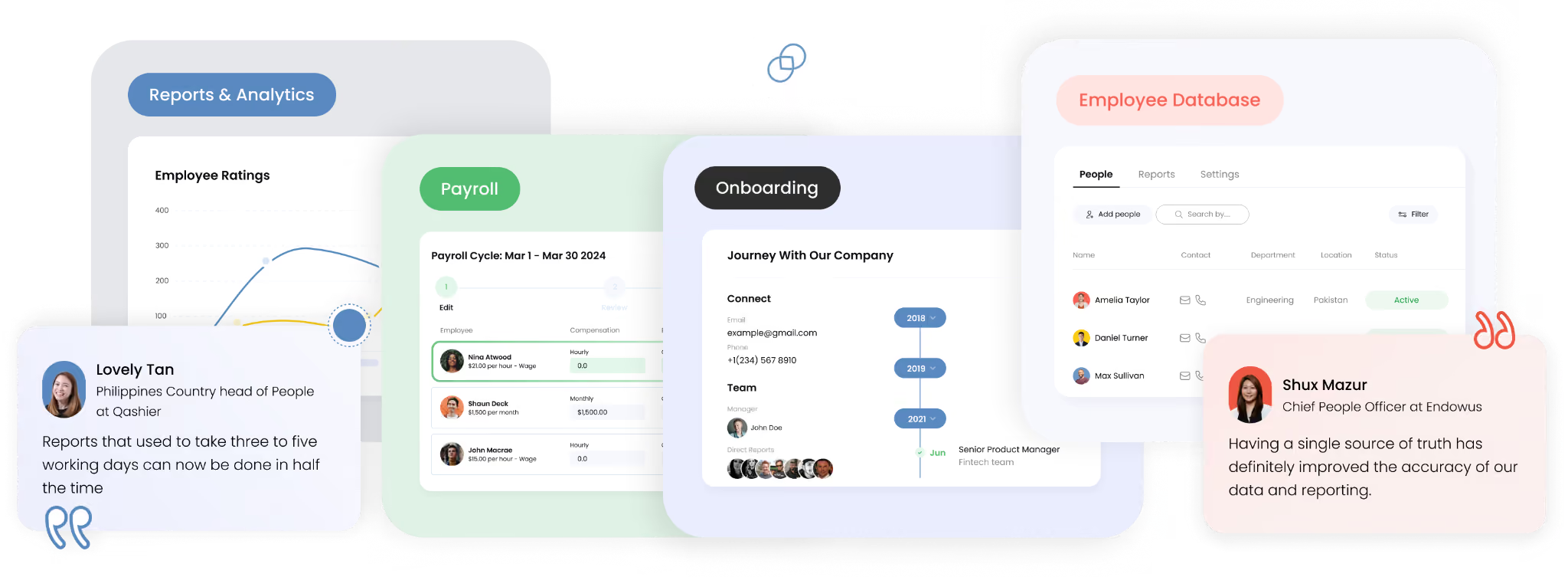
Omni HR is a full-suite HRIS designed for organizations managing employees across Southeast Asia and other APAC markets. The platform’s main advantage for enterprise buyers is the combination of core HR, payroll, attendance, leave, performance, recruitment, reporting, and employee self-service in one platform, with statutory compliance built around the markets where APAC businesses actually operate.
For enterprises with multiple entities across Singapore, Malaysia, the Philippines, Indonesia, and Hong Kong, that regional depth can reduce the need to stitch together separate HR and payroll systems for each market.
"Omni solved at least 80% of our problems. It also allowed us to further introspect and take initiative in our opportunities for improvement in the areas that a tool can't necessarily solve."
— Elena Argyriou, Chief of Staff at Snappymob
Best for: Enterprises with significant APAC operations that want scalable HR software with native regional compliance, rather than a global HCM platform that relies heavily on third-party payroll infrastructure in Asian markets.
Key features
- Core HR and centralized employee records
- Multi-country and multi-entity HR management
- Native payroll and statutory compliance across supported APAC markets
- Time, attendance, and leave management
- Performance management
- Recruitment and ATS
- Employee self-service through web and mobile
- Reporting and workforce analytics
- AI-powered HR assistance through Mino
- Integrations with finance and other business systems
Pros
- Strong native APAC statutory compliance
- Broad HRIS functionality across the employee lifecycle
- Designed for organizations operating across multiple Asian entities
- Unified HR and payroll data reduces reconciliation between separate systems
- More transparent pricing than many enterprise HCM competitors
Cons
- More geographically focused than Workday, SAP SuccessFactors, or Oracle for truly global organizations
- Enterprises with substantial US, European, or Latin American operations may need additional global capabilities
- Enterprise customers with highly specialized processes may require configuration or customization
Pricing: Starts from $3 per employee per month
2. Workday — Best for Large Global Enterprises
Workday is a broad enterprise HCM platform covering Core HR, talent management, payroll, workforce management, analytics, planning, and employee experience. Its major advantage is its ability to connect HR and workforce data with finance and planning across large, complex organizations.
Best for: Large global enterprises that need a comprehensive HCM platform and want HR, finance, planning, and workforce data connected within one enterprise ecosystem.
Key features
- Core HR and global employee management
- Payroll and workforce management
- Talent acquisition and talent management
- Workforce planning and analytics
- Employee experience
- AI through Workday Illuminate
- Extensive enterprise integrations
Pros
- Very broad enterprise HCM functionality
- Strong global workforce and organizational management
- Deep integration between HR, finance, and planning
- Extensive enterprise ecosystem
Cons
- Implementation can be substantial for complex organizations
- Pricing is not publicly standardized
- May be more platform than a company needs if its main challenge is regional HR and payroll rather than global HCM transformation
Pricing: Custom quote.
3. SAP SuccessFactors — Best for SAP-Centric Enterprises
SAP SuccessFactors is an enterprise HCM suite covering Core HR, payroll, talent management, workforce management, employee experience, and people analytics. Its strongest advantage is integration with the wider SAP ecosystem.
Best for: Large enterprises already using SAP for finance or operations that want HR to operate within the same broader technology ecosystem.
Key features
- Core HR and employee data management
- Payroll
- Talent acquisition and management
- Performance and goals
- Workforce analytics and planning
- Employee experience
- SAP ecosystem integrations
- AI capabilities through Joule
Pros
- Strong enterprise HCM breadth
- Deep integration with SAP finance and business systems
- Broad global localization capabilities
- Suitable for complex multinational organizations
Cons
- Implementation can be complex
- Pricing is not publicly standardized
- Best value is generally realized by organizations already invested in the SAP ecosystem
Pricing: Custom quote.
4. Oracle Fusion Cloud HCM — Best for Oracle-Centric Enterprises
Oracle Fusion Cloud HCM combines Core HR, talent management, workforce management, payroll, analytics, and employee experience with Oracle's broader cloud infrastructure and ERP ecosystem.
Best for: Enterprises standardizing their HR, finance, and business operations around Oracle Cloud.
Key features
- Core HR
- Global HR and workforce management
- Payroll
- Recruiting and talent management
- Workforce analytics
- Employee experience
- Oracle AI capabilities and agents
- Integration with Oracle Fusion ERP
Pros
- Strong fit with Oracle finance and ERP environments
- Broad enterprise HCM functionality
- Strong analytics and automation capabilities
- Suitable for complex global organizations
Cons
- Enterprise implementation can be substantial
- Pricing requires a sales engagement
- Can be unnecessarily complex for organizations seeking a more focused HRIS
Pricing: Custom quote.
5. Darwinbox — Best Enterprise HR Software for APAC
Darwinbox is an enterprise HCM platform with a particularly strong presence across India and Southeast Asia. Its platform spans Core HR, payroll, talent acquisition, performance, workforce management, employee experience, and analytics.
Best for: Large APAC enterprises that need broad HCM capabilities across multiple countries and complex organizational structures.
Key features
- Core HR
- Payroll and workforce management
- Talent acquisition
- Performance management
- Employee experience
- People analytics
- AI-enabled HR workflows
Pros
- Strong APAC presence
- Broad enterprise HCM functionality
- Designed for complex organizational structures
- Strong fit for organizations with significant India and Southeast Asia operations
Cons
- Enterprise-oriented implementation can be substantial
- Pricing is not publicly standardized
- May be more extensive than necessary for smaller organizations
Pricing: Custom quote.
6. UKG Pro — Best for Complex Workforce Management
UKG Pro combines Core HR, payroll, talent management, workforce management, scheduling, and employee experience. Its strongest differentiation is workforce management, particularly for organizations with hourly, shift-based, or frontline employees.
Best for: Large organizations with complex scheduling, timekeeping, and frontline workforce requirements.
Key features
- Core HR and payroll
- Workforce management
- Scheduling and time tracking
- Talent management
- Employee experience
- Workforce analytics
- AI-powered workforce insights
Pros
- Strong workforce management capabilities
- Well suited to complex scheduling environments
- Broad HR and payroll functionality
- Strong fit for large frontline workforces
Cons
- US-centric compared with APAC-focused platforms
- Enterprise implementation can be complex
- Pricing is not publicly standardized
Pricing: Custom quote.
7. Dayforce — Best for Unified HR and Payroll
Dayforce combines HR, payroll, workforce management, talent, and analytics on a unified platform. Its continuous payroll engine is a major differentiator for enterprises that want payroll and workforce data operating within the same system.
Best for: Enterprises that want HR, payroll, workforce management, and analytics on one platform.
Key features
- Core HR
- Global payroll
- Workforce management
- Talent management
- Scheduling and time
- Workforce analytics
- Employee experience
- AI-assisted HR capabilities
Pros
- Unified HR and payroll architecture
- Strong workforce management
- Broad enterprise functionality
- Suitable for complex multinational organizations
Cons
- Implementation can be substantial
- Pricing is not publicly standardized
- May be excessive for organizations with relatively straightforward HR requirements
Pricing: Custom quote.
8. ADP — Best for Payroll-Led Enterprise HR
ADP provides a broad range of HR, payroll, benefits, workforce management, and compliance services, with payroll remaining one of its strongest areas of differentiation. Its enterprise offering is particularly relevant to organizations that prioritize payroll infrastructure and compliance at scale.
Best for: Enterprises where payroll accuracy, compliance infrastructure, and established HR services are higher priorities than having the newest HR user experience.
Key features
- Enterprise payroll
- Core HR
- Benefits administration
- Time and attendance
- Workforce management
- Analytics and reporting
- Global payroll capabilities
Pros
- Extensive payroll and compliance experience
- Large enterprise customer base
- Broad range of HR services
- Strong US payroll infrastructure
Cons
- Pricing is generally customized
- Product structure can be more complex because different HR capabilities may sit across different ADP products
- APAC requirements may involve different products and delivery models depending on the country
Pricing:
9. Rippling — Best for HR, IT and Workflow Automation
Rippling takes a different approach from traditional enterprise HCM platforms by connecting HR with IT, applications, devices, payroll, and employee workflows. Instead of treating HR as a standalone system, it uses employee data to automate actions across the wider technology environment.
Best for: Tech-forward enterprises that want HR to serve as the trigger for automated IT, application, device, and employee workflows.
Key features
- Core HR
- Payroll
- Benefits
- Time and attendance
- Application management
- Device management
- Identity and access workflows
- Workflow automation
- Employee onboarding and offboarding
Pros
- Strong HR and IT integration
- Highly configurable workflow automation
- Modern employee experience
- Particularly compelling for technology-heavy organizations
Cons
- International statutory depth varies by market
- Less focused on APAC-native compliance than Omni HR
- Multiple modules can increase overall cost
- May not provide the same depth of traditional enterprise HCM functionality as Workday, SAP, or Oracle for very large organizations
Pricing: Custom quote.
What Enterprise HR Software Needs to Handle
Choosing the Best Enterprise HR Software for Your Team
The right platform depends less on which one has the most features and more on which one matches where your workforce is concentrated and what systems you're already standardized on.
Book a demo to see how Omni HR handles enterprise HR and payroll compliance across 10+ APAC markets.
Frequently Asked Questions
Enterprise HR software — also called enterprise HRIS or enterprise HRMS — is a people management platform built for large, complex organisations. Unlike standard HR tools, enterprise HR systems are designed to handle significant headcount across multiple locations, entities, or countries, with advanced security controls, multi-country payroll, compliance automation, and deep integration capabilities.
Enterprise HR software needs to scale across multiple entities, currencies, and regions, support role-based data access at a granular level, and integrate with finance and ERP systems. Small and mid-size HR software generally runs as a single instance with simpler permission structures and fewer compliance jurisdictions to manage.
Platforms with native statutory compliance built for the region, rather than routed through third-party partners, tend to serve APAC-concentrated enterprises best. Omni HR and Darwinbox both offer native payroll and compliance across multiple Southeast and South Asian markets, while global suites like Workday, SAP SuccessFactors, and UKG generally rely on partner networks for APAC statutory filing.
Enterprise implementations commonly run from a few months to over a year, depending on the number of entities, the complexity of approval workflows, and how many systems need to be integrated. Platforms with native multi-country compliance generally implement faster than those requiring third-party partner setup in each new market.
Most enterprise HCM platforms include payroll, but coverage depth varies significantly by country. Some platforms, like Omni HR and Darwinbox, run payroll natively across specific regions, while others, like Workday, SAP SuccessFactors, and ADP, deliver international payroll through certified in-country partners depending on where the company operates.