.png)
Summary: Omni's AI analytics agent, Mino, is built on a two-stage architecture that separates query construction from language model processing — meaning your employee records are never read by an AI model. This post covers how that works in practice, what it means for teams operating under PDPA and similar data privacy regulations across APAC, and what data is in scope for this release. Written by Ganesh Arshavin, Head of Engineering at Omni HR.
When we started building Mino, Omni’s AI Agent, we knew from the start we wanted to take the harder path.
Most AI features in enterprise HR software today are built on what's informally known as a GPT wrapper: take your customer's data, send it to a hosted large language model (LLM), ask it to read through everything and return an answer. It works, it ships fast, and it means your employee records, names, personal details, job history, are being transmitted to a third-party model running in an environment you don't control.
We didn't think that was good enough for HR data. So we built Mino differently, and I want to explain exactly how.
The problem with most "AI-powered HR" tools
A significant number of AI features in enterprise software today follow the GPT wrapper pattern: the platform takes your data, sends it to a hosted LLM, and asks the model to read through it and return an answer.
This approach is fast to build. It is also a material data security risk. Your employee records, names, salaries, performance data, personal details, are transmitted to a third-party model hosted outside your infrastructure. For HR data, that is a problem. These are some of the most sensitive records a company holds, and most vendors are not upfront about the fact that their AI is reading them.
Many vendors don't disclose this. Some obscure it in terms of service language. If you've ever asked a vendor "does your AI read our employee data?" and received a vague answer, there is often a reason for that.
How Mino is architected differently
Here's what actually happens when you ask Mino a question.
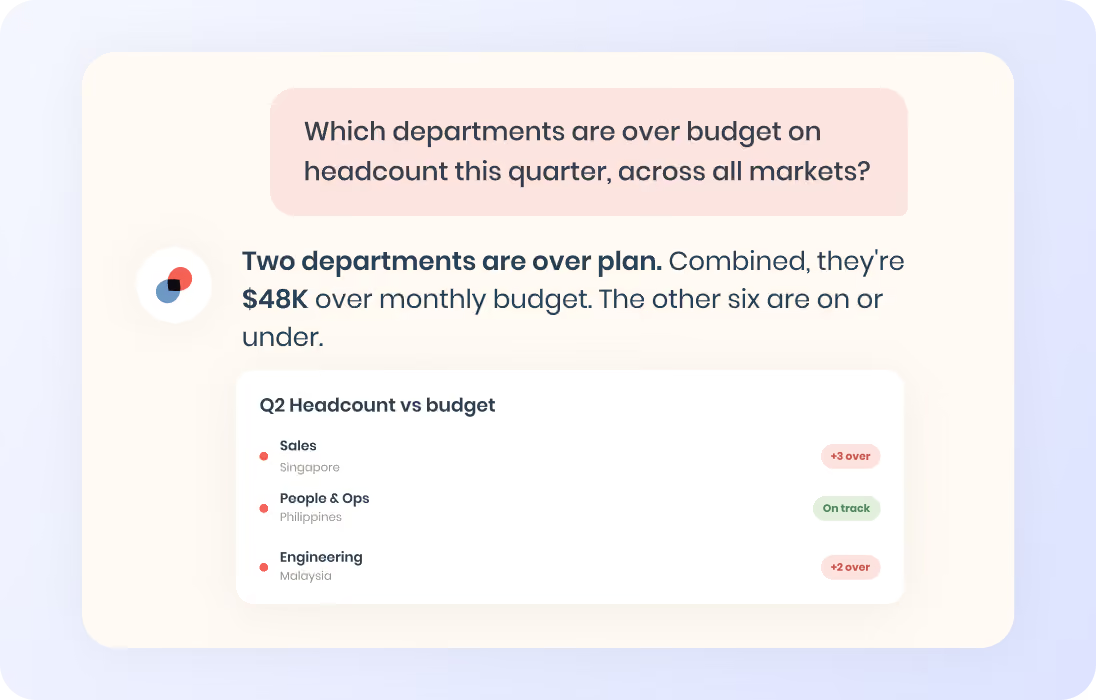
When an admin types a question into Mino, like, "What's our attrition rate by department over the last 12 months?", Mino does not retrieve your employee records and pass them to an AI model for analysis. Instead:
- Mino reads the schema, not the data. The analytics engine interprets your question against your data schema — the tables, fields, and relationships — without accessing the underlying employee records.
- Mino constructs a query. Based on your question, the engine generates a structured database query designed to retrieve exactly the information needed to answer it.
- Access control runs first. Before any data is returned, Omni's existing access control layer evaluates the query. If the requesting admin does not have permission to see certain employee data, that data is not returned.
- Only the query result is used. Only then does the language model come in. It works from that result set to generate the chart, summary, or insight you see on screen. The model reasons over the query output, not your underlying employee records.
This is sometimes described as query-based AI or schema-aware AI: the model reasons about structure and results, not raw content. It is meaningfully harder to build than a GPT wrapper, and it is the approach that only the largest enterprise HR platforms have invested in to date. We built it into Omni from the ground up.

What this means for your compliance posture
Your employee data does not leave your environment to be processed by an external AI model.
For teams operating under PDPA across Singapore, Thailand or Malaysia, or the Philippines Data Privacy Act, or for those with internal data governance policies that restrict data transmission to third parties, this architecture is relevant.
Specifically:
- No raw PII is transmitted to a hosted LLM. The AI model works from schema and query results, not employee records.
- Access control is enforced at the data layer. Permissions are respected by the system before data is ever surfaced, including within AI-generated responses.
- Admins can inspect query logic. Mino exposes the underlying query it constructed to answer any question. You can see exactly what was asked of your database, download the raw query result, and verify that what the AI returned matches what the data actually says.
We are also building individual opt-out controls for AI analytics. Employees will be able to exclude specific data (dependent information, for example) from being surfaced through Mino entirely. Admins will have the same ability at the user level, allowing users to choose how their data is used.
Data scope in this release
Mino launches with access to the following data categories:
Employee information Basic profile data (name, date of birth, gender, marital status, nationality, employee ID), contact details, emergency contacts, department and team assignment, location, and dependent data.
Job records Employment status, probation and notice periods, termination data (date, type, reason), job events, and reporting line (manager and manager's manager).
Expense data Expense categories, policy assignments and limits, policy proration settings, and submission history including status and approval state.
A note on custom fields: Custom fields are not yet ingested into the Mino data model in this release. This is on the roadmap for a future milestone.
Data refresh cadence: Data is updated once per day. This includes access control settings. Permission changes made in Omni will be reflected in Mino following the next scheduled refresh.

Calculated metrics: how Mino handles derived data
Several metrics Mino can produce, including attrition rate, churn rate, and new hire retention rate, are calculated fields rather than raw data points. Omni has built default calculation formulas directly into the data model to ensure these metrics are computed consistently, using the same definitions every time.
When you ask Mino for your attrition rate, you're getting a figure calculated against a defined, consistent methodology. Not an AI making its best guess about what "attrition" means from context.
For teams that use custom definitions, say a different formula for annualised turnover, this is worth being aware of. The underlying query logic is visible and downloadable, so you can verify the calculation methodology being applied.
Looking ahead
Mino is the beginning of a broader investment in AI-powered analytics at Omni. Over the coming months, we'll be expanding the data Mino can reason about, adding the ability to save and pin custom dashboards, and bringing compensation and performance data into scope.
The goal is straightforward: give HR teams the kind of analytical capability that has historically required a dedicated data team, and make it accessible to any admin who knows how to ask a question.
We'll share more as each phase rolls out.
Getting access
Mino is currently in early access. If you're an existing Omni customer and want to explore it, speak with your Customer Success contact. If you're evaluating Omni and want to see it in action, you can book a demo at omnihr.co/demo or start a 7-day free trial.
.png)


.png)