.png)
Summary. Managing Singapore tax obligations can be challenging, especially with varying IRAS tax rates, complex IRAS income tax requirements, and strict AIS submission timelines. Understanding how the IRAS Singapore framework works—from the Auto Inclusion Scheme (AIS) and IRAS tax bracket system to CIT rebate IRAS incentives—helps HR teams stay compliant and accurate. With Omni, businesses can simplify compliance through automated payroll, seamless IRAS integration, and accurate reporting—ensuring every IRAS tax and contribution is filed correctly and on time.
Singapore tax season can feel daunting for HR teams. While shuffling through IR8A forms, employee benefits, income details, and Central Provident Fund (CPF) data for multiple employees, errors can occur. This can negatively impact employees or lead to compliance issues for your business.
To prepare for Singapore’s tax season in 2026, understanding how IRAS and the AIS work together can help HR teams stay compliant and confident in every submission.
Understanding IRAS: Your Tax Partner in Singapore
Inland Revenue Authority of Singapore (IRAS) is the statutory body responsible for tax collection, administration, and ensuring compliance with tax laws by prosecuting tax evaders. It was formed in 1992 under the Ministry of Finance. Beyond its basic functions, IRAS also provides you with the tools and resources needed to file tax returns seamlessly.
What IRAS does beyond tax collection
Beyond the primary function of tax administration and collection, IRAS does more than that:
Revenue collection and policy advisory roles
The primary function of the IRAS is to ensure the prompt collection and documentation of taxes. This tax is then used to fund social amenities, such as hospitals, schools, and roads. IRAS is also involved in policy advisory. While it doesn’t make the laws itself, it monitors how these laws and policies affect businesses and offers suggestions to the Ministry of Finance, ensuring that Singapore’s tax system stays competitive, fair, and sustainable.
Digital transformation initiatives that benefit businesses
IRAS simplifies tax filing by introducing digital platforms, such as the MyTax Portal and the Auto-Inclusion Scheme (AIS), as well as APIs, to reduce administrative burdens. These digital tools allow individuals and companies to submit tax data more efficiently, saving time and minimising errors.
Support services designed to make compliance easier
IRAS Singapore provides educational resources on tax filing and payment using platforms like YouTube and X. These resources are often animated and easy to understand, thus ensuring that businesses understand their obligations and the exact steps to take during tax season to avoid mistakes.
Key tax types every business should know
When it comes to Singapore tax, businesses and individuals alike must understand that all income is taxable. Also, IRAS tax rates differ based on income level, type of tax, and residency status (for income tax).
In Singapore, tax filing is done on a preceding year basis. This means that when you file your tax return for the Year of Assessment (YA) 2026, you are actually declaring income earned between 1 January 2025 and 31 December 2025.
Learn more: Employer’s Manual for Taxation in Singapore
Income tax
Personal income tax in Singapore is administered by IRAS and is levied on income earned by individuals, such as salaries, bonuses, directors’ fees, and other allowances. Singapore uses a progressive income tax rate structure, meaning higher earners are taxed at higher IRAS tax brackets.
For the Year of Assessment 2026, the IRAS income tax rates for residents range from 0% to 24%, depending on income brackets. Non-residents are generally taxed at a flat rate of 15% or the resident rate, whichever results in a higher tax amount.
Individual taxpayers are required to file their income tax returns annually. However, under the Auto Inclusion Scheme (AIS), many employees’ income information is pre-filled through their employers’ AIS submission to IRAS Singapore, making the filing process simpler and more accurate.
Corporate income tax
Companies that operate in Singapore are subject to corporate income tax on profits derived from business activities. The IRAS corporate tax rate remains one of the most competitive in the region at 17%.
To encourage entrepreneurship, IRAS Singapore offers several tax reliefs, such as the Partial Tax Exemption (PTE) and Start-Up Tax Exemption (SUTE), both of which help reduce taxable income for eligible businesses.
Corporate income tax rebate
In addition, companies may benefit from CIT rebate IRAS incentives, introduced periodically by the Singapore government as part of fiscal policy measures to support business growth. These CIT rebate IRAS initiatives allow companies to offset a percentage of their tax payable, up to a capped amount, effectively reducing their overall tax liability.
While rebates are not permanent features of the IRAS tax system, they demonstrate IRAS Singapore’s role in fostering a business-friendly tax environment while maintaining compliance and fiscal sustainability.
Goods and services tax
GST is a broad-based consumption tax, similar to VAT in other countries. It is levied on the supply of goods and services in Singapore as well as on the import of goods.
As of 2024, the IRAS GST rate is 9%, following the completion of the two-step rate hike. Businesses with an annual taxable turnover exceeding S$1 million must register for GST with IRAS. Once registered, they are required to charge GST on taxable supplies, file regular GST returns, and remit collected taxes to IRAS Singapore.
Certain supplies, such as financial services, are GST-exempt, while international services and exported goods are zero-rated.
Property tax and stamp duties
Property tax is imposed on owners of properties in Singapore, based on the annual value of the property. Rates vary depending on whether the property is owner-occupied or rented out.
In addition, for Singapore tax, stamp duties are levied on certain transactions, such as the transfer or lease of real estate and the transfer of shares. Stamp duties are payable by the party acquiring the property or shares, and the rates can vary depending on the value and type of transaction.
Withholding tax
Singapore also imposes withholding tax on certain payments made to non-resident companies or individuals. These include interest, royalties, service fees, or rental of movable property made to parties outside Singapore.
The withholding tax rate depends on the type of payment and the tax treaty between Singapore and the recipient’s country of residence. This ensures that Singapore collects the appropriate IRAS tax on income derived locally by foreign entities.
The IR8A Form
The IR8A form is the most important document used by businesses when filing tax returns with IRAS Singapore. It documents employees’ income for the year, and it covers salaries, Annual Wage Supplement, bonuses, allowances, and benefits-in-kind. Every employer is expected to file Form IR8A for each employee during the tax season. Depending on the situation, this may also include supporting forms such as Appendix 8A, Appendix 8B, or IR8S.
Who needs to file IR8A?
IR8A filing is mandatory for all employees who are:
- Full-time and part-time staff under contract of service.
- Non-resident employees working in Singapore.
- Company directors (including non-resident directors).
- Board members receiving fees.
- Employees posted overseas but still under Singapore employment contracts.
- Employees who left the company during the year (resigned or terminated).
Special cases
- Directors: Directors’ fees are treated differently from salaries because they are typically approved at the Annual General Meeting (AGM) and may not be tied to regular payroll cycles.
- Overseas workers: If an employee is posted overseas but remains employed by the Singapore entity, their remuneration is still reportable under IR8A.
- Departed employees: If an employee leaves Singapore permanently, HR must file Form IR21 (not IR8A) one month before their departure, but their earnings up until departure are still included in the IR8A for that YA.
Essential Forms and Documentation
Alongside IR8A, HR teams may also need to prepare supporting forms depending on the employee’s circumstances.
Core IR8A requirements for employee remuneration
The IR8A must reflect the full range of an employee’s income, including: salary and wages, bonuses, commissions, allowances, and benefits-in-kind (e.g., housing, car, school fees for dependents).
Form IR8S for CPF contribution adjustments
IR8S is used when there are excess or shortfall CPF contributions for the year. If an employer made over-contributions or under-contributions to an employee’s CPF, report these via the IR8S so the necessary tax adjustments can be made.
The Auto Inclusion Scheme: Simplifying Tax Submissions
The Auto Inclusion Scheme (AIS) is a programme by IRAS Singapore to enable employers to file tax returns for employees electronically. Before the AIS, employers had to prepare IR8A forms and distribute them to employees, which was more error-prone and time-consuming. Under AIS, the income data submitted by employers is automatically included in employees’ tax returns. Employees can then log in to myTax Portal to review and adjust any additional personal data before submitting.
Is AIS Right for Your Business?
Under section 68(2) of the Income Act Tax, employers with 5 or more employees, or those who have been issued a notice by IRAS to file electronically, must participate in AIS.
Employers with fewer than 5 employees may choose to opt in voluntarily. AIS can help small businesses by reducing the burden on HR and speeding up tax filing processes.
Getting Started with AIS
1. Registration via myTax Portal
You can register for AIS through the myTax Portal. Registration must be done before the Year of Assessment.
2. Authorization and setup
Once registered, select an approver and preparer who will submit the employment income data.
3. Submission deadlines
AIS submission for employees’ employment income is due by 1 March each year. Employers are encouraged to submit earlier to allow employees time to review.
What You Need to Know About Singapore Income Tax Rates
Understanding IRAS Singapore tax rules is essential for both employers and employees. Below is an overview of how Singapore tax applies based on residency, income type, and work arrangements.
1. Determining tax residency status in Singapore
An individual’s tax residency determines how their IRAS income tax rate is calculated.
A person is considered a tax resident if they are:
- A Singapore citizen or Permanent Resident who ordinarily resides in Singapore, or
- A foreigner who has stayed or worked in Singapore for 183 days in a calendar year.
Those who do not meet this 183-day threshold are classified as non-residents for Singapore tax purposes.
2. Progressive IRAS tax rates for residents
The IRAS income tax rate ranges from 0% to 24%, depending on income brackets. This means individuals who earn more pay higher taxes under the IRAS tax bracket system.
For example:
- A resident earning S$30,000 per year may pay little or no tax after reliefs, as the first S$20,000 is tax-free.
- A resident earning S$200,000 per year will fall into a higher IRAS tax bracket.
3. Flat rate structures for non-residents
Income tax rate for non-residents is capped at a flat rate of 15%, or at the progressive IRAS tax rates applicable to residents, whichever results in a higher total tax amount.
For example:
- A non-resident earning S$50,000 would generally pay S$7,500, based on the 15% flat IRAS tax rate.
4. Tax considerations for remote and hybrid work
With the rise of hybrid and remote work, HR teams should pay close attention to where employees are physically performing their duties.
If an employee works outside Singapore for a Singapore-based company, questions may arise regarding:
- Their IRAS income tax residency status, and
- Which jurisdiction holds taxing rights (Singapore or the foreign country).
Double Taxation Agreements (DTAs) between Singapore and other countries can help avoid employees being taxed twice, but HR must maintain accurate records of work arrangements for IRAS Singapore compliance. Get the full list here.
5. Business tax obligations
ECI filing requirements and deadlines
Companies must file an Estimated Chargeable Income (ECI) within three months after the financial year-end. Even if profits are zero, IRAS expects this submission unless a waiver is granted. Late or missing filings may impact eligibility for certain CIT rebate IRAS benefits.
Choosing the right corporate tax form
Businesses must file either:
- Form C-S: For smaller companies (≤ S$5 million revenue) with straightforward tax matters.
- Form C: For larger companies or with complex deductions and foreign income.
Submitting the correct IRAS tax form ensures accurate assessment and faster processing,
GST registration thresholds and compliance
GST registration is compulsory once the annual taxable turnover exceeds S$1 million. Businesses below this threshold may register voluntarily to claim input tax credits.
Registered businesses must:
- File GST returns on time,
- Maintain valid invoices, and
- Remit collected GST to IRAS Singapore promptly.
6. Red flags that trigger IRAS attention
- Under-reported income in cash-heavy industries like retail and F&B.
- Incorrect GST claims on personal or non-business expenses.
- Mismatched asset purchases compared to declared income.
- Poor record-keeping or missing documentation for expense claims.
These issues can attract audits or penalties from IRAS.
IRAS Support Resources and Building Your Compliance Strategy
Even with software, it’s essential to know where to get help and how to strengthen compliance internally.
Accessing IRAS support
The myTax Portal serves as the central hub for IRAS filings, payments, and official notices. Employers can also access:
- IRAS’s virtual assistant for quick answers.
- Dedicated phone support for tax queries.
- Professional tax advisors or accountants for complex cases involving multiple entities or DTAs.
Building a robust compliance strategy
Technology only works well when paired with strong internal processes. Here are some tips to stay aligned with IRAS Singapore:
Record-keeping best practices
Keep invoices, receipts, and contracts organized for at least five years, per IRAS Singapore requirements.
Digital and cloud-based accounting tools like Omni can simplify storage and retrieval.
Using IRAS’s voluntary disclosure programme (VDP)
If mistakes are found, disclose them early through the IRAS VDP to minimize penalties and avoid escalated audits.
Building audit-ready documentation systems
Standardize payroll, expense, and tax records to ensure consistency across submissions. This helps your organization stay audit-ready, reduces compliance risks, and demonstrates transparency to IRAS Singapore.
How Omni Makes Tax Compliance Work for Your Business
IRAS Singapore tax compliance doesn’t have to be complicated. With Omni’s HR and payroll software, businesses can integrate seamlessly with IRAS systems, automate tax and statutory contributions, and stay compliant without manual effort.
Key features to look for
When selecting payroll or accounting software, check for features that simplify compliance:
- Direct AIS submission ensures that employee income data is sent directly to IRAS.
- Automated CPF and SDL calculations to prevent mistakes in contributions.
- Comprehensive reporting and audit trails to prepare you for any IRAS queries.
- Employee self-service portals for accessing payslips, leave, and tax forms without HR intervention.
Why businesses choose Omni
Seamless IRAS and CPF integration
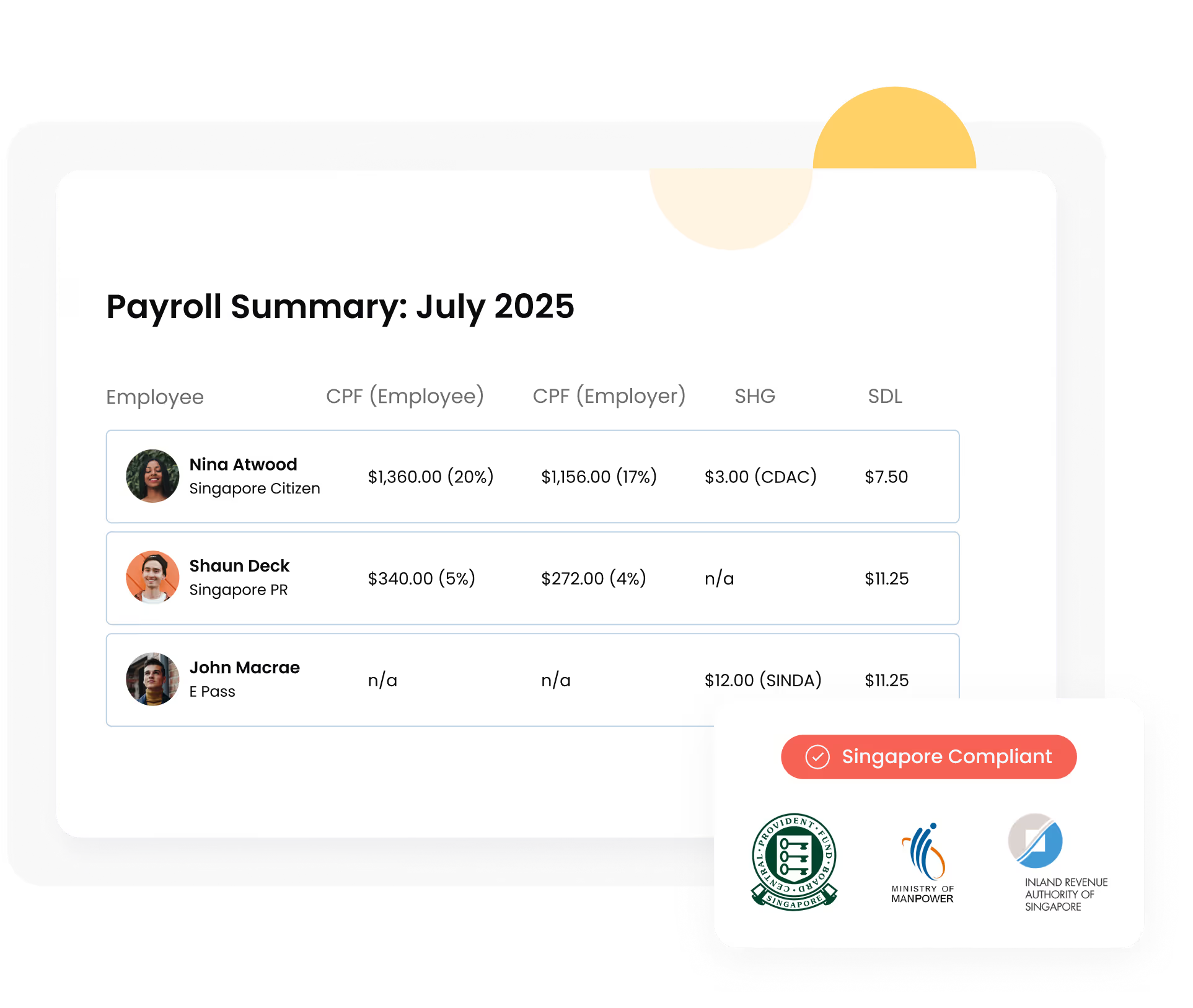
Omni connects directly with statutory bodies, such as IRAS Singapore and the CPF Board, making AIS submissions and payroll deductions seamless and automated.
Automated payroll and tax calculations
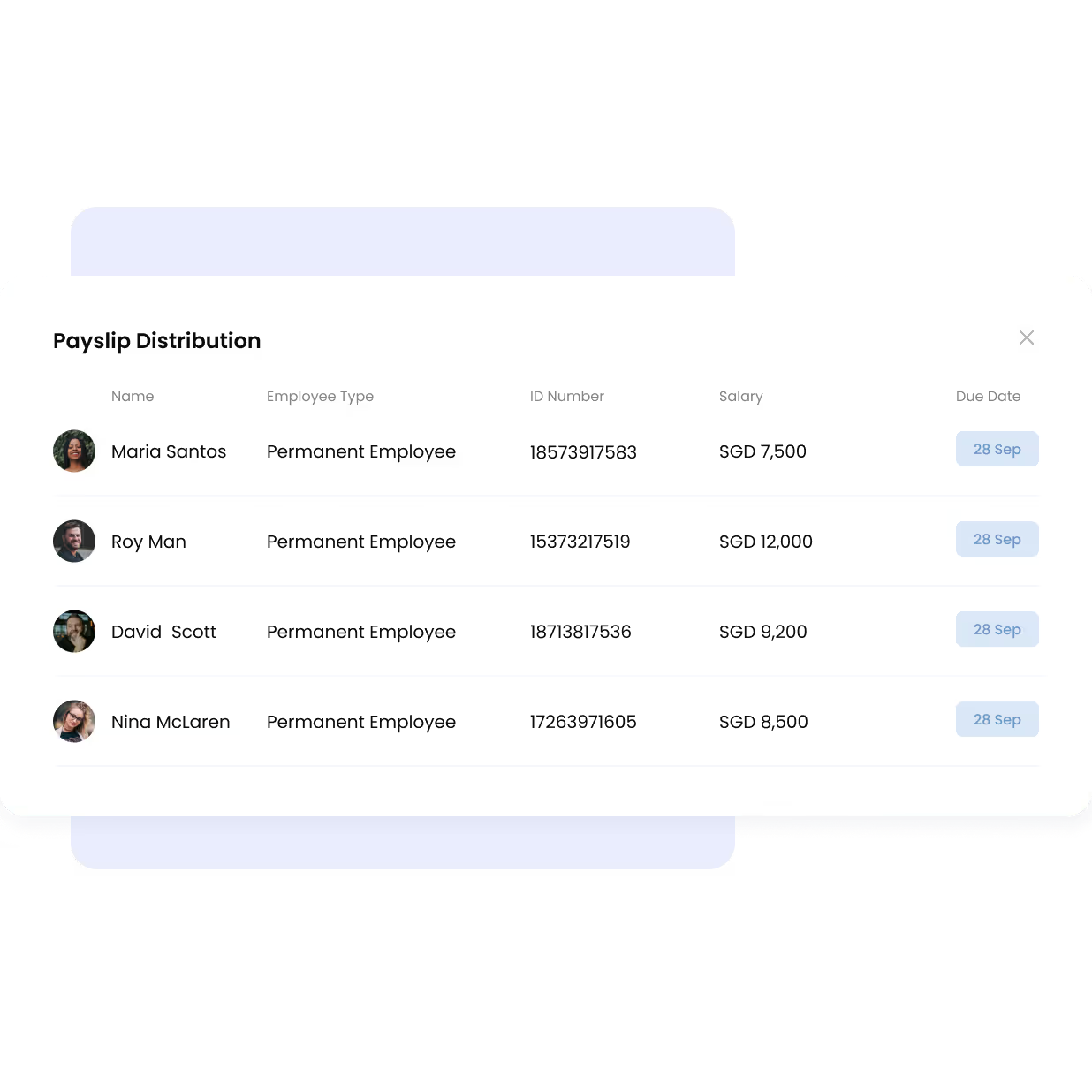
With Omni, payroll can be done in minutes. Our system automatically applies the right IRAS tax brackets and CPF rates, calculates deductions, and generates compliant payslips. HR teams can reduce manual entry and human error while maintaining a clear audit trail for each transaction.
“Payroll calculations that used to take five days can now be done in half the time with Omni.”
— Tengku Mohaizad, Group Head of HR Asia at Inspire Brands Asia
Audit-ready recordkeeping
Omni’s centralized document management system stores all employee tax, payroll, and compliance data in one place, making it easy to retrieve information needed during audits or reviews.
"With Omni HR, I uploaded all those documents in 30 minutes max, which was extremely fast."
— Andrei Perevalovi, Head of People Products at Virtual Internships
Scalable and compliant across regions
Whether you’re managing one Singapore entity or expanding across APAC, Omni scales with your business. Our localized compliance adapts accordingly to each market’s rules and regulations, ensuring accuracy across payroll, statutory contributions, and tax submissions.
With local support in your timezone, multilingual coverage in 10+ languages, and service across 190+ countries, Omni helps HR and finance teams stay compliant and supported wherever they operate.

See how Omni helps HR teams simplify IRAS Singapore submissions, automate CPF and AIS reporting, and save hours every tax cycle — book your product tour today!
.png)


.png)