.png)
Summary. A poorly structured payroll RFP doesn't just waste time; it produces responses that are impossible to compare and decisions that are hard to defend. The most effective payroll RFPs start with internal alignment across HR, Finance, IT, and Legal before a single vendor is contacted, and include a weighted scoring rubric built before proposals come in. Teams that skip this step unconsciously weight whatever the most impressive vendor happened to emphasise. For organisations operating across Asia-Pacific, the stakes are higher: compliance in markets like Malaysia, Singapore, and Indonesia is market-specific, frequently updated, and routinely underserved by global platforms. A well-run request for proposal process is how growing companies avoid costly vendor mismatches that take years to unwind.
Choosing a new payroll vendor is a significant decision. One that affects every employee in your organisation, your compliance standing across markets, and the efficiency of your People and Finance teams for years to come. With all the noise around the market, a well-structured request for proposal (RFP) is how you can cut through vendor sales pitches and get the information you actually need to make a confident, defensible decision.
The problem? Most payroll RFPs are either too vague to be useful or so long that vendors respond with copy-paste templates. Neither outcome helps you. In this guide, we walk through how to write a payroll RFP that actually works, one that generates specific, comparable responses and keeps your evaluation process on track.
Want to skip the blank page? Download Omni's free Payroll RFP Template for APAC, covering all six core sections, pre-loaded with questions tailored for multi-country payroll in Asia.
What is an RFP? (And When Do You Need One?)
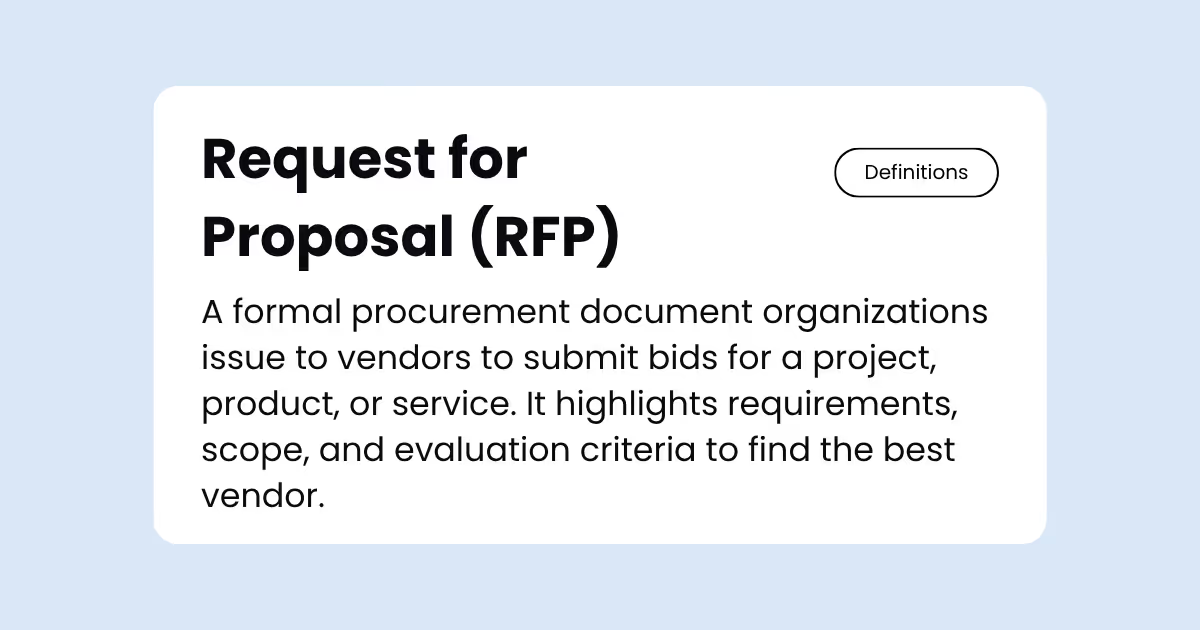
Before diving into structure, let's clarify the RFP meaning in this context. A request for proposal is a formal document sent to potential vendors that outlines your organisation's requirements and asks them to submit a structured response detailing how they'd meet those needs, at what cost, and on what timeline.
For payroll specifically, an RFP acts as both a requirements document and a shortlisting tool. It forces internal clarity before you speak to a single vendor, and it gives you a structured basis for comparison once responses come in.
When does a formal RFP make sense
A payroll RFP is worth the investment when:
- Your organisation has 100+ employees, or expects significant headcount growth within 12 months.
- You run payroll across multiple countries or are planning regional expansion.
- You have complex pay structures, including commissions, shift differentials, and a mix of independent contractors and full-time employees.
- You operate in a heavily regulated industry such as financial services, healthcare, or manufacturing.
- Your procurement or legal team must be formally involved in vendor selection
- You have integration requirements with an HRIS, ERP, time-tracking, or benefits system
When you can skip the RFP
If you have fewer than 50 employees, run single-country payroll with minimal integrations, and if one or two stakeholders can make the decision, a shortlist-and-demo approach will save everyone time. An unnecessary RFP creates friction without improving the outcome.
Step 1: Align Internally Before Writing
The most common reason payroll RFPs fail isn't bad writing — it's misalignment. HR wants automation, Finance wants auditability, IT wants API access, and Legal wants compliance documentation. When those requirements aren't consolidated before the RFP goes out, you end up with a document that's either contradictory or incomplete.
Before drafting anything, bring together your core stakeholders: HR, Finance, IT, Legal, and an executive sponsor. Align on:
- Current pain points: What's broken or insufficient with your existing setup?
- Must-have vs. nice-to-have: Be ruthless about this distinction
- Integration dependencies: Which systems must the new platform connect to?
- Go-live timeline: Do you have a hard deadline (e.g., new financial year)?
- Budget range: Even a rough figure helps vendors self-qualify and respond accurately
This alignment conversation typically surfaces requirements that no single stakeholder would have captured alone, and it prevents the awkward moment where IT flags a data residency issue after you've already shortlisted vendors.
Step 2: Structure Your Payroll RFP Document
A strong payroll RFP covers six core sections. Keep each one focused and specific.
1. Company overview
Keep this one page maximum. The overview should include your headcount, countries of operation, employment types (full-time, contractor, part-time), current payroll system, and the primary reason you're making a change. This context helps vendors tailor their response to your actual situation rather than sending a one-size-fits-all pitch.
2. Scope of work
Define exactly what you need the vendor to own: payroll processing, tax filing, payslip generation, off-cycle runs, year-end reporting, and support model. Ambiguity here leads to mismatched proposals and scope conversations during contract negotiation.
3. Functional requirements
Structure this as a tiered list of must-haves, important, and good-to-haves. Key areas to cover:
- Payroll automation and calculation accuracy
- Multi-currency and multi-country support
- Compliance updates (especially critical for teams operating across Asia, where regulations change frequently)
- HRIS and ERP integration
- Employee self-service portal
- Mobile accessibility
- Reporting and analytics
4. Technical and security requirements
Include API and connector requirements, data residency preferences, certifications (SOC 2, ISO 27001), uptime SLA expectations, and SSO compatibility. For organisations in regulated industries or with distributed data across Asia-Pacific, data residency and localisation are non-negotiables.
5. Pricing and commercial terms
Ask vendors to break down: per-employee-per-month (PEPM) pricing, implementation fees, multi-country add-on costs, contract length, exit clauses, and any additional charges for off-cycle runs or additional entities. Base pricing rarely tells the full story; always ask for the total cost of ownership.
6. Vendor information
Request years in operation, customer retention rate, regional references (ideally in your specific markets), and details on the implementation team structure. A vendor with strong global credentials but limited experience in Malaysian or Indonesian compliance is the wrong choice if those are your core markets.
Not sure how to phrase your requirements? Omni's Payroll RFP Template for APAC includes pre-written questions for every section above, including a functional requirements checklist and a vendor scoring sheet you can share directly with stakeholders.
Step 3: Build a Scoring Rubric Before You Send It
This step is where most teams lose objectivity. If you create your evaluation criteria after reading vendor proposals, you'll unconsciously weight whatever the most impressive proposal happened to emphasize.
Build your rubric first. Assign weights to 4–6 categories and share them with vendors upfront — it signals that you're running a serious process and gives them the chance to address your actual priorities.
Use a 1–5 scale per category and require vendors to respond using a standardised template rather than free-form proposals. This makes side-by-side comparison significantly easier.
Step 4: Run the Process Without Losing Momentum
A payroll RFP typically takes 6 to 10 weeks end-to-end. Here's a realistic timeline:
- Weeks 1 & 2: Internal alignment and RFP document drafted
- Weeks 2 & 3: Distributed to 3–5 shortlisted vendors
- Weeks 4 & 5: Vendor Q&A window
- Weeks 5 & 6: Proposals received and scored against your rubric
- Weeks 7 & 8: Shortlist demos and reference checks
- Weeks 9 & 10: Final decision, contract negotiation, and implementation kickoff
Set a firm submission deadline, cap proposal length (this discourages templated responses), and score proposals in parallel across stakeholders.
Common Payroll RFP Mistakes to Avoid
Even well-intentioned request for proposal processes go sideways. Watch for these:
- Sending to too many vendors at once. More than five or six responses create evaluation fatigue and make meaningful comparison difficult. Shortlist two to three vendors before you send.
- Skipping internal alignment. Misalignment between HR, Finance, and IT tends to surface at the worst possible moment — during demos or, worse, contract negotiation.
- Evaluating features without weighting priorities. A vendor with a polished UI but no multi-country support is the wrong choice if you are expanding across Southeast Asia.
- Underweighting implementation. The best payroll software can still fail if onboarding is under-resourced. Always ask for a detailed implementation plan and named contacts.
- Not asking for regional references. Payroll compliance is market-specific. A vendor with deep US or European experience may have real gaps in Malaysian EPF submissions, Singapore CPF compliance, or Indonesian BPJS calculations. Ask for references in the markets that matter to you.
- Ignoring the total cost of ownership. Base PEPM pricing rarely reflects the full picture. Ask explicitly about implementation fees, support tiers, additional entity costs, and off-cycle run charges.
Ready to send your RFP? Use Omni's free Payroll RFP Template for APAC to get started today — built for teams managing payroll across Asia, with all the right questions already written in.
What to Look For in a Payroll Vendor for Asia
If your organisation operates across Malaysia, Singapore, Indonesia, the Philippines, or elsewhere in the region, your payroll vendor evaluation has a specific layer of complexity that generic global platforms often fail to serve.
Compliance in Asia is not static; statutory contributions, tax brackets, and employment regulations change frequently and vary significantly between markets. A vendor that works well for US or European payroll may lack the localised expertise to handle EPF and SOCSO submissions in Malaysia, CPF contributions in Singapore, or BPJS calculations in Indonesia accurately and automatically.
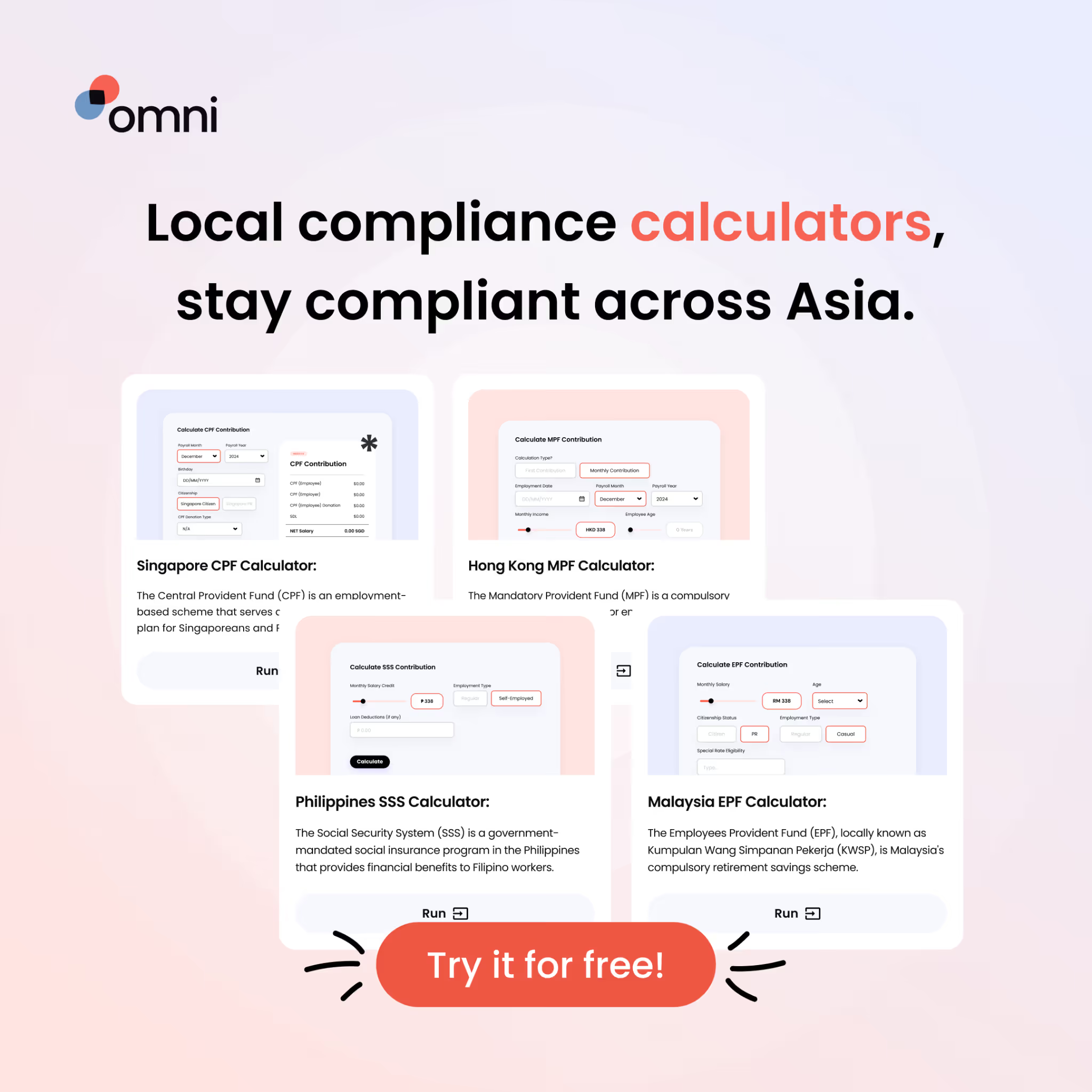
When evaluating vendors for Asian operations, prioritise:
- Automated, real-time compliance updates for each country you operate in
- Local support teams who work in your timezone and understand regional nuances
- Multi-currency payroll with built-in statutory calculation by market
- A combined HRIS and payroll platform that eliminates integration gaps between employee records and payroll runs
Why Growing Teams in Asia Include Omni HR in Their Payroll RFP Shortlist
Omni HR is built specifically for companies scaling across Asia, combining HRIS and payroll in one platform with deep localised compliance across Malaysia, Singapore, Indonesia, the Philippines, Hong Kong, and beyond.

Here's what makes Omni worth including in your payroll RFP evaluation:
- Localised compliance, automatically maintained. Omni handles statutory contributions and regulatory updates across Asian markets as they change — no manual tracking required.
- Integrated HR and payroll. Because HRIS and payroll live in one system, there's no integration overhead between employee records and payroll runs. Changes in headcount, leave, and employment status flow through automatically.
- Transparent pricing. Omni's per-employee pricing starts at $3/employee/month with no hidden fees.
- Dedicated onboarding support. A hands-on implementation team with experience migrating teams from spreadsheets and legacy systems, in your timezone.
- Employee self-service. Built-in payslip access, leave integration, and an employee portal that reduces the volume of payroll-related queries to HR.
Why APAC businesses choose Omni
Running a payroll RFP across multiple vendors? Our team can provide references from companies in your specific markets and walk you through a structured demo aligned to your RFP requirements. Contact us today to get started.