




















.png)
Summary. From 1 January 2027, Singapore's Central Provident Fund (CPF) contribution rates rise for employees aged above 55 to 65, to 35.5% in total for those above 55 to 60 and 26% for those above 60 to 65. Rates for all other age bands stay the same, the Ordinary Wage ceiling remains S$8,000 a month and the annual salary ceiling stays at S$102,000. Employers need to update payroll age bands before the first 2027 pay run, budget for higher employer contributions net of the one-year CPF Transition Offset, and keep ordinary and additional wages separate to avoid over- or under-contributions. Omni HR payroll applies the correct CPF rate by age and PR status, enforces both wage ceilings and files CPF, SDL and IR8A, so every contribution stays accurate and audit-ready.
The Central Provident Fund (CPF) is Singapore's mandatory social security savings scheme, funded by monthly contributions from employers and employees. It is an essential aspect of payroll for both, and CPF contribution rates keep changing, with the 2027 changes affecting payroll and HR budgeting once again.
Mismanaging the employer CPF contribution or employee CPF contribution can lead to costly compliance penalties and payroll errors. Most guides only cover high-level rates and skip details like the CPF wage ceiling, the annual CPF cap and employee-specific scenarios.
In this guide, we provide a complete overview of CPF contribution rates for 2027, CPF contribution history, the CPF contribution ceiling and how Omni HR helps you plan for and adapt to CPF changes in 2027 and beyond. For the step-by-step process of paying CPF, see our companion guide to CPF contributions for employers.
Importance of CPF Compliance and Planning
Every payroll manager in Singapore keeps a close eye on CPF contribution rates, as even a one-point change can affect both company costs and employee expectations. The employer CPF contribution is a direct line in your budget, while the employee CPF contribution shapes take-home pay and employee trust.
In 2027, the stakes stay high. Older workers contribute more again, and since the CPF Ordinary Wage ceiling reached S$8,000 in January 2026, more of each high earner's monthly salary is CPF-liable. With the statutory retirement age rising to 64 and the re-employment age to 69 from 1 July 2026, more employees are also staying in the higher-rate age bands for longer.
When CPF is mishandled, the impact goes beyond compliance notices. CPF contributions are due on the last day of each calendar month, and the CPF Board takes enforcement action if they are not paid by the 14th of the following month. Late payments attract interest of 1.5% per month from the day after the due date, plus a composition amount of up to S$1,000 per offence. Errors also force messy retroactive adjustments and can erode employee confidence. Companies that plan for each annual change avoid surprises and build trust with their teams.
Omni HR tip: From 1 January 2027, CPF contribution rates increase for employees aged above 55 to 65. The Ordinary Wage ceiling stays at S$8,000 and the annual salary ceiling at S$102,000. Employers receive a one-year CPF Transition Offset equal to half of the employer rate increase for these workers.
Key things you need to keep in mind as an employer:
- Staying on top of CPF contribution rates keeps your payroll accurate and compliant.
- The CPF employer contribution directly increases your manpower costs each year.
- The S$8,000 Ordinary Wage ceiling affects budgeting for your high earners, and leaves less room for CPF on bonuses.
- The 2027 changes raise contribution rates for employees aged above 55 to 65 from 1 January 2027.
- A smooth shift from 2026 to 2027 rates requires updated payroll systems and clear communication with your staff.
Many Singapore employers are turning to payroll automation and compliance tools to stay on top of these changes. Building CPF rules into your systems means fewer manual fixes and more confidence that you're meeting both compliance requirements and employee expectations. Compare options in our guide to Singapore payroll providers for CPF management.
Detailed CPF Contribution Rate 2027 Breakdown
To see how CPF contribution rates for 2027 play out in practice, let's walk through the rules using one employee as an example. This connects the dots across age brackets, ceilings, PR status and historical shifts.
1. Age brackets and CPF rates
CPF contribution rates are tiered by age. Younger employees contribute more because they are building their CPF Ordinary Account early, while older workers still save but at a lighter rate.
From 1 January 2027, the CPF contribution rates for Singapore Citizens and third-year-onward Permanent Residents earning more than S$750 a month are:
For example, Mr Tan is a 54-year-old Singapore Citizen earning S$8,000 a month. Because the CPF Ordinary Wage ceiling is now S$8,000, his full monthly salary is CPF-liable.
In his age group, the CPF contributions in 2027 are:
- Employer CPF contribution: S$1,360 (S$8,000 x 17%)
- Employee CPF contribution: S$1,600 (S$8,000 x 20%)
- Total CPF contribution: S$2,960
Once Mr Tan passes his 55th birthday, his CPF contributions automatically adjust to the lower rate for the above 55 to 60 age band. From the month after his 55th birthday onwards:
- Employer CPF contribution: S$1,320 (S$8,000 x 16.5%)
- Employee CPF contribution: S$1,520 (S$8,000 x 19%)
- Total CPF contribution: S$2,840
This example shows how CPF changes with age. Payroll teams need to track birthdays carefully, because the new age-band rate applies from the first day of the month after the employee's 55th, 60th, 65th or 70th birthday. Run the numbers for your own team with our CPF calculator.
2. Monthly wage ceiling and contribution caps
The CPF Ordinary Wage ceiling reached S$8,000 on 1 January 2026, the final step of an increase that began in 2023, and it stays at S$8,000 in 2027. This acts as the CPF monthly salary ceiling, or CPF cap, for ordinary wages.
CPF also treats different types of wages differently. See our FAQ on the difference between ordinary wages and additional wages for CPF.
- Ordinary Wages (OW): the fixed monthly salary, subject to the CPF monthly salary ceiling of S$8,000.
- Additional Wages (AW): bonuses, commissions and other variable payments, such as the Annual Wage Supplement. These are subject to the Additional Wage ceiling, calculated as S$102,000 minus the total Ordinary Wages subject to CPF for the year.
In short, the CPF Ordinary Wage ceiling and the annual salary ceiling of S$102,000 work together to set the maximum CPF contribution an employee can receive in a year: S$37,740.
Using the same example above:
- Mr Tan's ordinary wages of S$8,000 a month add up to S$96,000 over 12 months.
- If he gets a S$20,000 bonus at the end of the year, CPF does not apply to the full bonus. Only S$6,000 counts, because of the annual salary ceiling of S$102,000 (S$96,000 + S$6,000).
- The remaining S$14,000 of the bonus is CPF-free.
This is why Singapore payroll teams must keep ordinary wages and additional wages separate. They are capped under different CPF rules, and mixing them up is one of the most common payroll mistakes. For mid-month joiners and leavers, see our guides to prorated salary and incomplete month salary.
3. Employee type scenarios
CPF contribution rules also depend on the type of employee. Citizens and PRs in their third year or later contribute at the full rates. PRs in their first two years have reduced (graduated) contributions by default, and foreigners on work passes do not contribute at all.
Learn more: PR CPF Contribution Rates: What Employers and New PRs Should Know
Using the same Mr Tan example:
- If he had just become a PR (1st year), his CPF contributions would be much lower. On his S$8,000 salary, the employer contributes S$320 and the employee contributes S$400, a total of S$720.
- As a Singapore Citizen or a PR from the 3rd year onwards, the same salary means S$1,360 from the employer and S$1,600 from the employee, totalling S$2,960.
- By the 3rd year of PR, Mr Tan would be paying the full CPF contribution rates, the same as a citizen.
Managing the difference in CPF contribution rates between Singapore Citizens and PRs can be tricky. HR teams often miss the point when a PR moves from the graduated rates in the first two years to the full rates from the third year onward. Employers and PR employees can also jointly apply to contribute at full rates earlier.
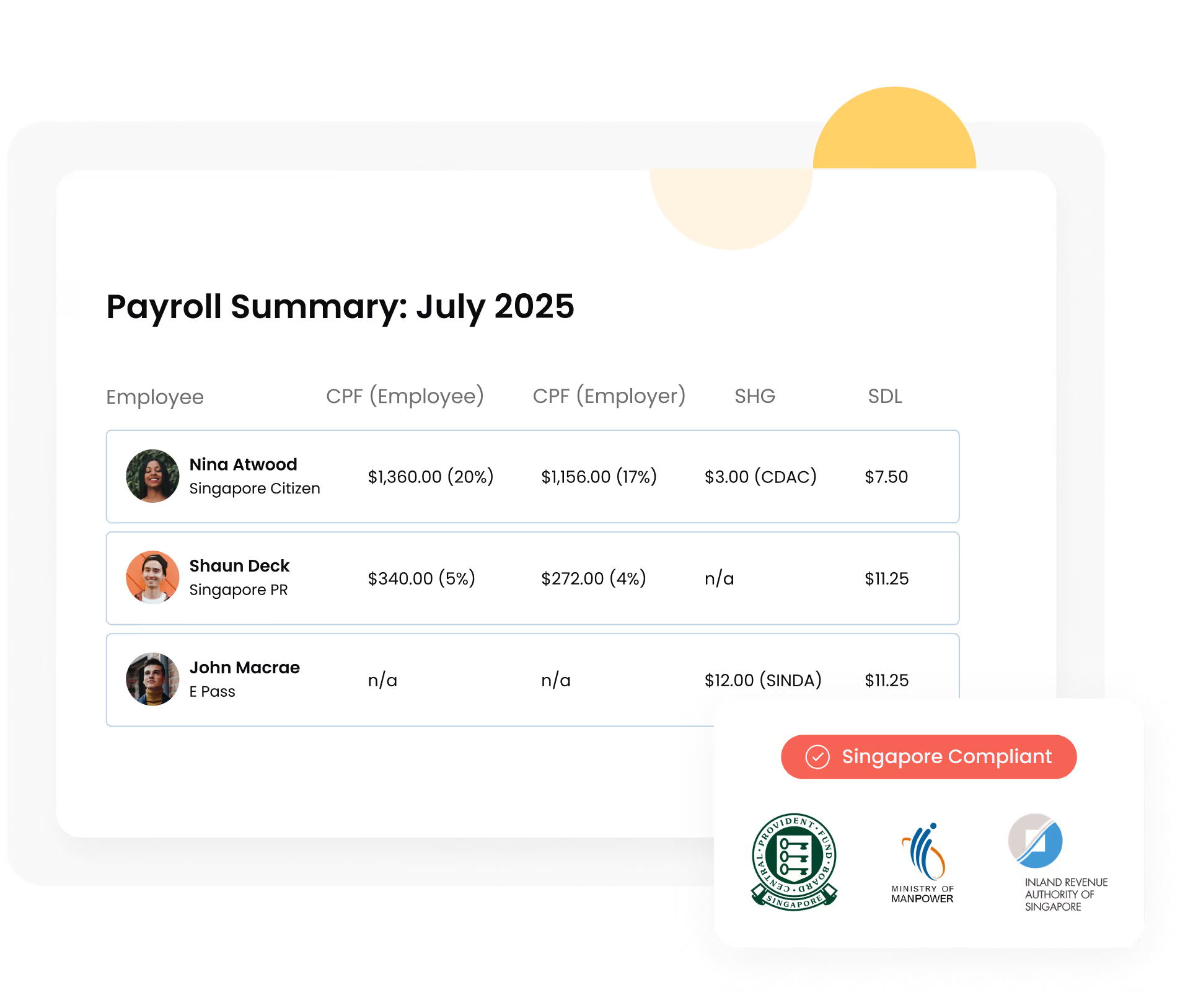
With HR tools like Omni HR, statutory contributions, including CPF employer contributions and employee CPF contributions, are automatically adjusted based on each employee's age and PR status, reducing payroll errors. If you engage freelancers, check whether contractors in Singapore attract CPF.
4. Historical context
CPF contribution rates for older workers and the CPF salary ceiling have risen steadily since 2023, in line with the recommendations of the Tripartite Workgroup on Older Workers.
For someone like Mr Tan, earning S$8,000 a month, that means:
- In 2024, CPF was only calculated on S$6,800.
- In 2025, CPF was calculated on S$7,400.
- From 2026 onwards, the full S$8,000 is CPF-liable.
The CPF contribution history shows a clear pattern: rates for older employees and the salary ceiling for higher earners have gone up steadily. With 2027, the rate for workers above 60 to 65 reaches its target of 26%. For employers, this means adjusting payroll systems early, because each change raises CPF employer contributions in a predictable but unavoidable way.
CPF Rate Comparison: 2026 vs 2027
Looking at CPF contribution rates side by side helps payroll teams spot the pressure points. With the CPF contribution rates for 2027, two things stand out:
- Higher contribution percentages for employees aged above 55 to 65 (from 34% to 35.5%, and from 25% to 26%).
- No change to the CPF salary ceilings: the Ordinary Wage ceiling stays at S$8,000 a month and the annual salary ceiling at S$102,000.
Here's the updated CPF contribution table comparing 2026 and 2027:
Rates apply to employees earning more than S$750 a month.
Why do these CPF contribution rates matter to your payroll team?
- CPF annual limit unchanged: the maximum CPF contribution remains S$37,740 a year, and the annual CPF salary ceiling is still S$102,000. With the Ordinary Wage ceiling at S$8,000, more of each employee's monthly salary is CPF-liable and less room remains for CPF on bonuses. This directly affects both the employer CPF contribution and the employee CPF contribution.
- Greater risk of payroll errors: when rates shift, payroll teams may misapply the CPF contribution table or confuse ordinary wages with additional wages. Errors in the CPF contribution statement can lead to over- or under-contributions.
- Automation reduces mistakes: with payroll tools like Omni HR, the latest CPF rates, contribution caps and monthly salary ceiling are built in. Every CPF contribution is calculated correctly, capped at the right limits and reflected in reports automatically, so the move from 2026 to 2027 rates is accurate for employers and employees.
Preparing for 2027 Changes
If 2026 was a big year for CPF, 2027 is just as important. The CPF Board has confirmed further contribution rate increases for senior workers from 1 January 2027, and employers need to prepare for adjustments that affect both budgets and compliance.
What's coming in 2027
- Higher CPF contribution rates for older workers: for employees aged above 55 to 60, the total rate rises by 1.5 percentage points to 35.5% (employer +0.5, employee +1). For those above 60 to 65, it rises by 1 percentage point to 26% (employer +0.5, employee +0.5).
- CPF Transition Offset: to cushion costs, employers receive a one-year CPF Transition Offset equal to half of the 2027 increase in employer contribution rates for Singapore Citizen and PR workers aged above 55 to 65. It is paid automatically.
- No change to the salary ceilings: the Ordinary Wage ceiling stays at S$8,000 a month and the annual salary ceiling at S$102,000.
- Cumulative effect of 2025 to 2027: for employees aged above 55 to 60, the total rate has risen from 31% in 2024 to 35.5% in 2027. Payroll teams should build these increases into longer-term manpower and financial planning, not just year-to-year adjustments.
Step-by-step transition planning for smooth compliance
- Review workforce demographics: look closely at how many employees you have aged above 55 to 65. This is where the 2027 increases hit, and where the retirement and re-employment age changes from July 2026 keep more employees on payroll for longer.
- Reforecast manpower costs: update your 2027 budget for the higher employer CPF contribution, net of the CPF Transition Offset. Even small percentage changes multiply quickly across larger workforces. Our HR budget guide can help.
- Check your payroll system early: make sure your HRIS or payroll software applies the 2027 age-band rates from the January 2027 payroll, alongside related deductions such as the Skills Development Levy and self-help group funds (CDAC, MENDAKI, SINDA).
- Communicate with employees: staff in their late 50s and early 60s will see slightly lower take-home pay when their employee CPF contribution rises. Clear communication before the first January payslip prevents confusion and builds trust.
- Run transition checks: in December 2026, run sample calculations using the 2027 CPF contribution rates, so January payroll holds no surprises. Mark the key dates in our free HR Calendar 2027, including IR8A filing.
Planning saves you the scramble. When you prepare for CPF adjustments early, beyond staying compliant, you show employees you care about their future. With Omni HR handling the upcoming changes automatically, contributions stay accurate and transitions stay smooth.
CPF Compliance Made Easy with Omni HR
Keeping track of changing CPF contribution rates can be confusing for Singapore HR teams. Between yearly rate changes for senior workers, the S$8,000 Ordinary Wage ceiling and the Additional Wage ceiling on bonuses, it is easy to make payroll errors. Misapplying an employer CPF contribution or forgetting to adjust an employee's CPF contribution after a birthday can result in inaccurate payments and compliance risk.

With Omni HR, CPF compliance is made easy:
- Automated CPF calculations: apply the right 2027 CPF rate across all employees and age groups, with age-band changes applied automatically after each birthday.
- Statutory filing handled: Omni HR payroll works out and files CPF, SDL and IR8A for you, with rules updated when regulations change.
- Built-in reporting: generate accurate CPF contribution statements and review the full CPF contribution table at any time.
- Ceiling and cap management: Omni HR applies the S$8,000 Ordinary Wage ceiling and tracks the Additional Wage ceiling across the year, so CPF is calculated only up to the correct cap.
- Integration across HR: connect payroll, time off and attendance so every CPF employer contribution and employee CPF contribution is correct and compliant.
- Local expertise: our local support and implementation team provides guidance on CPF contribution history, upcoming rate changes and compliance best practices. Prefer not to run payroll in-house? Our managed payroll services handle monthly processing and filings for you.
What sets Omni HR apart is not just CPF compliance. Omni HR is a modern, all-in-one HR platform built for growing teams in Singapore and beyond, recognized by G2 for ease of use. It replaces outdated legacy systems and separate tools with one compliant system for HR and payroll. See our guide to HR and payroll systems in Singapore.
“Omni provided us with a unified platform that integrated all essential HR functions into a single system. Payroll, leave tracking, and CPF contributions are now seamless.”
— Wenna Lee, HR Manager at IHRP
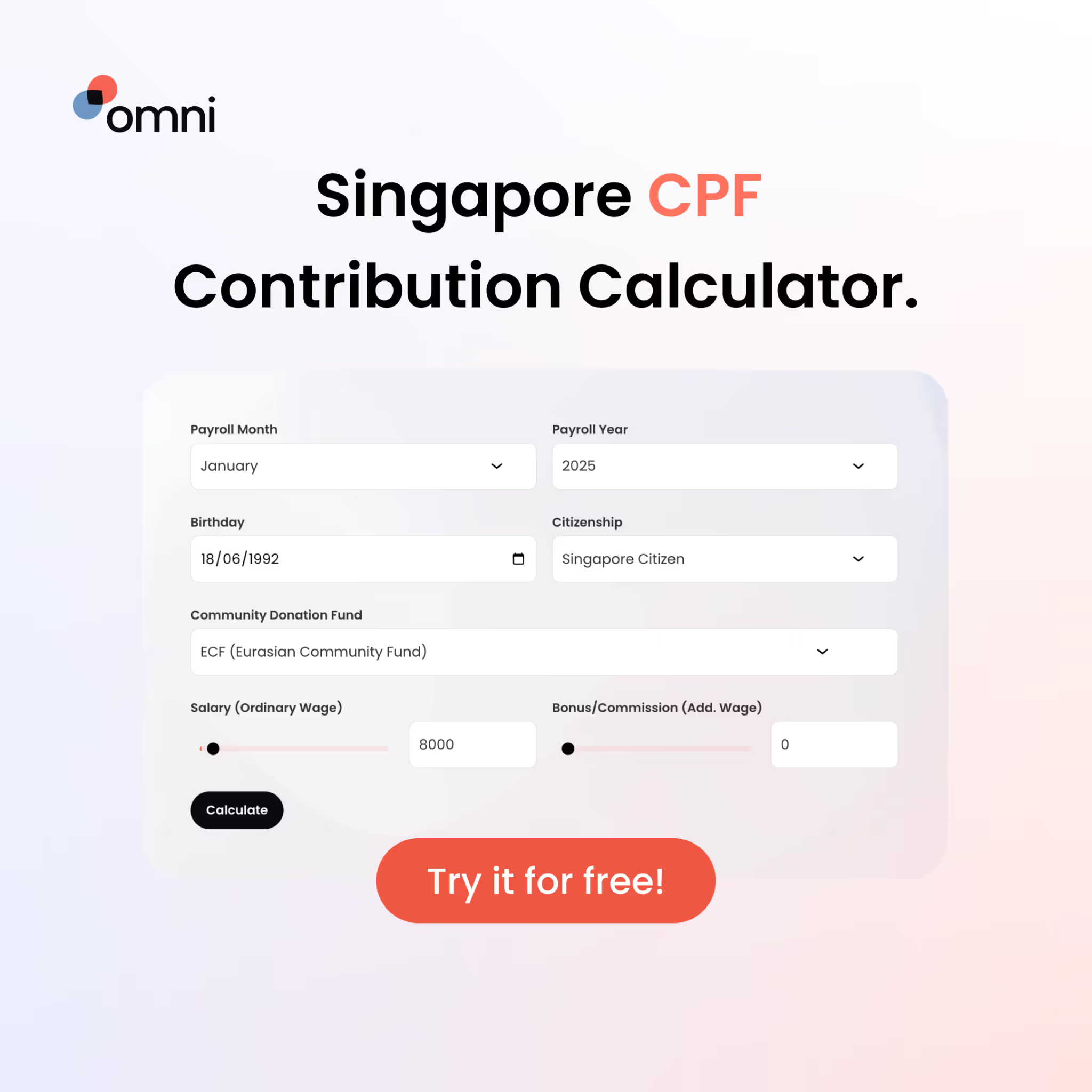
With Omni HR, you'll never miss a CPF contribution rate update, a ceiling change or a birthday-based adjustment again. Try our free CPF calculator to see exactly how much CPF applies to your employees, or book a demo with our team today.
Frequently Asked Questions
From 1 January 2027, total CPF contribution rates are 37% for employees aged 55 and below, 35.5% for above 55 to 60, 26% for above 60 to 65, 16.5% for above 65 to 70 and 12.5% for above 70. Only the two bands from above 55 to 65 change from 2026.
The employer CPF contribution ranges from 7.5% to 17% of wages, depending on the employee's age. For employees aged 55 and below, employers contribute 17%. For an employee earning S$8,000 a month, that is S$1,360. Use our CPF calculator to check your figures.
The maximum total CPF contribution is S$37,740 a year. This is 37% of the S$102,000 annual salary ceiling, which covers both ordinary wages (capped at S$8,000 a month) and additional wages such as bonuses.
Bonuses are Additional Wages. CPF applies only up to the Additional Wage ceiling: S$102,000 minus the total Ordinary Wages subject to CPF for the year. An employee earning S$8,000 a month has S$96,000 in Ordinary Wages, so only S$6,000 of bonuses attracts CPF. Read more about the Annual Wage Supplement.
New PRs contribute at graduated rates by default: in the first year, 4% from the employer and 5% from the employee; in the second year, 9% and 15% (for those aged 55 and below earning more than S$750). From the third year, full rates apply. See our guide to PR CPF contribution rates.
No. CPF applies only to Singapore Citizens and Permanent Residents. Foreign employees on work passes do not contribute to CPF, although employers may pay other levies, such as the Foreign Worker Levy, depending on the pass type.



.avif)
.avif)