.png)
Summary. From July 1, 2028, every organization in Singapore with more than 200 employees must have at least one HR professional certified at IHRP-CP level or higher. Recognized international equivalents also count. Singapore residents who certify between October 2026 and June 2028 get a S$100 government subsidy, bringing IHRP-CP fees to S$163.50. The mandate is designed to prepare employers for the Workplace Fairness Act, expected at the end of 2027, and upcoming Employment Act changes. This guide covers who's in scope, what it costs, the wider regulatory timeline, a 7-step plan to get your team ready and how Omni can help you stay compliant.
From July 1, 2028, every organization in Singapore with more than 200 employees must have at least one HR professional certified at the IHRP Certified Professional (IHRP-CP) level or higher. The Singapore government accepted this recommendation on September 24, 2026, and it will become mandatory.
If you lead HR at a growing Singapore company, or you're planning to set up a team here, this is one to put on your roadmap now. The good news: you have close to two years, the government is subsidizing the cost, and the steps to get ready are clear.
In this guide, we cover what the new rule says, why it's happening alongside Singapore's other big employment law changes, and a practical plan to prepare.
Where this rule comes from
The certification requirement is one of five recommendations from the Tripartite Workgroup on Human Capital Capability Development (TWG-HC). "Tripartite" means the workgroup brings together three parties: the Ministry of Manpower (MOM), the National Trades Union Congress (NTUC) and the Singapore National Employers Federation (SNEF).
The workgroup was set up in February 2025 to study how technology, longer working lives and workforce transformation are changing Singapore workplaces. Over 18 months, it consulted more than 1,000 employers, workers, HR professionals, trade associations, academics and government agencies. Its recommendations were released at the Institute for Human Resource Professionals' (IHRP) People Behind People Forum on September 24, 2026, and the government accepted all five.
Here's a snapshot of the full package:
- Singapore Opportunity Index (SOI). A national benchmark of the opportunities employers create for workers, built on verified administrative data. Employers will get reports and advisory support to interpret their results.
- Workforce planning support, especially for SMEs. SNEF and IHRP will publish practical guides. IHRP and startup co:grow are also piloting a model that matches SMEs with experienced HR leaders on a part-time, embedded basis.
- Responsible AI adoption in HR. The People-centred AI Transformation for HR (PATH) initiative will offer AI Starter Kits, 12 new IHRP AI Fluency Skills Badges, an NTUC playbook expected in Q1 2027, and guidance on fair, merit-based AI use in recruitment.
- A baseline for HR capability. The certification requirement this guide focuses on.
- Developing people leaders. The Human Capital Leadership Institute (HCLI) is designing a leadership program for senior HR and people leaders.
Together, the measures aim to benefit more than two million workers, support at least 2,000 enterprises and build the capabilities of 20,000 HR professionals and people leaders.
The certification requirement, explained
Who needs to comply. Organizations with more than 200 employees. If you're at 150 today and hiring steadily, run the numbers: crossing 200 before mid-2028 brings you into scope.
What counts. At least one suitable HR professional certified at the IHRP-CP level or higher. IHRP Senior Professional (IHRP-SP) and above also qualify. Equivalent certifications from international HR professional bodies that IHRP recognizes count too, subject to any bridging requirements IHRP sets.
When. The requirement becomes mandatory on July 1, 2028.
What it costs. For Singapore residents who certify between October 1, 2026 and June 30, 2028, the government adds a S$100 subsidy. That brings fees to:
Employers can also use their SkillsFuture Enterprise Credit to cover remaining out-of-pocket costs for their HR team.
Why the government is doing this. The stated goal is to help firms build progressive workplaces and good jobs, and to prepare them for the Workplace Fairness Act and upcoming Employment Act changes. In short, the law is getting more detailed, and the government wants a trained HR professional in every larger organization to handle it.
Why now: the bigger regulatory picture
The certification mandate lands in the middle of Singapore's busiest stretch of employment law reform in years. Here's how the key milestones line up:
The Workplace Fairness Act (WFA) is the one to watch most closely. It's Singapore's first law against workplace discrimination, and it covers decisions across the whole employee lifecycle: hiring, promotions, appraisals and dismissals. Once in force, employers must have a grievance handling process, and employees will be able to bring claims to the Employment Claims Tribunals for up to S$250,000.
The Employment Act is also under its first major review since 2019. Details are still to come, but expect changes to leave entitlements, overtime and business transfer provisions.
A certified HR professional gives your organization someone trained to interpret these changes and turn them into policy. That's the thinking behind making certification the baseline.
How to prepare: a 7-step plan
1. Confirm whether you're in scope
Check your current Singapore headcount and your hiring plan through mid-2028. If you're close to 200, plan as if you'll cross it. MOM is expected to share more detail on how headcount is counted, so keep an eye on official guidance.
2. Take stock of your HR team's credentials
List who on your team already holds IHRP certification or an international HR certification, and note when each one expires. Certifications are valid for three years, so one earned in late 2026 will need renewing before 2030.
3. Pick your certification candidates early
Choose at least one person to certify, ideally two. A backup protects you if your certified HR lead moves on. Prioritize the people who own policy, employee relations and compliance.
4. Use the subsidy window
The S$100 subsidy runs from October 1, 2026 to June 30, 2028, for Singapore residents. Certifying sooner means you capture the subsidy and give your team time to apply what they learn before the Workplace Fairness Act arrives. Remember to check your SkillsFuture Enterprise Credit for any remaining costs.
5. Build a training and renewal calendar
Treat certification like any other compliance deadline. Track exam dates, completion and renewal dates in one place, with automated reminders so nothing slips.
6. Get your house in order for the Workplace Fairness Act
Certification and fairness readiness go hand in hand. Start with:
- A written grievance handling process employees can use
- Structured, job-relevant criteria for hiring, promotion and performance decisions
- Clear records showing why each decision was made
- Manager training on fair employment practices
7. Plan for AI in HR responsibly
If you use AI in recruitment or people decisions, follow the PATH initiative and the upcoming guidance on responsible AI in hiring. Keep a human in the loop and document how AI-assisted decisions are reviewed.
Entering Singapore? Build this into your setup plan
If you're expanding into Singapore, you can design for these rules from day one instead of retrofitting later. A few things to keep in mind:
- Plan HR leadership around your headcount forecast. If your Singapore team could pass 200 by July 2028, budget for a certified HR professional as part of your entity setup.
- Check international certifications. If your regional HR lead holds a certification from an international HR body, confirm whether IHRP recognizes it and what bridging steps apply.
- Know who the subsidy covers. The S$100 subsidy is for Singapore residents, so factor full fees into your budget for anyone else.
- Localize your policies. Employee handbooks written for another market won't map neatly to Singapore. Grievance handling, fair hiring practices and leave entitlements all need a Singapore-specific version.
- Keep cross-border records consistent. When Singapore is one of several entities, keep each entity's compliance data separate while giving regional leaders a single view.
For a wider look at hiring in Singapore, see our Singapore hiring guide.
How Omni helps you stay ahead of Singapore's HR certification changes
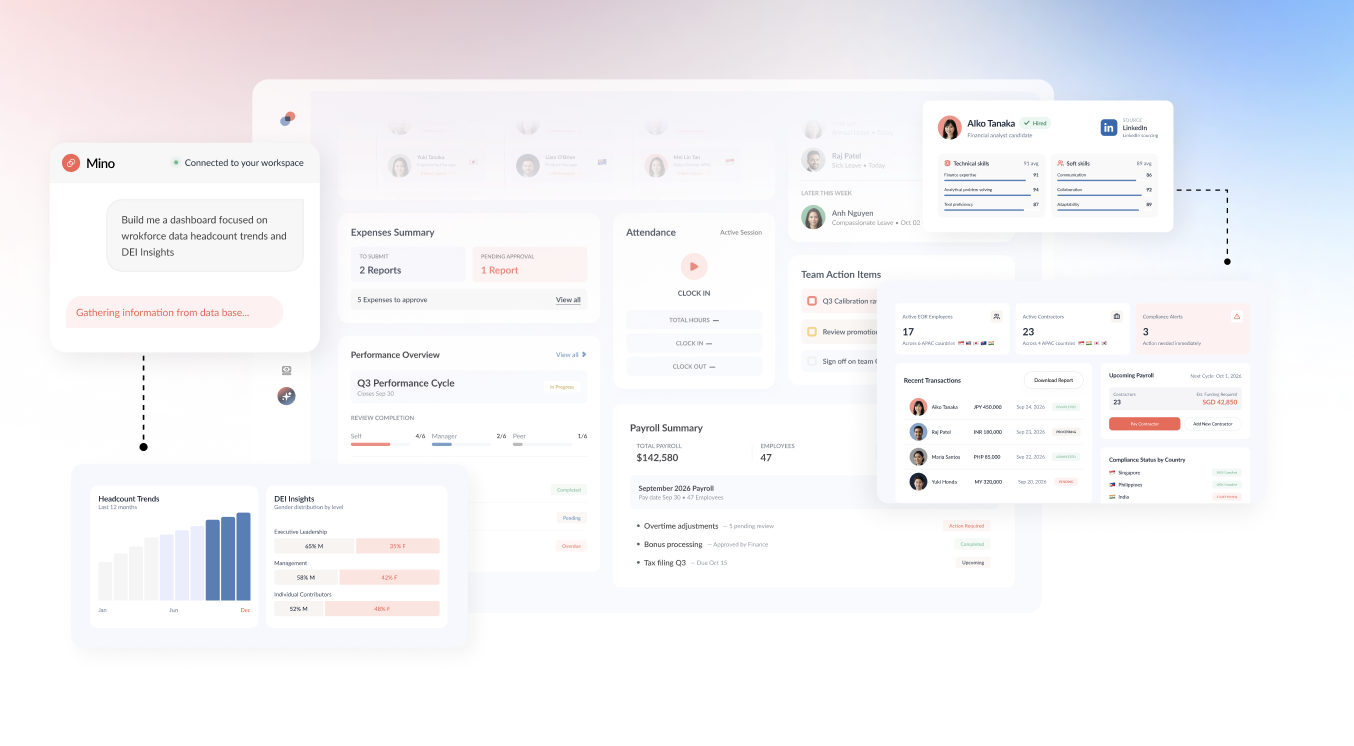
Certification gives your team the knowledge. The right system gives them the time and the records to put it into practice. Omni is an all-in-one HRIS and multi-country payroll platform built for multi-country, multi-entity operations across Asia, and we're designed to fit how your team works as regulations change.
Track certifications and renewals in one place. Our customizable employee database lets you add fields for HR certifications, levels and expiry dates.
Document fair, consistent decisions. Performance reviews, promotion records and employee documents live in one secure system. When the Workplace Fairness Act asks "why was this decision made?", you'll have the records to answer.
Stay compliant as rules shift. From parental leave to retirement age changes, our time off and payroll modules are built to keep pace with Singapore regulations, backed by a team on the ground in key Asia markets.
Manage Singapore alongside every other market. If Singapore is one of several entities, Omni handles multi-country payroll and HR across 200+ countries, with access controls so each entity's data stays where it belongs.
Get answers faster with AI. Omni HR's AI features help managers pull workforce insights, like headcount trends that show when you'll cross the 200-employee mark, and give employees quick answers to policy questions.
Want to see how Omni fits your team? Book a demo or start a 7-day free trial.
FAQ
When does Singapore's HR certification requirement start? July 1, 2028. From that date, organizations with more than 200 employees must have at least one HR professional certified at IHRP-CP level or higher.
What is IHRP-CP? IHRP Certified Professional is a certification from the Institute for Human Resource Professionals, Singapore's national HR professional body. It validates core HR competencies. IHRP Senior Professional (IHRP-SP) is the next level up and also meets the requirement.
Does an international HR certification count? Yes, if it comes from an international HR professional body that IHRP recognizes. Some certifications may need bridging steps first.
How much does certification cost? With the S$100 government subsidy for Singapore residents, IHRP-CP costs S$163.50 and IHRP-SP costs S$272.50. Both are valid for three years. Employers can use SkillsFuture Enterprise Credit for remaining costs.
My company has fewer than 200 employees. Does this affect me? Not directly. Still, the Workplace Fairness Act applies to employers with 25 or more employees, so building HR capability now is a smart move as you grow.
What details are still to come? MOM has yet to publish the full implementation details, such as how headcount is counted and how compliance will be checked. We'll update this guide as guidance is released.
.png)


.png)