






















If your Philippine people are employed through Multiplier and you have no Philippine entity, staying is usually right. If you run Philippine payroll on your own books and your recurring problem is how long a Philippine payroll question takes to resolve, Omni HR is the better fit. This guide compares the two on statutory depth, support, and cost, using Multiplier's own published pages.
The Short Answer
Move if your Philippine payroll runs on your own entity and your open tickets are about Philippine rules. Stay if Multiplier employs your Filipino staff for you, or if most of your headcount sits outside Asia. The deciding factor is rarely price. It is who answers when a Philippine payroll question lands.
Multiplier is a substantial platform. They hold 4.7 on G2 across 1,499 reviews as of 26 October 2026, they publish their Employer of Record price openly, and their FAQ answers the minimum-headcount question directly: "No. You can hire a single employee." They sell Employer of Record, Global Payroll, Contractor of Record, Contractors and Immigration as separate purchasable products. None of that is in dispute here.
What follows is the narrower question a team already on Multiplier is actually asking.
One Thing to Know About Omni HR Before You Read Further
Omni HR does not offer 24-hour support. If your Philippine payroll operation depends on someone being reachable at 3am Manila time, we are not the right answer and the rest of this page will not change that.
What we do offer is same-day responses during Asian business hours over WhatsApp, Slack and email. That is how we currently perform. It is not a contractual commitment and we do not publish a response time, which is worth saying plainly before we spend a section on support. Neither vendor on this page publishes one.
Their Philippine Pages Call It PAYE
Multiplier's Philippine Employer of Record page names SSS, PhilHealth and Pag-IBIG, and ties all three to Multiplier by name. That is real coverage, published on their own surface, and more than several competitors put in writing.
As of 26 October 2026, their Philippine payroll guide names the Bureau of Internal Revenue only once, as a company registration step. Form 2316, Form 1601-C and the Alphalist do not appear. The term used for Philippine income tax is PAYE.
PAYE is the British, Irish and New Zealand term. The Philippines does not operate PAYE. It operates BIR withholding tax on compensation, and the machinery is genuinely different in ways that show up in a payroll run. Under RR 11-2018, year-end annualisation has to absorb compensation paid by a previous employer if someone changed jobs mid-year, which means the system needs a field for pay it never processed. The same regulation requires Form 2316 for every employee by 31 January, issued in triplicate, with the employer copy retained for ten years. Withholding runs off the graduated table effective 1 January 2023, with the payroll-period tables published as an annex.
None of that is how PAYE works. A vendor describing your Philippine tax obligation in PAYE terms is describing a different country's mechanism, and that is a reasonable thing to raise with them directly.
This is worth stating carefully. It is a finding about what their pages say, not a claim about what their product does internally. We have not run their Philippine payroll and we are not going to guess at it. What we can say is that a company running Philippine payroll on its own entity cannot confirm from Multiplier's own site how BIR withholding, annualisation or Form 2316 are handled, because their pages do not describe them.
Omni HR runs native local payroll in the Philippines covering SSS, PhilHealth, Pag-IBIG and BIR, with the same native coverage in Singapore, Malaysia and Hong Kong.
Support Is Where This Decision Actually Gets Made
Two things sit on the record here, and they point the same way, which is what makes it worth writing down rather than asserting.
First, they promise 24/7 but publish no response time. Their pricing page promises "24/7 human support from local HR and legal experts" on the Contractor of Record card. Published channels are phone and email. There is no chat, Slack or WhatsApp, the help centre is a thin portal with two hub links, and no response time is published anywhere.
Second, two G2 reviews describe a specific gap, and it is not about hours. One G2 reviewer, who rated Multiplier five out of five, wrote:
"we have a team member in the Philippines who has had issues with their pay... the CSR is not a native Filipino and often doesn't know the basic labor laws that apply in the country"
G2 review, 5 out of 5, 13 March 2026
Another G2 reviewer, who rated Multiplier four out of five, wrote:
"The downside is I don't have a Philippine-based POC... I had to raise a ticket and wait for 1-2 business days"
G2 review, 4 out of 5, 19 May 2026
Read those two together and the complaint is not coverage hours. Multiplier is headquartered in Singapore and there is no basis for saying they are absent from Asian hours. The complaint is that the person who picks up does not know Philippine labour law, and that resolving a Philippine question means a ticket and a wait. That is a presence and response-time problem, not a timezone problem, and it is exactly how buyers put it to us: whether there is anyone on the ground in their country, and how fast the answer comes back.
Be fair about the wider picture. Support responsiveness is Multiplier's most-tagged strength on G2, and not by a small margin: Helpful and Customer Support are the two largest tags on the listing. Both things are true at once. They are widely rated as responsive, and these two reviewers describe a gap in local knowledge and no in-country point of contact. G2's auto-tags also carry Delays.
Omni HR answers over WhatsApp, Slack and email, and in practice responds the same day during Asian business hours. As above, that is current performance rather than a commitment, and we would rather say so than dress it up as a service level we do not publish either. The difference worth weighing is not the hours on the tin. It is whether a Philippine payroll question goes into a ticket queue or into a Slack thread.
The 13th Month Line on Their Own Guide
Multiplier's Philippine guide gets the core rule right: 13th month pay is mandatory and due by 24 December. The same guide also says employers "commonly pay 13th and 14th-month pay semi-annually in July and December." That second line describes what some companies choose to do, not what the law requires.
Presidential Decree 851 provides a single 13th month payment, equal to one twelfth of total basic salary earned during the year, for rank-and-file employees with at least one month of service, paid not later than 24 December. There is no statutory 14th month. A payroll system has to treat the required 13th month and an optional 14th month as two different things. The source is DOLE's Handbook on Workers' Statutory Monetary Benefits, 2024 edition.
There is also a filing step that gets missed because it is a report rather than a payment: a 13th month compliance report is due to reports.dole.gov.ph by 15 January. If your current system pays the benefit correctly and never prompts anyone to file the report, you have a gap that no payslip will reveal.
For a sense of whether naming forms is a fair bar to hold anyone to, another multi-country platform's Philippine page already publishes BIR Form 1601-C, SSS R3 and R5, PhilHealth ER2-RF1 and the Alphalist by name. So the standard is one that a comparable vendor already meets. We are not inventing it.
The Parallel Run: Nine Things to Test Before You Switch Anything
If you are considering a move, do not take anyone's word for statutory handling, ours included. Run one month in parallel and check these nine. Each one is a place where a system that is nearly right produces a number that is wrong.
1. SSS as a table, not a percentage. Contributions are 15% of the Monthly Salary Credit, split 10% employer and 5% employee, on an MSC floor of P5,000 and a ceiling of P35,000 in P500 steps, effective January 2025 under SSS Circular 2024-006 and RA 11199. A system that multiplies gross pay by a rate lands near the right answer and almost never on it.
2. The second cap inside the first. Regular SS stops at an MSC of P20,000. The band from P20,001 to P35,000 goes into the MPF or WISP column instead, credited to the employee's individual account, capped at P1,500 employer and P750 employee. Total employer maximum is P3,530 and employee P1,750. Take one senior employee above P20,000 and check the split lands in two columns rather than one.
3. Employers' Compensation is employer-only. It steps from P10 to P30 at an MSC of P15,000. It should never appear as an employee deduction on a payslip.
4. PhilHealth's base surviving an absence. 5.0% split evenly, on a floor of P10,000 and a ceiling of P100,000. The base is Monthly Basic Salary, which excludes commission, overtime, allowances, 13th month and bonuses. It is also not reduced by undertime, tardiness, leave without pay or absences. This is the single easiest one to catch: put someone on unpaid leave for three days and see whether their PhilHealth deduction moves. It should not.
5. Pag-IBIG's cap. 2% plus 2%, on a monthly fund salary cap of P10,000, so P200 from each side, effective February 2024 under HDMF Circular 460. Anyone earning above P10,000 should show the same figure as everyone else above it.
6. Annualisation reaching backwards. Anyone who joined mid-year brings their previous employer's compensation into your year-end computation. The system needs somewhere to enter pay it never ran, and someone has to be prompted to enter it. Test with a mid-year joiner rather than a founder.
7. Form 2316 mechanics. Every employee gets one by 31 January, in triplicate, with the employer copy retained for ten years. Check the system produces it as a document you can hand over, not as a report you would have to rebuild.
8. The P90,000 exemption as a shared bucket. It covers 13th month and other benefits combined, so de minimis excess quietly eats into it. That connects to a change most vendor content has not caught up with. RR No. 29-2025, issued 22 December 2025, reset the de minimis ceilings from January 2026: rice at P2,500 a month, uniform at P8,000 a year, medical assistance at P12,000 a year, laundry at P400 a month, Christmas gifts at P6,000 a year, and leave monetisation at 12 days. The overtime meal allowance is pegged at 30% of the regional minimum wage, which is why the next item moves it as well.
9. The July 2026 wage order, and the two thresholds behind it. Wage Order NCR-27 raised the NCR minimum wage from P695 to P755 on 25 July 2026, with a further step to P780 on 20 January 2027. That single change moves overtime, night differential, holiday pay, 13th month and the de minimis meal cap at the same time. While you are there, note that the Labor Code carries two different small-establishment thresholds: night differential exempts establishments with five or fewer workers under Article 86, and holiday pay exempts those with fewer than ten under Article 94. A system with one "small employer" switch gets one of the two wrong.
None of these are accusations against Multiplier. They are the tests, and we would rather you run them on us too.
Cost, If You Do Move
Published Multiplier figures, page-read 24 August 2026.
| Multiplier product | Published price |
|---|---|
| Global Payroll | $20 per person/mo |
| Employer of Record Core | $459 per employee/mo, annual billing ($499 monthly) |
| Employer of Record Growth | $519 per employee/mo, annual billing ($559 monthly) |
| Contractor of Record | $400 per contractor/mo |
| Contractors | $40 per month |
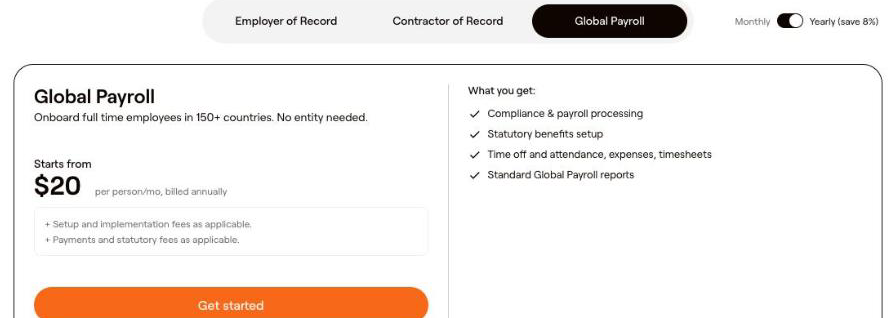
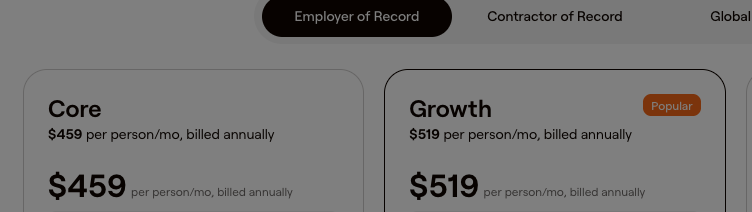
The only like-for-like line here is the first one. Global Payroll at $20 per person per month against Omni HR at USD 3 per employee per month for the core platform plus payroll software from USD 2, with no published setup fee. The Employer of Record figures are a different kind of purchase, because you are buying an employment relationship rather than a payroll engine, and lining $459 up against $5 would be dishonest.
Two things a Philippine buyer should notice on their pricing page regardless. Every tier carries unpriced add-ons, described in their own words as "+ Compliance mandated add-ons / + Implementation fee as applicable." And the page states that around 11% of supported countries have adjusted pricing without naming which ones, so a Philippine buyer cannot confirm from the page that the headline rate applies to them.
What Multiplier Does Better
Stated plainly, because a comparison that concedes nothing is not worth reading.
- Geographic reach. Their own pricing page cites 100+ countries for payroll. If a meaningful share of your people sit outside Asia, that beats an Asia-focused platform and it is not close.
- A published Employer of Record price with no minimum headcount. $459 for Core, $519 for Growth, and their FAQ confirms you can hire a single employee. Most of this category will not quote you without a call.
- Product breadth for companies without entities. Employer of Record, Contractor of Record, Contractors, Immigration and localized benefits as separate SKUs, plus a product for countries where they have no entity of their own.
- A shipped AI assistant. "Ask Multiplier" exists and works, and they under-market it. It appears in an editorial article on payroll and AI rather than on any product or pricing page.
Side by Side
| Omni HR | Multiplier | |
|---|---|---|
| Philippine statutory schemes named on their own pages | SSS, PhilHealth, Pag-IBIG, BIR | SSS, PhilHealth, Pag-IBIG, tied to Multiplier by name on the PH Employer of Record page |
| Philippine income tax vocabulary | BIR withholding | Described as PAYE. BIR named only as a registration step. Form 2316, Form 1601-C and the Alphalist do not appear, as of 26 October 2026 |
| 13th month on their own guide | Per PD 851 | Mandatory by 24 December, stated correctly. Grouped with an optional 14th month |
| Support channels | WhatsApp, Slack, email | Phone and email |
| Response time | Same day in Asian business hours in current practice, not a commitment, none published | None published. Pricing page promises 24/7 human support |
| 24-hour support | No | Claimed on two surfaces, contradicted on a third |
| Coverage outside the Philippines | Native payroll in MY, SG, HK. Managed payroll across 20+ Asian countries. EOR and contractor payments across Asia | 100+ countries for payroll per their pricing page. Genuinely wider than ours |
| AI | Mino agentic assistant and Connect AI, shipped and available today, plus an AI-assisted ATS | "Ask Multiplier" chatbot, documented in an editorial article |
| Published price | USD 3/employee/mo core platform plus payroll software from USD 2, no published setup fee | Global Payroll $20/person/mo. EOR from $459/employee/mo, plus unpriced compliance add-ons and implementation fee |
| Rating | 4.8/5 (G2) | 4.7/5 across 1,499 reviews (G2). 4.4/5 across 44 reviews (Gartner Digital Markets, syndicated to Capterra, GetApp and Software Advice) |
Two Things to Know About That 4.7
It is a big number and it deserves to be read properly rather than waved away.
Nearly every G2 review we read carries an Incentivized or Source: Seller invite tag. The smaller, organic-heavier Gartner Digital Markets pool sits 0.3 lower at 4.4 across 44 reviews, and that single pool is syndicated three ways to Capterra, GetApp and Software Advice, so it counts once rather than three times.
The more useful detail for a buyer: a large share of the G2 reviewers are people employed through Multiplier rather than companies buying it. Job titles like Reservations Specialist, writing about payslips and health cover. Twenty-seven of the reviews we read in August 2026 mention the Philippines, they are substantively Philippine, and most are written by employees rather than the finance team running payroll. Both experiences are valid. Only one of them tells you what your month-end will feel like.
On per-feature scores, GetApp is the only source with enough responses to be worth printing, and only two rows clear a usable sample: payroll management at 4.5 (n=18) and self-service portal at 4.4 (n=18). Their lowest sub-score across that pool is value for money at 4.2.
Stay or Move
| Stay on Multiplier if... | Move to Omni HR if... |
|---|---|
| You have no Philippine entity and they employ your Filipino staff for you | You run Philippine payroll on your own entity and want SSS, PhilHealth, Pag-IBIG and BIR handled natively |
| A meaningful share of your headcount sits outside Asia | The Philippines is your base, or the Philippines plus other Asian markets |
| You need 24-hour coverage, which we do not offer | Same-day answers during Asian business hours are enough |
| Phone and email suit how your team escalates | You would rather ask a Philippine payroll question in Slack or WhatsApp than open a ticket |
| Your Philippine population is mostly contractors | You expect worker types to change, and want contractors, EOR and own-entity payroll on one platform |
| A large public review pool is what you weigh most | You want the person answering to know Philippine labour law |
Book a demo to see Omni HR's Philippine payroll in action.
Further Reading
Frequently Asked Questions
Only if you run Philippine payroll on your own entity. If Multiplier employs your Filipino staff for you, moving means changing the employment relationship, which is a much larger decision than changing payroll software. The clearest reason to move is that your recurring problem is how long a Philippine payroll question takes to resolve.
Their Philippine payroll guide names SSS, PhilHealth and Pag-IBIG, and describes income tax as PAYE. As of 26 October 2026 it names the Bureau of Internal Revenue only once, as a company registration step, and Form 2316 and Form 1601-C do not appear. That is what their published pages say, not a statement about what their product does internally, so ask them directly.
PAYE is the British, Irish and New Zealand term for withholding income tax at source. The Philippines does not operate PAYE. It operates BIR withholding tax on compensation, with a year-end annualisation that must absorb pay from a prior employer, a Form 2316 issued to every employee by 31 January, and an Alphalist. The mechanics and the deadlines are different.
No. Omni HR responds the same day during Asian business hours over WhatsApp, Slack and email. That is current performance rather than a contractual commitment, and we do not publish a response time. Multiplier does not publish one either, though their pricing page promises 24/7 human support.
Two G2 reviews stand out, and both are positive overall. One G2 reviewer, rating Multiplier five out of five, wrote that the agent handling a Philippine pay issue "is not a native Filipino and often doesn't know the basic labor laws that apply in the country." Another G2 reviewer, rating it four out of five, wrote "I don't have a Philippine-based POC" and described a one to two business day ticket wait. For balance, support responsiveness is Multiplier's most-tagged strength on G2 overall, with Helpful and Customer Support its two largest tags.
Presidential Decree 851 requires one payment, one twelfth of total basic salary earned during the year, for rank-and-file employees with at least one month of service, paid not later than 24 December. There is no statutory 14th month. Multiplier's Philippine guide states the 24 December rule correctly, and also says employers "commonly pay 13th and 14th-month pay semi-annually in July and December", which describes common practice rather than the law. A compliance report is also due to reports.dole.gov.ph by 15 January.
Nine things. SSS calculated from the band table rather than a percentage, the MPF or WISP split above an MSC of P20,000, Employers' Compensation appearing as employer-only, PhilHealth not shrinking when someone takes unpaid leave, Pag-IBIG capping at P200 each side, annualisation accepting a prior employer's compensation, Form 2316 produced as a handover document, the P90,000 exemption treated as one shared bucket across 13th month and other benefits, and the July 2026 NCR wage order flowing through overtime, night differential and holiday pay.
The comparable line is Multiplier's Global Payroll at $20 per person per month against Omni HR at USD 3 per employee per month for the core platform plus payroll software from USD 2, with no published setup fee. Multiplier's Employer of Record pricing starts at $459 per employee per month for Core on annual billing, but that buys an employment relationship rather than payroll software and is not a like-for-like comparison. Every Multiplier tier adds unpriced compliance add-ons and an implementation fee, and their pricing page notes that around 11% of supported countries have adjusted pricing without naming them.