





















Key takeaways
- Mandatory: Philippines, Indonesia, India.
- Contractual or customary: Singapore, Malaysia, Hong Kong, Vietnam, and Thailand.
- Next deadlines: 18 December 2026 (Christmas THR in Indonesia), 24 December 2026 (Philippine 13th month pay), before 6 February 2027 (Lunar New Year payouts).
- What changes in 2027: higher CPF rates for Singapore employees above 55 to 65 from 1 January 2027, and India's bonus ceilings formally notified.
- Contribution rules differ by market: Singapore applies the Central Provident Fund (CPF) Additional Wage ceiling, Malaysia applies the Employees Provident Fund (EPF) but not the Social Security Organisation (SOCSO) or Employment Insurance System (EIS), and Hong Kong counts contractual bonuses as Mandatory Provident Fund (MPF) relevant income.
- Why it matters for payroll
- A missed Philippine deadline is a labour standards violation that Department of Labor and Employment (DOLE) field offices actively monitor.
- A Hong Kong end of year payment promised in a contract is enforceable under the Employment Ordinance.
- A Singapore bonus that exceeds the CPF Additional Wage ceiling is a contribution error the employer has to correct.
13th month pay is mandatory in three Asian markets including the Philippines (Presidential Decree No. 851), Indonesia (Tunjangan Hari Raya, a religious holiday allowance) and India (statutory bonus under the Code on Wages, 2019).
In Singapore, Malaysia, Hong Kong, Vietnam, and Thailand, it is not required by law, but it becomes binding once written into a contract or handbook.
For Philippine computation examples, see our 13th month pay computation guide or run the numbers in the 13th month pay calculator.
13th Month Pay in Asia At A Glance
13th Month Pay and Statutory Bonus Calendar: December 2026 to December 2027
What is 13th month pay, and how is it different from a bonus?
13th month pay is an additional payment, usually equal to one month of basic salary, paid once a year on top of 12 regular monthly salaries. In Asia it is a legal requirement in the Philippines and a contractual or customary payment in most other markets.
Three types of year-end payment are often confused. The category, not the label, decides whether you must pay:
Note:
- A payment called a "Christmas bonus" can still count toward a statutory obligation.
- A "13th month" written into a contract is enforceable even where no law requires it, so the first control is the wording in your employment contract.
- 14th month pay is not mandatory in any market in this guide. Some employers in Hong Kong, Singapore and the Philippines offer one by contract, usually as a mid-year or performance-linked payment.
Where is 13th month pay mandatory in Asia?
Is 13th month pay mandatory in the Philippines?
Yes. Under Presidential Decree No. 851, private-sector employers must pay every rank-and-file employee at least one-twelfth (1/12) of the total basic salary earned in the calendar year, on or before 24 December. DOLE restated the rule in Labor Advisory No. 16, Series of 2025 and ordered field offices to monitor compliance.
Worked example
An employee on PHP 30,000 basic a month who joined on 1 April 2026, with no unpaid absences, earns PHP 270,000 basic salary for the year (9 × 30,000).
Their 2026 13th month pay is PHP 270,000 ÷ 12 = PHP 22,500, due by 24 December 2026.
Watch for 2027
Bills to raise the tax-exempt ceiling to PHP 150,000 were filed in February 2026 but had not become law as of October 2026, so PHP 90,000 still applies.
How Omni HR helps
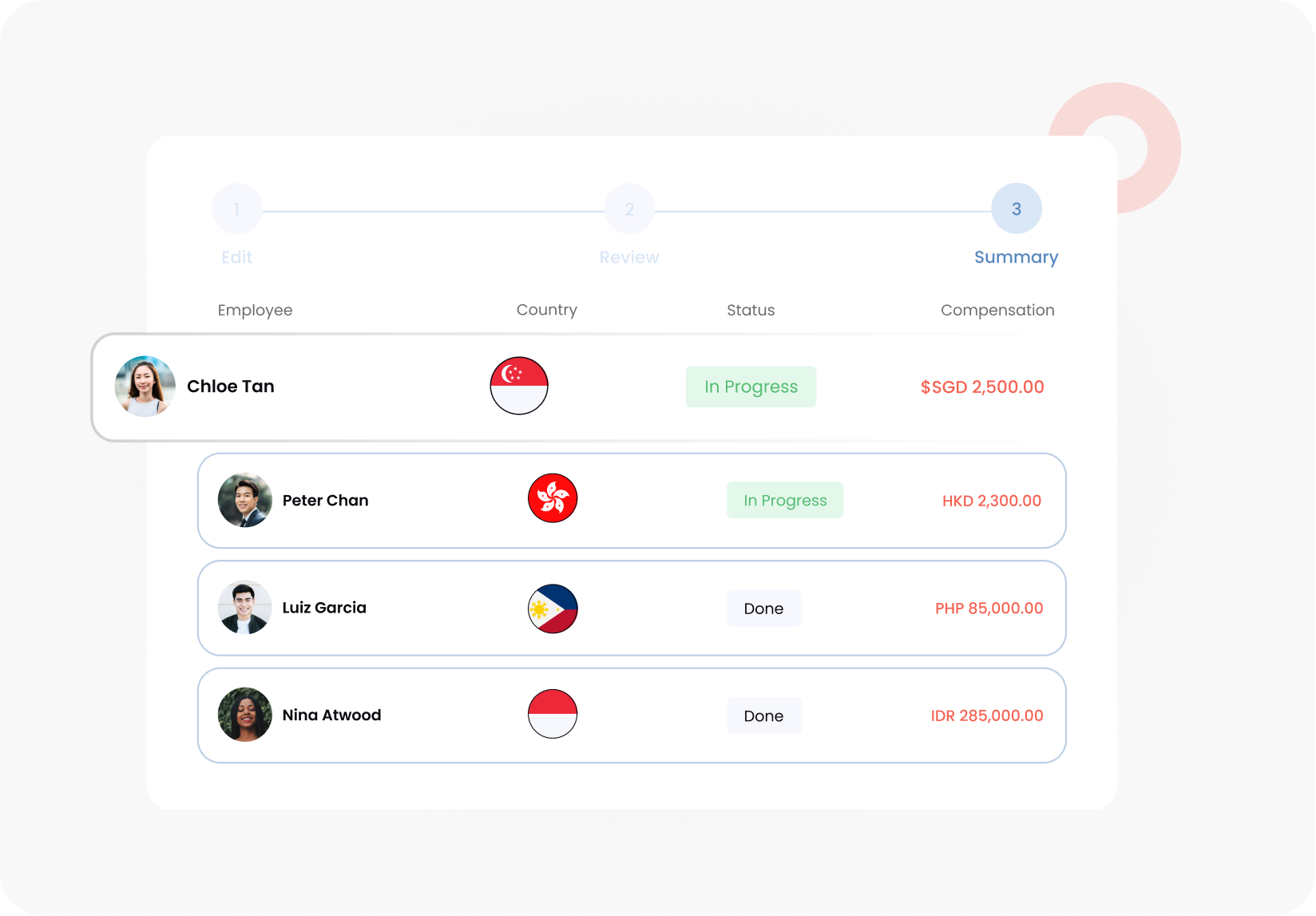
Omni HR calculates 13th month pay from basic salary actually earned and pro-rates it automatically for mid-year joiners and leavers, so final pay already carries the accrued amount.
Is THR mandatory in Indonesia?
Yes. Tunjangan Hari Raya (THR) is Indonesia's mandatory religious holiday allowance. Under Minister of Manpower Regulation No. 6 of 2016, employers must pay one month's wages to employees with 12 months' service, no later than seven days before the employee's own religious holiday.
Worked example
An employee earning IDR 6,000,000 a month with 6 months' service at the holiday receives (6 ÷ 12) × 6,000,000 = IDR 3,000,000.
Watch for 2027
Idul Fitri falls on 10 March 2027, so THR for Muslim employees is due by 3 March 2027. All other 2027 THR deadlines are in the calendar above. The Ministry of Manpower usually restates the rules in a THR circular each year before Eid.
Is a statutory bonus mandatory in India?
Yes, for covered employees. India's statutory bonus moved from the Payment of Bonus Act, 1965 to Chapter IV of the Code on Wages, 2019, in force from 21 November 2025. The Centre formally notified the eligibility and calculation ceilings on 25 August 2026, effective from 21 November 2025
Worked example
Where the INR 7,000 cap applies, the annual base is INR 84,000 (7,000 × 12).
The minimum bonus is 8.33% = INR 6,997 and the maximum is 20% = INR 16,800.
A higher state minimum wage raises both figures.
Where is 13th month pay contractual or customary?
Is 13th month pay mandatory in Hong Kong?
No, but once a contract promises an end of year payment (double pay, 13th month or a fixed year-end bonus), Part IIA of the Employment Ordinance (Cap. 57) regulates it. The Labour Department FAQ confirms the employer is then contractually bound to pay.
Who gets an end of year payment?
Other rules
- Amount if the contract is silent: average monthly wages over the 12 months before the payment is due.
- Probation: up to three months of probation is excluded when testing eligibility, but counts when calculating the pro rata amount.
- Payment period: the period in the contract, or the lunar year if none is stated.
- MPF: a contractual end of year payment counts as relevant income for Mandatory Provident Fund (MPF) contributions and should be itemised on the payslip.
- Penalty: failure to pay is a wage offence, with a maximum fine of HKD 50,000.
Is 13th month pay (AWS) mandatory in Singapore?
No. The Annual Wage Supplement (AWS) is Singapore's 13th month payment, and the Ministry of Manpower (MOM) states it is not compulsory. It depends on the employment contract or collective agreement. If business results are exceptionally poor, an employer can negotiate a lower AWS with employees or the union.
The bigger compliance issue is CPF, Singapore's mandatory savings scheme for citizens and permanent residents. AWS and bonuses are Additional Wages (AW), and CPF is payable only up to the AW ceiling:
AW ceiling = SGD 102,000 − total Ordinary Wages subject to CPF for the year
Worked example: how much of a one-month AWS attracts CPF in 2026?
With the Ordinary Wage ceiling at SGD 8,000 a month from 1 January 2026, high earners now attract CPF on far less of their bonus
What changes in 2027
- AWS paid in December 2026 counts against the 2026 AW ceiling at 2026 rates.
- AWS paid from January 2027 counts against the 2027 ceiling, at the new rates for employees above 55 to 65.
- Recalculate the AW ceiling when Ordinary Wages change mid-year or the employee leaves.
How Omni HR helps
Omni HR classifies AWS and bonuses as Additional Wages, applies the CPF AW ceiling for each employee and updates rate tables when the CPF Board changes them, including the January 2027 senior rates.
Read next: Annual Wage Supplement in Singapore: CPF Contributions and How to Calculate Your AWS Salary
Is a 13th month bonus mandatory in Malaysia?
No. Malaysia has no statutory 13th month pay or year-end bonus, and the Employment Act 1955 definition of wages excludes annual bonuses. A bonus becomes enforceable only through the contract, handbook or a collective agreement.
How a bonus is treated when you pay one
Watch for 2027
Budget 2027 (tabled 9 October 2026) proposes a RM2,000 minimum wage and automatic EPF membership at 18, subject to legislation. Bonuses set as a multiple of monthly pay rise with any wage increase.
Is 13th month pay mandatory in Vietnam?
No. Vietnam's Labour Code 2019 does not mention a "13th month salary". Article 104 treats all bonuses, including Tet bonuses, as payments the employer decides based on business results and work performance.
- Form: cash or in kind.
- When it becomes binding: once written into a contract or collective agreement.
- Policy obligation: the bonus policy must be published at the workplace after consulting the employee representative organisation; non-compliance carries fines of VND 10 to 20 million.
- Timing: usually paid before Tet, which falls on 6 February 2027.
Is a bonus mandatory in Thailand?
No. Thailand's Labour Protection Act B.E. 2541 (1998) does not require a bonus.
- When it becomes binding: once written into work rules or a contract, or once announced conditions are met.
- Tax: bonuses are taxable income.
What Changes For 13th Month Pay in Asia in 2027 and Beyond
The statutory rules above are stable, but the numbers around them move every year. These are the changes confirmed or pending for the 2027 cycle, as of October 2026.
Beyond 2027, four checkpoints recur every year:
- September: Indonesia's SKB sets next year's holidays and THR deadlines.
- October to November: Malaysia's national budget and DOLE's annual 13th month advisory.
- November: India's statutory bonus deadline for the previous financial year.
- January: CPF rate and ceiling changes take effect, and the Lunar New Year payout window opens.
How To Run 13th Month Pay Across Multi-Country Payroll
The payment rules are local, but the failure points are regional: different calendars, different wage bases and contribution rules that change every January. Five steps keep statutory bonuses compliant across markets.
- Classify every payment by market. Label each bonus as statutory, contractual or discretionary in each country, and make sure the employment contract matches. A Hong Kong double pay clause and a Philippine 13th month pay need different eligibility logic, even if both are "one month's pay".
- Build a single bonus calendar. Philippine 13th month pay is due by 24 December, Indonesian THR seven days before each employee's religious holiday, Chinese and Vietnamese payments before Lunar New Year, and India's statutory bonus within eight months of the financial year end.
- Accrue monthly. Booking one-twelfth of the liability each month avoids a December cash spike and gives accurate figures for final pay when employees leave mid-year. Our prorated salary guide covers the pro-rating logic.
- Apply local contribution and tax rules at payout. Check the CPF Additional Wage ceiling in Singapore, EPF without SOCSO or EIS in Malaysia, and the PHP 90,000 exemption in the Philippines.
- Keep an audit trail. Store the calculation basis, pro-rating, approvals and payslips per employee in your employee records, so you can answer a DOLE inspection, a Labour Department claim or a CPF Board audit with records rather than reconstructions. An annual HR audit is a good point to test it.
Check out our Q4 compliance updates for Asia round-up where it lists the other year-end deadlines to plan around.
How Omni HR Handles 13th Month Pay Across Asia

Omni HR runs local payroll for Singapore, Malaysia, the Philippines, Hong Kong and Indonesia on one platform, so statutory and contractual bonuses follow each market's rules without separate country systems.
- Philippines: calculates 13th month pay from basic salary actually earned, pro-rates automatically for mid-year joiners and leavers, and includes accrued amounts in final pay.
- Singapore: classifies AWS and bonuses as Additional Wages and applies the CPF AW ceiling, with rate tables updated when the CPF Board changes them.
- Malaysia: applies EPF and PCB to bonus payments and excludes them from SOCSO and EIS.
- Across markets: audit-ready payroll reports and payslips per employee, and a single view of bonus liabilities by country for finance.
For regional teams consolidating several payroll vendors, that means one set of controls to audit instead of one per country. Execo, an Omni HR customer, cut payroll data errors by 67% after consolidating onto the platform.
"Omni is like the Swiss army knife of HR tools. They cover all of our HR requirements and customize to what we need as we grow."
— Edsel Mendoza, CHRO at Execo
Book a demo to see how Omni HR calculates statutory and contractual bonuses across your Asian payroll.
Frequently Asked Questions
Singapore raises CPF rates for employees above 55 to 65 from 1 January 2027, and China's separate tax method for annual bonuses ends on 31 December 2027 unless extended. India's bonus ceilings are now formally notified under the Code on Wages, while Philippine bills on a higher tax-exempt ceiling and 14th month pay remain pending.
The Philippines mandates 13th month pay under P.D. 851. Indonesia mandates THR, a religious holiday allowance of one month's wages, and India mandates a statutory bonus of 8.33% to 20% for eligible employees. In other Asian markets it is contractual or customary.
No. MOM treats the Annual Wage Supplement as a contractual payment. It becomes enforceable when written into the employment contract or a collective agreement, and is subject to CPF as an Additional Wage.
No. The Employment Act 1955 does not require a bonus. If a bonus is paid, EPF and PCB apply, while SOCSO and EIS do not.
Under the TRAIN Law (RA 10963), 13th month pay is tax-exempt up to ₱90,000 combined with other bonuses. Amounts above ₱90,000 are subject to withholding tax at your graduated rate.
In the Philippines, yes, as part of final pay. In Hong Kong, resigning employees are not entitled to a pro-rata end of year payment unless the contract provides it. Elsewhere, the contract or company policy decides.