





















If you now employ people on your own Malaysian entity, EOR is no longer the product you are buying, and Multiplier does not publish a Malaysia own-entity payroll page. This guide compares Omni HR and Multiplier on that specific decision: statutory depth, published cost, support and what changes when a worker's status changes.
Omni HR vs Multiplier for Malaysia: The Short Answer
Once you have your own Malaysian entity, you are paying an EOR rate for something an EOR is no longer doing. Multiplier's published EOR Core price is $459 per employee per month. Their Global Payroll price is $20. That gap is the whole decision.
Multiplier sells five products: EOR, Global Payroll, Contractor of Record, contractor payments and immigration. So the question is not whether an own-entity path exists in their catalogue. It does. The question is what it looks like in Malaysia, and their Malaysian pages do not answer it. As at 24 August 2026, usemultiplier.com/malaysia/payroll loads and routes the reader to EOR: "Multiplier EOR solutions can smoothly take care of your company's payroll." There is no Malaysia own-entity payroll page anywhere on the site.
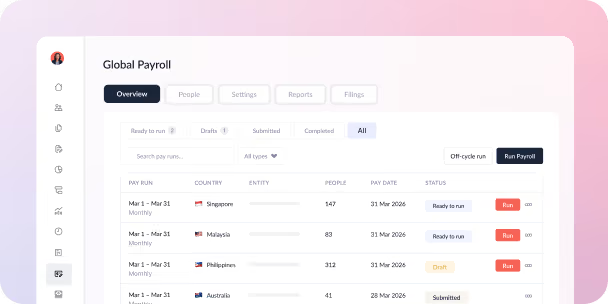
Omni HR runs native Malaysian payroll on your own entity, covering EPF, SOCSO, EIS, PCB and LHDN, and also covers managed payroll, EOR and contractor payments across Asia. This guide compares the two on the decision in front of you.
The Question You Have Not Been Asked Yet: Four Ways to Pay Someone in Malaysia
Most teams do not incorporate in Malaysia and then review their HR stack. The entity gets set up for a commercial reason, a client contract, a licence, a bank account, and payroll carries on as it was. So here is the question, posed plainly, because it is unlikely anyone else will pose it for you.
There are four ways to pay a person in Malaysia, and you now have access to all of them:
- On your own books. They are your employee, you run payroll, you remit EPF, SOCSO, EIS and PCB yourself.
- Managed payroll. They are your employee, but somebody else operates the pay run and the filings for you.
- Employer of Record. Somebody else holds the employment relationship. This is what you have been buying.
- Contractor payments. They invoice you, and you need that paid and recorded properly.
Each of those four is a different product at a different price. Most teams end up needing more than one, because people move between categories: a contractor takes a full-time role, an EOR hire moves onto the new entity.
For Malaysia specifically, Omni HR covers all four. Native local payroll on your own entity with EPF, SOCSO, EIS, PCB and LHDN. Managed payroll, which extends across 20+ countries in Asia. EOR across Asia. Contractor payments across Asia. When somebody's status changes, the system they sit in does not.
What Multiplier Publishes for Malaysia, and What It Does Not
Multiplier's Global Payroll FAQ describes the product as being "for companies with their own entities that need a single platform to run, standardize, and centralize multi-country payroll." Their pricing page adds that "you can use Multiplier's Global Payroll solution where you have entities and EOR where you don't."
On that same pricing page, the Global Payroll card reads: "Onboard full time employees in 150+ countries. No entity needed. $20 per person/mo."
Both can be true of a global catalogue. Neither resolves into a Malaysian page you can read.
What does exist on their site, as at 24 August 2026: roughly ten dedicated Malaysia pages, a Malaysia payroll URL that opens and points the reader at EOR, and a Malaysia EOR page. What does not exist is a Malaysia own-entity payroll page.
It is worth being precise about what that does and does not mean. We are not saying Multiplier cannot run payroll on your Malaysian entity. We have no visibility into their internals and we are not going to pretend otherwise. We are saying that their Malaysian coverage is not thin, that the specific offer a company in your position needs is the one thing not published, and that you would be signing without being able to read the scope first.
The practical version: ask them in writing what Global Payroll covers in Malaysia. Which filings they produce, which they do not, and what the Malaysian price is. Get it in the contract, not the demo.
Statutory Depth: LHDN, PCB, EA Form and Form E
Malaysian buyers audit payroll software. EPF comes up constantly, PCB and LHDN routinely, and buyers check a vendor's output against the government's own calculator and raise the difference on the call.
Multiplier's Malaysia payroll guide does name real schemes: EPF, SOCSO, EIS, MTD, and "Human Resource Development Fund (more than ten employees) 1.00%." That is more than plenty of vendors publish, and it should be said.
LHDN, PCB, EA Form and Form E do not appear on their Malaysia surfaces as at 24 August 2026. Their Malaysia EOR page names two schemes only: EPF and SOCSO.
Those four terms are not obscure. PCB is the monthly deduction you remit, LHDN is who you remit it to, the EA Form goes to every employee, and Form E is what the employer files. If payroll has just moved onto your own books, those four are now your obligation rather than somebody else's.
Omni HR's Malaysian payroll coverage is EPF, SOCSO, EIS, PCB and LHDN, run natively, with the same native local payroll in Singapore, Hong Kong and the Philippines.
What Changed in Malaysian Payroll in 2026, and Why It Is a Fair Test
Two of these moved this year. Ask both vendors, and ask us.
LINDUNG 24 JAM reversed six weeks after it started. The SOCSO scheme commenced 1 June 2026 at 0.75%, employee-side, on a wage ceiling of RM6,000. It steps to 1.00% on 1 June 2028 and 1.25% on 1 June 2031. Then, from 8 July 2026, by Cabinet decision, it became mandatory only for foreign workers and voluntary with an opt-out for local employees. June 2026 contributions were mandatory and are not refundable. Anyone who did not opt out was auto-enrolled on 31 August 2026, and that enrolment cannot be reversed. Combined SOCSO now runs at 1.75% employer and 1.25% employee.
Omni HR handles this as a per-employee configuration field, calculated automatically against PERKESO's official contribution table by salary band, including the July 2026 split between local and foreign employees.
EPF has a cliff at RM5,000, not a curve. Employee 11% and employer 13% up to RM5,000 of wages, then 11% and 12% above it.
And EPF cannot be calculated as a percentage at all below RM20,000. KWSP's own wording: employers are not allowed to calculate the employer's and employee's share based on exact percentage except for salaries that exceed RM20,000. Below that, the number has to come off the contribution table. A system doing the arithmetic gets a plausible figure that is wrong.
Foreign workers get three different answers across three schemes. Non-Malaysians registered from 1 August 1998 contribute to EPF at 2% and 2%, effective on October 2025 wages. They are in scope for SOCSO. They are out of scope for EIS. One foreign-worker toggle in a payroll system gets at least one of those wrong.
The HRD Corp levy counts Malaysian employees only. 1% for employers with ten or more, 0.5% for those with five to nine, on basic salary plus fixed allowances.
None of that is an accusation against Multiplier. It is the checklist you now own. Put all five questions to any vendor you are considering, including us.
The Cost of Staying: $459 Against $20 Against $5
All Multiplier figures below are from their pricing page, page-read 24 August 2026.
| Product | Published price |
|---|---|
| EOR Core | $459 per employee/mo on annual billing, $499 monthly |
| EOR Growth | $519 per employee/mo on annual billing, $559 monthly |
| EOR Enterprise | Custom |
| Global Payroll | $20 per person/mo |
| Contractor of Record | $400 per contractor/mo |
| Contractors | $40 per month |
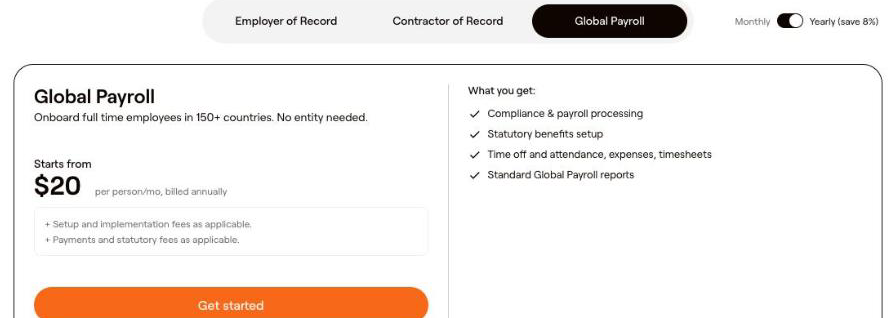
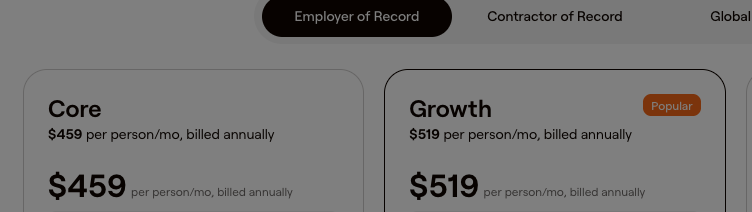
The 23x gap between $459 and $20 is the architecture of their pricing, and it is reasonable. EOR and payroll are different jobs, and holding an employment relationship in a country carries real cost. The problem is what happens when your situation changes and the price does not. Once people sit on your own Malaysian entity, the expensive half of what you were buying is work you have taken back.
A caution before the table, because the comparison is easy to abuse. An EOR price and an HRIS-plus-payroll price are not like for like, and any page that lines up $459 against $5 without saying so is being dishonest with you. The honest comparison is Global Payroll's $20 against Omni HR's $5: $3 for the core platform plus payroll software from $2. The EOR figures are shown separately, as what the path you are on costs.
| 25 people in Malaysia, monthly, published rates | Cost |
|---|---|
| Multiplier EOR Core, annual billing | $11,475 |
| Multiplier Global Payroll | $500 |
| Omni HR core platform plus payroll software | $125 |
Three caveats, all of them ours to state:
- Every Multiplier tier carries unpriced additions. Their page reads "+ Compliance mandated add-ons / + Implementation fee as applicable." The word "mandated" is theirs, and neither figure is published.
- Their pricing page notes that around 11% of the countries they support have adjusted pricing, without naming which. Malaysia is not named either way, so you cannot confirm from the page that the headline is your price.
- Omni HR is USD 3 per employee per month for the core platform plus payroll software from USD 2, with no published setup fee.
Give Multiplier this plainly, because it is a real advantage: there is no minimum headcount. Their FAQ answers it directly: "No. You can hire a single employee." Most EOR vendors impose a floor or hide the price behind a demo call. Multiplier does neither.
Support: A 24/7 Promise, and No Published Response Time
Buyers in this market ask two blunt questions, usually before anything about features. Is there someone on the ground in my country, and how fast do they come back to me?
Multiplier is headquartered in Singapore, so Asian working hours are not the issue and we are not going to pretend they are. What is on the record is narrower and more useful.
Their published support channels are phone and email. No chat, no Slack, no WhatsApp. Their help centre is a thin portal with two hub links. There is no published response time or service level anywhere on their site: the pages load, and the figure is absent.
On coverage, their pricing page promises "24/7 human support from local HR and legal experts" on the Contractor of Record card. What it does not give is a response time.
On the review side, support is genuinely their most-tagged strength: G2's auto-tags show Helpful and Customer Support, the two largest tags on the listing. Delays also appears as a tag.
Omni HR responds same day in Asia time zones through WhatsApp, Slack and email. That is our current actual performance rather than a contractual commitment, and we are not going to dress it up as one. Neither vendor on this page publishes a service level, and a comparison that implied otherwise would be inventing a difference.
How to Read Multiplier's 4.7 on G2
It is a large pool and a strong score. Two details change how to read it, and both sit on the listing itself.
Nearly every G2 review we read carries an Incentivized or Source: Seller invite tag. The smaller, more organic Gartner Digital Markets pool, which GetApp, Capterra and Software Advice all syndicate from one dataset, sits 0.3 lower at 4.4 across 44 reviews.
The more useful detail: a large share of those G2 reviewers are people employed through Multiplier rather than companies buying it. Job titles like Reservations Specialist, writing about payslips and health cover. Both experiences are real, and the 4.7 blends them. Only one tells you what your finance team's month-end will feel like.
GetApp is the only per-feature source with a usable sample, and only two rows clear it: payroll management at 4.5 (n=18) and self-service portal at 4.4 (n=18). Their lowest sub-score there is value for money at 4.2. Malaysia-specific review evidence is thin, at ten of the G2 reviews we read in August 2026, which is not enough to build a theme from.
| Platform | Omni HR | Multiplier |
|---|---|---|
| G2 | 4.8/5 | 4.7/5 across 1,499 reviews |
| GetApp | Not published here | 4.4/5 across 44 reviews |
Four Situations Where Multiplier Is Still the Better Answer
Four situations, stated plainly, where we would not tell you to move.
- Part of your Malaysian team stays on EOR. If the new entity covers some roles and not others, you are paying for something you are still using. Their EOR is published, priced and has no headcount floor.
- Your people are scattered well outside Asia. Multiplier publishes 100+ countries for payroll on their pricing page and 150+ for EOR. That is wider than an Asia-focused platform, and it is not close. If Malaysia is one of fifteen countries and most of the other fourteen are outside Asia, breadth beats depth.
- You are hiring one person in a country where you have nothing. Their FAQ says it directly: "No. You can hire a single employee." That is a genuine advantage and it is worth having on the shelf.
- Your workforce is mostly contractors. Contractor payments at $40 per month is a fair rate, and that is not the problem Omni HR is built around.
Worth knowing, because they under-market it: Multiplier has a shipped AI assistant called "Ask Multiplier." It sits in an editorial article rather than on any product or pricing page, so it is easy to miss on a feature list.
Stay on Multiplier, or Move to Omni HR: Six Ways to Decide
| Stay on Multiplier if... | Move to Omni HR if... |
|---|---|
| A meaningful part of your team stays on EOR, in Malaysia or elsewhere | Everyone in Malaysia is moving onto your own entity, and your obligations moved with them |
| Most of your headcount sits outside Asia, across many countries | Malaysia is your base, or Malaysia plus other Asian markets |
| You are still hiring into countries where you have no presence | You need PCB, LHDN and the EA Form named and handled, not inferred |
| Contractors are the bulk of how you engage people | You expect people to move between contractor, EOR and own-payroll status |
| Phone and email suit how your team works | You want WhatsApp or Slack with a same-day human response |
| You want the widest country list on this page | You want LINDUNG 24 JAM configured per employee against PERKESO's table |
Beyond payroll, Omni HR carries the rest of the stack on the same platform: an AI-assisted ATS, Mino and Connect AI both shipped and available today, performance reviews designed for Asian business cultures, and Slack, Microsoft Teams and Xero integrations.
One honest note on Omni HR: our mobile app does not cover the full suite. The workflows most people need on a phone, leave requests and approvals, run through our Slack and Microsoft Teams integrations rather than through the app itself. If your team expects to do everything from a phone, ask us to show you exactly what that looks like before you commit.
Book a demo to see how Omni HR runs Malaysian payroll on your own entity.
Further Reading
Frequently Asked Questions
If everyone is moving onto your own books, you are paying an EOR rate for an employment relationship you have taken back. Multiplier's published EOR Core price is $459 per employee per month against $20 for Global Payroll. Before deciding, ask them in writing what Global Payroll covers in Malaysia, because as at 24 August 2026 there is no Malaysia own-entity payroll page on their site and their Malaysia payroll URL routes to EOR.
Multiplier sells Global Payroll as a product for companies with their own entities, at $20 per person per month. But as at 24 August 2026 there is no Malaysia own-entity payroll page on their site, and their Malaysia payroll URL routes readers to their EOR product. Ask them directly what the Malaysian scope of Global Payroll is before you buy.
Their Malaysia payroll guide names EPF, SOCSO, EIS, MTD and the Human Resource Development Fund levy at 1.00%. LHDN, PCB, EA Form and Form E do not appear on their Malaysia surfaces as at 24 August 2026, and their Malaysia EOR page names only EPF and SOCSO. Omni HR's Malaysian coverage is EPF, SOCSO, EIS, PCB and LHDN.
On published rates, 25 people on Multiplier EOR Core at annual billing is $11,475 per month. The same 25 on Multiplier Global Payroll is $500. On Omni HR at USD 3 per employee per month for the core platform plus payroll software from USD 2, it is $125, with no published setup fee. Multiplier's tiers also carry unpriced compliance add-ons and an implementation fee, and their pricing page says around 11% of supported countries have adjusted pricing without naming them.
Yes. Omni HR has a dedicated per-employee configuration for LINDUNG 24 JAM, with automatic calculation against PERKESO's official contribution table, including the July 2026 change that made it optional for local employees while staying mandatory for foreign employees.
Omni HR covers four routes for Malaysia: payroll on your own entity, managed payroll, EOR and contractor payments, so a contractor going permanent or an EOR hire moving onto your books does not mean changing vendor. Multiplier sells EOR, Global Payroll, Contractor of Record, contractor payments and immigration as separate products globally, and their own-entity payroll route is not published for Malaysia.
Multiplier publishes phone and email, with no response time or service level stated anywhere on their site. Their pricing page promises 24/7 human support. Support is also their strongest review theme, with Helpful and Customer Support the two largest G2 tags. Omni HR responds same day in Asia time zones through WhatsApp, Slack and email, which is current performance rather than a contractual commitment.
Geographic breadth, published EOR pricing and no minimum headcount. Their pricing page cites 100+ countries for payroll and 150+ for EOR, which is wider than our Asia focus, and their FAQ confirms you can hire a single employee. They also hold 4.7 on G2 across 1,499 reviews as of 26 October 2026. If most of your people sit outside Asia, that combination is hard to argue with.