























Multiplier is a strong global platform with published EOR pricing and no minimum headcount. Its Philippine payroll guide names BIR only as a registration step, does not name Form 2316 or Form 1601-C, and describes Philippine income tax as PAYE, a British term for a mechanism the Philippines does not use. This guide compares four options for a Philippine team: Omni HR, Deel, Remote.com and Darwinbox.
Why This Guide Exists
If you employ people in the Philippines, the monthly work is SSS, PhilHealth, Pag-IBIG and BIR withholding, and the January work is Form 2316 for every employee. The question worth asking any vendor is whether they name those things on their own pages.
Multiplier's Philippine pages name three of them. Their PH Employer of Record page ties SSS, PhilHealth and Pag-IBIG to Multiplier directly. That is real, and more than some vendors publish.
As of 26 October 2026, their Philippine payroll guide names the Bureau of Internal Revenue only once, as a company registration step. Form 2316 and Form 1601-C do not appear. The term used instead is PAYE.
PAYE is the British, Irish and New Zealand term. The Philippines does not operate PAYE. It operates BIR withholding tax on compensation, with a year-end annualisation that has to absorb pay from any prior employer, a Form 2316 issued to every employee by 31 January, and an Alphalist. Those are different mechanics with different deadlines.
This guide compares four platforms for a Philippine team: Omni HR, Deel, Remote.com and Darwinbox.
Quick Comparison
| Platform | Best for | PH payroll (SSS, PhilHealth, Pag-IBIG, BIR) | Coverage beyond the Philippines | Starting price |
|---|---|---|---|---|
| Omni HR | Philippine teams running payroll on their own entity that want in-country responsiveness | Yes, native. SSS, PhilHealth, Pag-IBIG and BIR. | MY, SG, HK, PH native. 20+ Asian countries managed. EOR and contractor payments across Asia. | $3/employee/mo core platform, payroll from $2/employee/mo |
| Deel | Companies hiring in the Philippines without a Philippine entity | EOR route. PhilHealth, Social Security and HDMF named. BIR and 13th month not named on their PH page. | 150+ countries | EOR $599/employee/mo, contractors $49/month |
| Remote.com | Buyers who want a published flat price for either payroll or EOR, with no sales call | Sells a standalone Payroll product and an EOR product for the Philippines. Names BIR, SSS and PhilHealth on its PH country page. 13th month not named. | Global. Their own country count is not published, so we are not quoting one. | Payroll $29/employee/mo, EOR $599/employee/mo |
| Darwinbox | Large Philippine employers who want payroll inside a full HCM suite | Native, and the most detailed statutory reporting published by anyone here. | Multi-country Asian HCM. No EOR or contractor product surfaced. | Not published, demo only |
Why Philippine Teams Look for Multiplier Alternatives
Multiplier is not a weak product. It holds 4.7 on G2 across 1,499 reviews as of 26 October 2026, and its two largest review tags are Helpful and Customer Support. Three specific things send Philippine buyers looking anyway.
The tax vocabulary is not Philippine
Their Philippine pages name SSS, PhilHealth and Pag-IBIG, and describe income tax as PAYE. Their payroll guide names the Bureau of Internal Revenue only once, as a company registration step, and Form 2316 and Form 1601-C do not appear, as of 26 October 2026.
This is not a spelling preference. Under RR 11-2018, a Philippine employer issues Form 2316 to every employee by 31 January, in triplicate, and retains the employer copy for ten years. Year-end annualisation must add in compensation from a prior employer if the person changed jobs mid-year. Form 1601-C is the monthly withholding return. A system described in PAYE terms is being described with a different country's machinery.
For a fair benchmark on whether that is a reasonable bar: Darwinbox's Philippine payroll page names BIR Form 1601-C, SSS R3 and R5, PhilHealth ER2-RF1, Pag-IBIG reports and the Alphalist. Another multi-country platform already publishes at this level of detail, so this is not an invented standard.
The own-entity payroll path is not published for the Philippines
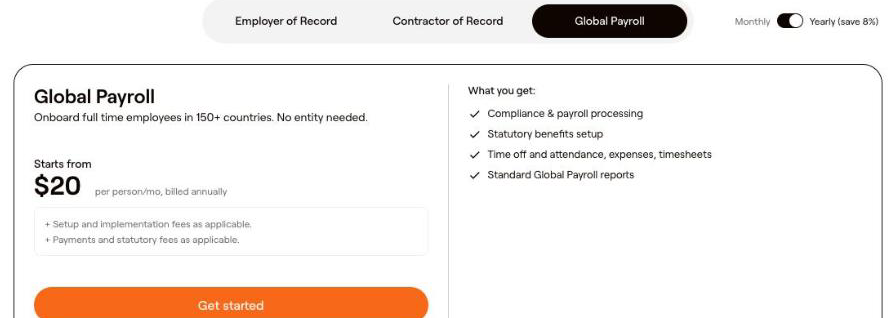
Multiplier sells Global Payroll as a separate product, described in their own FAQ as being "for companies with their own entities that need a single platform to run, standardize, and centralize multi-country payroll." Their pricing page adds that you can use Global Payroll where you have entities and EOR where you do not.
As at 24 August 2026, usemultiplier.com/philippines/payroll loads and makes no own-entity payroll offer at all. There is no Philippine own-entity payroll page on the site.
That is not a coverage problem. They run roughly eleven Philippine pages. The specific thing missing is the offer a company that already employs Filipinos on its own books actually needs to evaluate.
Their guide mixes a legal rule with a common practice
Multiplier's Philippine guide gets the core rule right: 13th month pay is mandatory and due by 24 December. The same guide also says employers "commonly pay 13th and 14th-month pay semi-annually in July and December." That second line describes what some companies choose to do, not what the law requires.
Presidential Decree 851 provides a single 13th month payment, one twelfth of total basic salary earned during the year, for rank-and-file employees with at least one month of service, paid not later than 24 December. There is no statutory 14th month. A payroll system has to treat the required 13th month and an optional 14th month as two different things. The source is DOLE's Handbook on Workers' Statutory Monetary Benefits, 2024 edition.
There is also a filing step that vendors routinely miss, because it is a report rather than a payment: a 13th month compliance report is due to reports.dole.gov.ph by 15 January.
What Philippine Payroll Actually Requires in 2026
Ask every vendor on this page these questions, us included. Two of these changed within the last nine months.
The NCR minimum wage moved on 25 July 2026. Wage Order NCR-27 took it from P695 to P755, with a further step to P780 on 20 January 2027. That single change moves overtime, night differential, holiday pay, 13th month and the de minimis overtime meal cap at the same time, because several of them are calculated off the regional minimum. Most vendor content has not caught up with it yet.
De minimis ceilings moved in January 2026. RR No. 29-2025, issued 22 December 2025, set rice at P2,500 a month, uniform at P8,000 a year, medical assistance at P12,000 a year, laundry at P400 a month, Christmas gifts at P6,000 a year, and leave monetisation at 12 days. The overtime meal allowance is pegged at 30% of the regional minimum wage, which is why the July wage order moved it too.
SSS is a table, not a percentage. Contributions run at 15% of the Monthly Salary Credit, split 10% employer and 5% employee, on an MSC floor of P5,000 and a ceiling of P35,000 in P500 steps, effective January 2025 under SSS Circular 2024-006 and RA 11199. There is a second cap inside the first one: regular SS stops at an MSC of P20,000, and the band from P20,001 to P35,000 goes into the MPF or WISP column instead, credited to the employee's individual account, capped at P1,500 employer and P750 employee. Total employer maximum is P3,530, employee P1,750. Employers' Compensation is employer-only and steps from P10 to P30 at an MSC of P15,000.
PhilHealth's base catches people out. 5.0% split evenly, on a floor of P10,000 and a ceiling of P100,000. The base is Monthly Basic Salary, which excludes commission, overtime, allowances, 13th month and bonuses. It is also not reduced by undertime, tardiness, leave without pay or absences. A system that calculates PhilHealth off net pay for the period gets it wrong every time someone takes unpaid leave.
Pag-IBIG is 2% plus 2%, on a monthly fund salary cap of P10,000, so P200 from each side.
The P90,000 tax exemption is a shared bucket, covering 13th month and other benefits combined. Excess de minimis quietly eats into it, which is why the January ceiling changes matter beyond the benefits themselves.
None of this is an accusation against any vendor here. It is the checklist.
1. Omni HR
Best for: Philippine companies running payroll on their own entity that want fast, human responses from people who know Philippine labour law.
Omni HR runs native local payroll in the Philippines covering SSS, PhilHealth, Pag-IBIG and BIR, with the same native coverage in Singapore, Malaysia and Hong Kong. Managed payroll runs across 20+ Asian countries, with EOR and contractor payments across Asia.
For a Philippine team that means one platform covers four situations: employees on your own payroll, payroll run as a managed service, someone employed through EOR, and contractors paid directly. A contractor who converts to permanent does not mean changing vendor.
| Capability | Omni HR | Multiplier |
|---|---|---|
| Philippine own-entity payroll | Native. SSS, PhilHealth, Pag-IBIG and BIR. | Global Payroll sold as a product for companies with their own entities. No Philippine own-entity payroll page published as at 24 August 2026. |
| Philippine tax vocabulary on their own pages | BIR | Income tax described as PAYE. BIR named only as a registration step. Form 2316 and Form 1601-C do not appear. |
| Statutory schemes named | SSS, PhilHealth, Pag-IBIG | SSS, PhilHealth, Pag-IBIG, tied to Multiplier by name on their PH EOR page |
| Coverage outside the Philippines | 20+ Asian countries managed, EOR and contractor payments across Asia | 100+ countries for payroll per their pricing page, 150+ for EOR. Genuinely wider than ours. |
| Support channels | WhatsApp, Slack and email, with same-day human responses in practice | Phone and email. No published response time. Their pricing page promises 24/7 human support. |
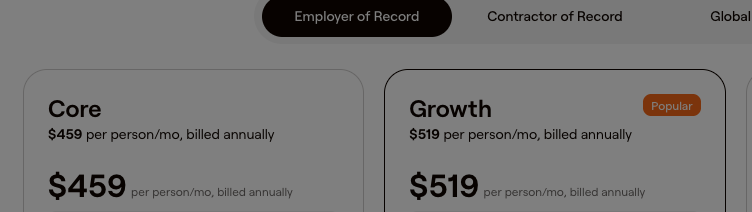
| Published price | $3/employee/mo core platform, payroll from $2/employee/mo, no published setup fee | EOR from $459/employee/mo, Global Payroll $20/person/mo, plus unpriced compliance add-ons and implementation fee |
| AI | Mino agentic assistant and Connect AI, both shipped, plus an AI-assisted ATS | "Ask Multiplier" chatbot, documented in an editorial article rather than on a product page |
| Rating | 4.8/5 (G2) | 4.7/5 across 1,499 reviews (G2), 4.4/5 across 44 reviews (GetApp) |
Book a demo to see Omni HR's Philippine payroll in action.
2. Deel
Best for: Companies putting their first people into the Philippines without a Philippine entity, and teams paying Filipino contractors.
Deel's Philippine hiring page leads with EOR and publishes a full price list, which is unusual in this category. EOR is $599 per employee per month, contractors $49 per month, and Contractor of Record $325 per month, across a stated 150+ countries. Their estimate of Philippine employer cost is 13.10% of salary.
On statutory naming, their Philippine page names the Philippine Health Insurance Corporation, Social Security and the Home Development Mutual Fund. Their own blog states that the EOR enrols employees in SSS, PhilHealth and Pag-IBIG on the buyer's behalf.
The honest limitations are two. BIR filings and 13th month mechanics are not named on their Philippine page, so Philippine payroll depth is not demonstrable from the page itself. And $599 per employee per month is the higher end of published EOR rates, which is a different kind of purchase from running payroll on your own entity.
Rating: 4.8/5 across 14,287 reviews on G2, a seller-level aggregate across all Deel products rather than a single product score.
3. Remote.com
Best for: Buyers who want a published flat price and a clear split between running payroll and employing someone, without a sales call to find out either number.
Remote is the only vendor here besides us that publishes a standalone payroll price for the Philippines separate from its EOR price. Payroll is $29 per employee per month, contractor management $29 per contractor per month, and EOR $599 per employee per month. For a buyer trying to work out which path they are actually on, having both numbers on one page is genuinely useful, and it is exactly the thing Multiplier's Philippine pages do not resolve.
The honest limitations. Their Philippine country page names BIR, SSS and PhilHealth, but 13th month pay does not appear on it as of 26 October 2026, and Form 2316 and Form 1601-C are not named either. So statutory depth is not shown there the way it is on Darwinbox's page. And $599 ties with Deel as the highest published EOR rate on this page.
We could not load Remote's G2 listing or find a published country count on their own site, so we are not quoting either.
4. Darwinbox
Best for: Large Philippine employers who want payroll living inside one HCM data model alongside core HR, talent and analytics.
Darwinbox publishes the deepest Philippine statutory detail of anything in this comparison, and it is not close. Their Philippine payroll page commits to calculating final salary after SSS, Pag-IBIG, PhilHealth and withholding tax deductions, and to producing BIR Form 1601-C, SSS R3 and R5, PhilHealth ER2-RF1, Pag-IBIG reports and the Alphalist. It also covers 13th month pay integrated into payroll and describes tax calculations aligned to BIR regulations.
Naming the actual return forms is a different level of specificity from naming the schemes, and almost nobody does it.
Two honest limitations. Pricing is fully gated behind a demo request. And there is no EOR or contractor-payment product on their surfaces, so any part of your Philippine workforce that is not on your own payroll is out of scope.
Their positioning is enterprise weight, with named references in the tens of thousands of employees. A 50 to 200 person Philippine company would be buying above its own complexity.
Rating: roughly 193 reviews on G2. We could not load the star rating directly, so we are not publishing one.
Employment Hero is a reasonable platform that comes up in this search, but we have not rostered it here. Its Philippine page is framed as hiring into the Philippines from Australia, which is an EOR route rather than a localised Philippine payroll product like the one it publishes for Malaysia.
Philippine Compliance and Structure: Who Handles What
| Capability | Omni HR | Multiplier | Deel | Remote.com | Darwinbox |
|---|---|---|---|---|---|
| Own-entity Philippine payroll | Native | No Philippine own-entity payroll page published | EOR route | Standalone Payroll product published at $29/employee/mo | Native |
| SSS, PhilHealth, Pag-IBIG named on their own PH pages | Yes | Yes | Yes | Not enumerated on the PH country page | Yes |
| BIR named | Yes | Only as a registration step. Income tax described as PAYE. | Not named on the PH page | Yes | Yes, including Form 1601-C and the Alphalist |
| 13th month | Yes | Mandatory by 24 December, stated correctly. Also grouped with an optional 14th month | Not named on the PH page | Not named on the PH country page as of 26 October 2026 | Integrated into payroll |
| EOR available | Yes, across Asia | Yes, 150+ countries | Yes, 150+ countries | Yes, $599/employee/mo | Not surfaced |
| Contractor payments | Yes, across Asia | Yes, two products at $400 and $40 | Yes, $49/contractor/mo | Yes, $29/contractor/mo | Not surfaced |
| Published starting price | $3/employee/mo core platform + payroll from $2 | EOR $459/employee/mo, Global Payroll $20/person/mo | EOR $599/employee/mo | Payroll $29, EOR $599 | Not published |
| Rating | 4.8/5 (G2) | 4.7/5, 1,499 reviews (G2). 4.4/5, 44 reviews (GetApp). | 4.8/5, 14,287 reviews (G2, seller-level) | Not published here | ~193 reviews, rating not published here |
Support: What Philippine Reviewers Actually Say
This is the part of the comparison where Multiplier's own promises and their own reviewers are worth reading side by side.
Their pricing page promises "24/7 human support from local HR and legal experts" on the Contractor of Record card.
Published channels are phone and email. There is no chat, Slack or WhatsApp, and no published response time anywhere on the site.
Two G2 reviews show what that can feel like in practice. One G2 reviewer, who rated Multiplier five out of five, wrote:
"we have a team member in the Philippines who has had issues with their pay... the CSR is not a native Filipino and often doesn't know the basic labor laws that apply in the country"
G2 review, 5 out of 5, 13 March 2026
Another G2 reviewer, who rated Multiplier four out of five, wrote:
"The downside is I don't have a Philippine-based POC... I had to raise a ticket and wait for 1-2 business days"
G2 review, 4 out of 5, 19 May 2026
To be fair about the wider pattern: support responsiveness is Multiplier's most-tagged strength on G2, with Helpful and Customer Support its two largest tags. Both things are true. They are widely rated as responsive, and these two reviewers describe a gap in local knowledge and an in-country point of contact.
Omni HR answers on WhatsApp, Slack and email, and in practice responds the same day during Asian business hours. That is how we currently perform, not a contractual commitment, and we would rather say so plainly than dress it up as a service level agreement we do not publish either.
Two Things to Know About Multiplier's 4.7
A 4.7 across 1,499 reviews is a large, strong pool and should not be waved away. Two details change how to read it, and both are visible on the listing.
Nearly every G2 review we read carries an Incentivized or Source: Seller invite tag. The smaller and more organic Gartner Digital Markets pool, which GetApp, Capterra and Software Advice all syndicate from the same dataset, sits 0.3 lower at 4.4 across 44 reviews.
More usefully for a Philippine buyer: a large share of the G2 reviewers are people employed through Multiplier rather than companies buying it. Job titles like Reservations Specialist, writing about payslips and health cover. Twenty-seven of the reviews we read in August 2026 mention the Philippines, and they are substantively Philippine, covering health cover, Certificates of Employment and local labour law. Most of those are written by employees rather than by the finance team running payroll. Both experiences are valid. Only one of them tells you what your month-end will feel like.
On per-feature scores, GetApp is the only source with enough responses to be worth printing, and only two rows clear a usable sample: payroll management at 4.5 (n=18) and self-service portal at 4.4 (n=18). Their lowest sub-score across that pool is value for money at 4.2.
When Multiplier Is the Right Answer
Three situations where we would not recommend Omni HR, stated plainly.
- You have no Philippine entity and need someone employed there next month. Multiplier, Deel or Remote takes on the employment relationship. Multiplier's price is published and their FAQ confirms there is no minimum headcount: "No. You can hire a single employee." Most of the category will not quote you without a call.
- Your people are scattered well outside Asia. Multiplier publishes 100+ countries for payroll and 150+ for EOR. That beats an Asia-focused platform and the comparison is not close.
- You are contractor-heavy with almost no employees. Contractor payments at $40 a month is a fair call, and it is not the problem Omni HR is built to solve.
When to Choose Multiplier vs Omni HR
| Choose Multiplier if... | Choose Omni HR if... |
|---|---|
| You are hiring across many countries at once, most of them outside Asia | The Philippines is your base, or the Philippines plus other Asian markets |
| You need someone employed in the Philippines without a local entity, fast | You run Philippine payroll on your own entity and need SSS, PhilHealth, Pag-IBIG and BIR handled together |
| A published EOR price with no minimum headcount is the deciding factor | You want the person answering your payroll question to know Philippine labour law |
| Your team is mostly contractors | You expect worker types to change, and want contractors, EOR and own-entity payroll in one platform |
| Phone and email support fits how your team works | You want WhatsApp or Slack with a same-day human response |
Further Reading
Frequently Asked Questions
It depends on whether you have a Philippine entity. If you do, Omni HR and Darwinbox both run native Philippine payroll, and Remote publishes a standalone payroll product at $29 per employee per month. If you do not have an entity, Deel, Remote and Multiplier itself all take on the employment relationship through EOR.
Their Philippine payroll guide names SSS, PhilHealth and Pag-IBIG, and describes income tax as PAYE. As of 26 October 2026 it names the Bureau of Internal Revenue only once, as a company registration step, and Form 2316 and Form 1601-C do not appear. That is what their published pages say, not a statement about what their product does internally, so ask them directly.
PAYE is the British, Irish and New Zealand term for withholding income tax at source. The Philippines does not operate PAYE. It operates BIR withholding tax on compensation, with a year-end annualisation that must absorb pay from a prior employer, a Form 2316 issued to every employee by 31 January, and an Alphalist. The mechanics and the deadlines are different.
Multiplier sells Global Payroll as a product for companies with their own entities at $20 per person per month. As at 24 August 2026 there is no Philippine own-entity payroll page on their site, and their Philippine payroll URL makes no own-entity offer. Ask them what the Philippine scope of Global Payroll is before you buy.
Two things. Wage Order NCR-27 raised the NCR minimum wage from P695 to P755 on 25 July 2026, with a further step to P780 on 20 January 2027, and that moves overtime, night differential, holiday pay and the de minimis meal cap with it. Separately, RR No. 29-2025 reset the de minimis benefit ceilings from January 2026, including rice at P2,500 a month and uniform at P8,000 a year.
It must be paid on or before December 24 each year. Employers may pay it earlier or in installments during the year.
Their published prices are $459 per employee per month for EOR Core on annual billing, $519 for EOR Growth, $20 per person per month for Global Payroll, $400 for Contractor of Record and $40 per month for contractor payments. Every tier adds unpriced compliance add-ons and an implementation fee. Their pricing page notes that around 11% of supported countries have adjusted pricing without naming them, so a Philippine buyer cannot confirm from the page that the headline applies.
On published rates, Omni HR at $3 per employee per month for the core platform plus payroll software from $2 is the lowest, with Remote's standalone payroll product at $29 per employee per month next. Darwinbox does not publish pricing. EOR products from Multiplier at $459, Deel at $599 and Remote at $599 are a different kind of purchase and are not a like-for-like comparison.