




















Multiplier is a strong global platform with published EOR pricing and no minimum headcount. What it does not publish is a Malaysian own-entity payroll page, and its Malaysia surfaces never name LHDN, PCB or the EA Form. This guide compares four options for a Malaysian team: Omni HR, Employment Hero, Darwinbox and Deel.
Why This Guide Exists
If you already employ people in Malaysia on your own books, the question is not which platform has the most countries. It is which one runs PCB, EPF, SOCSO, EIS and the EA Form correctly, every month and every January.
Multiplier answers that question well for companies without a Malaysian entity. Their EOR pricing is published, there is no minimum headcount, and their FAQ says so directly: "No. You can hire a single employee." Most EOR vendors hide the price behind a demo.
Where their site goes quiet is the other path. Multiplier sells Global Payroll as a separate product for "companies with their own entities," and their pricing page states you can use Global Payroll where you have entities and EOR where you do not. But as at 24 August 2026, usemultiplier.com/malaysia/payroll routes the reader to EOR: "Multiplier EOR solutions can smoothly take care of your company's payroll." There is no Malaysian own-entity payroll page on the site. A Malaysian buyer cannot find out from Multiplier what they would be buying.
This guide compares four platforms for a Malaysian team: Omni HR, Employment Hero, Darwinbox and Deel.
Quick Comparison
| Platform | Best for | MY payroll (EPF, SOCSO, EIS, PCB, LHDN) | Coverage beyond Malaysia | Starting price |
|---|---|---|---|---|
| Omni HR | Malaysian teams that want HR and payroll on their own entity, with room to add EOR or contractors later | Yes, native, including LINDUNG 24 JAM per employee | MY, SG, HK, PH native. 20+ Asian countries managed. EOR and contractor payments across Asia. | $3/employee/mo core platform, payroll from $2/employee/mo |
| Employment Hero | Malaysian SMEs and lean teams buying on price, especially with an Australian parent | Native. PCB (MTD), EPF, SOCSO, EIS, EA forms and HRDF named on their own MY pages. | Localised payroll for a short list of markets. EOR described as 180+ countries. | RM8 to RM18/employee/mo, minimums of RM160 to RM360/mo, HR and Payroll priced separately |
| Darwinbox | Large Malaysian employers who want payroll inside a full HCM suite | Native. EPF, SOCSO, EIS, HRDF and PCB submission reports in prescribed formats, plus bank and JV files. | Multi-country Asian HCM. No EOR or contractor product surfaced. | Not published, demo only |
| Deel | Companies hiring in Malaysia without a Malaysian entity, or paying Malaysian contractors | EOR route. EPF, SOCSO, EIS and HRDF rates named. PCB, LHDN and the EA Form are not named on their MY page. | 150+ countries | EOR $599/employee/mo, contractors $49/month |
Why Malaysian Teams Look for Multiplier Alternatives
Multiplier is not a weak product. It holds 4.7 on G2 across 1,499 reviews as of 26 October 2026, and its two largest review tags are Helpful and Customer Support. Three things send Malaysian buyers looking anyway, and all three come off Multiplier's own pages.
The own-entity payroll path is not published for Malaysia
Their Global Payroll FAQ describes the product as being "for companies with their own entities that need a single platform to run, standardize, and centralize multi-country payroll." Their pricing card, on the same site, describes Global Payroll as "Onboard full time employees in 150+ countries. No entity needed."
Both statements can be true of a global catalogue. Neither resolves into a Malaysian page. As at 24 August 2026 there is no Malaysia own-entity payroll page, and the Malaysia payroll URL points at EOR.
This matters more than it sounds, because Malaysia is not a thin market on their site. They run roughly ten Malaysia pages. The country coverage is there. The specific thing that is missing is the offer a company with its own Malaysian payroll actually needs.
The statutory vocabulary is incomplete for Malaysia
Their Malaysia payroll guide does name real schemes: EPF, SOCSO, EIS, MTD, and "Human Resource Development Fund (more than ten employees) 1.00%." That is more than many vendors publish.
LHDN, PCB, EA Form and Form E do not appear on their Malaysia surfaces as at 24 August 2026. Their Malaysia EOR page names two schemes only, EPF and SOCSO.
Those are not obscure terms. PCB is what you remit monthly. The EA Form is what every employee receives by the end of February, and Form E is what the employer files. A Malaysian finance lead uses those words every month.
For a fair benchmark on whether this is a reasonable bar: Darwinbox's Malaysia payroll page names EPF, SOCSO, EIS, HRDF and PCB in prescribed submission formats. Another multi-country platform already meets the standard, so it is not an invented one.
Their Malaysia guide also describes a "customary 13th-month pay at the end of each year." Malaysia has no statutory 13th month.
The published prices do not include Malaysia
All figures below are from their pricing page, read 24 August 2026.
| Product | Published price |
|---|---|
| EOR Core | $459 per employee/mo on annual, $499 monthly |
| EOR Growth | $519 per employee/mo on annual, $559 monthly |
| EOR Enterprise | Custom |
| Global Payroll | $20 per person/mo |
| Contractor of Record | $400 per contractor/mo |
| Contractors | $40 per month |
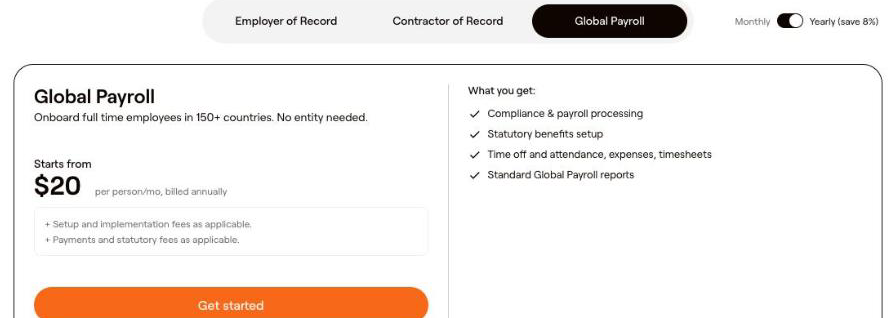
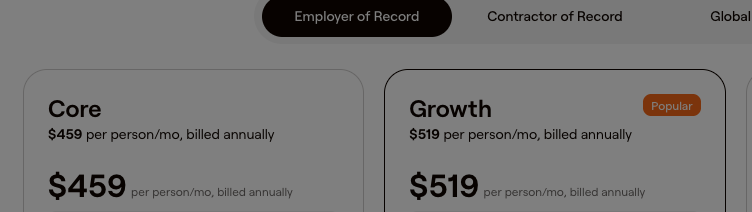
Two things a Malaysian buyer should notice. There is a 23x gap between the EOR price and the Global Payroll price, $459 against $20, and which side of it you land on depends entirely on the own-entity question their Malaysian pages do not answer. And every tier carries unpriced additions: "+ Compliance mandated add-ons / + Implementation fee as applicable." The word "mandated" is theirs.
Their pricing page also states that around 11% of the countries they support have adjusted pricing, without naming which ones. Malaysia is not listed either way, so the headline may or may not be your price.
What Malaysian Payroll Actually Requires in 2026
Any vendor on this page, us included, should be asked these questions directly. Malaysia changed twice this year.
LINDUNG 24 JAM reversed after six weeks. The SOCSO scheme commenced 1 June 2026 at 0.75%, employee-side, on a wage ceiling of RM6,000, rising to 1.00% in June 2028 and 1.25% in June 2031. From 8 July 2026, by Cabinet decision, it became mandatory only for foreign workers and voluntary with an opt-out for local employees. June 2026 contributions were mandatory and are not refundable. Employees who did not opt out were auto-enrolled on 31 August 2026, and that enrolment cannot be reversed. Combined SOCSO now runs at 1.75% employer and 1.25% employee.
EPF has a cliff, not a curve. 11% employee and 13% employer up to RM5,000 of wages, and 11% and 12% above it. KWSP's own instruction is blunt: employers are not allowed to calculate the employer's and employee's share on exact percentages except for salaries above RM20,000. Below that threshold, percentage arithmetic gives you the wrong number. It has to come off the contribution table.
Foreign workers get three different answers. Non-Malaysians registered from 1 August 1998 contribute to EPF at 2% and 2%, effective on October 2025 wages. They are in scope for SOCSO. They are out of scope for EIS. A single foreign-worker toggle in a payroll system gets at least one of these wrong.
The HRD Corp levy counts Malaysian employees only, at 1% for employers with ten or more and 0.5% for those with five to nine, on basic salary plus fixed allowances.
None of this is an accusation against any vendor here. It is the checklist. Ask it of all four, and ask it of us.
1. Omni HR
Best for: Malaysian companies running payroll on their own entity that also want the option to add EOR or contractor payments elsewhere in Asia without changing systems.
Omni HR runs native local payroll in Malaysia covering EPF, SOCSO, EIS, PCB and LHDN, with the same native coverage in Singapore, Hong Kong and the Philippines. Beyond that, managed payroll runs across 20+ Asian countries, with EOR and contractor payments across Asia.
For Malaysia specifically, that means one platform covers four situations: employees on your own payroll, payroll run as a managed service, someone employed through EOR, and contractors paid directly. A contractor who becomes permanent, or an EOR hire who moves onto your own books, does not mean changing vendor.
LINDUNG 24 JAM is handled as a per-employee configuration field, calculated automatically against PERKESO's official contribution table by salary band, including the July 2026 change that made it optional for locals and kept it mandatory for foreign employees.
| Capability | Omni HR | Multiplier |
|---|---|---|
| Malaysian own-entity payroll | Native. EPF, SOCSO, EIS, PCB, LHDN, plus LINDUNG 24 JAM per employee. | Global Payroll sold as a product for companies with their own entities. No Malaysia own-entity payroll page published as at 24 August 2026, and /malaysia/payroll routes to EOR. |
| Malaysian statutory vocabulary on their own pages | EPF, SOCSO, EIS, PCB, LHDN | EPF, SOCSO, EIS, MTD and HRDF on the payroll guide. EPF and SOCSO only on the Malaysia EOR page. LHDN, PCB, EA Form and Form E do not appear. |
| Coverage outside Malaysia | 20+ Asian countries managed, EOR and contractor payments across Asia | 100+ countries for payroll per their pricing page, 150+ for EOR. Genuinely wider than ours. |
| Support channels | WhatsApp, Slack and email, with same-day human responses in practice | Phone and email. No published response time. Their pricing page promises 24/7 human support. |
| Published price | $3/employee/mo core platform, payroll from $2/employee/mo, no published setup fee | EOR from $459/employee/mo, Global Payroll $20/person/mo, plus unpriced compliance add-ons and implementation fee |
| AI | Mino agentic assistant and Connect AI, both shipped, plus an AI-assisted ATS | "Ask Multiplier" chatbot, documented in an editorial article rather than on a product page |
| Rating | 4.8/5 (G2) | 4.7/5 across 1,499 reviews (G2), 4.4/5 across 44 reviews (GetApp) |
Book a demo to see Omni HR's Malaysian payroll in action.
2. Employment Hero
Best for: Malaysian SMEs and lean teams buying primarily on price, and Australian companies with a Malaysian arm that want one vendor across both.
Employment Hero has a genuinely localised Malaysian product. Their own Malaysian payroll page describes automating PCB (MTD), EPF and SOCSO contributions, and references EIS, EPF and EA forms. A separate statutory page adds HRDF. That is the full monthly and annual vocabulary, named on their own surfaces.
Pricing is published in ringgit, which almost nothing else here does. HR Standard is RM8 per employee per month with a RM160 monthly minimum, Premium RM12 with RM240, Platinum RM18 with RM360. Payroll Standard is RM8 with a RM160 minimum and Payroll Premium RM12 with RM240.
The honest limitation is in that pricing structure. HR and Payroll are separate plans, so a team that wants both pays two lines, and the monthly minimums mean a very small team pays a floor rather than a true per-head rate. Their EOR offering is described as covering 180+ countries, which is broader than ours.
Rating: 4.4/5 on G2, seller-level aggregate across their products rather than a single product score.
3. Darwinbox
Best for: Larger Malaysian employers who want payroll living inside one HCM data model alongside core HR, talent and analytics.
Darwinbox publishes the deepest Malaysian statutory detail of anything in this comparison. Their Malaysia payroll page commits to generating statutory submission reports for EPF, SOCSO, EIS, HRDF and PCB "in the prescribed formats," and to creating bank disbursement and JV files aligned to Malaysian banking needs. Prescribed formats and bank file generation are operational specifics, not marketing adjectives, and very few vendors put them in writing.
Two honest limitations. Pricing is fully gated behind a demo request, so there is no way to budget without a sales conversation. And there is no EOR or contractor-payment product on their surfaces, so if part of your Malaysian workforce is not on your own payroll, Darwinbox does not cover that part.
Their positioning and proof points are enterprise weight, with named references in the tens of thousands of employees. A 50 to 200 person Malaysian company would be buying above its own complexity.
Rating: roughly 193 reviews on G2. We could not load the star rating directly, so we are not publishing one.
4. Deel
Best for: Companies putting people into Malaysia without a Malaysian entity, and teams paying Malaysian contractors.
Deel publishes the most transparent Malaysian employer-cost breakdown of any vendor here. Their Malaysia hiring page names EPF at 13% up to MYR 5,000 and 12% above it, SOCSO at MYR 23.65 to 104.15, EIS at MYR 2.70 to 11.90, and HRDF at 1.00%, totalling an estimated 13.60% to 14.60% of salary, with their own caveat that these are estimates for general information. For modelling the cost of a Malaysian hire before you have an entity, that page is the most useful thing on this list.
Prices are published: $599 per EOR employee per month, $49 per contractor per month, across 150+ countries.
The honest limitations are two. PCB, LHDN and the EA Form are not named on their Malaysia page, so monthly remittance and annual form generation are not evidenced there. And for a team that already runs Malaysian payroll on its own entity, $599 per employee per month sits far above the RM8 to RM18 native-payroll options.
Rating: 4.8/5 across 14,287 reviews on G2, a seller-level aggregate across all Deel products rather than a single product score.
Malaysia Compliance and Structure: Who Handles What
| Capability | Omni HR | Multiplier | Employment Hero | Darwinbox | Deel |
|---|---|---|---|---|---|
| Own-entity Malaysian payroll | Native. EPF, SOCSO, EIS, PCB, LHDN | No Malaysia own-entity payroll page published. MY payroll URL routes to EOR. | Native | Native | EOR route |
| PCB / LHDN named on their own MY pages | Yes | No. MTD is named, PCB and LHDN are not. | Yes, PCB (MTD) | Yes, PCB | No |
| EA Form named | Yes | No | Yes | Not named as EA Form. Statutory submission reports in prescribed formats. | No |
| LINDUNG 24 JAM | Yes, per-employee configuration on PERKESO's table | Not named | Not named | Not named | Not named |
| EOR available | Yes, across Asia | Yes, 150+ countries | Yes, described as 180+ countries | Not surfaced | Yes, 150+ countries |
| Contractor payments | Yes, across Asia | Yes, two products at $400 and $40 | Not surfaced as a separate product | Not surfaced | Yes, $49/contractor/mo |
| Published starting price | $3/employee/mo core platform + payroll from $2 | EOR $459/employee/mo, Global Payroll $20/person/mo | RM8 to RM18/employee/mo, with RM160 to RM360 minimums | Not published | EOR $599/employee/mo |
| Rating | 4.8/5 (G2) | 4.7/5, 1,499 reviews (G2). 4.4/5, 44 reviews (GetApp). | 4.4/5 (G2, seller-level) | ~193 reviews, rating not published here | 4.8/5, 14,287 reviews (G2, seller-level) |
Two Things to Know About Multiplier's 4.7
A 4.7 across 1,499 reviews is a large, strong pool, and it should not be dismissed. Two details change how to read it, and both are visible on the listing itself.
Nearly every G2 review we read carries an Incentivized or Source: Seller invite tag. The smaller and more organic Gartner Digital Markets pool, which GetApp, Capterra and Software Advice all syndicate from the same dataset, sits 0.3 lower at 4.4 across 44 reviews.
More usefully, a large share of the G2 reviewers are people employed through Multiplier rather than companies buying it. Job titles like Reservations Specialist, writing about payslips and health cover. The 4.7 blends two different experiences, being employed through the platform and buying it. Both are valid. Only one of them tells you what your finance team's month-end will feel like.
On per-feature scores, GetApp is the only source with enough responses to be worth printing, and only two rows clear a usable sample: payroll management at 4.5 (n=18) and self-service portal at 4.4 (n=18). Their lowest sub-score across that pool is value for money at 4.2.
Malaysia-specific review evidence is thin on all sides. Ten of Multiplier's G2 reviews we read in August 2026 mention Malaysia, which is not enough to draw a theme from, and we are not going to invent one.
When Multiplier Is the Right Answer
Four situations where we would not recommend Omni HR, stated plainly.
- You have no Malaysian entity and need someone employed there next month. Multiplier or Deel is the correct answer. Their EOR products take on the employment relationship. Omni HR's EOR covers Asia, but if the wider need is global rather than Asian, Multiplier's reach is real.
- Your people are scattered well outside Asia. Multiplier publishes 100+ countries for payroll and 150+ for EOR. That beats an Asia-focused platform and the comparison is not close.
- You want a published EOR price and you are hiring one person. Their pricing is public and their FAQ confirms there is no minimum headcount. Most of the category will not quote you without a call.
- You are contractor-heavy with almost no employees. Contractor payments at $40 per month is a fair call and it is not the problem Omni HR is built to solve.
When to Choose Multiplier vs Omni HR
| Choose Multiplier if... | Choose Omni HR if... |
|---|---|
| You are hiring across many countries at once, most of them outside Asia | Malaysia is your base, or Malaysia plus other Asian markets |
| You need someone employed in Malaysia without a local entity, fast | You run Malaysian payroll on your own entity and need PCB, EPF, SOCSO, EIS, LHDN and the EA Form handled |
| A published EOR price with no minimum headcount is the deciding factor | You want LINDUNG 24 JAM configured per employee against PERKESO's table, not handled manually |
| Your team is mostly contractors | You expect worker types to change, and want contractors, EOR and own-entity payroll in one platform |
| Phone and email support fits how your team works | You want WhatsApp or Slack with a same-day human response |
One honest note on Omni HR: our API is basic. We are strong on the integrations most Malaysian finance teams actually use, including Slack, Microsoft Teams and Xero, but if your plan is to build custom workflows on top of an open payroll API, we are not the strongest choice on this page today.
Further Reading
Frequently Asked Questions
It depends on whether you have a Malaysian entity. If you do, Omni HR, Employment Hero and Darwinbox all run native Malaysian payroll, and Multiplier does not publish a Malaysia own-entity payroll page. If you do not have an entity, Deel and Multiplier itself are the stronger answers, because both take on the employment relationship through EOR.
Multiplier sells Global Payroll as a product for companies with their own entities, at $20 per person per month. But as at 24 August 2026 there is no Malaysia own-entity payroll page on their site, and their Malaysia payroll URL routes readers to their EOR product. Ask them directly what the Malaysian scope of Global Payroll is before you buy.
Their Malaysia payroll guide names EPF, SOCSO, EIS, MTD and the HRDF levy at 1.00%. LHDN, PCB, EA Form and Form E do not appear on their Malaysia surfaces as at 24 August 2026, and their Malaysia EOR page names only EPF and SOCSO. That is what their pages say, not a statement about what their product does internally.
Yes. Omni HR has a dedicated per-employee configuration for LINDUNG 24 JAM, with automatic calculation against PERKESO's official contribution table, including the July 2026 change that made it optional for local employees while staying mandatory for foreign employees.
The scheme itself is employee-side, starting at 0.75% on a wage ceiling of RM6,000 from 1 June 2026, rising to 1.00% in June 2028 and 1.25% in June 2031. With it included, combined SOCSO now runs at 1.75% employer and 1.25% employee. Employees who did not opt out by 31 August 2026 were auto-enrolled, and that enrolment cannot be reversed.
Their published prices are $459 per employee per month for EOR Core on annual billing, $519 for EOR Growth, $20 per person per month for Global Payroll, $400 for Contractor of Record and $40 per month for contractor payments. Every tier adds unpriced compliance add-ons and an implementation fee. Their pricing page notes that around 11% of supported countries have adjusted pricing without naming them, so a Malaysian buyer cannot confirm from the page that the headline applies.
On published rates, Omni HR at $3 per employee per month for the core platform plus payroll software from $2, and Employment Hero at RM8 to RM18 per employee per month, are the two lowest, though Employment Hero prices HR and Payroll as separate plans with monthly minimums of RM160 to RM360. Darwinbox does not publish pricing. EOR products from Deel at $599 and Multiplier at $459 are a different kind of purchase and are not a like-for-like comparison.
Omni HR covers all four routes for Malaysia: payroll on your own entity, managed payroll, EOR and contractor payments. Multiplier sells EOR, Global Payroll, Contractor of Record and contractor payments as separate products globally, though the own-entity payroll route is not published for Malaysia. Employment Hero has native Malaysian payroll plus a separate EOR offering. Darwinbox surfaces neither EOR nor contractor payments.