




















Remote.com is a strong global platform, and its Singapore page gets the basics right: it names IRAS, CPF Board and the Skills Development Levy, and it publishes a Singapore price. We read that page against Singapore's rules on 26 October 2026. It covers the monthly payroll items. It does not mention Form IR8A, the Auto-Inclusion Scheme, Form IR21 or the Foreign Worker Levy. Here is what that means, where Remote is ahead on support, and whether it is enough to move.
What Remote Gets Right in Singapore
If your Singapore payroll already runs through Remote.com, you are probably asking a fair question. CPF comes out right every month. So what is missing, and is it enough to move?
Start with the credit, because Remote has earned it. We read Remote's Singapore country page on 26 October 2026. Here is what it gets right.
- It names the right authorities. The page says: "Employers must file payroll taxes and contributions with the Inland Revenue Authority of Singapore (IRAS) and CPF Board regularly." The British term "PAYE" appears zero times.
- It names the Skills Development Levy (SDL) on its own line. That matters more than it looks. CPF Board says SDL is owed for "all your employees working in Singapore, including foreign employees". Staff on a work pass pay no CPF, but they still attract SDL. Many vendor pages fold SDL into one "contributions" line, or leave it out.
- It says Singapore has no statutory minimum wage. "There is no statutory minimum wage in Singapore, with two exceptions." That is correct.
- It leaves out 13th month pay, and that is also correct. Singapore has no statutory 13th month. The Annual Wage Supplement is a contractual bonus, not a legal duty.
- It publishes a Singapore price on the Singapore page. The block is headed "Transparent Pricing in Singapore", in USD. EOR starts at $599 per employee per month. Global Payroll starts at $29, and the page says plainly that it is "For paying employees in countries where you own the entity."
Remote's support is also strong. It offers human live messaging 24 hours a day, Monday to Friday, an AI assistant around the clock, and a named Payroll Service Level Agreement for payroll customers. On hours, Remote is ahead of us. We cover that below.
So this is not a page about a weak vendor. It is about a narrower question: what Remote's Singapore page covers, and what it leaves out.
Quick Comparison
| Remote | Omni HR | |
|---|---|---|
| What it is | Global employment platform: EOR, payroll, contractors and more | HR and payroll platform built for Asia |
| Payroll on your own Singapore entity | Global Payroll, "For paying employees in countries where you own the entity" | Native Singapore payroll |
| CPF and SDL | Both named on the Singapore page | CPF, SDL and IRAS covered. Omni HR files CPF |
| Form IR8A and the Auto-Inclusion Scheme (AIS) | Neither appears on the Singapore page, as of 26 Oct 2026 | Omni HR submits IR8A through AIS |
| Foreign Worker Levy (FWL) | Does not appear on the Singapore page, as of 26 Oct 2026 | Omni HR handles FWL and work pass holders |
| Payroll price | From $29 per employee/mo | $3 core platform + Singapore payroll from $4 per employee/mo |
| EOR price | From $599 per employee/mo | EOR available across Asia |
| Human support | Live messaging 24 hours a day, Monday to Friday. AI assistant 24/7. Named Payroll SLA | Same-day responses during Asian business hours, in current practice |
| Support channels | Live messaging, email, AI assistant | WhatsApp, Slack and email |
Remote's figures come from its Singapore country page and help centre, read 26 October 2026. Payroll and EOR are different purchases, so compare them line by line, not across lines.
What the Page Covers, and What It Leaves Out
Singapore payroll has two kinds of duty.
The first kind leaves your bank account every month: CPF and SDL. Remote's Singapore page names both.
The second kind is filings and separate payments. Some come once a year. Some come when a person leaves. Some go to a different agency. These are the ones with fixed deadlines and fines. As of 26 October 2026, none of them appears on Remote's Singapore page.
| Obligation | What the rule is | On Remote's Singapore page, 26 Oct 2026 |
|---|---|---|
| Form IR8A | Required by law for every employee (S68(2), Income Tax Act). Prepared by 1 March for the year before | "IR8A": 0 |
| Auto-Inclusion Scheme (AIS) | Electronic submission of employee income to IRAS. Mandatory for employers with 5 or more employees in 2026 | "Auto-Inclusion": 0. "AIS": 0 |
| Form IR21 tax clearance | Filed at least one month before a non-citizen employee stops work or leaves Singapore for over three months. The employer must withhold all monies due. Fine of up to $5,000 | "IR21": 0. "Tax clearance": 0 |
| Foreign Worker Levy | Paid monthly to the Ministry of Manpower (MOM) by the 17th of the next month, pro-rated by day | "Foreign Worker Levy": 0. "S Pass", "Employment Pass" and "Work Permit": 0 each |
| CPF wage ceilings | Ordinary Wage ceiling of $8,000 a month from 1 January 2026. Annual salary ceiling of $102,000, which sets the Additional Wage ceiling | "CPF": named 4 times. "Ordinary Wage", "Additional Wage", "wage ceiling", "8,000" and "102,000": 0 |
| SDL | 0.25% of monthly wages, minimum $2, maximum $11.25 per employee | Named as "Skills Development Levy (SDL)" and shown as "Up to 0.25%". The $2 minimum and $11.25 maximum are not stated |
Two notes before the detail. First, this is a reading of a public web page, not a test of Remote's payroll engine. A page that skips a rule does not prove the product skips it. Second, Remote's own Singapore price block lists "Tax filings and statutory contributions remitted in each country" as part of Global Payroll. So filings are part of what Remote sells. The page just does not say which Singapore filings it means. That is the question to ask.
Form IR8A and AIS: five employees is the line
Every Singapore employer must prepare Form IR8A for every employee, by 1 March for the year before. That is the law under S68(2) of the Income Tax Act.
Under the Auto-Inclusion Scheme (AIS), the employer sends that income data to IRAS electronically. IRAS says AIS is mandatory for employers with 5 or more employees in 2026. Five is a low bar. Every company with 50 to 500 people is in scope, every year.
As of 26 October 2026, "IR8A", "Auto-Inclusion" and "AIS" each appear zero times on Remote's Singapore page. This tells you what the page says, not what Remote's product does. Ask Remote to show you a full-year AIS file before you sign.
Omni HR submits IR8A through AIS, from the same payroll that runs your CPF.
Form IR21: the filing that comes when foreign staff leave
Form IR21 is tax clearance. IRAS requires it at least one month before a non-citizen employee stops work, or leaves Singapore for more than three months. From the time you know, you must hold back all money due to that person until IRAS clears it. Late or missing filing can bring a fine of up to $5,000.
Many companies use a global platform precisely because they employ people who are not Singapore citizens. IR21 is the filing that applies when those people leave.
As of 26 October 2026, "IR21" and "tax clearance" each appear zero times on Remote's Singapore page. If you employ foreign staff, ask Remote to walk you through an IR21 case, including the hold on final pay.
Foreign Worker Levy: a third payment, to a different agency
The Foreign Worker Levy is not part of CPF. It is a separate monthly payment to the Ministry of Manpower (MOM), due by the 17th of the following month. It is pro-rated by day, from the date a pass is issued to the date it is cancelled. So a worker who starts mid-month changes the levy for that month.
As of 26 October 2026, "Foreign Worker Levy" appears zero times on Remote's Singapore page. So do "S Pass", "Employment Pass" and "Work Permit". The page does name MOM twice, both times about reporting work injuries.
This is where the contrast is clearest. Omni HR handles the Foreign Worker Levy and work pass holders, alongside CPF and SDL, in one Singapore payroll.
CPF: named, but not described
You said CPF comes out right every month. That may well be true, and nothing here says otherwise.
As of 26 October 2026, "CPF" appears four times on Remote's Singapore page: as a label in its tax widget, in the IRAS and CPF Board sentence, and in the line "Employers must ensure accurate deductions for CPF contributions and income tax." The page does not describe the wage ceilings.
Those ceilings are where CPF gets harder. The Ordinary Wage ceiling rose to $8,000 a month from 1 January 2026. The annual salary ceiling of $102,000 sets how much bonus pay attracts CPF, and it has to be tracked across the year for each employee. If you want to test any payroll, test a bonus month for someone earning above $8,000.
Four Figures to Check Against the Source
Remote's Singapore page also carries some general facts and figures. Here are four of them, each set next to what the authority says.
- As at 26 October 2026, Remote's Singapore page lists a "VAT rate" of 7%. IRAS says Singapore's tax is GST, and that "The current GST rate in Singapore is 9%", in force since 1 January 2024.
- As at 26 October 2026, the page says Singapore income tax has "rates ranging from 0% to 22%". IRAS says "The current highest personal income tax rate is at 24%", from Year of Assessment 2024.
- As at 26 October 2026, the page says cleaners "must have a minimum wage of SGD 1,200 per month". MOM's Progressive Wage schedule for the cleaning sector sets $2,080 a month for a full-time outsourced General Cleaner, from 1 July 2026 to 30 June 2027.
- As at 26 October 2026, the page says security guards "must have a minimum wage of SGD 1,100 per month". MOM's schedule sets at least $3,090 a month for a Security Officer, from 1 January to 31 December 2026.
One more point on the last two. As at 26 October 2026, the page calls these figures a "minimum wage", and the term "Progressive Wage Model" appears zero times. The Progressive Wage Model is a ladder for each sector, and it steps up on published dates. If you employ cleaners or security staff, check the current rung with MOM each year.
Support: Where Remote Is Ahead
This is the part where Remote wins, and we will say so plainly.
Remote's help centre, as of 26 October 2026:
- "Live Messaging connects you with our Customer Care team 24/5 (24 hours a day, Monday to Friday)."
- "RemoteAI, our AI assistant, gives instant answers 24/7."
- Email: "We aim to respond within 24 hours."
- Global Payroll customers get their own address, gp-help@remote.com, answered by a Payroll Client Services team.
- A named Payroll Service Level Agreement, which the help centre describes as covering "roles and responsibilities".
Omni HR does not offer 24-hour support.
What we offer is different in kind. You can reach Omni HR on WhatsApp, Slack and email, and we give same-day responses during Asian business hours. That is how we perform today. It is not a contractual commitment. The real difference is the channel. A payroll question can go into the Slack or WhatsApp thread your HR team already uses, instead of a ticket queue.
If round-the-clock human cover on weekdays matters most to you, for example because you also run payroll for teams in Europe or the Americas, Remote is the stronger choice on hours.
Ratings. Remote holds 4.3 out of 5 from 102 verified reviews on GetApp, as of 26 October 2026. GetApp shares one review pool with Capterra and Software Advice. One reviewer in that pool wrote that Remote is "super easy to use, requires literally no training." Another wrote that the "support team is very scripted... doesn't tally with complexities." These are single reviews, not typical experiences. This guide does not quote a G2 figure for Remote. Omni HR is rated 4.8 out of 5 on G2.
Pricing: Compare Software to Software
Remote publishes its Singapore prices on its Singapore page, which many vendors do not. Credit to Remote. All Remote figures below were read on 26 October 2026.
| Product | Remote | Omni HR |
|---|---|---|
| Payroll on your own entity | Global Payroll, starting at $29 per employee/mo, "For paying employees in countries where you own the entity" | $3 per employee/mo for the core platform, plus Singapore payroll software from $4 |
| EOR (no entity of your own) | Starting at $599 per employee/mo, "For hiring employees in countries where you don't have an entity yet" | EOR available across Asia. A different purchase, priced separately |
| Contractors | Contractor Management, starting at $29 per contractor/mo | Contractor payments across Asia |
| Setup fees | Pricing FAQ: "no setup or onboarding fees" | No published setup fee |
Three things to notice.
Work out your path first. At Remote, EOR starts at $599 and payroll at $29. If you already have a Singapore entity, you need payroll, not EOR. Remote's own price block draws that line clearly.
Remote's $29 can include a specialist. Its Global Payroll bullets include "Self-serve or fully managed with a specialist" and "Remote Platform included, no base fee". Omni HR's price is software that your team runs, with the Singapore rules built in. Omni HR also offers managed payroll across 20+ countries in Asia, if you want someone else to run it.
Compare like with like. Set Remote's $29 payroll price against Omni HR's $3 core platform plus Singapore payroll from $4. Do not set an EOR price against a software price. They are not the same purchase.
Is It Enough to Move?
Here is the honest answer. It depends on who you employ.
If your Singapore team is mostly citizens and PRs, and you value 24/5 support, the case to move is weaker. Ask Remote to show you a full-year AIS file. If it is right, you may be well served where you are.
If you employ S Pass, Work Permit or Employment Pass holders, the picture changes. The Foreign Worker Levy is a monthly payment to MOM, pro-rated by day, on top of CPF and SDL. That is where you want your payroll to name and handle each item.
If Singapore is one of several Asian countries, for example Singapore plus Malaysia, Hong Kong or the Philippines, a platform with native payroll in each of those countries removes a lot of hand-offs.
If your people are spread across the world, Remote's global reach is a real strength. Asia may be only part of your picture.
Where Omni HR Fits
Remote is built to cover many countries from one global platform. That is a real strength. Omni HR is built the other way round: depth in Asia first.
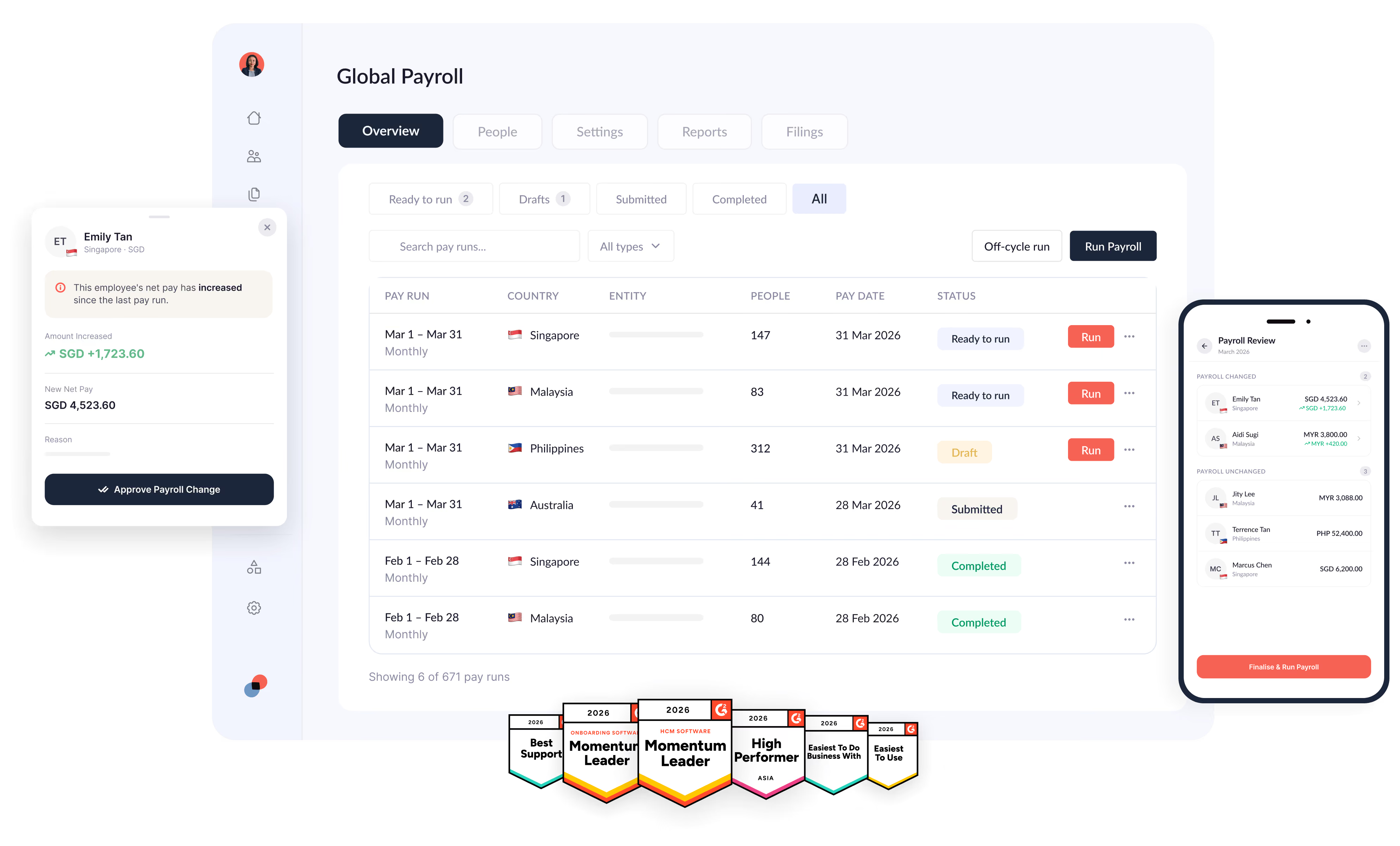
Singapore payroll, with the rules built in. Omni HR has native Singapore payroll covering CPF, SDL, IRAS and the Foreign Worker Levy. Omni HR files CPF and submits IR8A through AIS. It handles the Foreign Worker Levy and work pass holders. Your team runs payroll. The Singapore rules are already in the system.
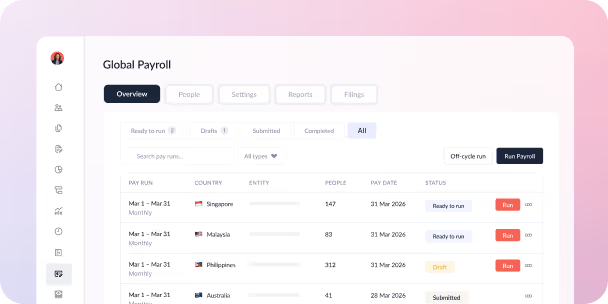
One platform for Asia. Native payroll in Singapore, Malaysia, Hong Kong and the Philippines. Managed payroll across 20+ countries in Asia. EOR and contractor payments across Asia. HR, an AI-assisted applicant tracking system and payroll all sit in one place. Mino, our AI assistant, and the Omni MCP connector are available today. Omni HR connects with Slack, Microsoft Teams, Xero, Google Workspace and Microsoft 365.
Support you can message. WhatsApp, Slack and email, with same-day responses during Asian business hours. That is current practice, not a guarantee.
Pricing. $3 per employee per month for the core platform, plus Singapore payroll software from $4. No published setup fee.
When to Choose Remote vs Omni HR
| Choose Remote if... | Choose Omni HR if... |
|---|---|
| You want human support 24 hours a day on weekdays, and a named Payroll SLA | You employ work pass holders and want the Foreign Worker Levy handled alongside CPF and SDL |
| Your people are spread across many countries, well beyond Asia | Your team is in Singapore, or Singapore plus other Asian markets |
| You want the option of fully managed payroll from one global platform | You want IR8A submitted through AIS from the same system that runs your CPF |
| You want EOR and payroll prices shown on the Singapore page itself | You want to ask a payroll question in WhatsApp or Slack and get a same-day answer |
Whichever you pick, run one month of payroll in parallel first. Check SDL for a foreign employee who pays no CPF. Check CPF in a bonus month for someone above the $8,000 Ordinary Wage ceiling. Check a Foreign Worker Levy month where a pass starts mid-month. Check a full-year AIS file. Ask every vendor to show these live, Omni HR included.
Book a demo to see Singapore payroll in Omni HR.
Further Reading
Frequently Asked Questions
We can only speak to Remote's page, not its product. As of 26 October 2026, "IR8A", "Auto-Inclusion" and "AIS" each appear zero times on Remote's Singapore country page. Its price block does list "Tax filings and statutory contributions remitted in each country" for Global Payroll, so ask Remote to show you a full-year AIS file. Form IR8A is required for every employee, and AIS is mandatory for employers with 5 or more employees in 2026. Omni HR submits IR8A through AIS.
Form IR21 is tax clearance for non-citizen employees. IRAS requires it at least one month before the person stops work or leaves Singapore for more than three months. The employer must hold back all money due until clearance, and late or missing filing can bring a fine of up to $5,000. As of 26 October 2026, "IR21" and "tax clearance" appear zero times on Remote's Singapore page, so ask Remote to walk you through a case.
As of 26 October 2026, "Foreign Worker Levy", "S Pass", "Employment Pass" and "Work Permit" each appear zero times on Remote's Singapore page. The levy is a separate monthly payment to MOM, due by the 17th of the following month and pro-rated by day. Omni HR handles the Foreign Worker Levy and work pass holders alongside CPF and SDL.
As of 26 October 2026, Remote's Singapore page shows EOR starting at $599 per employee per month, Global Payroll starting at $29 per employee per month for companies that own their entity, and Contractor Management starting at $29 per contractor per month, all in USD. Omni HR is $3 per employee per month for the core platform, plus Singapore payroll software from $4. EOR is a different purchase, so compare it separately.
Yes. Remote offers human live messaging 24 hours a day, Monday to Friday, an AI assistant 24/7, and a named Payroll Service Level Agreement, per its help centre as of 26 October 2026. Omni HR does not offer 24-hour support. We answer on WhatsApp, Slack and email with same-day responses during Asian business hours. That is current practice, not a contractual commitment.
No. Singapore has no statutory 13th month pay. The Annual Wage Supplement is a contractual bonus, not a legal requirement. Remote's Singapore page correctly leaves it out.
MOM's cleaning-sector schedule sets $2,080 a month for a full-time outsourced General Cleaner, from 1 July 2026 to 30 June 2027. Its security-sector schedule sets at least $3,090 a month for a Security Officer in 2026. As at 26 October 2026, Remote's Singapore page lists SGD 1,200 for cleaners and SGD 1,100 for security guards, under the label "minimum wage".
It depends on who you employ. If your team is mostly citizens and PRs and you value 24/5 support, Remote may serve you well. If you employ work pass holders, or run payroll in several Asian countries, Omni HR gives you native Singapore payroll covering CPF, SDL, IRAS and the Foreign Worker Levy, with IR8A submitted through AIS, on one platform for Asia.