






















Remote.com is a strong global platform with published prices. On its own Philippines page, Employer of Record starts at $599 per employee per month, and payroll for a company that owns its Philippine entity starts at $29. That is about 20 times apart. If you are paying the first price for people you could employ yourself, this guide compares four alternatives for a Philippine team: Omni HR, Deel, Darwinbox and Multiplier. It also covers what you take on, and what you give up, when you move.
Why This Guide Exists
Remote.com (Remote) is a well-run global platform. It publishes its prices, which many vendors in this category do not. It sells two different products for the Philippines, and its own Philippines page shows both.
As of 26 October 2026, Remote's Philippines page shows:
- Employer of Record: "Starting at $599 employee per month", for "hiring employees in countries where you don't have an entity yet".
- Global Payroll: "Starting at $29 employee per month", "for paying employees in countries where you own the entity".
Those two numbers are about 20 times apart. Under Employer of Record (EOR), Remote is the legal employer of your Philippine staff. Under payroll, your own Philippine company is the employer, and the platform runs payroll for it.
So the first question is not which vendor to pick. It is a question only you can answer: do you have a Philippine corporation, or do you plan to set one up?
- If you do not, and do not plan to, EOR is the honest answer, and this page will not talk you out of it.
- If you do, or soon will, you may be paying an EOR rate for people you could employ directly.
This guide is for the second group. It compares four alternatives: Omni HR, Deel, Darwinbox and Multiplier. It also covers the Philippine rules that become your job when you stop using EOR, and what you give up by leaving a global platform like Remote.
Quick Comparison
| Platform | Best for | Payroll on your own Philippine entity | EOR in the Philippines | Starting price, own-entity payroll | Rating |
|---|---|---|---|---|---|
| Omni HR | Philippine teams on their own entity, or moving onto one, who want payroll, EOR and contractors in one Asian platform | Native. SSS, PhilHealth, Pag-IBIG and BIR | Available across Asia | $3/employee/mo core platform, plus payroll from $2/employee/mo | 4.8/5 (G2) |
| Deel | Teams spread across many countries who want the same global setup they have today | Global Payroll, published for 130+ countries | From $599/employee/mo | $29/employee/mo | 4.9/5 from 4,318 reviews (GetApp, 26 Oct 2026) |
| Darwinbox | Large Philippine employers who want payroll inside a full HR suite | Native, with the Philippine forms named on its own page | Not offered as a product, when we read their site in August 2026 | Not published | 4.2/5 from 45 reviews (GetApp, August 2026) |
| Multiplier | Small teams who want the lowest published EOR headline and no minimum headcount | Global Payroll, sold globally | $459 Core or $519 Growth/employee/mo, billed annually | From $20/person/mo, billed annually, plus fees "as applicable" | 4.7/5 from 1,499 reviews (G2, 26 Oct 2026) |
Prices from each vendor's own pages, read 26 October 2026, unless the cell says otherwise. Payroll and EOR are different purchases. Compare payroll with payroll and EOR with EOR, never across.
Why Philippine Teams Look for Remote.com Alternatives
Remote is not a weak product. One reviewer in the Gartner Digital Markets pool, which feeds Capterra, GetApp and Software Advice, called it "super easy to use, requires literally no training." It holds 4.3 out of 5 from 102 reviews on GetApp, as of 26 October 2026. Three specific things send Philippine buyers looking anyway.
The two prices are about 20 times apart
At $599 per employee per month, ten Philippine staff on EOR cost $5,990 a month in platform fees, before salary. The same ten people on payroll, at Remote's starting price of $29, would cost $290.
Remote's EOR price is not out of line for the category. It is the same headline as Deel's $599, and above Multiplier's $459 Core and $519 Growth, which are billed annually. The point is the gap between the two paths, not the gap between vendors.
The cost of EOR can feel heaviest at small scale. One reviewer in the same Gartner pool wrote: "for one employee we pay more to Remote than the employee."
To be fair to Remote: if you already own a Philippine entity, you do not have to leave Remote to get the cheaper path. Their own Philippines page offers it, and their pricing FAQ says there are "no setup or onboarding fees". You should price that option before you price anyone else. We cover when staying is the right call further down.
Leaving EOR means the Philippine rules become yours
On EOR, the EOR is the employer. When your own company becomes the employer, SSS, PhilHealth, Pag-IBIG, BIR withholding and 13th month pay become your company's obligations. Your payroll system has to know them in detail.
So read what each vendor says about the Philippines on its own pages. Remote gets real credit here. Its Philippines page names the Bureau of Internal Revenue (BIR) for payroll tax filing, and the word "PAYE" appears zero times. PAYE is the UK term, and the Philippines does not use it.
As of 26 October 2026, the same page does not mention 13th month pay, and "DOLE" appears zero times. That tells you what the page says, not what Remote's product does. But 13th month is the rule a Philippine HR manager checks first, and it becomes yours the day you move off EOR. Ask any vendor, us included, to show you a 13th month run before you sign.
The minimum wage appears twice, with two figures
Near the top, as of 26 October 2026, Remote's Philippines page says: "The minimum wage in the Philippines for workers in the private sector is PHP 755.00 per day effective July 25 2026." That matches Wage Order NCR-27 exactly, so credit to Remote.
Further down, the same page says: "The Philippines' minimum wage varies by region, with the highest set at PHP 610 per day in Metro Manila."
Wage Order NCR-27 raised the NCR minimum wage from PHP 695 to PHP 755 on 25 July 2026. A second step takes it to PHP 780 on 20 January 2027.
What You Take On When You Employ Directly: The 2026 Checklist
If you move Philippine staff from EOR onto your own payroll, this is what your payroll system has to get right. Ask every vendor on this page to show each item live, us included.
The NCR minimum wage moves again on 20 January 2027. Wage Order NCR-27 took it to PHP 755 on 25 July 2026, and it steps to PHP 780 on 20 January 2027. The minimum wage feeds overtime, night differential, holiday pay, 13th month pay and the de minimis overtime meal allowance. That is five calculations that move on one date. If you plan to switch around the new year, test the January step.
SSS is a table, not a percentage. Contributions are 15% of the Monthly Salary Credit (MSC): 10% from the employer and 5% from the employee. The MSC runs from PHP 5,000 to PHP 35,000 in PHP 500 steps (SSS Circular 2024-006, RA 11199). Regular SSS stops at an MSC of PHP 20,000. The part from PHP 20,001 to PHP 35,000 goes to a separate fund, the MPF. The employer maximum is PHP 3,530 and the employee maximum is PHP 1,750. Employees' Compensation is paid by the employer only.
PhilHealth is 5%, on a defined base. The 5% is split evenly, with a floor of PHP 10,000 and a ceiling of PHP 100,000. The base is Monthly Basic Salary. It leaves out commission, overtime, allowances, 13th month and bonuses. It is also not reduced when someone is late, takes unpaid leave or is absent.
Pag-IBIG is capped. It is 2% from each side, on a monthly fund salary capped at PHP 10,000. So the most each side pays is PHP 200 (HDMF Circular 460).
BIR withholding, and Form 2316. Tax is withheld on a graduated table in effect since 1 January 2023. Every employee must get a Form 2316 by 31 January, in triplicate, and you keep the employer copy for ten years. If someone joins mid-year, year-end tax has to include pay from their previous employer (RR 11-2018).
13th month pay, and the report people forget. Presidential Decree 851 requires one twelfth of total basic salary earned in the year. It covers rank-and-file employees with at least one month of service, and it must be paid by 24 December. A compliance report is then due to DOLE by 15 January. It gets missed because it is a filing, not a payment.
The PHP 90,000 exemption is one shared bucket. It covers 13th month and other benefits together, so extra de minimis benefits eat into it.
De minimis ceilings moved in January 2026. RR No. 29-2025 set rice at PHP 2,500 a month, uniform at PHP 8,000 a year, medical assistance at PHP 12,000 a year, laundry at PHP 400 a month and Christmas gifts at PHP 6,000 a year. The overtime meal allowance is set at 30% of the regional minimum wage, which is why the wage order moves it too.
This list is not a charge against any vendor here. It is the test.
What You Give Up by Leaving a Global Platform
This is the second half of the question, and it deserves a straight answer. Here is what Remote offers that you should weigh before you move.
- Reach far beyond Asia. If you employ people in Europe or the Americas as well, one global platform for all of them is simpler. Omni HR is built for Asia.
- A named Payroll Service Level Agreement. Remote's help centre points Global Payroll customers to "our Payroll Service Level Agreement for more details about roles and responsibilities", as of 26 October 2026. It is the only vendor in this comparison that names a payroll SLA.
- Human support around the clock on weekdays. Remote's help centre says live messaging reaches its Customer Care team "24/5 (24 hours a day, Monday to Friday)", and its AI assistant answers 24/7. Global Payroll customers also get a dedicated payroll support address.
- Published prices with no setup fee. Remote's pricing FAQ says "no setup or onboarding fees", as of 26 October 2026.
- No minimum headcount. When we read it in September 2026, Remote said you can add "any number of direct, EOR employees and contractors, with no minimum requirements or fees."
If most of those matter more to you than Philippine depth, Remote's own payroll product may be your best move. If your team is mainly in the Philippines, or in the Philippines and other Asian markets, read on.
1. Omni HR
Best for: Philippine companies running payroll on their own entity, or moving onto one, who want payroll, EOR and contractor payments in one platform built for Asia.
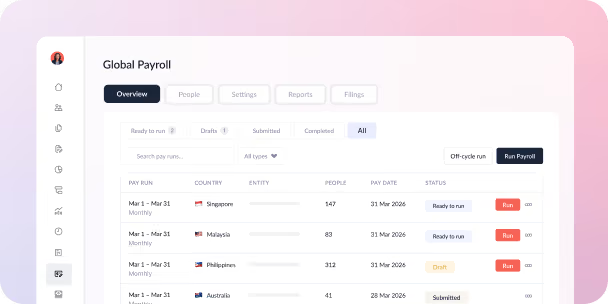
Omni HR runs native Philippine payroll covering SSS, PhilHealth, Pag-IBIG and BIR. It covers Form 2316, Form 1601-C, 13th-month pay calculations and the DOLE compliance report. Your team runs payroll. The Philippine rules are built in.
| Capability | Omni HR | Remote |
|---|---|---|
| Payroll on your own Philippine entity | Native. SSS, PhilHealth, Pag-IBIG and BIR | Global Payroll, "for paying employees in countries where you own the entity" |
| 13th month pay | 13th-month pay calculations and the DOLE compliance report covered | Not mentioned on the Philippines page, as of 26 Oct 2026 |
| Form 2316 and Form 1601-C | Covered | Not named on the Philippines page |
| EOR | Available across Asia | From $599/employee/mo |
| Contractor payments | Across Asia | Contractor Management, priced separately |
| Coverage | Native payroll in the Philippines, Singapore, Malaysia and Hong Kong. Managed payroll in 20+ Asian countries | Global |
| Support | WhatsApp, Slack and email, same-day responses in Asian business hours | 24/5 human live messaging, 24/7 AI assistant, email, named Payroll SLA |
| Starting price, own-entity payroll | $3/employee/mo core platform, plus payroll from $2/employee/mo. No published setup fee | From $29/employee/mo. "No setup or onboarding fees" |
The path from EOR to your own entity, on one platform
Omni HR offers payroll on your own entity, managed payroll across 20+ Asian countries, EOR across Asia and contractor payments across Asia. That matters for a team in the middle of a move. Some staff may stay on EOR while your Philippine company is set up. Others move onto your own payroll. A contractor may become an employee. You do not change vendors at each step.
HR, an AI-assisted applicant tracking system, performance reviews built for Asian business cultures and payroll all sit in one place. Mino, our AI assistant, and the Omni MCP connector are available today.
Integrations
One honest gap: Omni HR's API exists but is basic, so if your move depends on building custom connections into your own systems, test that with us before you commit. Most teams connect through our ready integrations with Slack, Microsoft Teams, Xero, Google Workspace and Microsoft 365.
Support
Omni HR answers on WhatsApp, Slack and email. In practice we respond the same day during Asian business hours. That is how we perform today, not a contractual commitment or a service level agreement.
Pricing
Omni HR is $3 per employee per month for the core platform, plus payroll software from $2 per employee per month in the Philippines, with no published setup fee. The fair comparison is with Remote's Global Payroll at $29, Deel's at $29 and Multiplier's from $20. EOR is a different purchase, so compare EOR prices separately.
Book a demo to see Philippine payroll in Omni HR.
2. Deel
Best for: Teams spread across many countries who want a global platform at the same headline prices as Remote.
Deel is the closest like-for-like to Remote. As of 26 October 2026, its pricing page shows EOR "Starting at $599 per EOR employee per month", the same as Remote. It now also publishes Global Payroll at "$29 per employee per month", to "Run payroll across 130+ countries", again the same as Remote. Contractors are $49 per month. Its EOR plan lists "24/7 support".
So for this reader, moving from Remote to Deel does not change the headline cost of either path. The decision comes down to everything else.
When we read Deel's Philippines page in August 2026, it led with EOR. It named the Philippine Health Insurance Corporation, Social Security and the Home Development Mutual Fund, and estimated Philippine employer cost at 13.10% of salary. BIR and 13th month pay were not named on that page. That is a statement about the page, not the product, so ask Deel to show you Philippine payroll on your own entity.
Rating: 4.9 out of 5 from 4,318 reviews on GetApp, as of 26 October 2026.
3. Darwinbox
Best for: Large Philippine employers who want payroll inside one HR suite, alongside core HR, talent and analytics.
When we read it in August 2026, Darwinbox's Philippine payroll page published the deepest statutory detail in this comparison. It named "BIR Form 1601-C, SSS R3, R5, PhilHealth ER2-RF1, and Pag-IBIG reports, Alpha listing". It described 13th month pay as "directly integrated into payroll", and tax calculations "aligned to BIR regulations". It also had an office in Manila, and listed documented RESTful APIs and 100+ ready integrations.
For a company moving off EOR, that depth is the point. These are the forms your own entity will file.
The honest limitations, from the same August 2026 reading. Employer of Record was not offered as a Darwinbox product, so any staff you still need on EOR would sit with another vendor. Its payroll FAQ says it handles payroll for contractors as well as employees. There was no pricing page, and quotes went through sales. Its own FAQ says its payroll is "designed for large enterprises operating across multiple geographies". A 50 to 200 person Philippine company may be buying more than it needs.
Rating: 4.2 out of 5 from 45 reviews on GetApp, as of August 2026.
4. Multiplier
Best for: Small teams who want the lowest published EOR headline here, with no minimum headcount.
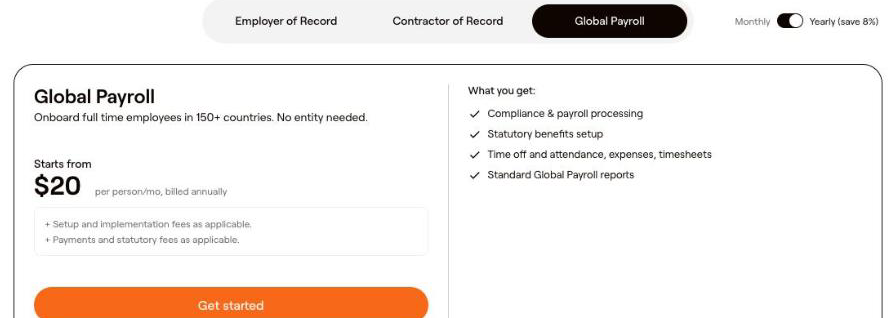
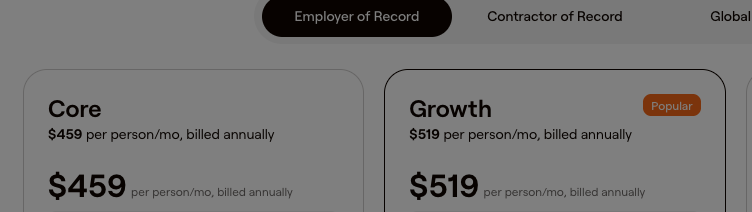
As of 26 October 2026, Multiplier's EOR is $459 per person per month on Core and $519 on Growth, both billed annually. That is the lowest published EOR headline in this comparison. Global Payroll starts from $20 per person per month, billed annually, plus fees named "as applicable". There is no minimum headcount. Its pricing page promises "24/7 human support".
On Philippine detail, its Philippines guide gets the core 13th month rule right: mandatory, by 24 December. It names the Bureau of Internal Revenue once, as a registration step. But it calls Philippine income tax "PAYE", and says employers "commonly pay 13th and 14th-month pay semi-annually in July and December". There is no statutory 14th month in the Philippines. Some employers pay one by choice.
If you are leaving EOR, the $20 payroll price is the one to look at. Ask Multiplier to confirm in writing what that price covers for a Philippine entity you own, and what the "as applicable" fees will be.
Rating: 4.7 out of 5 from 1,499 reviews on G2, as of 26 October 2026.
Philippine Payroll and Pricing: Who Covers What
| Omni HR | Remote | Deel | Darwinbox | Multiplier | |
|---|---|---|---|---|---|
| Payroll on your own Philippine entity | Native | Global Payroll, for countries "where you own the entity" | Global Payroll, 130+ countries | Native | Global Payroll, sold globally |
| EOR | Across Asia | From $599/mo | From $599/mo | Not offered (Aug 2026) | $459 Core, $519 Growth, billed annually |
| Contractor payments | Across Asia | Contractor Management, priced separately | $49/contractor/mo | Contractor payroll named in its FAQ (Aug 2026) | Not checked for this page |
| BIR on its Philippine pages | Yes | Named. "PAYE" appears zero times | Not named (Aug 2026) | Named, with Form 1601-C (Aug 2026) | Named once, as a registration step. Tax called "PAYE" |
| 13th month on its Philippine pages | 13th-month pay calculations covered | Not mentioned (26 Oct 2026) | Not named (Aug 2026) | Integrated into payroll (Aug 2026) | Mandatory by 24 December, plus a "14th-month" line |
| Starting price, own-entity payroll | $3 core + payroll from $2/employee/mo | From $29/employee/mo | $29/employee/mo | Not published | From $20/person/mo, billed annually, plus fees "as applicable" |
| Setup fee | None published | "No setup or onboarding fees" | Not stated here | Not published | Fees named "as applicable" |
| Support | WhatsApp, Slack, email. Same-day in Asian business hours | 24/5 human, 24/7 AI, named Payroll SLA | "24/7 support" on EOR | Not published (Aug 2026) | "24/7 human support" |
Read 26 October 2026 unless marked. "Not named" and "not mentioned" describe each vendor's public pages, not what its product does.
When Staying With Remote Is the Right Answer
We would rather you make the right move than move to us. Stay with Remote, or switch to its own payroll product, if:
- You own a Philippine entity and most of your people are outside Asia. Remote's Global Payroll is built for exactly that, from $29 per employee per month, with no setup or onboarding fees.
- You have no Philippine entity and no plan to set one up. Then EOR is the right product, and Remote's price is in line with Deel's.
- A named Payroll SLA and 24/5 human support matter most. No one else in this comparison publishes both.
When to Choose Remote.com vs Omni HR
| Choose Remote if... | Choose Omni HR if... |
|---|---|
| Your people are spread across the world, and the Philippines is one country of many | Your people are in the Philippines, or across several Asian markets |
| You have no Philippine entity and need EOR for the long term | You own, or are setting up, a Philippine entity and want to stop paying an EOR rate |
| You want a named Payroll SLA and human live messaging 24 hours a day on weekdays | You want to message your payroll question on WhatsApp or Slack and get a same-day answer |
| You are happy paying Global Payroll from $29 per employee per month | You want own-entity payroll at $3 core plus payroll from $2 per employee per month |
| One global vendor for every country outweighs local depth | You want SSS, PhilHealth, Pag-IBIG, BIR and 13th month in one Philippine payroll, with EOR and contractors on the same platform |
Whichever you pick, run one month of payroll in parallel before you move anyone off EOR. Test SSS above an MSC of PHP 20,000, PhilHealth during unpaid leave, the Pag-IBIG cap, the PHP 780 minimum wage step on 20 January 2027, and a 13th month run with the DOLE report.
Further Reading
Frequently Asked Questions
It depends on whether you have a Philippine entity. If you do, Omni HR and Darwinbox both run native Philippine payroll, and Deel and Multiplier both sell Global Payroll. If you do not, EOR is the right product, and Deel at $599 and Multiplier at $459 billed annually are the published alternatives to Remote's $599. You may also be able to stay with Remote and move onto its own payroll product.
As of 26 October 2026, Remote's Philippines page shows Employer of Record starting at $599 per employee per month, and Global Payroll starting at $29 per employee per month for countries where you own the entity. Its pricing FAQ says there are no setup or onboarding fees.
That is your call, and it turns on one question: do you have, or plan to set up, a Philippine corporation? If not, EOR lets another company employ your staff legally. If you do, payroll on your own entity costs far less. At Remote, the two starting prices are about 20 times apart.
If you own a Philippine entity, yes. Remote sells Global Payroll "for paying employees in countries where you own the entity", starting at $29 per employee per month, and shows that price on its Philippines page. Price that option before you compare other vendors.
Your company becomes the employer. SSS, PhilHealth, Pag-IBIG, BIR withholding, Form 2316 by 31 January, 13th month pay by 24 December and the DOLE 13th month report by 15 January all become your obligations. Your payroll system has to get each one right.
Wage Order NCR-27 raised it from PHP 695 to PHP 755 per day on 25 July 2026. It rises again to PHP 780 on 20 January 2027. The change also moves overtime, night differential, holiday pay, 13th month pay and the de minimis overtime meal allowance.
It must be paid on or before December 24 each year. Employers may pay it earlier or in installments during the year.
Mainly reach outside Asia, a named Payroll Service Level Agreement, and human live messaging 24 hours a day on weekdays. If your people are mostly in the Philippines or elsewhere in Asia, an Asia-focused platform gives you more local depth in exchange. If they are spread across the world, a global platform may still be the better fit.