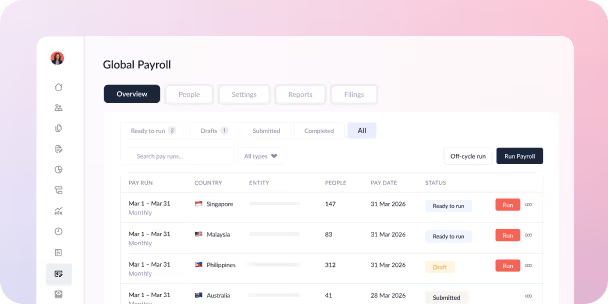

























Remote and Multiplier are both global platforms with published prices, and both serve the Philippines from a single global product. We read each vendor's Philippines pages against the actual Philippine rules. Remote names the right tax agency but never mentions 13th month pay. Multiplier names 13th month pay but calls Philippine tax "PAYE" and adds a 14th month. Here is what that means for your choice.
Two Global Platforms, One Country, Two Different Misses
If you are comparing Remote and Multiplier for a team in the Philippines, you are comparing two strong global platforms. Both publish their prices. Both sell Employer of Record (EOR) for companies with no local entity, and payroll for companies that have one. Both cover far more countries than the Philippines.
So the useful question is not which one is bigger. It is which one understands Philippine payroll. The quickest honest test is to read what each vendor says about the Philippines on its own pages, then check it against the law.
We did that on 26 October 2026. The result is interesting. Neither page gets everything right, and they miss in opposite directions.
- Remote names the right tax agency, the Bureau of Internal Revenue (BIR), and never says "PAYE". But its Philippines page does not mention 13th month pay.
- Multiplier names 13th month pay and the 24 December deadline. But it describes Philippine income tax as "PAYE", which is a British term, and it says employers "commonly pay 13th and 14th-month pay semi-annually in July and December". There is no statutory 14th month in the Philippines.
One says too little. The other says something extra that is not the law. Below, we go through each item, give each vendor credit where it is due, and show what the rule actually is.
Quick Comparison
| Remote | Multiplier | Omni HR | |
|---|---|---|---|
| What it is | Global employment platform | Global employment platform | HR and payroll platform built for Asia |
| Philippine income tax on its PH pages | Names the Bureau of Internal Revenue (BIR). "PAYE" appears zero times | Calls it "PAYE". Names the Bureau of Internal Revenue once, as a registration step | BIR withholding, built into payroll |
| 13th month pay on its PH pages | Not mentioned, as of 26 Oct 2026 | Mandatory by 24 December, plus a "13th and 14th-month" line | 13th-month pay calculations covered |
| Payroll on your own PH entity | Global Payroll, "for paying employees in countries where you own the entity" | Global Payroll, sold for companies with their own entities | Native Philippine payroll |
| Payroll price | From $29 per employee/mo | From $20 per person/mo, billed annually | $3 core platform + payroll from $2 per employee/mo |
| EOR price | From $599 per employee/mo | From $459 per person/mo, billed annually (Core) | EOR available across Asia |
| Coverage | "Hire in 90+ countries without a local entity" (EOR) | 100+ countries for payroll | Managed payroll in 20+ countries across Asia |
Prices from each vendor's own pricing page, read 26 October 2026. Payroll and EOR are different purchases, so compare them line by line, not across lines.
The Statutory Audit, Item by Item
Here is the full read. The middle column is what the law says. The last two columns are what each vendor's Philippines pages say, as of 26 October 2026.
| Item | What the rule is | Remote's Philippines page | Multiplier's Philippines pages |
|---|---|---|---|
| Income tax | BIR withholding tax on compensation. The Philippines does not use PAYE | Names BIR for payroll tax filing. "PAYE": 0 | "progressive income tax (PAYE)". Bureau of Internal Revenue named once, for company registration |
| Form 2316 and Form 1601-C | Form 2316 goes to every employee by 31 January | Neither appears | Neither appears |
| 13th month pay | One twelfth of basic salary earned, paid by 24 December (PD 851) | "13th month": 0 | Named as mandatory by 24 December. Also says employers commonly pay a 13th and 14th month |
| DOLE 13th month report | Compliance report to DOLE by 15 January | "DOLE": 0 | Not found on the guide |
| SSS | 15% of Monthly Salary Credit, from a band table | Described as a percentage of salary | Named as a mandatory deduction |
| PhilHealth | 5% of Monthly Basic Salary, floor PHP 10,000, ceiling PHP 100,000 | "5% split equally". No base, floor or ceiling | Named as a mandatory deduction |
| Pag-IBIG | 2% + 2% on a fund salary capped at PHP 10,000 | The name "Pag-IBIG" appears zero times. No PHP 10,000 cap stated | Named as a mandatory deduction |
| NCR minimum wage | PHP 755 from 25 July 2026, PHP 780 from 20 January 2027 | States PHP 755, and also PHP 610 further down | Not covered in this audit |
Two notes before the detail. First, these are readings of public web pages, not tests of either payroll engine. We have not run payroll on either product. Second, a page that skips a rule does not prove the product skips it. But a buyer reads the page first, and the page is what each vendor chose to say.
Income tax: Remote is right, Multiplier says "PAYE"
Remote's Philippines page says: "Employers must file payroll taxes and contributions with the Bureau of Internal Revenue (BIR) regularly." That is correct, and the word "PAYE" appears zero times on the page. Credit to Remote.
Multiplier's Philippines payroll guide says: "Philippines payroll mandates progressive income tax (PAYE) and contributions to SSS, PhilHealth, and PagIBIG." PAYE stands for "pay as you earn". It is the term used in the UK, Ireland and New Zealand. The Philippines uses BIR withholding tax on compensation instead.
The difference is not just a word. Under RR 11-2018, Philippine year-end tax has to add in pay from a previous employer when someone joins mid-year. Every employee must get a Form 2316 by 31 January, in triplicate, and the employer keeps its copy for ten years. Withholding runs off a graduated table in effect since 1 January 2023.
To be fair to Multiplier, its guide does name the Bureau of Internal Revenue once, as the place to register your company before you set up payroll. But Form 2316 and Form 1601-C do not appear on either of its Philippines pages, as of 26 October 2026. Remote does not name those forms either.
13th month pay: Multiplier names it, Remote does not
This is the item a Philippine HR manager checks first. It is a hard December cash event, and it is the best known payroll rule in the country.
The rule. Presidential Decree 851 requires one 13th month payment, equal to one twelfth of total basic salary earned in the year. It covers rank-and-file employees with at least one month of service, and it must be paid by 24 December. There is also a compliance report due to DOLE by 15 January. That report gets missed often, because it is a filing, not a payment.
Remote. As of 26 October 2026, the term "13th month" appears zero times on Remote's Philippines page. So does "DOLE". The only "thirteenth" on the page says the Philippines is "the thirteenth most populous country on Earth". This tells you what the page says, not what Remote's product does. Ask Remote to show you a 13th month run before you sign.
Multiplier. Multiplier's guide gets the core rule right. It says "mandatory 13thmonth pay by December 24th". Credit to Multiplier. Its Philippines EOR page also lists "13th-month pay" and "Withholding tax" among the items an EOR manages.
But the same guide also says employers "commonly pay 13th and 14th-month pay semi-annually in July and December". The same line appears again, in the answer to the question "What are the payroll cycle requirements in the Philippines?" There is no statutory 14th month in the Philippines. Some employers pay one by choice, but the law does not require it. A page that lists it next to the requirements can leave a reader thinking it is one.
So Remote's page is missing the rule. Multiplier's page has the rule, plus something extra. That is what we mean by opposite directions.
SSS, PhilHealth and Pag-IBIG: where the detail lives
All three schemes have rules that a simple percentage misses.
SSS is a table, not a percentage. Contributions are 15% of the Monthly Salary Credit (MSC): 10% from the employer and 5% from the employee. The MSC runs from a floor of PHP 5,000 to a ceiling of PHP 35,000, in PHP 500 steps (SSS Circular 2024-006, RA 11199). Regular SSS stops at an MSC of PHP 20,000. The part from PHP 20,001 to PHP 35,000 goes to a separate fund, the MPF.
Remote's page describes the employer share as "10% of the employee salary" and the employee share as "a 5% deduction is taken from the employee's monthly salary". Run that on a PHP 60,000 salary and you get a far bigger figure than the PHP 35,000 ceiling allows. In fairness, the same page does mention the MPF for earnings above PHP 20,000. Multiplier's guide names SSS as a mandatory deduction.
PhilHealth is 5%, but on a defined base. The 5% is split evenly, on Monthly Basic Salary, with a floor of PHP 10,000 and a ceiling of PHP 100,000. The base is not reduced when someone is late, takes unpaid leave or is absent. Remote's page says "PhilHealth: 5% split equally between employee and employer". The rate is right. The base, floor and ceiling are not stated, and the words "basic salary" do not appear on the page.
Pag-IBIG is capped. It is 2% from each side, on a monthly fund salary capped at PHP 10,000, so PHP 200 each (HDMF Circular 460). Remote's page calls it only "Home Development Mutual Fund", and the name "Pag-IBIG" appears zero times. It gives the employer share as "2% MSC", but MSC is an SSS term, not a Pag-IBIG one, and no PHP 10,000 cap is stated.
Minimum wage: Remote's page gives two figures
Near the top, Remote's Philippines page says: "The minimum wage in the Philippines for workers in the private sector is PHP 755.00 per day effective July 25 2026." That matches Wage Order NCR-27 exactly. Most vendor pages have not caught up, so credit to Remote.
Further down, as of 26 October 2026, the same page says: "The Philippines' minimum wage varies by region, with the highest set at PHP 610 per day in Metro Manila."
Wage Order NCR-27 raised the NCR minimum wage from PHP 695 to PHP 755 on 25 July 2026, with a second step to PHP 780 on 20 January 2027. The minimum wage feeds overtime, night differential, holiday pay and 13th month pay, so the January step is worth putting in your plan now.
Is the bar fair?
Yes. Another multi-country platform, Darwinbox, named BIR Form 1601-C, SSS R3 and R5, PhilHealth ER2-RF1, Pag-IBIG reports and the Alphalist on its Philippines payroll page when we read it in August 2026, and it covered 13th month pay. Naming the real forms is a bar a global vendor can meet.
Pricing: Both Publish, and the Paths Are Very Different
Both vendors publish their prices, which many EOR vendors do not. Both prices below come from their own pricing pages, read 26 October 2026.
| Product | Remote | Multiplier |
|---|---|---|
| EOR (no entity of your own) | From $599 per employee/mo | $459 per person/mo, billed annually (Core). $519 (Growth) |
| Payroll (your own entity) | From $29 per employee/mo | From $20 per person/mo, billed annually |
| Extra fees named on the page | "No setup or onboarding fees" (pricing FAQ) | EOR: "+ Compliance mandated add-ons + Implementation fee as applicable". Payroll: "+ Setup and implementation fees as applicable" and "+ Payments and statutory fees as applicable" |
| Philippines price | Shown on their Philippines page: EOR from $599, Global Payroll from $29 | Headline only. "~11% of countries we support have adjusted pricing", countries not named |
| Minimum headcount | Not stated on the pricing page | None: "You can hire a single employee" |
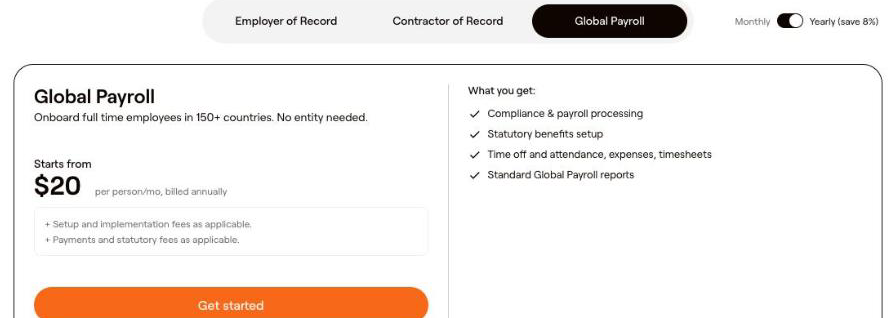
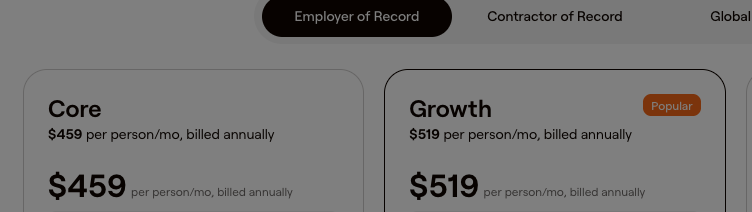
Three things to notice.
The real cost question is which path you are on. EOR costs about 20 times the payroll price or more at both vendors. If you already have a Philippine corporation, you need payroll, not EOR. If you do not, you need EOR or a contractor setup. Work that out first, because it matters far more than the gap between the two vendors.
On EOR, Multiplier is cheaper at the headline. $459 against $599, though Multiplier's figure is billed annually and carries "compliance mandated add-ons", and it may not be the Philippine rate.
On payroll, the gap is smaller than it looks. $20 against $29, but Multiplier names setup, implementation, payment and statutory fees "as applicable" without pricing them. Remote's pricing FAQ says there are no setup or onboarding fees. Ask both for a written Philippine quote.
Support and Ratings
Remote publishes 24/7 answers from its AI assistant and human live messaging 24 hours a day, Monday to Friday, according to its help centre as of 10 September 2026. It also names a Payroll Service Level Agreement for Global Payroll customers. No other vendor in this comparison publishes one.
Multiplier publishes phone and email support, and we found no published response time on its pages as of 24 August 2026. As of 24 August 2026, its largest G2 tags were about helpfulness and customer support. Its Philippine reviewers raise a more specific point. One G2 reviewer, writing a five-star review, wrote that "the CSR is not a native Filipino and often doesn't know the basic labor laws that apply in the country."
Remote's reviewers raise a different issue. One reviewer in the Gartner Digital Markets pool, which feeds Capterra, GetApp and Software Advice, wrote: "support team is very scripted... doesn't tally with complexities." These are single reviews, not typical experiences, and they are about different problems. Do not read them as the same complaint.
Ratings. Multiplier holds 4.7 out of 5 on G2 from 1,499 reviews, as of 26 October 2026. When we read the reviews in August 2026, many were written by people employed through Multiplier rather than companies buying it, so the score blends two experiences. Remote holds 4.3 out of 5 from 101 reviews in the Gartner Digital Markets pool, as of 10 September 2026. This guide does not quote a G2 figure for Remote.
What Each Does Well
Remote
- Names BIR correctly and never uses "PAYE" on its Philippines page.
- Carries the July 2026 minimum wage of PHP 755.
- Publishes a Philippines price block on its Philippines page, for both EOR and payroll.
- Sells payroll for companies with their own entity, in plain words: "For paying employees in countries where you own the entity."
- Names a Payroll Service Level Agreement.
Multiplier
- The lowest published EOR headline here, with no minimum headcount.
- Names 13th month pay and its 24 December deadline.
- Names SSS, PhilHealth and Pag-IBIG on both Philippines pages.
- A large review base: 4.7 on G2 from 1,499 reviews.
- The widest payroll reach by its own count, 100+ countries.
Where Omni HR Fits
Both vendors are built to cover many countries. That is a real strength if your people are spread across the world. It is also why each one describes the Philippines from one global template.
Omni HR is built the other way round: depth in Asia first. For a company whose team is in the Philippines, or the Philippines plus other Asian markets, that changes what you get.
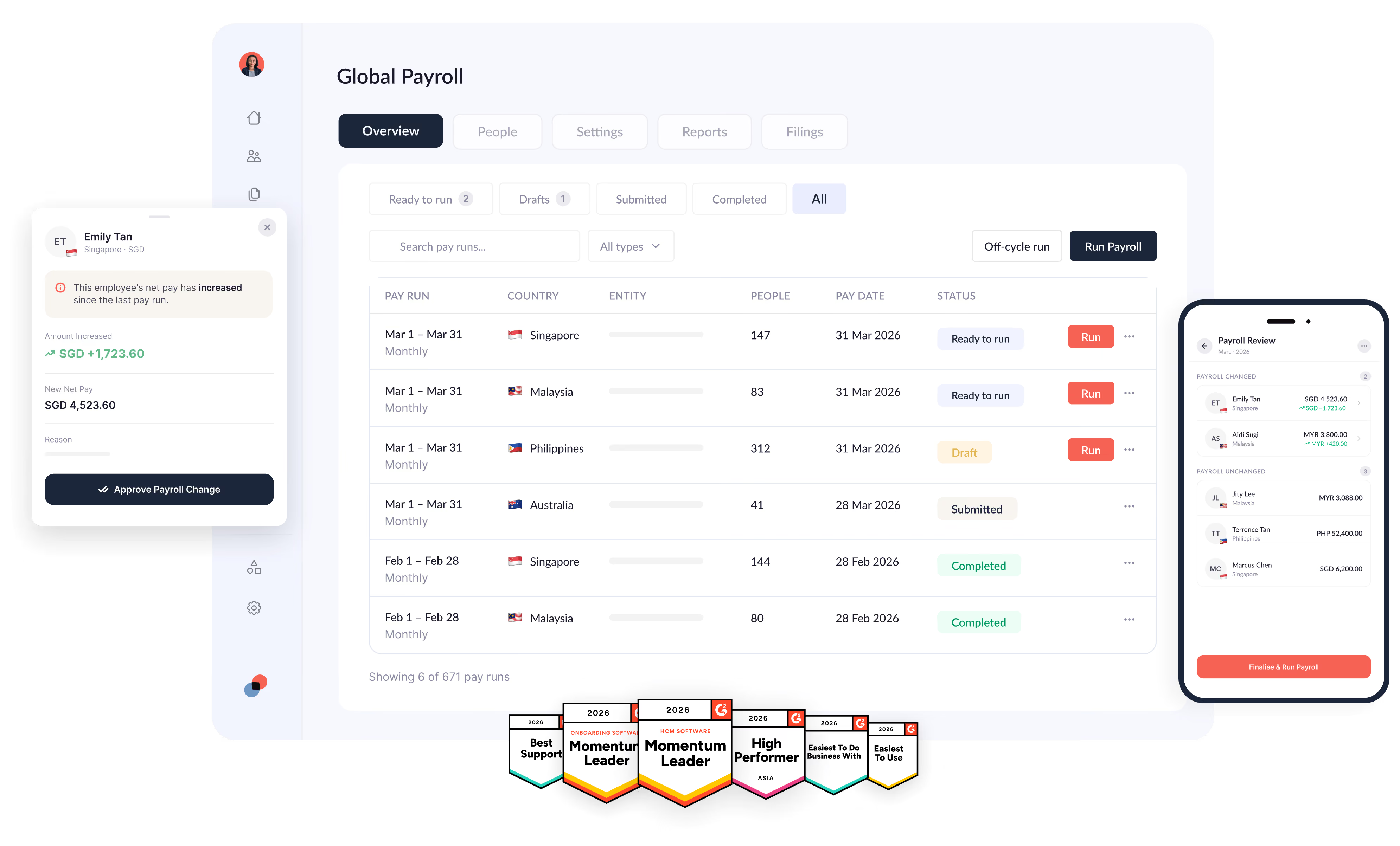
Philippine payroll, with the rules built in. Omni HR has native Philippine payroll covering SSS, PhilHealth, Pag-IBIG and BIR. It covers Form 2316, Form 1601-C, 13th-month pay calculations and the DOLE compliance report. Your team runs payroll. The Philippine rules are already in the system.
One platform for every way you pay people. Payroll on your own entity, managed payroll across 20+ countries in Asia, EOR across Asia, and contractor payments across Asia. If an EOR hire later moves onto your own books, or a contractor becomes an employee, you do not change vendors. HR, an AI-assisted applicant tracking system, performance reviews built for Asian business cultures, and payroll all sit in one place. Mino, our agentic AI assistant, and Connect AI are available today.
Support you can message. Omni HR answers over WhatsApp, Slack and email, with same-day responses during Asian business hours. That is how we perform today, not a contractual commitment.
Pricing. Omni HR is $3 per employee per month for the core platform, plus payroll software from $2, with no published setup fee. Compare that with Remote's $29 and Multiplier's $20 payroll prices. EOR is a different purchase, so compare EOR prices separately. G2 rating: 4.8 out of 5.
One honest gap. The Omni HR mobile app does not cover the full suite. Leave requests and approvals work on mobile through our Slack and Microsoft Teams integrations, but some tasks still need a laptop. If your Philippine team is spread across sites and works mainly from phones, ask us to show you exactly what works on mobile before you decide.
When to Choose Each
| Choose Remote if... | Choose Multiplier if... | Choose Omni HR if... |
|---|---|---|
| You want a named Payroll Service Level Agreement | You want the lowest published EOR headline and no minimum headcount | Your people are in the Philippines, or across several Asian markets |
| You want 24/7 AI answers and human support 24 hours a day on weekdays | You need payroll in many countries outside Asia, 100+ by their count | You want SSS, PhilHealth, Pag-IBIG, BIR and 13th month in one Philippine payroll |
| You want a Philippines price shown on the Philippines page itself | A large public review base matters most to you | You want payroll, EOR and contractor payments in Asia on one platform |
| Your team is spread across the world and the Philippines is one country of many | Your Philippine team is mostly employed through EOR | You want to ask a payroll question in Slack or WhatsApp, and get a same-day answer |
Whichever you pick, run one month of payroll in parallel first. Test SSS above an MSC of PHP 20,000, PhilHealth during unpaid leave, the Pag-IBIG cap, and a 13th month run with the DOLE report. Ask every vendor to show these live, us included.
Book a demo to see Philippine payroll in Omni HR.
Further Reading
Frequently Asked Questions
It depends on what you need. Remote names the Bureau of Internal Revenue correctly and publishes a Philippines price, but its Philippines page does not mention 13th month pay, as of 26 October 2026. Multiplier names 13th month pay and has the lower EOR headline, but describes Philippine income tax as "PAYE". If Philippine payroll depth is the deciding factor, test both live before you sign.
We can only speak to Remote's page, not its product. As of 26 October 2026, the term "13th month" does not appear on Remote's Philippines country page, and neither does DOLE. Ask Remote to show you a 13th month run. The rule is one twelfth of basic salary earned, paid by 24 December, with a DOLE compliance report by 15 January.
PAYE is the British, Irish and New Zealand term for withholding income tax at source. The Philippines does not operate PAYE. It operates BIR withholding tax on compensation, with a year-end annualisation that must absorb pay from a prior employer, a Form 2316 issued to every employee by 31 January, and an Alphalist. The mechanics and the deadlines are different.
Not by law. Presidential Decree 851 requires one 13th month payment. Some employers pay a 14th month by choice. Multiplier's guide says employers "commonly pay 13th and 14th-month pay semi-annually in July and December", and repeats it in an answer about payroll requirements.
As of 26 October 2026, Remote's EOR starts at $599 per employee per month and its Global Payroll at $29, both shown on its Philippines page. Multiplier's EOR Core is $459 per person per month billed annually, and Global Payroll starts from $20 billed annually, plus fees named "as applicable". Multiplier says about 11% of countries have adjusted pricing, without naming them. Omni HR is $3 per employee per month for the core platform, plus payroll software from $2.
Payroll, by a wide margin. At both vendors, EOR costs about 20 times the payroll price or more. EOR is for when you have no Philippine entity and need someone else to employ your staff. If you already have a Philippine corporation, you need payroll software, not EOR.
SSS is 15% of the Monthly Salary Credit, split 10% employer and 5% employee. The credit runs from PHP 5,000 to PHP 35,000 in PHP 500 steps, and the part above PHP 20,000 goes to a separate fund, the MPF. It is not a flat percentage of salary, so a payroll system needs the band table.
Run one month in parallel. Check SSS for someone above PHP 20,000, PhilHealth for someone on unpaid leave (it should not drop), Pag-IBIG capping at PHP 200 each side, the NCR minimum wage step to PHP 780 on 20 January 2027, and a 13th month run with the DOLE report. Ask every vendor to show these live, Omni HR included.